
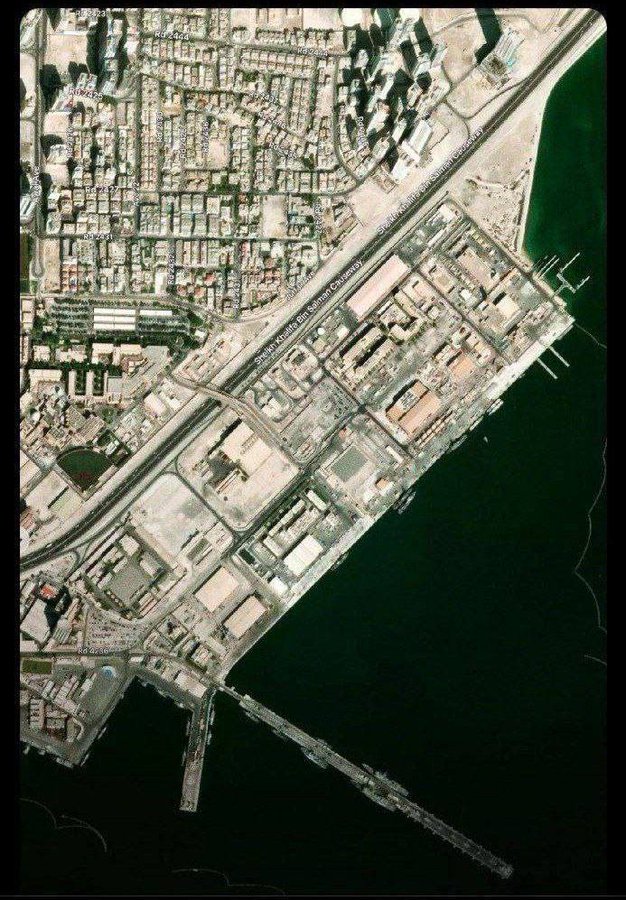
Why Iran Regards the Naval Command in Bahrain as the Core Instrument of American Maritime Dominance in the Middle East
Iran’s sustained focus on the United States Fifth Fleet, headquartered in Manama, Bahrain, must be understood within the broader geopolitical contest that has shaped the Persian Gulf since the end of the Cold War. The fleet is not merely a tactical naval formation but the central instrument of American maritime primacy in a region that remains indispensable to global energy markets and strategic transit. Its area of responsibility stretches across the Persian Gulf, the Red Sea, the Gulf of Oman, the Arabian Sea, and parts of the Indian Ocean, encompassing three critical chokepoints: the Strait of Hormuz, the Suez Canal, and the Bab el-Mandeb Strait. The British geographer Halford Mackinder once argued that control of strategic corridors determines the balance of world power, and while his “Heartland” thesis concerned Eurasia, its maritime analogue applies with equal force to the Gulf, where narrow sea lanes concentrate extraordinary economic leverage.
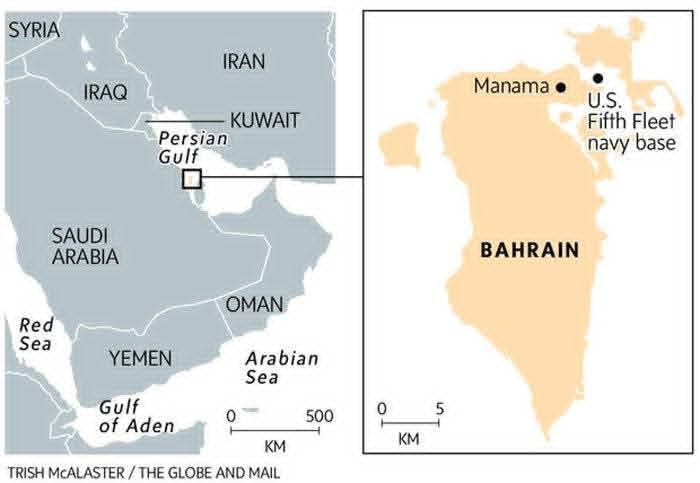
Alfred Thayer Mahan, whose writings profoundly influenced American naval doctrine, observed that “whoever rules the waves rules the world.” The Fifth Fleet embodies that maxim in regional form. Since its reestablishment in 1995, following the Soviet collapse and the consolidation of American unipolarity, the fleet has served as the guarantor of sea control across waters through which a significant share of global oil exports transit daily. In practical terms, this has meant not only the deployment of destroyers, submarines, and carrier strike groups, but also the maintenance of a command architecture integrating surveillance, logistics, intelligence, and allied coordination. The fleet supported operations in Afghanistan beginning in 2001 and in Iraq in 2003, demonstrating the capacity of sea-based power to shape continental campaigns. Its forward presence institutionalized what many strategists termed the “Pax Americana” in the Gulf.
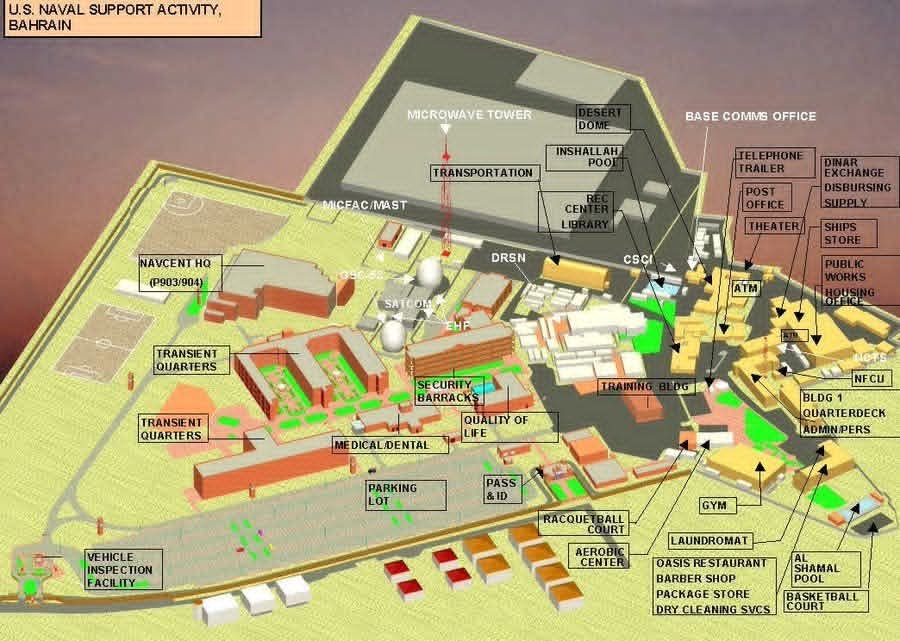
To appreciate fully why Bahrain is so fiercely contested, one must understand that the Fifth Fleet headquarters is not merely a pier-side concentration of ships, but an integrated administrative and operational nerve center. From Manama, planning, intelligence fusion, maritime security operations, anti-piracy patrols, and diplomatic coordination with regional partners are conducted across an area of responsibility spanning roughly 6.5 million square kilometers and touching more than twenty states. Over thirty major naval vessels, submarines, and rotational carrier strike groups operate under its authority, supported by thousands of personnel, aircraft, and precision-guided systems. In effect, the headquarters functions as the principal node through which American military power in the Middle East is synchronized. Its concentration in a single geographic location, while efficient for command and control, inevitably creates a focal point of vulnerability.
From Tehran’s perspective, however, the fleet represents encirclement rather than order. Iranian strategic thought since the 1980–1988 Iran–Iraq War has emphasized asymmetric response to superior conventional forces. Ayatollah Ruhollah Khomeini declared during that war that “we will export our revolution to the whole world,” a statement often interpreted in ideological terms but also reflective of a security doctrine rooted in deterrence through disruption. Contemporary Iranian military planners have refined this approach into what Western analysts describe as anti-access and area denial strategy. By investing in ballistic missiles, naval mines, fast attack craft, cruise missiles, and increasingly sophisticated drone capabilities, Iran seeks to raise the cost of American intervention and to threaten precisely those nodes that enable U.S. power projection.
Recent reporting, including satellite imagery analyses published by major international newspapers, has drawn attention to alleged damage inflicted upon infrastructure associated with the fleet’s headquarters in Bahrain. Accounts describe the destruction of radomes, satellite terminals, and warehouse facilities, installations essential to surveillance, communications, and logistics. Whether the full extent of these claims withstands independent verification remains a matter for careful scrutiny; yet the strategic logic behind such targeting is clear. Radomes protect radar arrays that provide situational awareness across vast maritime spaces. Satellite terminals sustain encrypted communications and data exchange between ships, aircraft, and allied forces. Logistics warehouses enable sustained operations by ensuring ammunition, fuel, and maintenance capacity. The degradation of these assets would not merely damage buildings; it would impair the fleet’s “eyes,” “ears,” and arteries.
The logic of asymmetric warfare favors precisely such strikes. Low-cost unmanned aerial systems, including variants similar to the Shahed-136 loitering munition attributed to Iran, are designed to exploit the high-value, high-cost nature of advanced military infrastructure. By targeting surveillance and coordination nodes rather than heavily defended warships at sea, Iran aims to impose disproportionate costs and generate operational confusion. In modern network-centric warfare, disruption of command-and-control systems can yield cascading effects: diminished radar coverage increases the risk of misidentification; impaired communications complicate air defense coordination; interrupted logistics delay reinforcement and resupply. Even isolated incidents, such as contested reports of aircraft losses attributed alternatively to hostile action or friendly fire, acquire heightened significance when viewed against the possibility of degraded situational awareness.
The Fifth Fleet, situated only a short distance from Iranian shores, is therefore both symbol and target. Its presence in Bahrain underscores the network of American security partnerships with Gulf monarchies, arrangements that reinforce U.S. influence while constraining Iran’s regional ambitions. Henry Kissinger once remarked that “power is the ultimate aphrodisiac,” yet he also noted that legitimacy determines whether power can endure. For Iran, challenging the fleet is a means of contesting both dimensions: undermining the material basis of American dominance and questioning the credibility of its guarantees to regional allies. Any demonstrated vulnerability in radar systems, logistics hubs, or command facilities would have psychological as well as operational consequences, potentially shaking allied confidence and emboldening adversaries.
Geopolitically, the stakes extend beyond bilateral hostility. Control of the Strait of Hormuz alone has implications for energy security in Europe and Asia, particularly for states heavily dependent on Gulf exports. The Suez Canal and the Bab el-Mandeb Strait link the Mediterranean to the Indian Ocean, forming arteries of global commerce whose disruption would reverberate through supply chains and insurance markets. The Fifth Fleet’s mandate to secure freedom of navigation is therefore intertwined with the broader liberal international order that emerged after 1945. Its degradation would signal not merely a local setback but a challenge to the assumption of uncontested American maritime supremacy.
Furthermore, the headquarters in Bahrain serves as a diplomatic and intelligence clearinghouse. Liaison officers from regional partners coordinate maritime security, missile defense, and counterterrorism efforts through its structures. Data from multiple theaters converge there for analysis and dissemination. If such a hub were severely compromised, the consequences would include diminished intelligence fusion, weakened diplomatic leverage, and reduced capacity to synchronize joint operations. In an environment where regional security architectures depend heavily on American coordination, including cooperation that indirectly supports Israel’s defensive posture, the erosion of this node could reverberate far beyond the Gulf itself.
Yet it would be simplistic to regard the fleet as either invulnerable or irreplaceable. Modern warfare increasingly privileges distributed systems, redundancy, cyber resilience, and rapid reconstitution of command networks. The United States retains global naval assets and the capacity to reassign forces or establish alternative command arrangements should circumstances demand. Nevertheless, the symbolic and operational weight of the Fifth Fleet’s headquarters in Bahrain is such that sustained, visible damage would constitute one of the most significant American military reversals in the region in decades, with ramifications for deterrence credibility worldwide.
As Clausewitz wrote, “war is the continuation of politics by other means,” and in this theater politics is inseparable from the control of sea lanes and strategic chokepoints. Iran’s emphasis on blinding sensors, disrupting communications, and striking logistics reflects a calculated effort to shift the balance of deterrence without confronting American naval power in symmetrical battle. By targeting the infrastructure that binds ships, aircraft, and allies into a coherent system, Tehran seeks to erode the very architecture of maritime dominance.
In sum, Iran’s focus on the Fifth Fleet reflects a rational appraisal of where American power in the Middle East is most concentrated. The fleet integrates combat capability, intelligence coordination, logistical sustainment, and diplomatic influence into a single operational framework headquartered in Bahrain. To threaten it is to strike at the central pillar of U.S. regional strategy. Whether such efforts can achieve decisive and lasting effect remains uncertain; yet the geopolitical logic behind Iran’s attention is unmistakable: in a contest defined by maritime corridors, surveillance networks, and forward bases, the neutralization of the principal naval command would alter the regional balance in ways that extend far beyond the waters of the Gulf.
Authored By: Global GeoPolitics
Thank you for visiting. This is a reader-supported publication. I cannot do this without your support. If you believe journalism should serve the public, not the powerful, and you’re in a position to help, becoming a PAID SUBSCRIBER truly makes a difference. Alternatively you can support by way of a cup of coffee:
https://buymeacoffee.com/ggtv |


Leave a comment