
How Gulf states bankroll U.S. military presence while buying weapons and defending the petrodollar
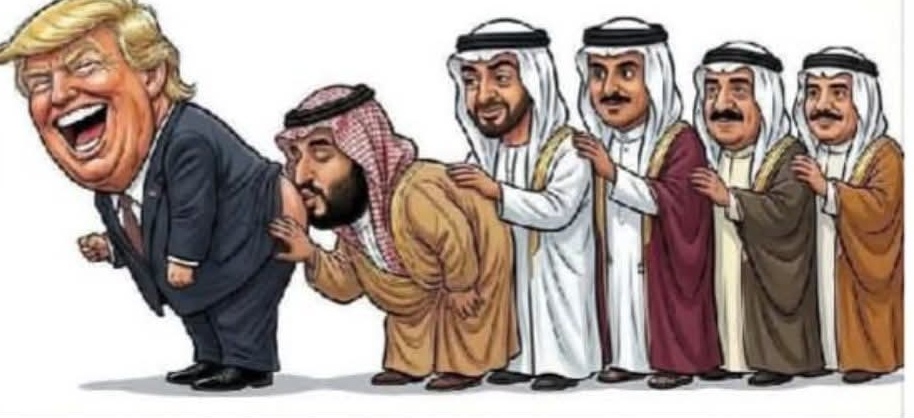
(Disclaimer: I did not create the headline cartoon image)
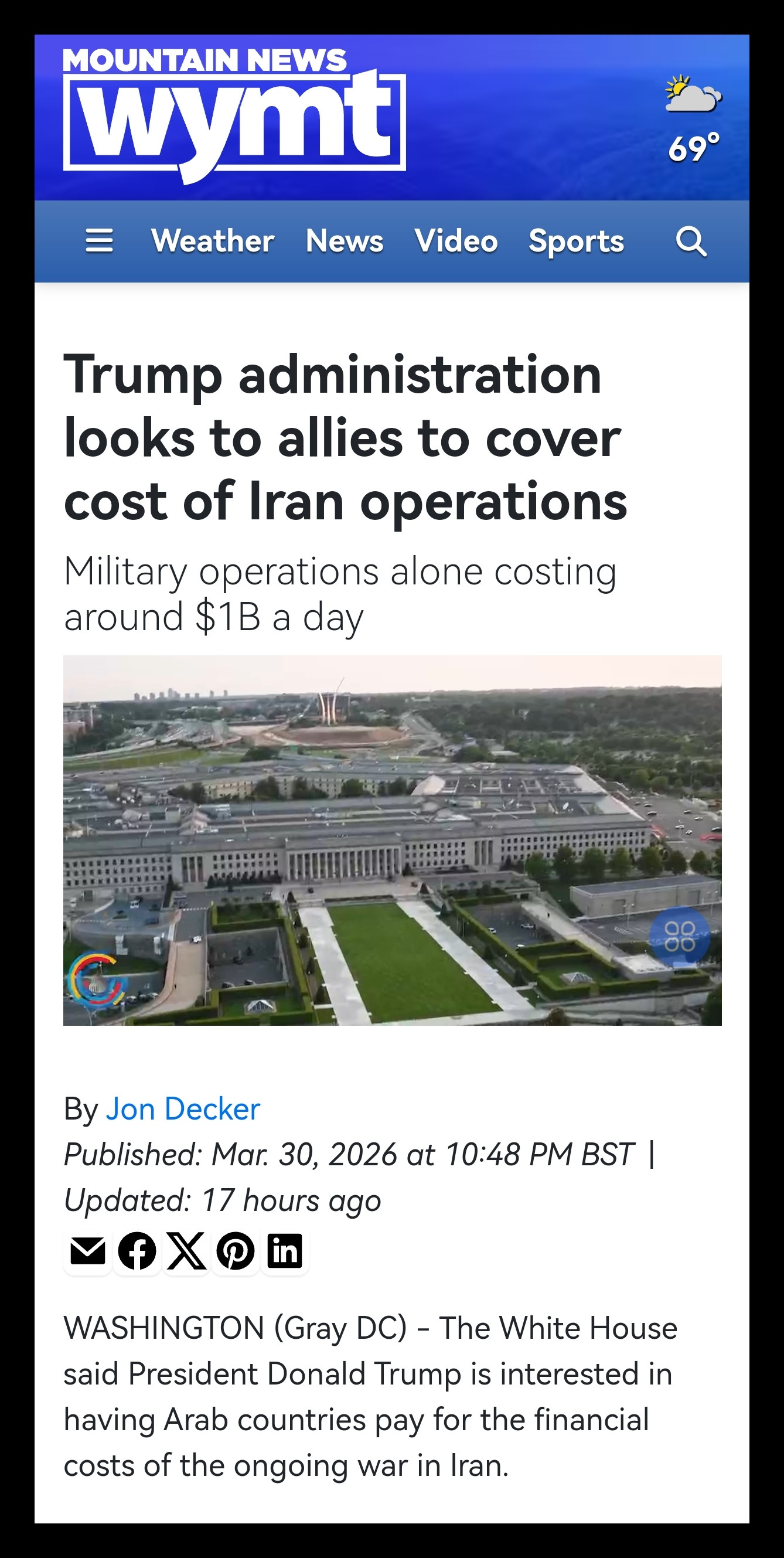
The Gulf states are charged for the “myth” of protection. They didn’t start the Iranian war nor were they even consulted. They just woke up to the news of the double tap bombing of a girls elementary school by U.S. made Tomahawks like the rest of us. This is a supranational controlled system operates as a protection racket, no different from the mafioso or cartels. What is now being reported, that the Trump administration wants allies to help cover a war costing around $1 billion a day, does not reveal strength as much as it exposes the structure underneath it. (https://www.kolotv.com)
What is often called proof of American superpower status in the Gulf is better understood as a system of militarised dependence that has been built over decades. Gulf states are puppet regimes built under the then British Empire and already operate inside this racket system: they host military bases, fund their presence, and effectively pay a “protection fee” for security guarantees. At the same time, they are locked into purchasing most of their weapons from the same provider, meaning their defense, maintenance, and training all remain tied to Washington. This is not a loose alliance but a tightly integrated structure where the cost of protection and the supply of security are controlled by the same actor.
On close analysis, what emerges is dependence disguised as alignment. When missiles fly, Gulf states wait for a call from the power that already controls the infrastructure, bases, fleets, sanctions, and escalation. This is driven by dependence, not trust, but reliance built into the system. Because their security architecture is externally anchored, alternatives are limited and costly to develop. What looks like alignment is often necessity. This is why the arrangement is like a form of “hostage architecture,” where compliance is maintained not through constant force but through dependence that has been deeply woven over time.
In this “war of choice”, these dependent mornachies are paying twice. The current push to have these Arab states contribute directly to the cost of war highlights a deeper contradiction. These states are already paying for the system through base hosting, arms purchases, and long-term security arrangements, yet are now being asked to finance active military operations as well. This creates a dynamic where the same countries both fund the infrastructure of security and are expected to subsidize its use in conflict. Rather than demonstrating unquestioned dominance, this moment reveals the transactional nature of the relationship and raises questions about how sustainable or consensual it truly is.
At the core of this system is a tightly controlled economic loop that extends far beyond security. Much of the Gulf’s oil infrastructure has historically been developed, financed, or closely tied to Western corporate and financial systems, while the oil itself is sold globally in U.S. dollars, reinforcing American monetary dominance. The revenues generated do not circulate independently; they are largely recycled back into Western economies through the purchase of government debt, financial assets, and major investments in Western markets. At the same time, those same profits are used to buy high-cost military equipment from Western arms manufacturers, locking Gulf states into long-term dependency for maintenance, training, and operational use. These states also fund the presence of foreign military bases on their own soil, effectively paying for the very security architecture they rely on. Crucially, the use of this military equipment is not fully sovereign, as it often depends on continued alignment, authorization, and cooperation with Western powers. The result is a closed system in which capital, security, and sovereignty are all interconnected, limiting genuine independence while maintaining the appearance of partnership.
Claims about the continued dominance of the dollar follow a similar pattern. That dominance was built over decades through military reach, financial systems, and political influence, and it does not disappear overnight. However, its persistence does not necessarily reflect trust or respect; it reflects how deeply the global system has been structured around it. Moments like this, where allies are asked to shoulder increasing costs, begin to expose the gap between the narrative of stable leadership and the reality of managed dependence.
This dominance of the U.S. dollar in global energy markets is closely tied to the structure of the petrodollar system established in the 1970s, when major oil producers, particularly Saudi Arabia, agreed to price oil exports in dollars and reinvest surplus revenues into U.S. financial markets. This arrangement reinforced global demand for the dollar and supported U.S. government borrowing through large-scale purchases of Treasury securities by Gulf states. Today, most international oil transactions are still conducted in dollars, and Gulf sovereign wealth funds remain heavily invested in Western assets. At the same time, these states allocate significant portions of their revenues to purchasing military equipment from U.S. and European defense companies, further recycling capital back into the same system. These financial and security arrangements are well documented and create structural incentives to maintain the existing order, including alignment with U.S. policy in periods of regional conflict.
An old imperial logic in modern operates in these Gulf states, they are not sovereign. At its core, this reflects a familiar imperial logic: influence maintained not by direct rule, but by building systems that others cannot easily exit. Obedience is interpreted as alignment, coercion as partnership, and dependence as respect. Yet when the costs become more explicit, as they are now, the distinction between voluntary cooperation and structural reliance becomes harder to ignore.
Even when expressed in modern policy language, the underlying model remains consistent with older forms of empire, sustained through interlocking financial, military, and political dependencies rather than overt control. As recent remarks by President Trump himself illustrate, this relationship is not one of equals. In a public speech he stated that Saudi Crown Prince Mohammed bin Salman “didn’t think he would be kissing my ass” and now “has to be nice to me,” underscoring the power imbalance at the center of U.S.–Gulf ties.
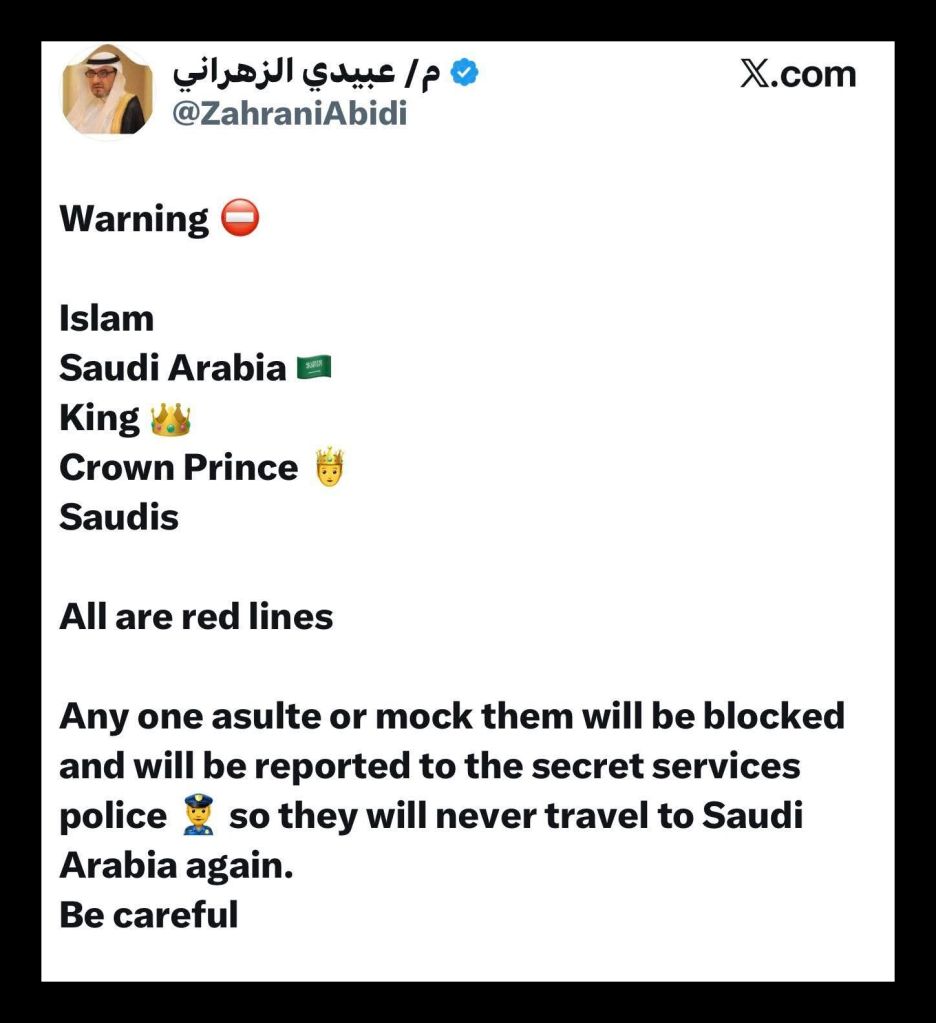
Trump?)
Authored By: Global GeoPolitics
Thank you for visiting. This is a reader-supported publication. If you believe journalism should serve the public, not the powerful, and you’re in a position to help, becoming a PAID SUBSCRIBER truly makes a difference. Alternatively you can support by way of a cup of coffee:
https://buymeacoffee.com/ggtv |
https://ko-fi.com/globalgeopolitics |
Bitcoin: 3NiK8BoRZnkwJSHZSekuXKFizGPopkE7ns


Leave a comment