
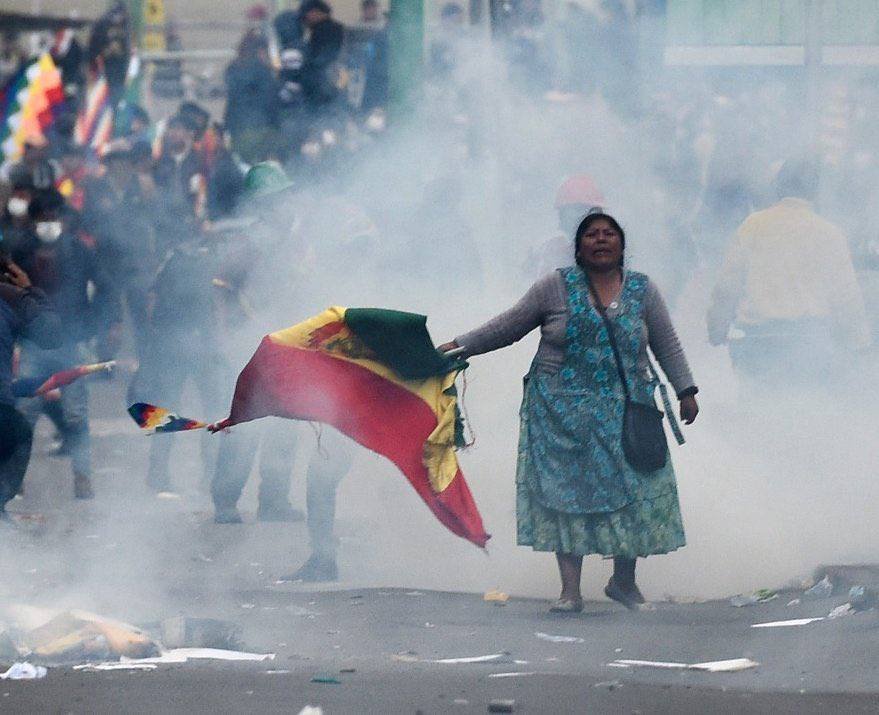
The US signed a lithium agreement, put the DEA back in La Paz, and allegedly ordered Evo Morales killed – Bolivia’s workers burned it all down
An Editorial Analysis | May 2026
Bolivia has never been a simple country to govern, and the Andean republic’s turbulent history of resource nationalism, external interference, and popular mobilisation has repeatedly confounded those who imagined it could be redirected without consequence. The collapse of President Rodrigo Paz’s government in May 2026, barely six months after he took office, belongs to a sequence that stretches back through the 2003 Black October massacre, the 2019 removal of Evo Morales, and the decades of structural adjustment and IMF conditionality that generated the political conditions for Morales’s initial rise. Understanding the current upheaval requires holding several threads simultaneously: a genuine economic crisis with roots in structural decline, a set of geopolitical agreements that inflamed already raw nationalist sentiment, and an alleged assassination plot whose exposure transformed what might have remained a manageable social movement into an existential confrontation with the Paz administration.
The economic inheritance Paz received from his predecessor Luis Arce was severe by any honest measure. Bolivia spent much of the twentieth century as a major natural gas exporter, with hydrocarbons revenue funding the social programmes that sustained political support for the Movement for Socialism across nearly two decades. That model collapsed as reserves declined sharply and production fell, converting Bolivia from a net fuel exporter into a net importer reliant on diesel from Russia and other foreign suppliers. By early 2026, interannual inflation had reached fourteen percent, dollar shortages had driven the black market exchange rate to more than fifty percent above the official rate, and fuel queues were a permanent feature of life in La Paz and El Alto. The country faced principal repayments on approximately 1.85 billion dollars in bonds during 2026, with foreign exchange reserves nearly depleted. In this context, Paz ran for and won the presidency on a straightforward if audacious proposition: that realigning Bolivia toward Washington would unlock the investment capital and technical expertise required to finally monetise the country’s extraordinary lithium reserves, estimated by the United States Geological Survey to be the largest in the world.
Bolivia possesses lithium deposits beneath the Salar de Uyuni salt flat in the Altiplano that are broadly estimated to represent more than a third of the planet’s identified resources, a geological endowment that earned the country the designation the Saudi Arabia of lithium during the global electric vehicle expansion of the early 2020s. The comparison carried its own irony, given that Saudi Arabia’s oil wealth delivered state revenues rather than development promises for much of the twentieth century, and that Bolivia’s lithium had similarly spent decades generating international enthusiasm without producing material transformation for Bolivian communities. Under Morales and Arce, the state miner Yacimientos de Litio Bolivianos pursued a policy of state-led industrialisation in partnership first with German firms and subsequently with Chinese and Russian entities, including a 2023 agreement with Russia’s Uranium One Group to develop direct lithium extraction plants at Pasto Grande and Uyuni Norte, and a deal with China’s Citic Guoan involving eight hundred and fifty-seven million dollars of pledged investment. Neither arrangement had moved beyond contested pilot stages by the time Paz took office.
Paz arrived in government with a Washington education and a platform constructed around the argument that the Chinese and Russian contracts were opaque, unbankable, and structurally incompatible with attracting Western investment capital. His senior economic adviser José Luis Lupo told Bloomberg that the previous lithium agreements had been forged behind the backs of the regions and the country, while Foreign Minister Fernando Aramayo moved quickly to open negotiations with the Trump administration over financial assistance, including discussions about a currency swap arrangement similar to that extended to Argentina under Javier Milei’s government. On 27 April 2026, Bolivia and the United States signed a memorandum of understanding on critical minerals, including lithium, establishing a framework for knowledge-sharing and exploring forms of cooperation, with Washington publicly expressing its interest in securing supply chains. The agreement was presented by Aramayo and the Paz government as the first step in a technological partnership that would finally deliver Bolivia’s lithium to international markets.
The critical minerals memorandum did not exist in a vacuum. The Trump administration’s aggressive campaign to lock in mineral supply chains across Latin America had already produced bilateral agreements or frameworks with Argentina, Ecuador, Peru, Paraguay, and numerous other states, part of a strategy documented in the State Department’s February 2026 Critical Minerals Ministerial. Bolivia’s attendance at that ministerial, and its subsequent bilateral agreement, placed Paz squarely within a US-directed regional realignment that was being pursued with considerable urgency as competition with China for battery mineral supply chains intensified. From Washington’s perspective, redirecting Bolivia’s lithium away from Uranium One Group and the Chinese consortium CBC and toward American-aligned investment structures represented a straightforward supply chain security objective. From the perspective of Bolivia’s miners, indigenous communities, and the Bolivian Workers’ Central, the largest labour federation in the country, the same agreement represented a transfer of the country’s most strategically significant resource to the same external interests that had managed Bolivia’s natural wealth to their own advantage throughout the colonial and neoliberal periods.
The DEA agreement compounded the political damage. Paz’s government confirmed in February 2026 that Bolivia had agreed to allow the United States Drug Enforcement Administration to establish a permanent operational presence in La Paz, reversing Morales’s 2008 decision to expel the agency. The Morales expulsion had been rooted in specific accusations that DEA activities constituted political surveillance and interference directed against the MAS government rather than genuine narcotics enforcement; it had become one of the defining symbols of Bolivia’s assertion of sovereign independence from Washington’s security apparatus. The Paz government framed the reversal as a professional law enforcement arrangement, with Foreign Minister Aramayo noting that negotiations were still under way to finalise the specific areas of cooperation and operational limits for the agency. For a country with living memory of Operation Condor and the CIA’s documented role in training and directing the intelligence apparatus that made that programme possible, the argument that the DEA’s return was a routine law enforcement matter did not travel far beyond the presidential administration’s own communications staff.
Operation Condor, active from roughly 1975 to 1983, was a coordinated programme of political repression operating across the US-backed military dictatorships of Chile, Argentina, Uruguay, Paraguay, Bolivia, and Brazil, directed explicitly toward the physical elimination of leftist political figures, trade union leaders, and suspected subversives. The CIA’s role in the creation and training of the intelligence services that staffed this apparatus, including Chile’s DINA under Pinochet, is thoroughly documented in declassified State Department and CIA materials. For the constituencies that toppled Paz, the return of the DEA was not separable from this history. When the existence of a military plan codenamed Plan Cóndor became public, those associations crystallised into something considerably more politically volatile than economic grievance alone could produce.
On 15 May 2026, Evo Morales posted on X that the United States had ordered the Paz government to carry out a military operation, with the support of the DEA and the United States Southern Command, to detain or kill him. Morales named specific military units, including the Army’s Ninth Division in the tropical Chapare region under Colonel Franz Andrade Loza, whom he said the government had promised to promote to general and appoint as armed forces commander on completion of the operation. He also named an F-10 unit under Lieutenant Colonel Carlos Giménez Ortuño, a former aide to Jeanine Áñez’s defence minister. Among the civilian figures he implicated was Carlos Sánchez Berzaín, the former interior minister under Gonzalo Sánchez de Lozada who fled to Miami following the 2003 Black October massacre, in which security forces killed more than sixty demonstrators. Morales also named Vice Minister of Social Defence Ernesto Justiniano, reported to be in Washington. Leaked documents, shared by police officers opposed to the operation, provided what Morales’s supporters took as corroboration of the outline he described.
The political and institutional context of the assassination allegation carries weight that pure scepticism cannot dismiss. Sánchez Berzaín is a real figure with a documented history in Bolivian anti-left operations who did flee to Miami in 2003. The DEA was genuinely present in La Paz under the new agreement. United States Southern Command is operationally active in the region and has, as Trump’s military campaign Operation Southern Spear demonstrated in late 2025, authorised lethal force against suspected targets in the Caribbean and Eastern Pacific with a frequency that has alarmed human rights lawyers. The Paz government’s decision to pursue criminal proceedings against Morales, the arrest warrant for alleged statutory rape and the contempt finding for his non-appearance were both issued while the political crisis was escalating, fitted a pattern that Bolivian social movements identified as lawfare designed to neutralise the principal opposition leader before he could organise resistance. The parallel with the treatment of Lula da Silva in Brazil before the 2018 election, which used criminal proceedings to remove him from the ballot, was drawn explicitly by several commentators, and the institutional record provides grounds for the comparison.
The popular mobilisation that brought Paz down drew from multiple and not entirely unified sources. The Bolivian Workers’ Central, which represents Bolivia’s organised labour in the broadest coalition of any union body in the country, called for Paz’s resignation. The Tupac Catari Single Workers’ Federation organised roadblocks across the country. Miners’ cooperatives deployed dynamite-carrying demonstrators who attempted to breach Plaza Murillo on 14 May. Farmers’ organisations that had originally mobilised in opposition to Law 1720, an agricultural reform measure that the government repealed under pressure, remained in the streets demanding Paz’s departure after the concession proved insufficient to dissipate their anger. Morales’s own supporters, the Evistas organised around the Chapare tropics, began a six-day march toward La Paz that converged with the existing protests on 18 May. The Catholic bishops’ conference appealed for humanitarian pauses and dialogue, noting that sixty-seven roadblocks had created shortages of food, medicine, and oxygen for hospitals, with three deaths attributed directly to the blockades.
The United States Bureau of Western Hemisphere Affairs condemned the protests on 17 May in a statement that accused demonstrators of destabilising the democratically elected government of Rodrigo Paz and declared Washington’s support for his efforts to restore order. A joint statement from the governments of Argentina, Chile, Peru, Ecuador, Costa Rica, Paraguay, Panama, and Honduras expressed concern over the humanitarian situation and rejected actions oriented at destabilising democratic order. Argentina’s President Milei authorised the deployment of a Hércules C-130 aircraft to deliver food supplies to La Paz. Colombian President Gustavo Petro took the opposing position, describing the protests as a popular insurrection and offering Bogotá as a mediation venue, an offer the Paz government rejected. The geometry of regional alignment on the Bolivia question reproduced almost exactly the political division between the US-aligned right-wing governments and the residual Latin American left that has been reshaping the continent since the Trump administration’s seizure of Venezuelan President Nicolás Maduro in early 2025.
The Paz government’s attempt to frame the uprising as a foreign-directed conspiracy orchestrated by Morales did not survive contact with the composition of the movement itself. Rafael Archondo, former editor of Fides, the Jesuit-affiliated Bolivian news agency, observed that many of the roadblocks were occurring in areas that had actually voted for Paz in the 2025 election. The protesters included not only Morales loyalists but mining cooperatives, indigenous federations, farmers opposed to agricultural legislation, teachers, transport workers, and urban residents facing fuel shortages and inflation that had been building since before Paz took office. Presidential spokesperson José Luis Gálvez’s characterisation of dark forces seeking to destabilise democracy resonated within the administration’s own constituency but not much further. Paz’s governing record since taking office in November 2025 provided substantive grounds for the discontent independently of any manipulation by Morales: a failed attempt to eliminate fuel subsidies in January that the government abandoned under mass street pressure, a regional elections defeat in April in which Paz’s allies were comprehensively defeated, and a governing style that opposition figures and labour organisers alike described as serving narrow national and international interests with an evidently anti-labour disposition.
The structural economic conditions underlying the crisis cannot be attributed to Paz’s seven months in office, but the political decisions he took in that period compressed what might have been a prolonged governance struggle into a short and decisive confrontation. The memorandum on critical minerals, the DEA agreement, and the alleged Plan Cóndor did not create Bolivia’s lithium deficit or its depleted gas reserves or its dollar shortage. They provided a legible political narrative for a population already experiencing material hardship, one that connected the present government to a specific and historically grounded fear, that Bolivia’s natural wealth would once again be alienated to external interests under the protection of Washington’s security apparatus, as it had been under Sánchez de Lozada and the structural adjustment governments of the 1990s. The naming of Sánchez Berzaín as a planner of the assassination plot was not incidental. He is the direct human link between the Black October massacre and the present crisis, and his reported involvement, if confirmed, closes a political circle that Bolivian workers and indigenous communities had been watching for with considerable historical vigilance.
Whether the specific details of Plan Cóndor as described by Morales will be independently verified in their entirety remains an open question. The Bolivian state does not, at the time of writing, have a functioning government in the conventional sense, and the institutional conditions for a transparent investigation are uncertain. What can be stated on the basis of documented facts is that the Paz administration did readmit the DEA, did sign the lithium memorandum with Washington, did pursue criminal proceedings against the principal opposition leader under circumstances that a substantial portion of the Bolivian public regarded as political, and did find itself confronted with the largest popular uprising since the Black October period, which itself produced a government that fell within weeks. The regional alignment that supported Paz through its final days, Washington, Buenos Aires, Santiago, Lima, represents the same political configuration that has backed the continent’s right-wing experiments from Bolsonaro’s Brazil to Milei’s Argentina, each accompanied by accelerated natural resource agreements with American-aligned interests and each generating its own distinctive form of popular resistance. Bolivia’s uprising, whatever its immediate resolution, is unlikely to be the last of these confrontations. The Altiplano’s lithium will remain where it is, and the competition for access to it will not diminish.
You maybe interested in my other article on the triggers behind the uprising:
Bolivia Erupts as Workers and Indigenous Groups Revolt Against Rodrigo Paz
Prior to Protests Spreading, A Human Shield Forms Around Morales After Alleged Kidnapping Plot
Authored By: Global GeoPolitics
Thank you for visiting. This is a reader-supported publication. If you believe journalism should serve the public, not the powerful, and you’re in a position to help, becoming a PAID SUBSCRIBER truly makes a difference. Alternatively you can support by way of a cup of coffee:
https://buymeacoffee.com/ggtv |
https://ko-fi.com/globalgeopolitics |
Bitcoin: 3NiK8BoRZnkwJSHZSekuXKFizGPopkE7ns
References
Al Jazeera (2026) ‘Bolivia revives anti-drug alliance after nearly 18-year break with US’, 25 February. Available at: aljazeera.com/news/2026/2/25/bolivia-revives-anti-drug-alliance-after-nearly-18-year-break-with-us
Al Jazeera (2026) ‘Explosions heard as mining groups stage anti-government protest in Bolivia’, 14 May. Available at: aljazeera.com/economy/2026/5/14/explosions-heard-as-mining-groups-stage-anti-government-protest-in-bolivia
Andean Information Network (2013) ‘International Declaration on Tenth Anniversary of Black October’, October. Available at: ain-bolivia.org/2013/10/international-declaration-on-tenth-anniversary-of-black-october
Buenos Aires Herald (2026) ‘US accuses protesters in Bolivia of destabilising government of Rodrigo Paz’, 17 May. Available at: buenosairesherald.com/world/us-accuses-protesters-in-bolivia-of-destabilizing-government-of-rodrigo-paz
Central Intelligence Agency (1976) Intelligence Information Cable: ‘Condor, A Cooperative Program of the Intelligence Services of Chile, Argentina, Bolivia, Paraguay, Uruguay and Brazil’, 25 June [declassified]. Available via: nsarchive.gwu.edu/briefing-book/southern-cone/2025-11-26/operation-condor-network-transnational-repression-50-years
Dinges, J. (2004) The Condor Years: How Pinochet and His Allies Brought Terrorism to Three Continents. New York: The New Press.
GIS Reports (2025) ‘Bolivia’s political chaos puts economy at risk’, January. Available at: gisreportsonline.com/r/bolivia-political-chaos
Harvard Law School International Human Rights Clinic (2018) ‘Clinic’s case against former Bolivian president for role in 2003 massacre to proceed to trial’, 20 February. Available at: humanrightsclinic.law.harvard.edu
Harvard Law School International Human Rights Clinic (2020) ‘U.S. Appeals Court Rules Against Former Bolivian President and Defense Minister Over 2003 Massacre’, 3 August. Available at: hls.harvard.edu/clinic-stories/legal-policy-work
Harvard Law School International Human Rights Clinic (2021) ‘Court Upholds $10 Million Judgment Against Bolivian Leaders for 2003 Massacre’, 6 April. Available at: humanrightsclinic.law.harvard.edu
Kyiv Independent / Mamani v. Sánchez de Lozada and Sánchez Berzaín, Case No. 07-22459, United States District Court, Southern District of Florida [civil proceedings, 2007–2023].
Kornbluh, P. (2013) The Pinochet File: A Declassified Dossier on Atrocity and Accountability. Updated edition. New York: The New Press.
La Region (2025) ‘Bolivia’s Secret Lithium Agreements’, 6 October. Available at: laregion.bo/en/bolivias-secret-lithium-agreements
Lessa, F. (2022) The Condor Trials: Transnational Repression and Human Rights in South America. New Haven: Yale University Press.
Lessa, F. (2024) ‘No Safe Haven: Operation Condor and Transnational Repression in South America’, International Studies Quarterly, 68(2). Available at: academic.oup.com/isq/article/68/2/sqae035/7637878
Mining.com (2025) ‘Bolivia is rethinking lithium deals with China, Russia in US pivot’, 7 November. Available at: mining.com/web/bolivia-is-rethinking-lithium-deals-with-china-russia-in-us-pivot
Mining.com (2026) ‘Bolivia vows to back lithium, energy deals to rebuild trust’, 19 January. Available at: mining.com/bolivia-vows-to-back-lithium-energy-deals-to-rebuild-trust
Mining.com (2026) ‘Bolivia’s lithium gamble tests US realignment in Latin America’, 27 January. Available at: mining.com/mining-com-series-mining-power-and-a-new-us-strategy-in-latin-america
Morales, E. (2026) Post on X [formerly Twitter], 15 May, @evoespueblo. Reproduced in: teleSUR English (2026) ‘Evo Morales Claims US-Backed Military Plot to Kill or Detain Him in Bolivia’. Available at: telesurenglish.net/evo-morales-claims-u-s-backed-military-plot-to-kill-or-detain-him-in-bolivia
National Catholic Reporter (2026) ‘Bolivia’s bishops urge humanitarian pauses as protests collapse country’, 19 May. Available at: ncronline.org/news/bolivias-bishops-urge-humanitarian-pauses-protests-collapse-country
National Security Archive, George Washington University (2025) ‘Operation Condor: A Network of Transnational Repression 50 Years Later’, 26 November. Available at: nsarchive.gwu.edu/briefing-book/southern-cone/2025-11-26/operation-condor-network-transnational-repression-50-years
Oriental Review (2026) ‘A New Crisis in Bolivia’, 18 May. Available at: orientalreview.su/2026/05/18/a-new-crisis-in-bolivia
Peoples Dispatch (2026) ‘No Peace for Paz: Bolivian movements demand president resign’, 18 May. Available at: peoplesdispatch.org/2026/05/18/no-peace-for-paz-bolivian-movements-demand-president-resign
Reuters (2026) ‘Bolivia Miners Clash With Police, Explosions Rock La Paz’, 14 May. Reproduced at: usnews.com/news/world/articles/2026-05-14/explosions-heard-during-bolivia-march-by-mining-groups
Southshore Journal (2026) ‘Bolivia seeks technological cooperation from the US to develop lithium industry’, May. Available at: southshorejournal.org/bolivia-seeks-technological-cooperation-from-the-us-to-develop-lithium-industry
United States Department of State (2026) ‘2026 Critical Minerals Ministerial’, 5 February. Available at: state.gov/releases/office-of-the-spokesperson/2026/02/2026-critical-minerals-ministerial
United States Department of State, Bureau of Western Hemisphere Affairs (2026) Statement on Bolivia protests, 17 May [@WHAAsstSecty on X]. Reproduced in: Buenos Aires Herald, 17 May 2026.
United States Geological Survey (2026) Mineral Commodity Summaries: Lithium. Washington DC: USGS.
Washington Post (2026) ‘Bolivia protesters allied with ex-leader Morales march on capital as unrest widens’, 18 May. Available at: washingtonpost.com/world/2026/05/18/bolivia-evo-morales-rodrigo-paz-protests


Leave a comment