
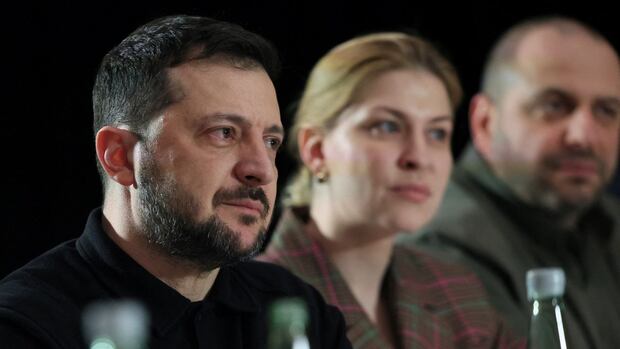
New recordings tie Zelensky’s inner circle to seven billion dollars in diverted military funds while Ukrainians die at the front
An Editorial Analysis | May 2026
The political crisis gathering around Volodymyr Zelensky now extends far beyond military setbacks, territorial losses, mobilisation controversies, or deteriorating demographics. A far more dangerous threat has emerged from inside the Ukrainian state itself, where corruption investigations, insider testimony, and increasingly visible fractures within the governing structure have begun colliding with the geopolitical interests of the Western powers that financed and protected the wartime administration in Kiev for more than four years.
Recent disclosures connected to Ukraine’s National Anti-Corruption Bureau, commonly known as NABU, have intensified scrutiny surrounding Zelensky’s inner circle at precisely the moment Ukraine remains financially dependent upon continued European support. Investigations linked to what Ukrainian media and investigators have informally described as “Operation Midas” now involve allegations concerning military procurement contracts, inflated pricing mechanisms, luxury property development, energy-sector kickback schemes, and financial transfers tied to senior political associates connected to the presidential administration. Reuters described the current investigation as the most serious corruption crisis facing Zelensky’s government since the beginning of the Russian invasion. (reuters.com)
Ukraine entered the war carrying a longstanding international reputation for entrenched corruption, oligarchic patronage networks, opaque procurement structures, and political capture extending across successive administrations after independence. Transparency International repeatedly ranked Ukraine among the most corrupt states in Europe throughout the post-Soviet period, while Western governments continued financing reform programmes that produced limited structural change inside the judiciary, customs administration, energy sector, and state procurement systems. The present investigations therefore emerged within an already documented institutional environment rather than from isolated wartime allegations or politically manufactured accusations. The scale of the investigations now surrounding former senior officials close to the presidency has become impossible for Western governments or European institutions to dismiss quietly. The Financial Times recently reported that Ukrainian anti-corruption authorities issued formal notices of suspicion against Andriy Yermak, Zelensky’s former chief of staff, alongside several other senior figures connected to an alleged money-laundering operation involving elite property development near Kiev. (ft.com) Associated Press similarly described the affair as a major embarrassment for the Ukrainian administration during sensitive negotiations concerning continued Western assistance and future European Union integration. (apnews.com)
The broader significance of these investigations extends well beyond conventional corruption scandals inside post-Soviet political systems. Ukraine’s wartime state has depended almost entirely upon external financing, foreign intelligence support, NATO logistics, European macro-financial assistance, and extensive political protection from Washington, London, Brussels, Berlin, and Paris. Allegations involving procurement diversion or enrichment through military contracts therefore strike directly at the political legitimacy of the Western coalition which repeatedly portrayed Ukraine as a democratic model defending European civilisation against authoritarian aggression.
The appearance of Yulia Mendel on Tucker Carlson’s programme dramatically intensified this developing crisis because her criticisms emerged from a former insider rather than from Russian state media, opposition oligarchs, or foreign governments hostile toward Kiev. Mendel served as Zelensky’s press secretary between 2019 and 2021 and previously published material strongly supportive of the Ukrainian president. Her recent public accusations therefore carried unusual political weight precisely because they represented a reversal from a former loyalist rather than predictable hostility from an established adversary.
Mendel alleged during the interview that Zelensky privately expressed contempt for democratic procedures, relied heavily upon media manipulation, and tolerated increasingly coercive wartime methods inside Ukraine. Several of her claims remain impossible to independently verify, while others directly contradict official Ukrainian government narratives. Kyiv Post published a detailed fact-check review arguing that a number of Mendel’s assertions lacked corroborating evidence or conflicted with publicly documented events. (kyivpost.com) Even so, the interview achieved substantial international attention because many of the institutional tendencies she described already had visible public manifestations before her appearance.
Western concern regarding Zelensky’s relationship with anti-corruption institutions emerged long before Mendel’s interview. During 2025, widespread criticism followed legislation that subordinated NABU and the Specialised Anti-Corruption Prosecutor’s Office to executive influence through the prosecutor general’s office. The Guardian described the legislation as effectively weakening the independence of the anti-corruption agencies and provoking some of the largest protests seen in wartime Ukraine. (theguardian.com) Meduza similarly reported that critics inside Ukraine believed the restructuring aimed partly at shielding figures close to the presidential administration from investigation. (meduza.io) Under intense pressure from domestic protests and European governments, Zelensky later moved toward restoring aspects of institutional independence. (youtube.com)
These developments matter because Ukraine’s anti-corruption architecture was never purely domestic. NABU itself emerged after the 2014 Maidan revolution under substantial Western sponsorship, supervision, and technical guidance. European institutions and American agencies viewed anti-corruption mechanisms as essential instruments for disciplining Ukraine’s oligarchic political system while simultaneously protecting foreign financial assistance from wholesale diversion. The current investigations therefore expose tensions not merely within Ukraine but within the Western security and financial framework that constructed post-2014 Ukraine.
The newly released recordings and investigative materials discussed extensively inside Ukrainian political circles allegedly concern Timur Mindich, a businessman and long-standing associate of Zelensky from the Kvartal 95 entertainment period preceding Zelensky’s presidency. According to claims circulating in Ukrainian media and commentary, investigators examined procurement relationships involving defence manufacturing, state contracts, and elite residential developments connected to figures within Zelensky’s political network. Reuters, the Financial Times, and The Times all reported that Mindich became linked to broader corruption investigations involving property development and energy-sector kickbacks. (thetimes.com)
Ukraine’s wartime procurement system created conditions uniquely vulnerable to abuse. Massive emergency spending, restricted public oversight, military secrecy provisions, accelerated contracting procedures, and extensive foreign financing generated opportunities for profiteering familiar from many previous wars. American intervention in Iraq produced comparable scandals involving contractors, inflated invoices, subcontracting chains, and politically protected intermediaries. Afghanistan generated similar accusations throughout the occupation period, where billions of dollars disappeared through opaque procurement structures protected by wartime urgency and strategic necessity.
Ukraine entered the war already carrying a long international reputation for systemic corruption. Transparency International consistently ranked the country among Europe’s most corrupt political systems throughout the post-Soviet period, despite periodic reform campaigns after 2014. Western governments nevertheless continued presenting Zelensky’s administration as uniquely reformist because geopolitical necessity overrode institutional scepticism. Russian military aggression transformed Ukraine from a problematic client state into the central strategic theatre for NATO’s confrontation with Moscow.
During the early stages of the war, Zelensky achieved genuine political stature internationally because he remained in Kiev while Russian forces advanced toward the capital. Western media coverage elevated him into a symbolic wartime figure comparable to earlier national resistance leaders. Political reality subsequently became more complicated as the war evolved into a grinding attritional conflict producing catastrophic casualties, severe economic destruction, mass emigration, industrial collapse, and increasing dependence upon foreign financing.
The constitutional question surrounding Zelensky’s continued presidency also became politically sensitive after the expiration of his elected term during wartime conditions. Ukrainian authorities argued that martial law legally prevented national elections while the country remained under invasion. Critics inside and outside Ukraine increasingly responded that indefinite postponement of elections risked concentrating executive power without democratic renewal. Mendel’s allegations concerning authoritarian tendencies therefore gained additional resonance because they intersected with already existing concerns regarding centralised wartime authority.
The deeper problem confronting European governments involves political ownership of Ukraine’s wartime administration. Brussels, Berlin, Paris, and London collectively invested enormous financial, diplomatic, and reputational capital into sustaining Zelensky’s government. European Union institutions tied future membership prospects to anti-corruption reforms while simultaneously transferring unprecedented financial assistance into Ukrainian state structures. According to NABU reporting, investigators uncovered major schemes involving energy contracts, defence procurement irregularities, and illicit enrichment among senior officials during the wartime period. (reports.nabu.gov.ua)
European officials therefore face contradictory imperatives. Continued support for Ukraine remains central to broader European strategic policy concerning Russia, NATO credibility, and continental security architecture. Yet European electorates increasingly question the scale of financial transfers into Ukraine amid worsening domestic economic conditions throughout much of Europe. Corruption investigations involving elite Ukrainian officials now threaten to weaken public support further precisely when European governments seek additional long-term commitments.
The issue extends beyond simple theft or enrichment. Wartime corruption undermines military effectiveness directly because inflated contracts, diverted resources, defective procurement systems, and politically protected contractors weaken battlefield logistics and degrade combat readiness. Ukraine already suffers severe manpower shortages, artillery deficits, infrastructure destruction, and mounting demographic exhaustion. Corruption allegations within military procurement therefore carry strategic implications extending beyond domestic political scandal.
Russian officials and media organisations consistently argued throughout the conflict that Ukraine operated through oligarchic patronage, foreign financial dependency, and systemic corruption protected by Western political interests. Large sections of Western media initially dismissed these arguments wholesale because they originated from Moscow during wartime conditions. Subsequent investigations by Ukrainian anti-corruption bodies, Western journalists, parliamentary inquiries, and former insiders increasingly demonstrated that substantial parts of those criticisms rested upon documented institutional realities rather than invented fabrications. Wartime political alignment encouraged many Western governments and media organisations to minimise or defer scrutiny of corruption allegations that would under ordinary circumstances have generated sustained international scandal.
Public confidence in major Western media institutions also deteriorated substantially during recent years across the United States and Europe. Iraq’s nonexistent weapons of mass destruction, intelligence failures surrounding Afghanistan, disputed pandemic policies, political censorship controversies involving social media platforms, and repeated misreporting surrounding major international crises collectively weakened institutional credibility. Tucker Carlson’s audience expansion partly reflects this broader collapse of confidence within legacy media structures. Even critics who regard Carlson as politically tendentious acknowledge his ability to reach audiences increasingly distrustful toward official narratives.
Mendel’s appearance therefore mattered less because every allegation she advanced could immediately be proven conclusively and more because substantial sections of Western audiences now instinctively assume institutional concealment whenever establishment media ignore politically damaging testimony. Kyiv Post attempted to rebut several of her assertions through detailed factual examination, yet the broader atmosphere of distrust ensured that many viewers regarded the rebuttal itself as politically motivated institutional damage control rather than neutral journalism. (kyivpost.com)
The anti-corruption investigations additionally expose widening fractures among competing Ukrainian political and oligarchic factions. Former president Petro Poroshenko retains influence despite longstanding rivalry with Zelensky. Oligarchic networks weakened after 2022 nevertheless continue operating inside economic sectors tied to energy, banking, logistics, construction, and defence manufacturing. Wartime conditions temporarily suppressed visible factional conflict while external financing continued flowing steadily. Financial strain and deteriorating battlefield realities now appear to be reopening internal struggles for political survival.
Several European governments increasingly appear concerned that uncontrolled scandal surrounding Zelensky’s entourage could eventually produce institutional instability damaging broader Western strategic objectives. The European Union consequently seeks greater supervisory influence over Ukrainian judicial mechanisms, prosecutorial structures, and anti-corruption procedures as conditions attached to future financing. Critics inside Ukraine interpret these demands as a form of external administrative supervision approaching partial political trusteeship. Supporters argue that European oversight represents the only credible mechanism capable of preventing oligarchic capture of wartime assistance.
The larger historical pattern remains familiar. Western powers repeatedly supported foreign governments presented publicly as democratic reformers while privately tolerating corruption, repression, or oligarchic patronage because strategic priorities took precedence over institutional standards. South Vietnam under Ngo Dinh Diem, Afghanistan under Hamid Karzai, Iraq following the American invasion, and numerous Cold War client states across Latin America, Africa, and the Middle East all demonstrated similar contradictions between public rhetoric and operational reality.
Ukraine differs because the conflict carries existential implications for European security arrangements and because Russian military pressure remains immediate and continuous. Yet war rarely eliminates entrenched political habits inside states already shaped by oligarchic patronage, regional factionalism, weak institutions, and emergency dependency upon external financing. Military crises often intensify those tendencies rather than remove them.
Ordinary Ukrainians nevertheless carried the overwhelming human cost of a geopolitical confrontation shaped far beyond their direct control, enduring mass displacement, economic collapse, bereavement, forced mobilisation, and the destruction of entire cities while political and strategic decisions were increasingly driven by competing external powers, oligarchic interests, intelligence structures, and wartime financial networks operating around Kiev. Large numbers of Ukrainian soldiers fought under brutal battlefield conditions believing they were defending their homeland from existential danger, even as mounting evidence suggested that the conflict itself had evolved into a wider proxy struggle between NATO and Russia following years of failed diplomacy, abandoned neutrality arrangements, the collapse of the Minsk framework, and the steady militarisation of Ukraine after 2014.
The origins of the present conflict cannot be understood outside the geopolitical restructuring that followed the 2014 Maidan uprising, during which Western governments, intelligence structures, and political foundations became deeply involved in shaping Ukraine’s post-Yanukovich order. Victoria Nuland’s intercepted 2014 telephone conversation with Geoffrey Pyatt exposed direct American involvement in discussions concerning the composition of Ukraine’s future government before Yanukovich had even left office, while subsequent Western funding, military integration, intelligence cooperation, and NATO expansion steadily transformed Ukraine into a frontline strategic platform directed against Russia. Moscow interpreted these developments not as isolated Ukrainian domestic politics but as part of a longer Western encirclement strategy aimed at weakening Russian state power, controlling Eurasian energy corridors, obstructing emerging multipolar alignment, and ultimately containing China through the fragmentation of Russia’s geopolitical position. Russian officials repeatedly argued throughout the Minsk process that diplomatic settlement remained possible if Ukrainian neutrality, Donbas autonomy, and security guarantees were respected, yet later admissions by Angela Merkel and François Hollande that the Minsk agreements largely functioned as instruments to buy time for Ukrainian military preparation reinforced Moscow’s belief that negotiations had been conducted in bad faith from the beginning.
The growing scandal nevertheless damages the moral simplicity through which the war was frequently presented to Western audiences. Political systems operating under emergency wartime conditions rarely remain morally pristine for extended periods, especially where enormous financial transfers intersect with oligarchic structures, weak institutional safeguards, intelligence operations, and concentrated executive authority.
Whether the present investigations ultimately implicate Zelensky personally remains uncertain. No formal criminal allegations currently target the Ukrainian president directly in the reported investigations. (reuters.com) Political opponents, hostile foreign governments, oligarchic rivals, and competing security factions all possess incentives for selective disclosure, strategic leaks, or narrative manipulation. Nevertheless, the cumulative pattern emerging from anti-corruption probes, institutional conflicts, investigative reporting, parliamentary criticism, and insider testimony suggests that the wartime Ukrainian state now confronts a legitimacy crisis extending far beyond ordinary political opposition.
The strategic dilemma facing Europe and the remaining Western coalition consequently grows more severe with each passing month. Continued unconditional support risks association with an increasingly controversial political structure accused of corruption, coercion, and democratic deterioration. Withdrawal of support risks military collapse, territorial defeat, and major geopolitical consequences across Eastern Europe. Attempts to restructure Ukrainian governance through external oversight may stabilise financial supervision temporarily while simultaneously deepening perceptions that Ukraine functions under foreign administrative influence rather than sovereign democratic control.
The conflict therefore approaches a dangerous political stage where military exhaustion, financial dependency, corruption investigations, demographic collapse, and external supervision increasingly converge. Western governments spent years constructing an image of Ukraine as a unified democratic project resisting authoritarian aggression. The emerging reality appears considerably harsher, more fragmented, and more historically familiar than the moral clarity dominating wartime rhetoric during the conflict’s earlier phases.
Authored By: Global GeoPolitics
Thank you for visiting. This is a reader-supported publication. If you believe journalism should serve the public, not the powerful, and you’re in a position to help, becoming a PAID SUBSCRIBER truly makes a difference. Alternatively you can support by way of a cup of coffee:
https://buymeacoffee.com/ggtv |
https://ko-fi.com/globalgeopolitics |
Bitcoin: 3NiK8BoRZnkwJSHZSekuXKFizGPopkE7ns
References
Amar, T.C. (2026) ‘The Spoiled Prince of Kiev: Zelensky has deceived and ruined his country with Western help’, RT Opinion, May 2026.
Carnegie Endowment for International Peace (2026) ‘The Corruption Scandal Engulfing Ukraine Won’t Die Down Anytime Soon’, Politika, 26 February. Available at: carnegieendowment.org/russia-eurasia/politika/2025/11/ukraine-corruption-scandal
Centre for European Reform (2025) ‘Tough love: How the EU should tackle corruption and the rule of law in Ukraine’, 9 September. Available at: cer.eu/insights/tough-love-how-eu-should-tackle-corruption-and-rule-law-ukraine
Euromaidan Press (2026) ‘How far has Ukraine come on its key EU reform commitments? Nine points out of 100’, 7 April. Available at: euromaidanpress.com/2026/04/07/ukraine-scores-9-of-100-kachka-kos-eu-reform-plan
Euromaidan Press (2026) ‘Why a Ukrainian newsroom is asking the EU not to go easy on Ukraine’, 11 February. Available at: euromaidanpress.com/2026/02/11/impartial-does-not-mean-indifferent
European Policy Centre (2025) ‘Ukraine’s government is undermining its own path to Europe’, 24 July. Available at: epc.eu/publication/ukraines-government-is-undermining-its-own-path-to-europe
Kyiv Independent (2025) ‘Exclusive: Maker of Ukraine’s new Flamingo cruise missile facing corruption probe’, 29 August, updated 24 December. Available at: kyivindependent.com/exclusive-maker-of-ukraines-prized-flamingo-cruise-missile-facing-corruption-probe
Kyiv Independent (2025) ‘Corruption investigation reveals startling link between defence company Fire Point, Zelensky’s associate Mindich’, 13 November. Available at: kyivindependent.com/money-man-for-mindich-energy-corruption-scheme-was-employed-by-flamingo-maker-fire-point
Kyiv Independent (2025) ‘Ukraine’s law enforcement uncovers drone procurement corruption scheme involving lawmakers’, 3 August. Available at: kyivindependent.com/ukraines-anti-corruption-agencies-uncover-bribery-scheme-involving-lawmaker-officials-soldiers
Kyiv Independent (2026) ‘Explainer: What’s the corruption controversy around drone maker Fire Point, and what should be done?’, May. Available at: kyivindependent.com/explainer-whats-the-corruption-controversy-around-drone-maker-fire-point
Kyiv Independent (2026) ‘How Iuliia Mendel went from defending Zelensky to echoing Kremlin-friendly narratives’, 13 May. Available at: kyivindependent.com/ex-zelensky-spokesperson-iuliia-mendel-sparks-outrage-after-tucker-carlson-interview
Kyiv Post (2026) ‘FACT-CHECK: How Credible Was Zelensky’s Ex-Spokesperson in Tucker Carlson Interview?’, 14 May. Available at: kyivpost.com/post/76131
Mendel, I. (2026) Interview with Tucker Carlson, The Tucker Carlson Show, 11 May. Full transcript available at: singjupost.com/tucker-carlson-show-w-iuliia-mendel-zelenskys-former-press-secretary-transcript
National Anti-Corruption Bureau of Ukraine (NABU) (2025) Semi-Annual Investigations Report, second half of 2025. Available at: reports.nabu.gov.ua/en/investigations
New Union Post (2025) ‘Ukraine must work on a 10-point EU reform plan by 2026’, 11 December. Available at: newunionpost.eu/2025/12/11/ukraine-reform-plan-eu-membership
Radio Free Europe / Radio Liberty (2026) ‘EU Presses Ukraine On Reforms As Funding And Membership Prospects Hang In Balance’, 7 April. Available at: rferl.org/amp/eu-pressures-ukraine-reforms-funding-membership-delay/33726670
VoxUkraine (2025) ‘How Ukraine Is Fulfilling the Ukraine Facility Program: €50 Billion from the EU and an Institutional Test of European Integration’, 29 October. Available at: voxukraine.org/en/how-ukraine-is-fulfilling-the-ukraine-facility-program
Wikipedia (2026) ‘Fire Point (Ukrainian firm)’, updated May 2026. Available at: en.wikipedia.org/wiki/Fire_Point_(Ukrainian_firm)
ZN.ua (2025) ‘European Commission Report 2025 – Ukraine pointed out problems with courts, NABU, and bar reform’, 7 November. Available at: zn.ua/eng/the-war-discount-is-not-endless-eu-demands-ukraine-accelerate-justice-reforms


Leave a comment