
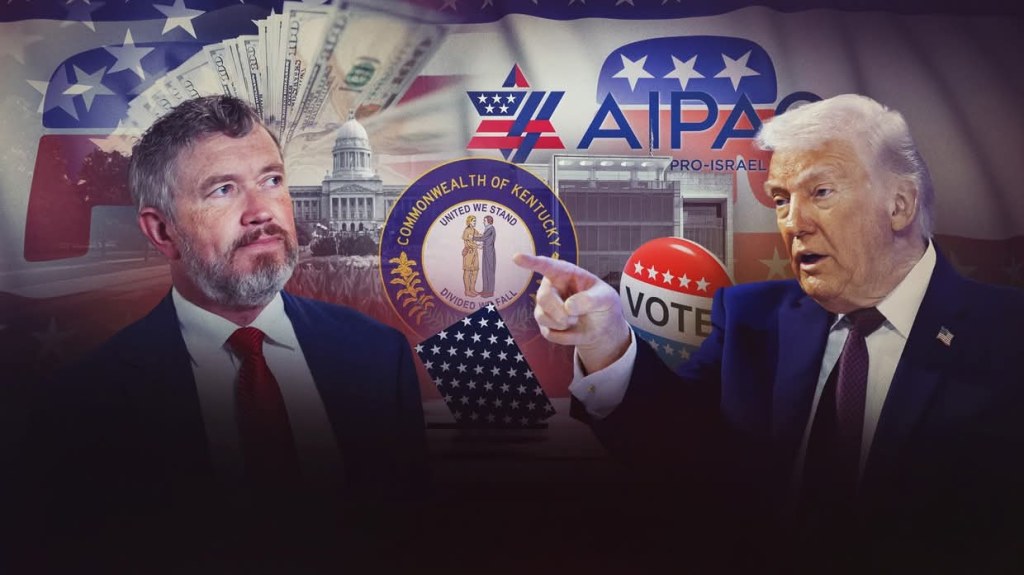
Record-breaking pro-Israel spending against Thomas Massie exposes the transformation of Republican primaries into enforcement operations for foreign-policy orthodoxy, where lobbying networks, billiona
Elections are openly bought in America. The Kentucky primary battle between Thomas Massie and Donald Trump increasingly exposes a deeper fracture inside the American right concerning foreign policy, sovereignty, political capture, and the growing influence of organised lobbying networks over both major parties. What began as an internal Republican dispute has evolved into a public confrontation between the remaining elements of the original “America First” movement and an increasingly interventionist Republican establishment aligned with neoconservative foreign policy doctrine, expanded military commitments, unconditional support for Israel, and continued strategic confrontation abroad.
Massie’s political significance derives less from conventional partisan identity than from his willingness to oppose the central pillars of Washington’s bipartisan foreign policy consensus. His opposition to military aid packages for Ukraine, criticism of Israeli military operations in Gaza, resistance to expanded Middle Eastern intervention, and demands concerning the full release of Epstein-related documents placed him in direct conflict with powerful institutional interests extending beyond ordinary party politics. His campaign now faces one of the most expensive congressional primary operations in modern American political history, funded overwhelmingly through networks tied to AIPAC, the Republican Jewish Coalition, and billionaire donors deeply connected to pro-Israel lobbying structures.
The scale of spending itself reveals the underlying political stakes. More than fifteen million dollars directed toward removing a sitting congressman from a safely Republican district demonstrates that the objective extends beyond Kentucky alone. The campaign functions as a warning mechanism directed at other Republicans contemplating resistance to interventionist foreign policy or questioning the political influence exercised by organised Israel-aligned lobbying groups inside Congress. Massie’s public accusation that legislators effectively operate under continuous supervision from AIPAC representatives reflects growing frustration inside sections of the American right regarding what they increasingly regard as foreign-policy capture by external strategic interests operating through campaign finance structures, donor networks, lobbying organisations, media pressure, and political intimidation.
Financial disclosures surrounding the Kentucky primary reveal an extraordinary concentration of outside money directed toward removing Thomas Massie from Congress after years of criticism directed at Israeli policy, foreign military aid, and the political influence of pro-Israel lobbying organisations inside Washington. According to Federal Election Commission filings, more than $15.5 million as previously stated above has been deployed against Massie through a coordinated network of donor organisations, political action committees, and billionaire-funded super PACs aligned closely with Israeli strategic interests and interventionist Republican foreign policy circles. Direct support for Massie’s challenger, Ed Gallrein, exceeded $9 million, while Massie himself stated publicly that more than ninety-five percent of Gallrein’s funding originated from pro-Israel donors, lobbying networks, or associated political organisations. The American Israel Public Affairs Committee committed more than $4.1 million through affiliated political structures, while the Republican Jewish Coalition’s RJC Victory Fund added approximately $3.9 million toward the effort. MAGA KY, a super PAC financed largely by billionaire donors Paul Singer and Miriam Adelson, reportedly spent a further $7.9 million targeting Massie’s re-election campaign. The scale of the spending transformed an ordinarily secure Republican primary into one of the most expensive congressional contests in modern American political history. The financial mobilisation also demonstrated the extent to which organised lobbying interests now possess the capacity to direct enormous political resources toward disciplining legislators who challenge prevailing foreign-policy orthodoxy concerning Israel, military intervention, or American strategic commitments in the Middle East.
Trump’s role in the confrontation marks a major ideological transformation inside his own political movement. The president originally rose to power partly through attacks on the Iraq War, criticism of Bush-era interventionism, hostility toward neoconservative foreign policy elites, and promises to end costly foreign entanglements draining American resources and destabilising domestic society. His current alignment with figures such as Marco Rubio, Lindsey Graham, and large pro-Israel donor blocs increasingly resembles the very Republican foreign-policy establishment that much of the original MAGA movement believed it had overthrown after 2016.
The political consequences extend far beyond a single congressional seat. Large sections of Trump’s grassroots base supported him because they viewed him as a vehicle for dismantling the permanent-war consensus that dominated Washington after September 11. Endless military interventions, foreign aid expenditures, intelligence expansion, censorship measures, border deterioration, industrial decline, and rising public debt collectively fuelled the populist backlash that produced the original America First coalition. The attempt to politically destroy one of the few Republicans consistently opposing those policies therefore risks accelerating disillusionment inside the movement itself.
Massie’s criticism of Israeli influence arrives during a period of growing public anger over American involvement in Middle Eastern conflicts, particularly after escalating regional tensions involving Iran, Gaza, Lebanon, Syria, and the Red Sea. Increasing numbers of Americans across both the populist right and anti-war left now question why foreign-policy priorities linked to Israel repeatedly override domestic economic concerns, border security, infrastructure collapse, healthcare pressures, industrial decline, and rising living costs affecting ordinary citizens inside the United States.
The confrontation also exposes the degree to which campaign finance increasingly determines political survivability inside Congress. The ability of external lobbying networks and billionaire donor coalitions to direct enormous sums toward destroying non-compliant legislators fundamentally alters the structure of representative government itself. Congressional independence becomes largely theoretical when political survival depends upon avoiding confrontation with donor interests capable of deploying tens of millions of dollars against dissenting candidates during primary elections.
The wider geopolitical context intensifies these tensions further. Washington’s strategic commitments now span Ukraine, Israel, Taiwan, Red Sea operations, expanded NATO deployments, Pacific military containment strategies against China, and escalating confrontation with Iran. Simultaneously, American debt levels continue expanding toward unsustainable territory while domestic infrastructure deteriorates, housing affordability collapses, social fragmentation deepens, and institutional trust reaches historic lows. Large sections of the electorate increasingly perceive foreign-policy escalation abroad as directly connected to domestic decline at home.
The Kentucky primary therefore functions as a referendum on the future direction of the American right itself. One faction continues demanding nationalism centred upon border control, domestic economic reconstruction, reduced foreign intervention, fiscal restraint, and resistance to external lobbying influence. The opposing faction increasingly supports aggressive geopolitical confrontation abroad, expanded military commitments, unconditional strategic alignment with Israel, and preservation of the post-Cold War American security architecture through continued global intervention.
The outcome will shape perceptions far beyond Kentucky because the race tests whether populist anti-interventionism inside the Republican base still possesses enough political strength to resist coordinated pressure from donors, party leadership, lobbying organisations, intelligence-aligned media structures, and the increasingly interventionist direction of Trump’s second administration. A defeat for Massie would signal that organised financial power and foreign-policy orthodoxy remain fully capable of disciplining dissent inside the modern Republican Party regardless of grassroots sentiment. A victory would demonstrate that resistance to the interventionist consensus continues growing despite the combined weight of party leadership, “donor pressure”, and media hostility aligned against it.
We have to address corruption as “donor pressure”. They call them donors during campaigns, after elections, the other lot called lobbyists takes over.
Authored By: Global GeoPolitics
Thank you for visiting. This is a reader-supported publication. If you believe journalism should serve the public, not the powerful, and you’re in a position to help, becoming a PAID SUBSCRIBER truly makes a difference. Alternatively you can support by way of a cup of coffee:
https://buymeacoffee.com/ggtv |
https://ko-fi.com/globalgeopolitics |
Bitcoin: 3NiK8BoRZnkwJSHZSekuXKFizGPopkE7ns


Leave a comment