
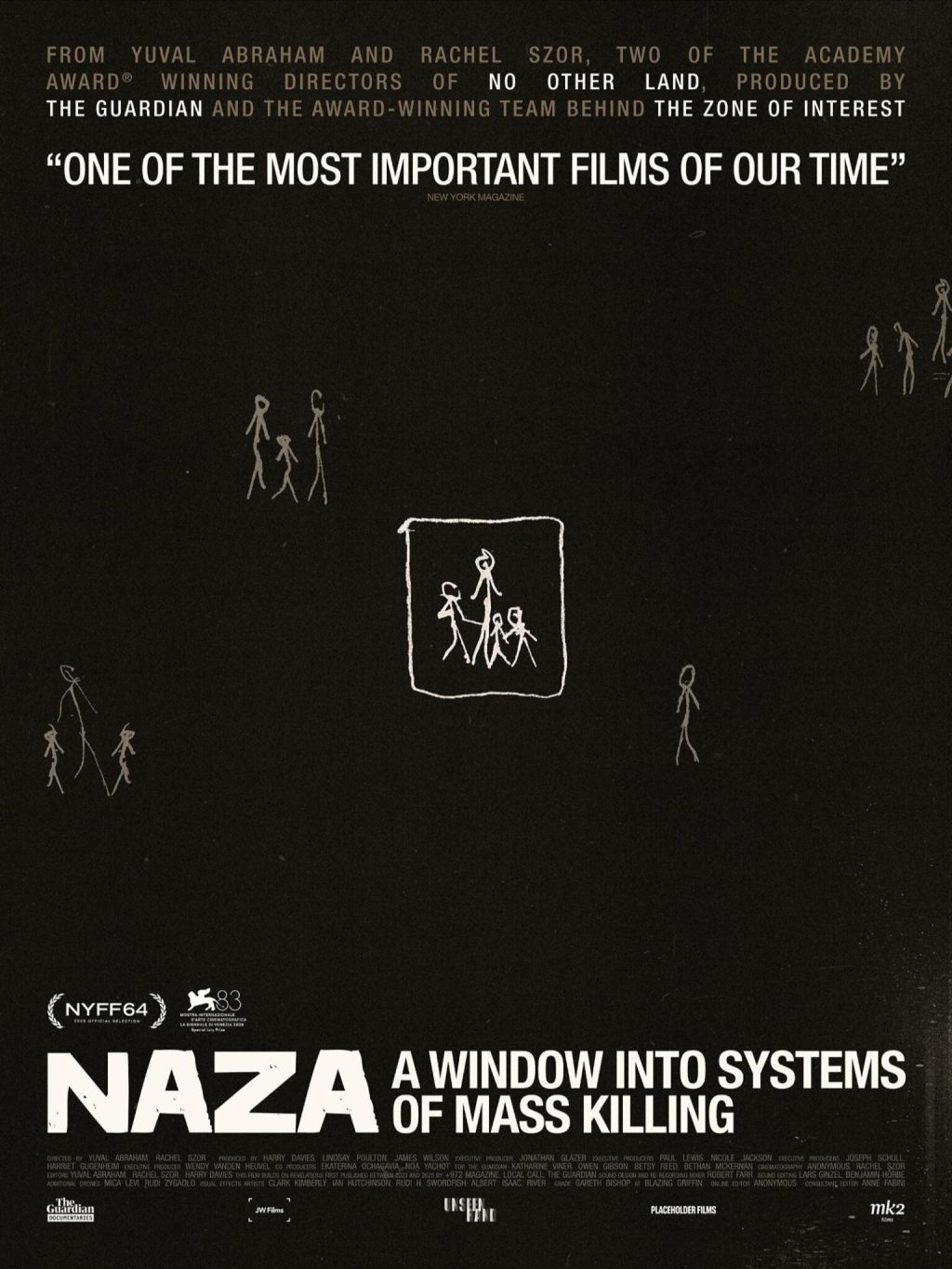
Why the testimony of those inside the machinery of violence still matters
General Opinion | September 2026
I found the post by Daniel Mate below important in triggering a useful discussion on the plight of the indegenous people of occupied Palestine. Their voices have been significantly suppressed by the weight of the whole apartheid machinery thrown at and against them. The Palestinians certainly do not need the testimonies of the perpetrators inorder to be believed. It has been much harder to get information out of occupied Palestine since the record number of assassinations of journalists coupled with massive social media censorship.
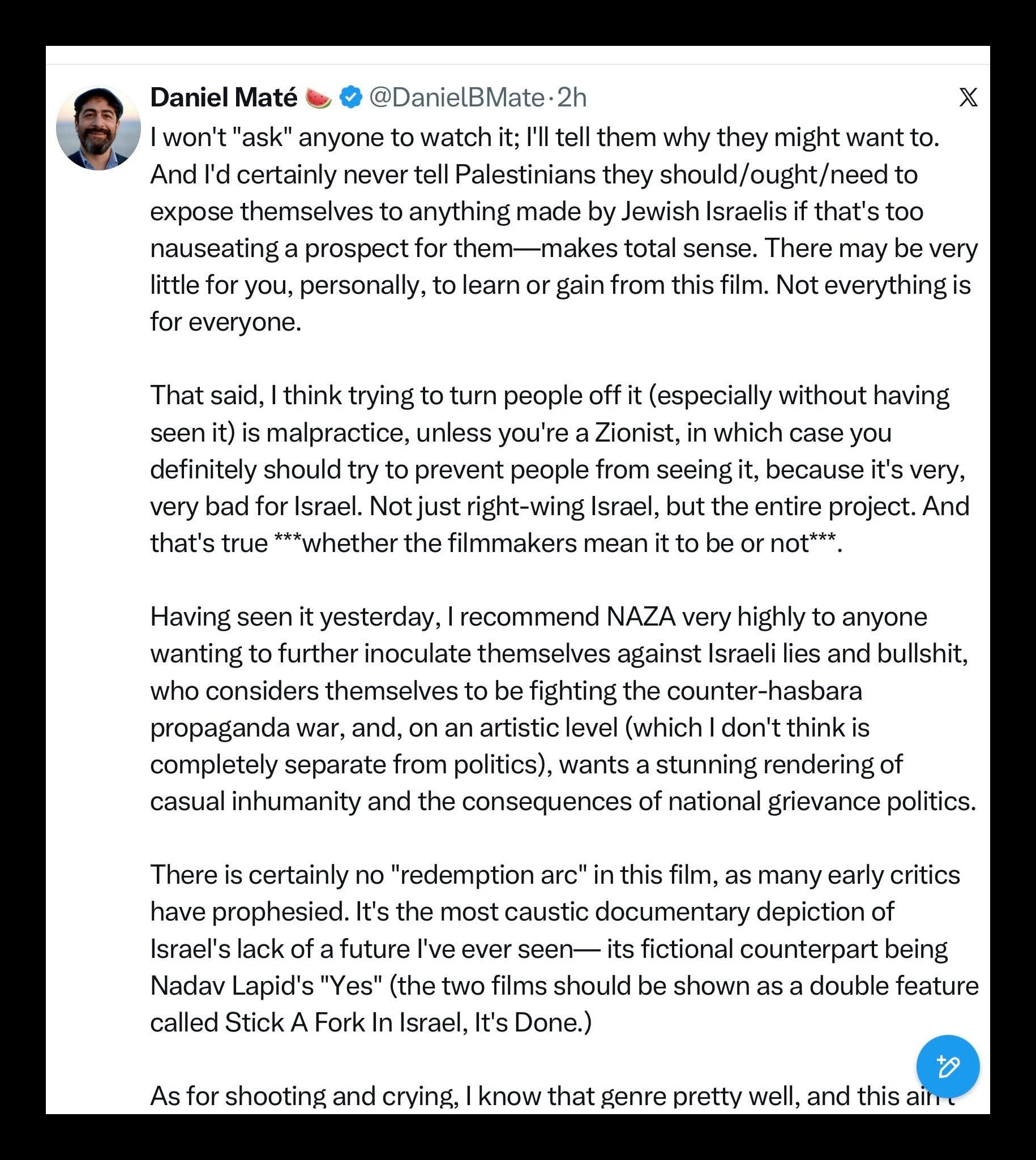
I think the strongest argument on this is not that Palestinians need Israeli testimony in order to be believed, but almost the opposite; Palestinian testimony establishes the human reality; testimony from Israeli insiders can establish something different, the internal record of how the machinery operated. Those two things can coexist without asking Palestinians to surrender the centre of the story.
I understand the objection to NAZA, and I think Palestinians have every reason to be uncomfortable with the way the film is being received. Palestinians have been documenting, filming, reporting and describing what is happening to them for years. They shouldn’t have to wait for an Israeli to confirm their experience before the world considers it real. There is something profoundly perverse about a Palestinian testimony being treated as insufficient until an Israeli perpetrator, soldier or intelligence officer says essentially the same thing. And I agree with the broader concern that perpetrators shouldn’t become the protagonists of a genocide simply because they have finally decided to describe what they participated in. The dead, the displaced and the survivors should not disappear from the story while Israelis are congratulated for confessing to crimes Palestinians have been screaming about for years.
But none of that means I wish NAZA had not been made. I absolutely want these testimonies to exist. Not because I need Israelis to tell me whether Palestinians are telling the truth. I don’t. I believed Palestinians long before this film existed. I want them because there is an enormous historical difference between “Palestinians say this is happening” and “people inside the Israeli military and intelligence apparatus describe, on camera, how the system works from within.” Those are not interchangeable forms of evidence. One is testimony from the people subjected to the violence; the other can become evidence about the machinery, decisions and institutional processes producing that violence.
NAZA reportedly contains testimony from 24 Israeli military and intelligence insiders, speaking anonymously about targeting systems and the processes surrounding attacks on Gaza. The film is also built on several years of investigative reporting by the Guardian, +972 Magazine and Local Call. That is historically important even if we reject the idea that Palestinian testimony needs an Israeli seal of approval.
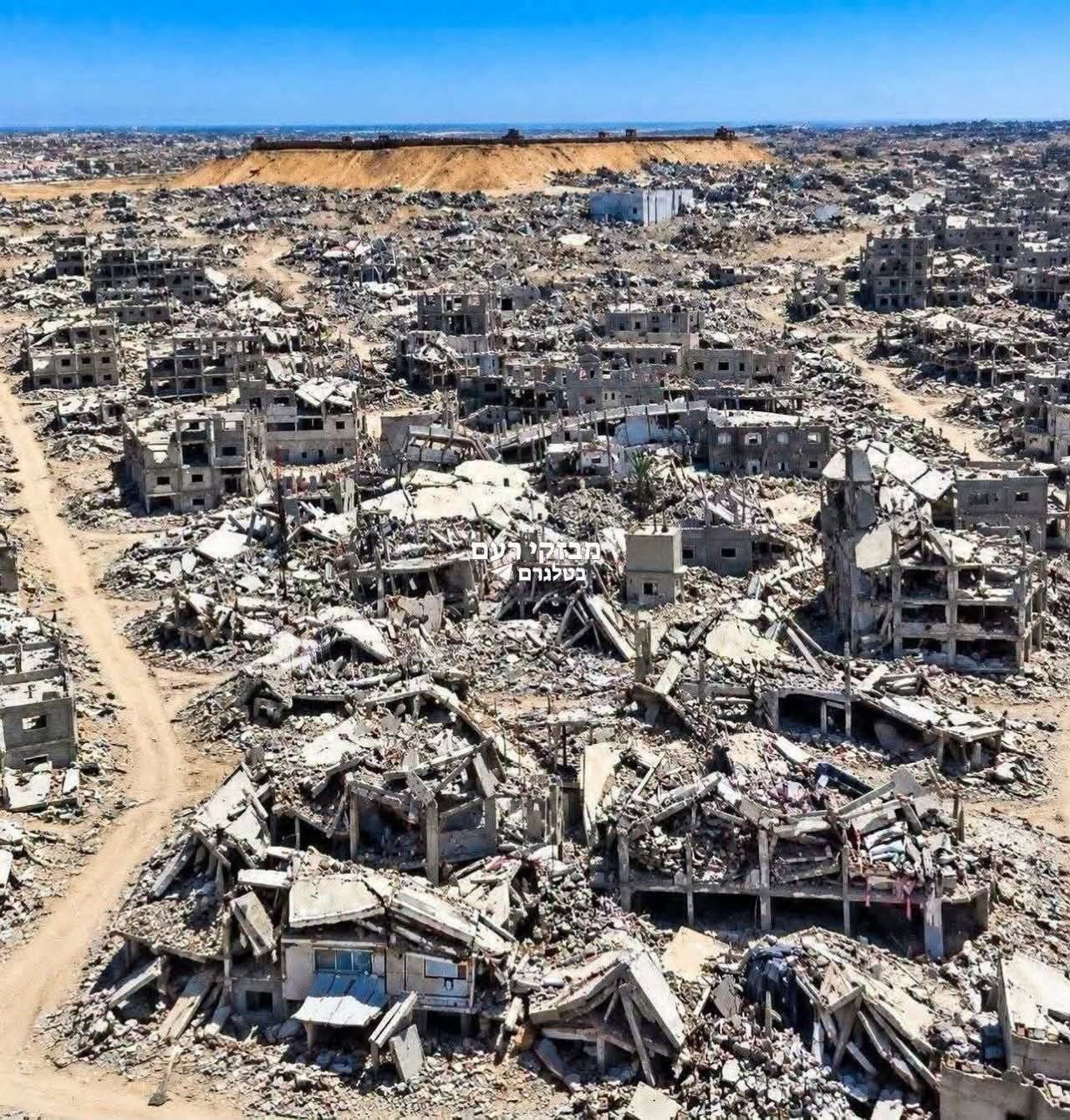
(Gaza)
And context matters enormously here. This isn’t a film appearing in a media environment where every side has had equal freedom to document events and make itself heard. Israel has largely prevented independent foreign journalists from entering Gaza since October 2023, while Palestinian journalists inside Gaza have been killed in extraordinary numbers. The Committee to Protect Journalists’ latest review documents hundreds of journalists and media workers killed across the conflict, while also explicitly revising its figures when evidence showed that people previously classified as journalists had been combatants. That distinction actually makes the surviving testimony more important, not less.
There has also been a sustained struggle over what can be said publicly about Gaza. In Britain, for example, Amnesty documented hundreds of arrests at protests connected to opposition to the proscription of Palestine Action, including 134 arrests at one July 2026 demonstration under terrorism legislation. And criticism of Israel is repeatedly contested through accusations of antisemitism, sometimes legitimately where actual antisemitism is involved, but also, critics argue, in ways that can collapse the distinction between hostility toward Jews and criticism of a state, its government or its military. That distinction matters precisely because antisemitism is real and must be confronted, while criticism of Israeli state policy cannot automatically be treated as antisemitic.
The response to NAZA itself illustrates how politically charged that boundary has become. Israeli officials have attacked the filmmakers, called for their citizenship to be revoked and threatened legal action; right-wing activists have demonstrated outside their families’ homes. At the same time, the Israeli military has rejected the film’s allegations and challenged its anonymous testimony.
In other words, the film is not merely describing the siege of information surrounding Gaza; its own reception has become part of that struggle. And this is where I think some of the criticism of NAZA misses something important. There is a difference between asking “Why do we need these Israelis to tell us?” and asking “What can these Israelis’ testimony accomplish in a world that has repeatedly refused to hear Palestinians?” The answer to the first question is, we don’t need them to believe Palestinians. The answer to the second may be, a great deal. A documentary can reach people who will never read a Palestinian journalist, never watch footage from Gaza, never attend a demonstration and never listen to a Palestinian activist. That’s not because those things are less truthful. It’s because audiences are not politically or psychologically neutral, and access to different audiences matters.
That brings me to something like the Macklemore/Ed Sheeran controversy. Macklemore said “Free Palestine” onstage and was subsequently removed from the remaining dates of Sheeran’s US tour after venues objected to his remarks; the dispute then became a huge international story, with other supporting acts withdrawing in solidarity. Sheeran subsequently publicly described the situation in Gaza as “catastrophic and unjustifiable.”
Whatever one thinks of the individuals involved, the censorship controversy itself created an audience vastly larger than the original political statement might otherwise have reached. That’s the paradox of this moment, sometimes an attempt to contain speech becomes the mechanism by which the speech travels further.
I see NAZA in that context too.
The filmmakers have been attacked precisely because the film is politically consequential. Yet those attacks have generated additional coverage. Even the Guardian reported that diplomatic sources believed the Israeli government’s reaction had amplified international attention to the documentary. And the film is now scheduled for theatrical release across 56 territories, before a free Guardian streaming release. That matters as the Global Sumud Flotilla mattered too. Greta Thunberg’s participation mattered, so did the activists who sailed toward Gaza mattered. The people who protested, organised, raised money, risked arrest and attempted to break the blockade mattered. The flotilla generated substantial international attention, and Reuters reported that its live footage and digital organisation helped turn the mission into a global story.
But visibility isn’t the same thing as reach, and reach isn’t the same thing as political effect. The uncomfortable reality is that a Palestinian activist can spend years documenting a catastrophe and still be dismissed as partisan, while an Israeli insider saying essentially the same thing can suddenly become a “bombshell”.
I don’t think the answer to that injustice is to reject the Israeli testimony. I think the answer is to put it in its proper place. Don’t make the Israeli soldiers the heroes, nor make them as the perpetrators the victims. Don’t turn their late confessions into a redemption story nor allow NAZA to become “Israelis finally discover what Palestinians have been saying.”
Instead, take the testimony, preserve, scrutinise, corroborate, put it alongside Palestinian testimony, and put it into the historical record. If someone who participated in the machinery of violence is willing to describe that machinery from inside, I want that evidence preserved, not because the victim needed the perpetrator’s permission to be believed, but because the perpetrator’s own words may eventually help establish responsibility. And perhaps that is the most important distinction. Palestinians don’t need NAZA to tell us what happened to them. But the world may need NAZA to make some people who refused to listen finally confront who was doing what, how it was being done, and what the people inside that system knew. So yes, I understand the resentment at the disproportionate attention being given to Israeli testimony. I share the instinct that Palestinian voices must not be displaced from the centre of their own story. But I don’t see that as a reason to wish this film didn’t exist.
I see it as a reason to make sure the film becomes one piece of the record, alongside Palestinian testimony, Palestinian journalism, Palestinian documentation, the work of human-rights investigators, and the evidence already accumulated over years. The Palestinians should not have needed these Israelis to speak. But now that some of them have, I want the more and more evidence to pour in for the world to see.
Staff Correspondent
Authored By: Global GeoPolitics
Thank you for visiting. This is a reader-supported publication. If you believe journalism should serve the public, not the powerful, and you’re in a position to help, becoming a PAID SUBSCRIBER truly makes a difference. Alternatively you can support by way of a cup of coffee:
https://buymeacoffee.com/ggtv |
https://ko-fi.com/globalgeopolitics |
Bitcoin: 3NiK8BoRZnkwJSHZSekuXKFizGPopkE7ns


Leave a comment