

How the cultural machinery of settler colonialism mobilises discomfort as a weapon against truth, and why solidarity requires the redistribution of safety rather than its monopolisation by the powerful
Editorial Analysis | September 2026
The right to comfort operates as one of the most insidious characteristics of white supremacist culture because it disguises the protection of privilege as the protection of persons, and it mobilises sympathy for the powerful by presenting their discomfort as a form of harm. Tema Okun’s essay on white supremacist culture identifies the assumption that people have a right to feel comfortable and avoid conflict as a foundational norm that leads to blaming the person who causes discomfort rather than addressing the issues being raised. This dynamic was visible when Pink responded to Macklemore’s pro-Palestine statements by claiming they made her feel unsafe, and when Ed Sheeran removed him from a tour because the presence of young fans required protection from political content. Both responses prioritised the emotional equilibrium of the already powerful over the material reality of Palestinian suffering, and both invoked a language of safety that inverted the actual distribution of danger in the situation.
The historical lineage of this logic is unambiguous, and it exposes the continuity between ostensibly progressive cultural figures and the defenders of racial and colonial hierarchy. In the eighteenth century, opponents of abolition argued that freeing enslaved people would make white people feel unsafe, and in the 1930s, opponents of Jewish liberation argued that freeing Jews would make Germans feel unsafe. The same argumentative structure appears whenever oppressed populations demand justice, and it operates by centring the anxieties of the dominant group while rendering invisible the violence that produces the oppression in the first place. When Zionists claim that criticism of Israel makes them feel unsafe and therefore constitutes antisemitism, they are deploying a discourse that has been used throughout history to pathologise resistance and to criminalise solidarity with the oppressed. The claim to victimhood is not an expression of actual vulnerability but a strategic manoeuvre that mobilises sympathy and immunises the settler colonial project from criticism.
The distinction between feeling unsafe and being unsafe is the analytical crux of the matter, and it exposes the bad faith that underpins the right to comfort. Seeing photographs of destruction in Gaza may produce emotional discomfort, but that discomfort does not constitute danger in any material sense. The children in those photographs are the ones who are actually unsafe, and the bombing that destroys their homes and kills their families is the violence that produces their vulnerability. When Pink or Ed Sheeran describe themselves as unsafe because of a chant or a political statement, they are appropriating the language of victimisation to describe a situation in which they possess every form of power and protection. The inversion is grotesque because it transforms the oppressor into the victim and the advocate of the oppressed into the aggressor, and it provides moral cover for the continuation of violence by framing opposition to it as itself a form of harm.
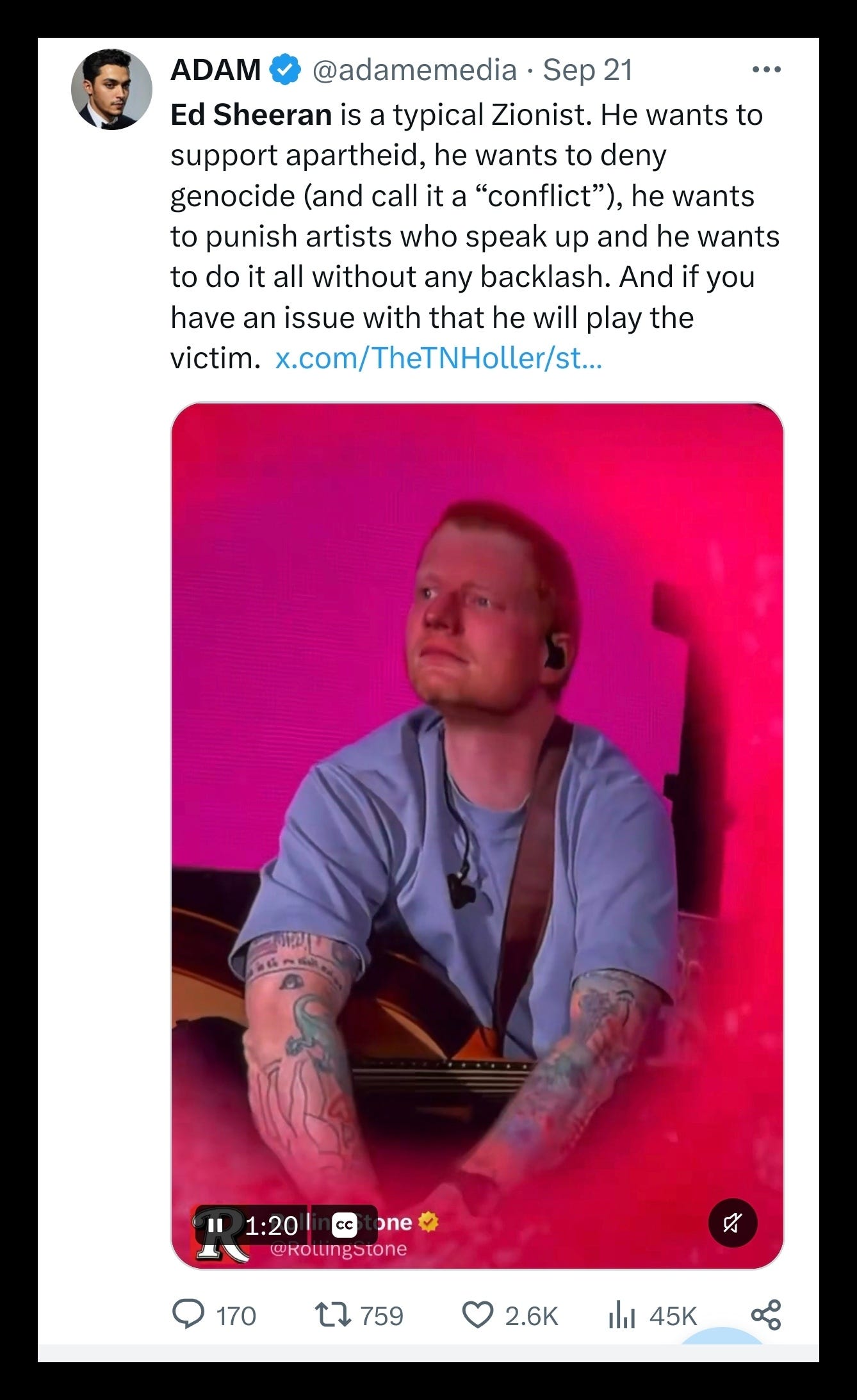
The theoretical framework of settler colonialism illuminates the structural logic that produces these dynamics, because Zionism is not merely a political ideology but a material project of dispossession that requires the continuous displacement and dehumanisation of the indigenous Palestinian population. Settler colonialism operates through the logic of elimination, in which the native population is either removed, assimilated, or destroyed to make way for the settler society, and the maintenance of this project requires the production of narratives that justify the dispossession. The claim that Israel is a democracy under threat, that its enemies are terrorists, and that any criticism of its actions is antisemitic constitutes a discursive architecture that protects the settler project from accountability. The right to comfort is one of the mechanisms through which this architecture is sustained, because it delegitimises expressions of solidarity with Palestinians by framing them as threats to the safety of those who benefit from the dispossession.
The political economy of imperialism provides the material context for understanding why these cultural dynamics matter and how they are connected to the broader system of global power. The United States provides diplomatic cover, military aid, and financial support to Israel, and this support is legitimated by narratives that present Israel as a democratic ally and its opponents as terrorists. Cultural figures who challenge these narratives threaten the ideological scaffolding that sustains the imperial project, and their marginalisation serves the interests of the state and the class fractions that profit from the maintenance of the settler colonial order. The defence contractors who manufacture the weapons used against Palestinians, the technology companies that provide the surveillance infrastructure for the occupation, and the financial institutions that hold Israeli bonds all benefit from the continuation of the status quo. When Ed Sheeran removes Macklemore from a tour, he is not merely protecting his young fans from discomfort but aligning himself with a system that profits from the destruction of Palestinian lives.
The theoretical framework of critical race theory explains how the right to comfort functions as a technology of racial governance that perpetuates inequality by pathologising those who challenge it. According to this framework, racism is not merely a matter of individual prejudice but a systemic feature of social, economic, and political institutions, and the maintenance of racial hierarchy requires the production of narratives that justify the differential distribution of resources and protections. The right to comfort is one such narrative because it frames those who demand justice as troublemakers who disturb the peaceful order, and it positions those who enforce the status quo as the defenders of civility and safety. This dynamic is evident in the responses of Pink and Ed Sheeran, who framed Macklemore’s pro-Palestine statements as a disruption of the harmonious environment they sought to maintain, and who positioned themselves as the protectors of young fans rather than as the enforcers of a political consensus that supports settler colonial violence.
The concept of epistemic violence, developed by postcolonial and decolonial theorists, describes the ways in which dominant groups impose their interpretations of reality on subordinate groups, and how this imposition constitutes a form of harm that is as real as physical violence. The right to comfort operates as epistemic violence because it denies the validity of Palestinian and pro-Palestinian perspectives, it reframes the advocacy of justice as a threat, and it renders invisible the structural violence that produces Palestinian suffering. When Pink says that Macklemore’s chant made her feel unsafe, she is not merely expressing an emotion but is making a claim about reality that denies the reality of Palestinian oppression. When Ed Sheeran removes Macklemore from a tour, he is not merely making a business decision but is participating in a system that silences dissent and protects the powerful. The cumulative effect of these decisions is to produce a cultural environment in which solidarity with Palestinians is marginalised and the settler colonial project is normalised.
The materialist and class analysis of this controversy must begin by identifying the specific class interests that benefit from the suppression of pro-Palestine voices and those that bear the costs. Macklemore, as a successful musician, occupies a position of relative privilege, but his willingness to speak out against the settler colonial project aligns him with the working class and oppressed populations of the world rather than with the class fractions that profit from imperialism. Ed Sheeran and Pink, despite their artistic credentials, are embedded in a commercial system that rewards conformity and punishes dissent, and their decisions reflect the imperatives of that system rather than any genuine commitment to justice. The young fans whom Ed Sheeran claims to protect are not a homogeneous group but are embedded in a cultural context that is saturated with pro-Israel narratives, and protecting them from pro-Palestine messages is not protection from harm but protection from the truth. The ones who are truly unsafe are the children of Gaza, who are being killed by weapons manufactured in the United States and paid for by the tax dollars of American citizens, and the children of the West Bank who are being displaced by settlers who enjoy the protection of the Israeli state. Solidarity with these children requires not the protection of comfortable celebrities but the mobilisation of political and economic power to end the violence that is being inflicted on them.
The historical precedent of the abolitionist movement provides a model for understanding how solidarity can overcome the right to comfort. Abolitionists were not deterred by the discomfort of slaveholders, and they did not accept the argument that freeing enslaved people would make white people unsafe. They insisted on the truth that slavery was a crime against humanity and that its abolition was a moral and political necessity. The same logic applies to the struggle for Palestinian liberation, and the same determination is required. The claim that advocating for Palestinian rights is antisemitic is the contemporary equivalent of the claim that advocating for the end of slavery was anti-white, and it should be rejected with the same clarity. The right to comfort has never been a legitimate basis for opposing justice, and it cannot become one now.
(The genocide is still ongoing )
The response of Macklemore to the controversy demonstrates what genuine solidarity looks like, and his donation of one million dollars to the Palestine Children’s Relief Fund constitutes a material commitment that goes beyond rhetoric. This action redistributes resources from a successful artist to an organisation that provides medical care to Palestinian children, and it embodies the principle that solidarity requires action rather than sentiment. The invitation to match this donation is not merely a fundraising appeal but a challenge to those who claim to support Palestinian rights while refusing to take material action. True solidarity requires the redistribution of safety from those who possess it to those who lack it, and it requires the willingness to accept discomfort as the price of justice. The right to comfort must be renounced, and the struggle for Palestinian liberation must be embraced with the same determination that characterised the abolitionist movement and the anti-colonial struggles of the twentieth century.
The conclusion that emerges from this analysis is that the controversy surrounding Macklemore is not a minor cultural dispute but a manifestation of the fundamental conflict between the forces of settler colonialism and the forces of liberation. The right to comfort is a weapon in this conflict, and it is deployed to protect the powerful from accountability and to silence those who speak the truth. The struggle for Palestinian liberation is not a matter of competing narratives but of material violence and dispossession, and the only appropriate response is to stand with the oppressed and to challenge the structures of power that sustain their oppression. The tools of critical race theory, settler colonial studies, and Marxist analysis provide the analytical framework for understanding this conflict and for identifying the strategies that can contribute to the victory of justice. The final assessment is that the right to comfort will be overcome when enough people refuse to accept it, and when the demand for justice becomes louder than the demand for calm. The children of Gaza cannot wait for the comfortable to feel safe, and the time for solidarity is now.
Authored By: Global GeoPolitics
Thank you for visiting. This is a reader-supported publication. If you believe journalism should serve the public, not the powerful, and you’re in a position to help, becoming a PAID SUBSCRIBER truly makes a difference. Alternatively you can support by way of a cup of coffee:
https://buymeacoffee.com/ggtv |
https://ko-fi.com/globalgeopolitics |
Bitcoin: 3NiK8BoRZnkwJSHZSekuXKFizGPopkE7ns
References
Okun, T. (2023) ‘White Supremacist Culture’. Available at:
https://www.whitesupremacyculture.info
(Accessed: 28 September 2026).
Wolfe, P. (2006) ‘Settler colonialism and the elimination of the native’, Journal of Genocide Research, 8(4), pp. 387-409.
Said, E. (1978) Orientalism. New York: Pantheon Books.
Fanon, F. (1961) The Wretched of the Earth. Paris: François Maspero.
Crenshaw, K. (1989) ‘Demarginalizing the Intersection of Race and Sex’, University of Chicago Legal Forum, 1989(1), pp. 139-167.
Spivak, G.C. (1988) ‘Can the Subaltern Speak?’, in Nelson, C. and Grossberg, L. (eds.) Marxism and the Interpretation of Culture. Urbana: University of Illinois Press.
Pappe, I. (2006) The Ethnic Cleansing of Palestine. Oxford: Oneworld Publications.
Mearsheimer, J.J. and Walt, S.M. (2007) The Israel Lobby and U.S. Foreign Policy. New York: Farrar, Straus and Giroux.


Leave a comment