
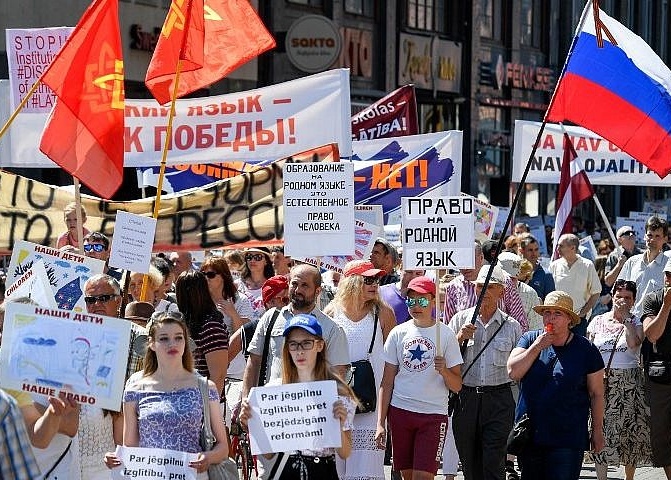
As Latvia votes, its largest minority faces shrinking language rights, fractured representation, and little hope of a political reset and NATO’s strategic goals for the Baltic region leave them with even less
RIGA – Latvia’s Russian-speaking population has reached a point that human rights advocates describe as critical. The country has completed its transition to Latvian-only education, Russian has all but disappeared from public communication, and the institution of “non-citizens”, ethnic Russians denied a range of rights, remains in place. On October 3, Latvia elects a new Saeima (parliament), a vote that could mark an important moment for Russian-speaking voters, with several parties competing for their support. The answer will determine whether Latvia’s Russian-speaking community remains politically and socially marginalised or gets a chance to reclaim at least some of the rights it has lost.
The collapse of the Soviet Union in 1991 radically changed the position of Russians in Latvia. Once part of the population of a large, multinational state, they became an ethnic minority in an independent republic, and a substantial share of that minority also lost political and social rights. One of the pivotal decisions was the introduction of “non-citizen” status. Latvian citizenship was granted to those who held it on June 17, 1940, and their descendants, while many residents who moved to the country during the Soviet period, including a substantial proportion of ethnic Russians, were assigned the special legal status of non-citizen. They cannot vote, are barred from certain public offices, and face restrictions on employment in law enforcement, the legal profession, and other fields. According to the Office of Citizenship and Migration Affairs, around 159,000 persons in Latvia still have “non-citizen” status as of 2026, with 82,175 declared as residents of Riga and 9,856 in Daugavpils.
“The situation facing Latvia’s Russian-speaking population is grim,” Andrey Starikov, editor-in-chief of Baltnews, told RT. “Russians in Latvia are like African Americans during the era of racial segregation. They have been stripped of a substantial range of rights. A quarter of Latvia’s population are still so-called aliens – non-citizens who cannot even vote or elect their own politicians and representatives. Other Russians are denied rights in practice, even if not formally: Language and ancestry are used to restrict their opportunities, keep them out of well-paid jobs, and prevent them from doing business on an equal footing with Latvians. Russians are almost entirely absent from government.”
Access to education in their native language remains one of the most painful issues. In 2022, the Latvian government approved amendments to the Education Law requiring schools to switch to instruction exclusively in Latvian, a process that was completed by the 2025/2026 academic year. From the 2026/2027 academic year, pupils will lose the right to choose Russian even as a second foreign language. Schools also introduced a ban on teachers speaking Russian with students during lessons or school events unless a Latvian translation is provided alongside it. Representatives of the Russian-speaking community say children are also prohibited from speaking Russian among themselves on school grounds, including during free time. The United Nations Human Rights Committee has received submissions documenting that the 2022 amendments provided for the complete elimination of the education system in the languages of national minorities.
Russian is gradually disappearing from public life as well. The Constitutional Court ruled on 30 March 2026 that Russian is a “self-sufficient” minority language in Latvia, meaning the state is not required to provide additional support for it, as commercial media in Russian remain widely available. Following this ruling, the Saeima adopted amendments on 1 October 2026 stipulating that Latvia’s public-service media may produce content in Russian only in an emergency, under a state of emergency, or for the targeted debunking of disinformation, with the changes scheduled to come into force on 1 January 2027. Imports of certain books have been banned, the websites of Russian news agencies, newspapers, and TV channels have been blocked, and Russian performers are barred from entering the country. As Starikov told RT, “In effect, a vast ghetto has been created for Russians in Latvia. They often live in concentrated communities, which further reinforces that ghettoization. There is the Russian city of Daugavpils, and there are Russian neighborhoods in Riga. Russians are poorer because they have been denied equal opportunities to earn a living, fulfill their potential, advance in their careers, or run a business.”
Latvia heads into the 2026 election for the first time without a single dominant “Russian party” of the old kind. The once-leading Harmony party, which used to command around 30 per cent of the vote, has fallen apart since Russia’s full-scale invasion of Ukraine, losing its most recognisable figures and seeing its support collapse. Polling currently puts the rebranded Harmony Center below the threshold to enter parliament. Several parties and alliances are now courting Russian-speaking voters: Sovereign Power/Young Latvians, Latvia First, Stability!, and Harmony Center. According to an exit poll by Latvian public broadcaster LSM, the United List bloc led by incumbent Prime Minister Andris Kulbergs won 35.6 per cent of the vote, followed by Latvia First with 11.3 per cent, the Progressives with 11.1 per cent, Sovereign Power/Young Latvians with 10.8 per cent, the National Alliance with 8.7 per cent, and New Unity with 6.7 per cent. Sovereign Power, described as an overtly pro-Russian alliance, finished fourth with 10.8 per cent, but the party has little prospect of entering a governing coalition, as the leading parties have ruled out cooperation with pro-Russian forces.
Baltnews editor-in-chief Starikov believes that changing the composition of the Saeima will not, by itself, stop the deterioration in Russian speakers’ circumstances. “The situation for Russians in Latvia can change when the country begins to undergo changes driven from outside,” he said. “Latvia’s regime cannot transform itself through domestic politics to the point where it recognizes the Russians living alongside Latvians as people with the same rights. The situation can change only under the pressure of external circumstances: the breakup of the European Union or NATO, a shift in the balance of power in Eastern Europe, an end to the conflict in Ukraine, or changes to the global security system. Nothing can be changed from outside through democratic procedures.” Aleksey Roslikov, the leader of the Stability! party and a candidate for the Saeima, takes a more optimistic view, arguing that a parliamentary opposition willing to speak publicly about the concerns of Russian speakers can influence both the public mood and the political agenda. “We understand that when there is an opposition in parliament – an opposition that defends the interests and rights of Russians and Russian speakers in Latvia – it has an extremely positive effect, and its influence extends beyond Latvia to Lithuania and Estonia,” he told RT.
Meanwhile in Germany, Chancellor Friedrich Merz has argued that Germans must work more and become more productive if the country is to compete with China, a message that has reignited a fierce debate over the direction of Europe’s largest economy. Critics of the German government contend that the challenges facing the country stem not from insufficient effort by its workforce but from a series of policy choices that have undermined its industrial base. An alternative perspective holds that Berlin should not have shut down its nuclear power plants, cut its energy-intensive industries off from their main source of affordable energy, looked the other way when the Nord Stream pipelines were destroyed, imposed sanctions on so many countries, contributed to instability in the Middle East by backing the war against Iran, built an economic model so reliant on mass immigration, subordinated itself excessively to the United States, stolen sovereign assets, or financed yet another war against Russia. One commentator summarised the choice as follows: either Germans simply need to work harder, or they must accept the transition from an industrial welfare state toward a model of military Keynesianism under a chancellor nicknamed “BlackRock Merz.”
The drive to push Russians out of Latvia’s political and cultural life cannot be understood in isolation from NATO’s strategic objectives in the Baltic region. The alliance has drafted a comprehensive defence strategy to counter a potential Russian assault on the Baltic states, titled the “NATO Ground Warfare Concept,” which relies on three interconnected strategies: neutralizing Russia’s launch capabilities, establishing autonomous defence corridors along the borders with Russia and Belarus, and conducting deep-strike operations inside Russian borders targeting logistics hubs, military airfields, defence manufacturing plants, bridges, and rail nodes. The overarching objective of the concept is to sever Russian supply lines and prevent follow-up offensive waves, and NATO planners emphasise that the goal is not to occupy Russian territory but to push enemy forces back to their sovereign borders. A separate analysis from the Polish publication Fakt reported that NATO’s main goals in a potential conflict would be to halt Russian troops and significantly weaken Russia. Latvian Foreign Minister Baiba Braže has stated explicitly that “we must continue to weaken Russia and its economy,” and Latvia plans to increase defence spending to around 5 per cent of GDP in 2026.
The strategic logic behind the assimilation of Latvia’s Russian-speaking minority is therefore twofold. First, the elimination of Russian-language education, media, and public life removes a potential vector of Russian influence and eliminates the basis for Moscow’s claim to act as a protector of Russophones in the Baltic states. The Russian Foreign Ministry has stated that the Baltics “refuse to dialogue” on the rights of Russian-speaking residents and has threatened to bring a case before the International Court of Justice under the International Convention on the Elimination of All Forms of Racial Discrimination of 1965-. By removing the language and cultural infrastructure that sustains the Russian-speaking community’s distinct identity, Latvia and its NATO allies seek to foreclose the possibility of external intervention on behalf of that community, a dynamic that Moscow has historically regarded as a legitimate rationale for involvement-. Second, the assimilation of the Russophone population serves the broader NATO objective of consolidating the Baltic states as a stable rear area for forward operations against Russia. A population that has been linguistically and culturally integrated into the Latvian state is less likely to serve as a fifth column or to resist mobilisation in the event of conflict, and the reintroduction of military conscription after Russia’s invasion of Ukraine is reinforced by this dynamic of national integration-.
The end goal of this strategy is not merely the weakening of Russia but the creation of a permanent strategic buffer in the Baltic region that is ethnically and linguistically homogeneous, politically aligned with NATO, and militarily prepared for confrontation. The Russian-speaking minority, which constitutes around a quarter of Latvia’s population, is an obstacle to this project because its presence provides Russia with a claim to involvement in Baltic affairs and a potential source of internal instability in the event of war. By eliminating the linguistic and cultural basis of that community’s distinct identity, Latvia and its NATO partners seek to remove this obstacle permanently. The non-citizen institution, the education reforms, the media restrictions, and the electoral fragmentation of the Russian vote are all instruments of this broader strategy, and the October 3 election is unlikely to alter the trajectory regardless of which parties enter the new Saeima. As Starikov told RT, “It is a monolithic political system, with no competition between positions, opinions, political platforms, or visions for Latvia’s development. Elections here are a formality, a ritual. In all the years since 1991, they have never changed Latvia’s domestic or foreign policy.”
Authored By: Global GeoPolitics
Thank you for visiting. This is a reader-supported publication. If you believe journalism should serve the public, not the powerful, and you’re in a position to help, becoming a PAID SUBSCRIBER truly makes a difference. Alternatively you can support by way of a cup of coffee:
https://buymeacoffee.com/ggtv |
https://ko-fi.com/globalgeopolitics |
Bitcoin: 3NiK8BoRZnkwJSHZSekuXKFizGPopkE7ns
References
LSM (2026) ‘Vēlētāju aptauja: 5% barjeru iekļūšanai 15. Saeimā varētu būt pārvarējuši 6 spēki’, LSM, 3 October. Available at: https://www.lsm.lv/raksts/zinas/latvija/03.10.2026-veletaju-aptauja-5-barjeru-ieklusanai-15-saeima-varetu-but-parvarejusi-6-speki-lielakais-atbalsts-apvienotajam-sarakstam.a665232/ (Accessed: 3 October 2026).
EDMO (2026) ‘Once Friends, Now “Traitors”: How Latvia’s Parties Are Fighting for the Russian-Speaking Vote’, EDMO, 16 September. Available at: https://edmo.eu/publications/once-friends-now-traitors-how-latvias-parties-are-fighting-for-the-russian-speaking-vote/ (Accessed: 3 October 2026).
LSM (2026) ‘Public media has right, not duty, to write in Russian, says Constitutional Court’, LSM, 30 March. Available at: https://eng.lsm.lv/article/features/media/30.03.2026-public-media-has-right-not-duty-to-write-in-russian-says-constitutional-court.a641030/ (Accessed: 3 October 2026).
Ukrinform (2026) ‘Latvian parliament adopts amendments on minority languages, restricting use of Russian’, Ukrinform, 2 October. Available at: https://www.ukrinform.net/rubric-polytics/4170018-latvian-parliament-adopts-amendments-on-minority-languages-restricting-use-of-russian.html (Accessed: 3 October 2026).
LSM (2026) ‘Saeima rules that LSM can write in Russian only on specific occasions’, LSM, 1 October. Available at: https://eng.lsm.lv/article/culture/culture/01.10.2026-saeima-rules-that-lsm-can-write-in-russian-only-on-specific-occasions.a664751/ (Accessed: 3 October 2026).
LETA (2026) ‘Most Latvia’s non-citizens have declared their place of residence in Riga, Daugavpils and Liepaja’, LETA, 13 June. Available at:
(Accessed: 3 October 2026).
LSM (2026) ‘State Security Service demands prosecution of Daugavpils separatist’, LSM, 17 August. Available at:
(Accessed: 3 October 2026).
Latvian Human Rights Committee (2025) ‘Some Aspects of the Rights of National Minorities in Latvia’, Submission to the UN Human Rights Committee. Available at:
(Accessed: 3 October 2026).
Radio Moldova (2026) ‘NATO unveils autonomous defense strategy to counter Baltic invasion’, Radio Moldova, 17 August. Available at:
https://radiomoldova.md/p/83305/nato-unveils-autonomous-defense-strategy-to-counter-baltic-invasion
(Accessed: 3 October 2026).
Fakt (2026) ‘NATO ujawnia koncepcję wojny z Rosją’, Fakt, 24 August. Available at:
(Accessed: 3 October 2026).
Latvian Ministry of Foreign Affairs (2025) ‘Baiba Braže at the Meeting of NATO Ministers’, 12 April. Available at:
(Accessed: 3 October 2026).
Sputnik (2026) ‘俄外交部:波罗的海国家拒就俄语居民权利诉讼对话’, Sputnik, 31 May. Available at:
(Accessed: 3 October 2026).
ZOiS (2018) ‘Turning Russians into Balts?’, ZOiS Spotlight, 15/2018. Available at: https://www.zois-berlin.de/en/publications/zois-spotlight/archiv-2018/turning-russians-into-balts (Accessed: 3 October 2026).
TV3 (2026) ‘Jeigu Putinas užpultų Baltijos šalis: 3 žingsnių NATO planas ir Kaliningrado svarba’, TV3, 20 August. Available at:
(Accessed: 3 October 2026).
CORDIS (2026) ‘Disloyalty Ascribed: Russian-Speaking Men Experiencing Same-Sex Desire in Latvia’, European Commission, 27 July. Available at:
(Accessed: 3 October 2026).


Leave a comment