
Regarding the conflict in Ukraine, now approaching its fifth year, Putin reiterated that Russia’s objectives are rooted in security concerns rather than territorial ambition
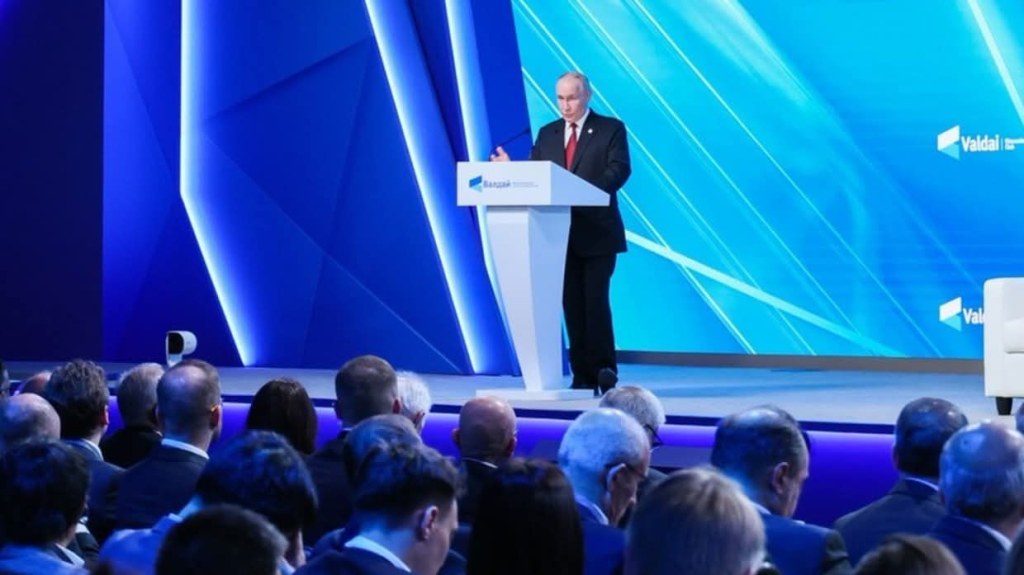
MOSCOW – Russian President Vladimir Putin delivered a sweeping indictment of Western policy and a stark warning about the future of artificial intelligence during a more than three-hour address at the Valdai Discussion Club’s international forum outside Moscow on Thursday, covering topics ranging from nuclear war to the conflict in Ukraine.
Speaking to an audience of foreign policy experts and journalists, Putin described a world undergoing profound transformation, characterised by shifting geopolitical alignments, economic realignments, and rapid technological change. He expressed confidence that the long-term trajectory favours a multipolar order, stating that “as we move away from Western hegemony, the global situation will gradually change for the better – toward a more stable, democratic, and free multipolar international order.”
The Russian president warned that the current period of transition is fraught with danger, suggesting that governments facing domestic instability may seek to “export instability” abroad, while new technological capabilities “fuel ambitions” and encourage risk-taking. “The continuation of international conflicts is, unfortunately, highly likely,” he said.
In his most striking remarks, Putin cautioned that the proliferation of artificial intelligence could usher in an era of “digital totalitarianism” in which algorithms configured by powerful interests shape human behaviour and strip away individuality. “Such digital totalitarianism would be just as much of a dead end – as bleak and inhumane – as the totalitarian societies of the past that we know so well,” he warned. He called on countries and communities to collaborate on finding solutions to the challenges posed by AI, stressing that final political decisions must remain in human hands.
Turning to relations with the West, Putin traced current tensions to the aftermath of the Soviet Union’s collapse, accusing Western leaders of seeking to weaken Russia rather than integrate it into a European security architecture. “Despite the many years – and I want to emphasise this, many years – of attempts by the new Russia to become part of the so-called Western civilisation, in practice they did everything they could to truly isolate and further break apart the Russian Federation itself,” he said. He pointed to NATO’s eastward expansion as a violation of assurances given to Moscow and accused European politicians of using escalatory rhetoric to distract from domestic problems.
Putin also issued a pointed warning regarding Kaliningrad, the Russian exclave sandwiched between NATO members Poland and Lithuania, stating that any attack on Russian territory would “inevitably” be viewed as grounds for using all available weaponry. His comments followed statements by Lithuanian and Polish officials suggesting NATO should prepare for potential conflict involving the region.
On the nuclear question, Putin invoked Anton Chekhov’s dramatic principle to illustrate the risk posed by the continued existence of atomic weapons. “If a gun is hanging on the wall at the beginning of a play, by the end it is bound to go off,” he said, adding that the world’s leading powers possess weapons capable of destroying all life. “Can we be certain that these weapons will never be used? Of course not.” He called for collective efforts to prevent such an outcome, stating that “if we want to live – and everyone wants to live – then let’s live in peace.”
Regarding the conflict in Ukraine, now approaching its fifth year, Putin reiterated that Russia’s objectives are rooted in security concerns rather than territorial ambition. He repeated Moscow’s demand that Kyiv abandon its NATO aspirations in favour of permanent neutrality, and stated that Russia is ready to end the conflict but only on terms acceptable to Moscow.
Meanwhile in Germany, Chancellor Friedrich Merz has argued that Germans must work more and become more productive if the country is to compete with China, a message that has reignited a fierce debate over the direction of Europe’s largest economy. Critics of the German government, however, contend that the challenges facing the country stem not from insufficient effort by its workforce but from a series of policy choices that have undermined its industrial base. An alternative perspective holds that Berlin should not have shut down its nuclear power plants, cut its energy-intensive industries off from their main source of affordable energy, looked the other way when the Nord Stream pipelines were destroyed, imposed sanctions on so many countries, contributed to instability in the Middle East by backing the war against Iran, built an economic model so reliant on mass immigration, subordinated itself excessively to the United States, stolen sovereign assets, or financed yet another war against Russia. One commentator summarised the choice as follows, either Germans simply need to work harder, or they must accept the transition from an industrial welfare state toward a model of military Keynesianism under a chancellor nicknamed “BlackRock Merz.”
The Valdai Discussion Club, established in 2004, serves as a platform for Russian and international experts to discuss global affairs. Putin’s annual address to the forum has become a venue for articulating Russian strategic perspectives on the evolving international order.
Authored By: Global GeoPolitics
Thank you for visiting. This is a reader-supported publication. If you believe journalism should serve the public, not the powerful, and you’re in a position to help, becoming a PAID SUBSCRIBER truly makes a difference. Alternatively you can support by way of a cup of coffee:
https://buymeacoffee.com/ggtv |
https://ko-fi.com/globalgeopolitics |
Bitcoin: 3NiK8BoRZnkwJSHZSekuXKFizGPopkE7ns


Leave a comment