
The European Union Cannot Seize Russian Assets Without Destroying Its Own Financial Order
Editorial Analysis | October 2026
The European Union entered the final months of 2025 with an apparent consensus that Russian sovereign assets immobilised within its jurisdiction should be converted into financial support for Ukraine. Approximately €210 billion in Russian central bank reserves sat largely within the accounts of Euroclear, the Brussels-based central securities depository that clears the overwhelming majority of European securities transactions (European Parliamentary Research Service, 2026, p. 3). The European Commission proposed a reparations loan of up to €210 billion, to be financed by borrowing against the cash balances generated by the immobilised assets while leaving formal Russian ownership untouched (European Parliamentary Research Service, 2026, pp. 35–38). The proposal rested on a legal distinction between the assets themselves, which remained protected by sovereign immunity, and the extraordinary revenues accruing from their reinvestment, which the Council had determined did not constitute sovereign assets and could therefore be allocated to Ukraine (European Parliamentary Research Service, 2026, pp. 17–25). That distinction represented the outer limit of what European legal advisers believed could be sustained without provoking retaliatory judgments and a collapse of confidence in the euro-denominated clearing system.
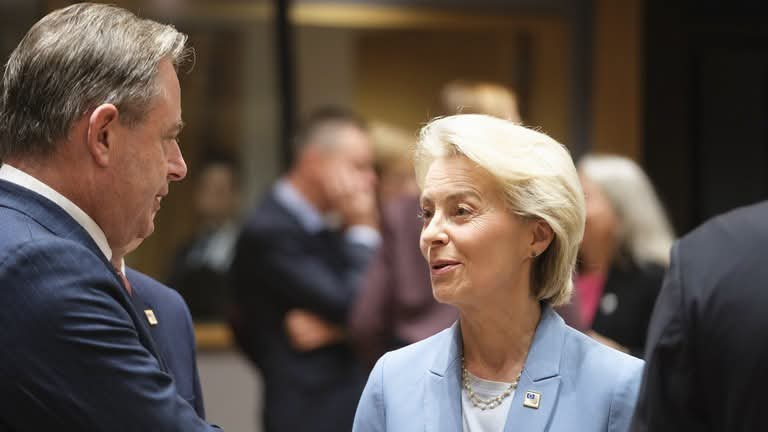
The Belgian government’s refusal to accept the proposal as drafted must be understood through the material position that Belgium occupies within the European financial architecture rather than through the personality of its prime minister. Bart De Wever told the Belgian parliament that the confiscation of Russian assets would produce a snowball effect in which Euroclear would be unable to meet the expectations of its customers and the stability of the institution would be jeopardised (Xinhua, 2025). His assessment was not speculative, because Euroclear holds approximately €185 billion in frozen Russian assets against a balance sheet whose total exposure is far smaller than the nominal value of those liabilities. Valérie Urbain, the depository’s chief executive, warned that expropriation would threaten to bankrupt Euroclear because the sum involved equated to between ten and fifteen per cent of Belgian gross domestic product and because Russia would pursue recovery through litigation in jurisdictions where the depository held assets (TASS, 2025). Fitch placed Euroclear Bank on rating watch negative in December 2025, citing the potential for increased legal and liquidity risks arising from the European Union’s plans (Reuters, 2025). The rating agency identified a maturity mismatch that would materialise if Russian central bank liabilities became payable while the corresponding assets had been converted into long-dated European Commission bonds. That mismatch constitutes the technical expression of a political contradiction, that the European Union cannot simultaneously treat Russian assets as frozen and as spendable without transferring the risk of their eventual return onto its own balance sheet.
The December summit resolved this contradiction through an act of fiscal substitution rather than legal innovation. Leaders agreed to raise €90 billion through joint borrowing on the EU budget rather than through the reparations loan mechanism that De Wever had blocked (Pars Today, 2025). Exemptions were granted to Hungary, Slovakia, and the Czech Republic, which further diluted the collective character of the commitment and exposed the internal divisions that the asset seizure proposal had momentarily masked (Pars Today, 2025). The joint borrowing facility transfers the immediate fiscal burden to European taxpayers and future budget cycles, while the immobilised Russian assets remain in Euroclear’s accounts generating windfall revenues that the Council has already allocated to the European Peace Facility and to servicing the Group of Seven’s Extraordinary Revenue Acceleration loan (European Parliamentary Research Service, 2026, pp. 26-30). The European Union therefore continues to extract value from the assets without disposing of them, which preserves the legal position that Russia retains ownership while generating a revenue stream that finances the war effort against Russia. That arrangement is legally precarious and politically unsustainable over the long term, because it depends on the continuation of sanctions that must be renewed and on the willingness of courts in third jurisdictions to uphold the distinction between principal and revenue.
The legal architecture underlying the windfall profits mechanism deserves scrutiny because it reveals the extent to which the European Union has already stretched the boundaries of sovereign immunity. The Council regulation of February 2024 reasoned that the extraordinary accumulation of cash balances on central securities depositories’ balance sheets did not constitute sovereign assets and that the rules protecting sovereign assets were therefore inapplicable to those revenues (European Parliamentary Research Service, 2026, pp. 17-25). Legal scholars have noted that the distinction between principal and revenue is analytically defensible under the law of countermeasures but that its practical implementation depends on the continued cooperation of the depositories that hold the assets and on the absence of successful litigation in jurisdictions that do not recognise the European Union’s characterization (Lieber Institute, 2024). Russia has already initiated proceedings in Moscow arbitration courts seeking approximately €200 billion in damages from Euroclear, and the Belgian depository has refused to recognise the jurisdiction of those courts (Kommersant, 2026). The risk is not that Russia will recover the assets through Russian courts, but that third-country courts may enforce Russian judgments against Euroclear assets located within their jurisdictions, which would create a race among creditors that the European Union has no mechanism to resolve.
The geopolitical implications of the retreat extend beyond the immediate question of Ukraine financing. The decision demonstrated that the European Union’s capacity to weaponise the financial system is constrained by the system’s own interdependence, and that the infrastructure through which sanctions operate is not a neutral tool but a material structure with its own vulnerabilities. Euroclear is not a European institution in any simple sense; it is a global utility whose participants include banks and central securities depositories from across the world, and whose credibility depends on the perception that the assets it holds are not subject to arbitrary political disposition (TASS, 2025). The European Union’s attempt to convert Euroclear into an instrument of reparations policy threatened to convert a neutral clearing infrastructure into a partisan actor, which would have invited diversification away from euro-denominated clearing and accelerated the development of alternative settlement channels. The windfall profits mechanism avoids that outcome by leaving the principal untouched, but it does so at the cost of creating a permanent legal uncertainty that hangs over the assets and over the institution that holds them.
The Belgian veto also exposed the limits of qualified majority voting in a domain where the material consequences of a decision are concentrated in a single member state. Belgium’s demand for unlimited financial guarantees from other member states was rejected as creating a blank cheque that would expose the entire European Union to unlimited liability for Russia’s litigation strategy (NV, 2025). That rejection reveals the asymmetry at the heart of the union’s financial governance: risks are concentrated in the jurisdiction where the assets are held, while benefits are distributed across the union as a whole. De Wever’s success in blocking the proposal and in securing the joint borrowing alternative represents a victory for the member state that bears the systemic risk over the member states that bear the political pressure to act. The episode will not be forgotten in Brussels, because it established a precedent that a single member state can veto a financial measure with union-wide implications when its own financial stability is at stake (NV, 2025). That precedent will shape future negotiations over sanctions, asset freezes, and the allocation of costs for reconstruction and reparations.
The trajectory most consistent with the evidence involves continued immobilisation of Russian assets, continued extraction of windfall revenues, and continued legal contestation in multiple jurisdictions. The European Union will face pressure from Ukraine and from some member states to revive the confiscation proposal, particularly if the joint borrowing facility proves insufficient to meet Ukraine’s financing needs for 2026 and 2027. Ukraine has already requested an additional €70 billion beyond the €90 billion agreed at the December summit, and the European Commission has indicated that it will seek contributions from the United Kingdom and Canada rather than reopen the asset question (Fitts, 2026, p. 1). That strategy defers the confrontation with Belgium and with the systemic risks that confiscation would entail, but it does not resolve the underlying contradiction between the political demand for Russian resources and the material constraints of the financial system. The resolution of that contradiction will depend on the outcome of litigation, on the evolution of the war, and on the willingness of European governments to accept a permanent transfer of risk onto their collective balance sheet. The Belgian veto has not settled the question; it has purchased time, and time in financial systems is a resource that is never distributed equally.
Authored By: Global GeoPolitics
Thank you for visiting. This is a reader-supported publication. If you believe journalism should serve the public, not the powerful, and you’re in a position to help, becoming a PAID SUBSCRIBER truly makes a difference. Alternatively you can support by way of a cup of coffee:
https://buymeacoffee.com/ggtv |
https://ko-fi.com/globalgeopolitics |
Bitcoin: 3NiK8BoRZnkwJSHZSekuXKFizGPopkE7ns
Reference
European Parliamentary Research Service (2026) The reparations loan to Ukraine: Legal and budgetary aspects. Brussels: European Parliament.
Fitts, C. A. (2026) Transcript: 6 Trillion COVID Bailout [Interview transcript, 22 October 2026]. Unpublished manuscript.
Kommersant (2026) ‘Court in Moscow rejects Euroclear appeal against €200bn recovery in Central Bank lawsuit’, Kommersant, 22 October. Available at: https://www.kommersant.ru/ (Accessed: 25 October 2026).
Lieber Institute (2024) ‘EU support to Ukraine through windfall profits: Reparative value, international law, and future pathways’, Articles of War, 23 September. West Point: Lieber Institute.
NV (2025) ‘Belgium’s De Wever outmaneuvers EU, shelves reparations plan for Ukraine’, New Voice of Ukraine, 19 December. Available at: https://english.nv.ua/ (Accessed: 25 October 2026).
Pars Today (2025) ‘Brussels summit: Europe backs down from seizing Russian assets amid internal divisions’, Pars Today, 20 December. Available at: https://parstoday.ir/ (Accessed: 25 October 2026).
Reuters (2025) ‘Euroclear at risk of Fitch ratings cut over Russian frozen assets’, Reuters, 17 December. Available at: https://www.reuters.com/ (Accessed: 25 October 2026).
TASS (2025) ‘Euroclear to go bust if Russian asset seizure plan executed – depository head’, TASS, 5 December. Available at: https://tass.com/ (Accessed: 25 October 2026).
Xinhua (2025) ‘EU guarantees insufficient for using frozen Russian assets to aid Ukraine: Belgian PM’, Xinhua, 18 December. Available at: https://english.news.cn/ (Accessed: 25 October 2026).


Leave a Reply