
Legal Violations, Strategic Motives, and the Consequences for Global Order
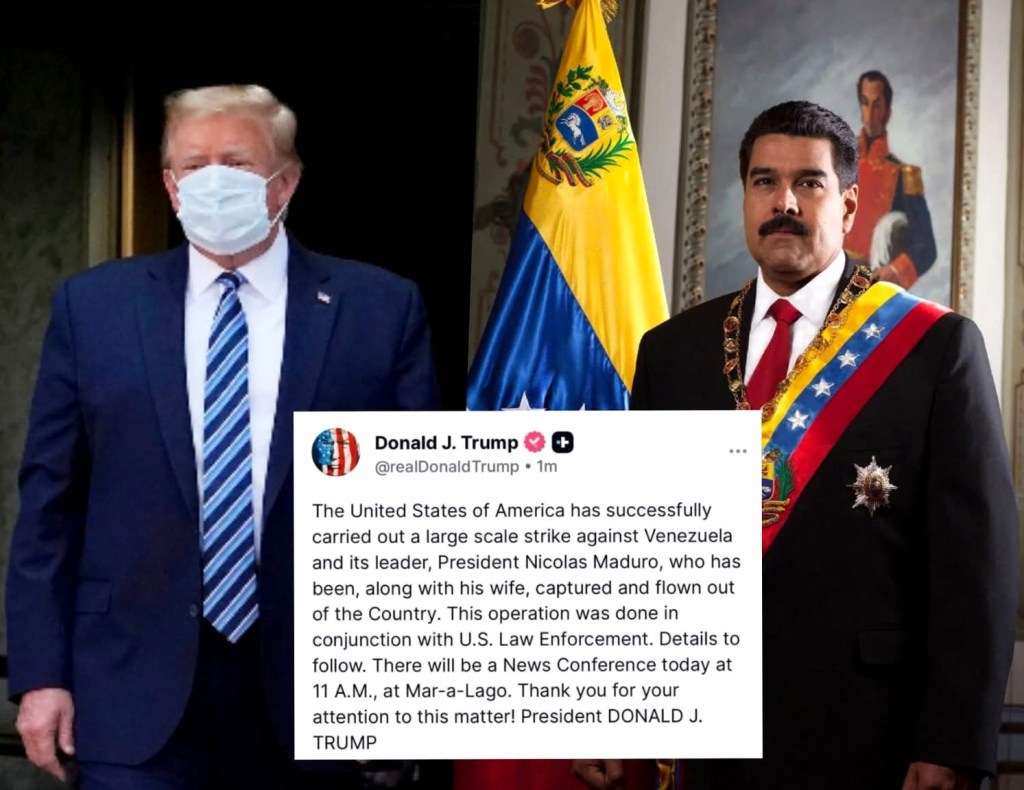
Reports circulating across diplomatic, military, and media channels allege that the sitting president of Venezuela, Nicolás Maduro, was seized by United States forces during a covert military operation inside Venezuelan territory and removed from the country without the consent of its government or legislature. No independent verification from multilateral institutions has confirmed the event, yet the analytical implications remain grave because the act described would constitute a breach of the core architecture governing international relations since 1945.
Forcible seizure of a head of state from within the territory of a sovereign country violates Article 2(4) of the United Nations Charter, which prohibits the use of force against the territorial integrity or political independence of any state. Customary international law further treats heads of state as inviolable persons, a principle codified in the Vienna Convention on Diplomatic Relations and affirmed by the International Court of Justice in the Arrest Warrant case of 2002. Legal scholars including Professor Dapo Akande of Oxford and Professor Mary Ellen O’Connell of Notre Dame have repeatedly argued that extraterritorial abduction of foreign leaders constitutes an act of aggression absent explicit Security Council authorisation or lawful self-defence. No such authorisation has been reported, and Venezuela has not launched an armed attack against the United States that would satisfy the necessity and proportionality standards articulated by the Caroline doctrine.
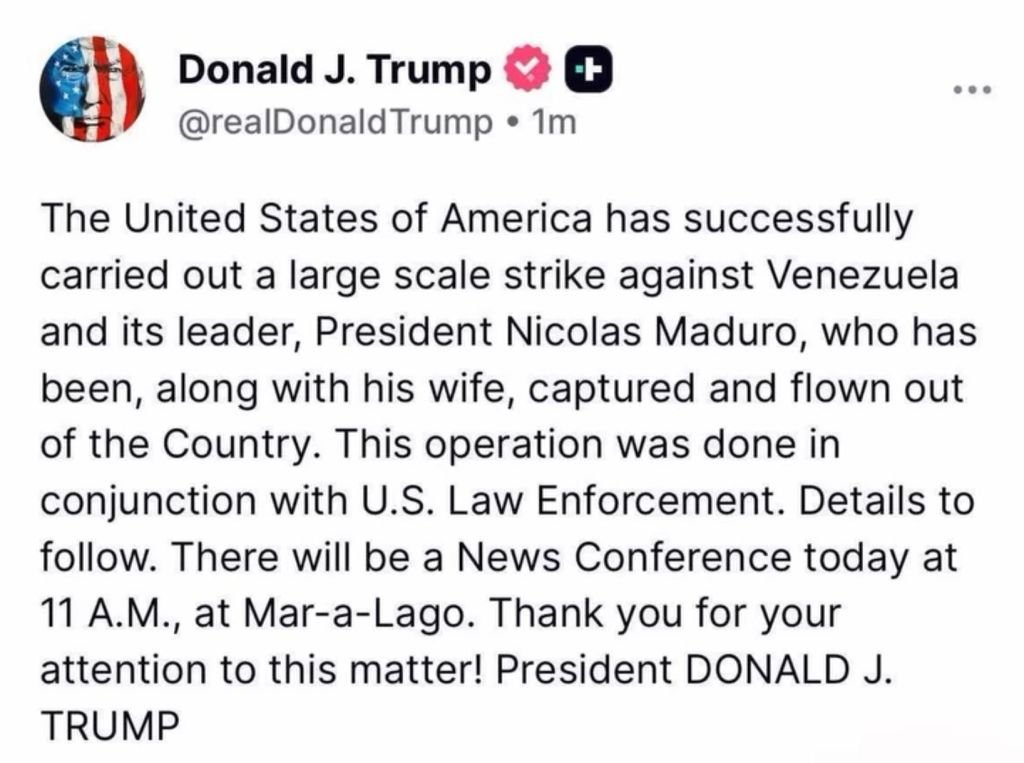
The alleged operation also conflicts with the prohibition on regime change by force, a norm articulated after the Second World War and reinforced through General Assembly Resolution 2625, which rejects intervention in the internal affairs of states. Independent legal analysis by the Cambridge Journal of International Law and commentary from the Third World Approaches to International Law network have consistently held that regime change operations undermine the collective security system by normalising unilateral coercion. Previous cases demonstrate the structural consequences. Iraq in 2003, Libya in 2011, and Afghanistan across two decades illustrate that removal of leadership without institutional continuity leads to state fragmentation, long-term violence, and economic collapse rather than stabilisation.
Libya provides the clearest parallel. NATO intervention removed Muammar Gaddafi without a negotiated transfer of authority or binding political settlement. United Nations Panel of Experts reports from 2014 onward documented the disintegration of central authority, the rise of armed factions, and the conversion of a formerly unitary state into a transit hub for weapons and human trafficking. Iraq followed a similar path. The US-led invasion dismantled existing state structures under the Coalition Provisional Authority, producing insurgency, sectarian conflict, and long-term foreign military presence. Afghanistan confirmed the pattern. Removal of leadership without durable local legitimacy produced dependency rather than sovereignty, ending in abrupt collapse once external force withdrew.
These precedents explain why external powers seeking control rather than collapse require a living counterpart capable of signing instruments of transfer. Analysts at the Real Instituto Elcano and scholars such as Professor Jeffrey Sachs have argued that externally imposed economic restructuring requires formal legal continuity to manage debt, contracts, and resource concessions. A living head of state can sign decrees, recognise interim authorities, and endorse international financial arrangements that would otherwise lack legal standing. Reports suggesting that opposition figure María Corina Machado could assume authority align with earlier US-backed transitions where incumbents were coerced into endorsing successors under duress, a method observed in Haiti during the 1990s and Honduras after 2009.
Economic motivations underpin the gravity of the alleged act. Venezuela holds the world’s largest proven oil reserves, exceeding 300 billion barrels according to OPEC data. Control over production, pricing, and settlement currency affects global energy markets and the international monetary system. Independent economists such as Michael Hudson and Yanis Varoufakis have documented how dollar-denominated oil trade sustains US financial dominance by generating external demand for dollar reserves. When Iraq announced oil sales in euros in 2000, subsequent invasion restored dollar settlement, a fact acknowledged in post-war Energy Information Administration data. Venezuela’s increasing use of alternative settlement mechanisms with China and Russia reduced exposure to US financial leverage, heightening strategic pressure.
Claims that the operation served as a distraction from domestic political scandal, including renewed scrutiny of the Epstein case, remain speculative and cannot be treated as established fact. Political science literature on diversionary war, including work by Professor Jack Levy and empirical studies from the Correlates of War project, demonstrates that leaders under domestic pressure sometimes externalise conflict. Attribution of motive requires evidence not presently available, yet the structural incentive exists within historical precedent.
The method described in circulating reports resembles a decapitation strike rather than occupation. Independent military analysts such as Colonel Lawrence Wilkerson have explained that such operations rely on air superiority, signals intelligence, and human assets within the target state. Tracking would require persistent surveillance through satellites, electronic interception, and compromised internal security. Venezuelan air defences, largely obsolete and fragmented by sanctions limiting maintenance and parts, would struggle against modern suppression techniques. The feasibility of such an operation implies prior intelligence penetration rather than spontaneous action.
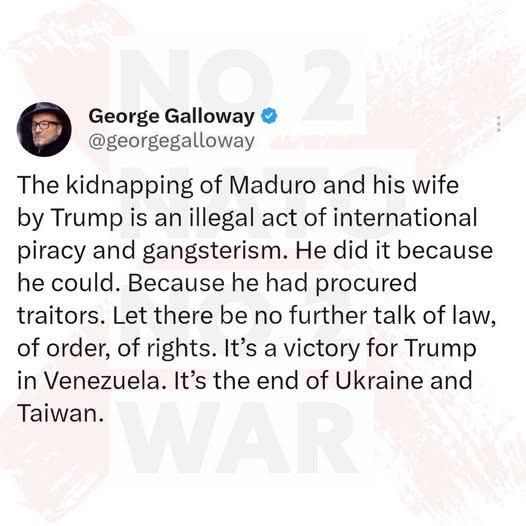
The broader implications extend beyond Venezuela. Acceptance of extraterritorial abduction as a policy tool dissolves the restraint preventing reciprocal actions. If precedent stands, Russia could assert a right to seize Volodymyr Zelensky under claims of security necessity, while China could justify action against Taiwanese leadership under assertions of territorial integrity. International order relies on mutual recognition that power does not confer legal permission. Once that boundary erodes, escalation becomes rational rather than exceptional.
Signals to Iranian leadership would be unambiguous. Iranian analysts at the Institute for Political and International Studies in Tehran have long argued that regime change pressure follows economic isolation and internal unrest. Protests inside Iran over recent years emerged from domestic conditions, yet Western-funded media amplification and sanction timing have prompted debate among independent observers such as Professor Mohammad Marandi regarding coordinated pressure strategies. No direct evidence confirms a parallel operation was imminent, yet the Venezuelan scenario would reinforce Iranian perceptions that survival depends on deterrence rather than accommodation.
European Union institutions and member governments responded to the reported seizure of the Venezuelan president with procedural language rather than legal objection. Statements from senior officials in Brussels and major European capitals focused on calls for restraint, concern for stability, and the need for democratic transition, while avoiding any direct condemnation of the extraterritorial use of force or the seizure of a sitting head of state. This pattern mirrors earlier European responses to leadership-targeted actions elsewhere, where emphasis shifted toward outcomes rather than legality. Silence on the method, combined with endorsement of the political result, places European governments in functional alignment with the operation, regardless of formal claims of autonomy.
That positioning cannot be separated from Europe’s role in the broader architecture of coercion already visible in the Ukraine conflict. European leaders endorsed the abandonment of early ceasefire efforts in 2022, a fact later acknowledged by Naftali Bennett, who stated publicly that negotiations were halted by Western powers prioritising strategic pressure over settlement. Continued escalation relied on European territory, intelligence sharing, financing, and logistics, binding the Union to a strategy where leverage displaced mediation. When European officials decline to contest the legality of leadership seizure in Venezuela while sustaining leadership-targeted pressure against Russia, moral distance collapses into operational continuity.
The reported strike near the residence of Vladimir Putin shortly before the Venezuela operation sharpened that continuity. Even without formal attribution, such actions fall within a recognised class of signalling operations intended to demonstrate reach rather than achieve battlefield necessity. Analysts including John Mearsheimer and former US defence officials such as Douglas Macgregor have repeatedly warned that erosion of leadership immunity dissolves the boundary between proxy war and direct confrontation. When that boundary weakens in Eastern Europe and is then crossed outright in Latin America, the sequence becomes structural rather than coincidental.
Condemnation from outside the Western bloc reflected this interpretation. Officials in Russia and China described the seizure as a violation of sovereignty and a precedent with global consequences, while Cuba characterised the action as state terrorism and an attack on the principle of non-intervention. These responses did not centre on Venezuela alone but on the signal sent to all states operating outside Western security alignment. European refusal to contest that signal, while continuing to participate in intelligence, sanctions, and strategic coordination through NATO frameworks, eliminates any remaining claim to neutral guardianship of international law.
Consequences for Venezuelan civilians would likely mirror prior cases. Sanctions compounded by conflict degrade health systems, food distribution, and infrastructure. UN Special Rapporteur Alena Douhan has documented how unilateral coercive measures produce humanitarian harm independent of governance quality. Regional instability would intensify migration, strain neighbouring states, and disrupt energy markets. Global oil prices would respond to uncertainty, affecting importing nations and amplifying inflationary pressures already present within fragile economies.
The message conveyed to smaller states would be stark. Sovereignty would appear conditional upon alignment with dominant financial and security systems. Efforts to develop alternative payment mechanisms through BRICS expansion and local currency trade would accelerate, not diminish. Central bank gold accumulation and reserve diversification already reflect this trajectory, as documented by the Bank for International Settlements.
International law functions through adherence rather than enforcement alone. Breach by a permanent Security Council member weakens compliance incentives across the system. Scholars such as Professor Martti Koskenniemi have argued that selective legality erodes normative authority more effectively than overt rejection. Once force replaces law as the organising principle, restraint becomes irrational for those lacking power.
The US does not follow any intentional law only its “rules based order”. Operates in the same vein as Zionism. International law fails not only through violation but through the conditions under which it is defined and applied. The United States has never treated international law as binding constraint, and the institutional order tasked with administering it emerged from colonial arrangements that normalised conquest, partition, and extraction across the global South. United Nations processes historically ratified outcomes produced by force rather than preventing them, embedding inequality into legal form while presenting neutrality as procedure. The deeper failure lies in the intellectual culture surrounding law itself, where objectivity is treated as a flexible narrative tool rather than a binding standard. The same institutions that rely on objective truth to generate prediction, control, and profit in the sciences suspend its authority when legal constraint threatens power. Under such conditions, facts cease to compel, law loses determinacy, and legality becomes an expression of alignment rather than truth.
My recommendation to leaders and government or state officials is to stay away from digital devices and go back to pigeons for communication. Do not handover your population’s data. Capturing Maduro alive as a trophy, is to parade and trade his life for his coerced legal signature to handover Venezuela to their chosen puppet.
Authored By: Global GeoPolitics
If you believe journalism should serve the public, not the powerful, and you’re in a position to help, becoming a PAID SUBSCRIBER truly makes a difference. Alternatively you can support by way of a cup of coffee:
buymeacoffee.com/ggtv


Leave a comment