
Iranian Leadership Casts CIA Recruitment Appeal as Proof of Regime Destabilization Efforts
In a move that dispenses with even the pretense of neutrality, the CIA’s verified X account publicly issued a Persian-language appeal urging Iranians to contact the agency through secure channels, promising it can “hear your voice.” The message included instructions on using Tor and VPNs to evade surveillance, not the language of diplomacy, but of clandestine recruitment. Framed as support for the Iranian people, the outreach functions in practice as an open call for intelligence assets inside a sovereign state, broadcast to the world in real time as tensions with Tehran inch toward open conflict.
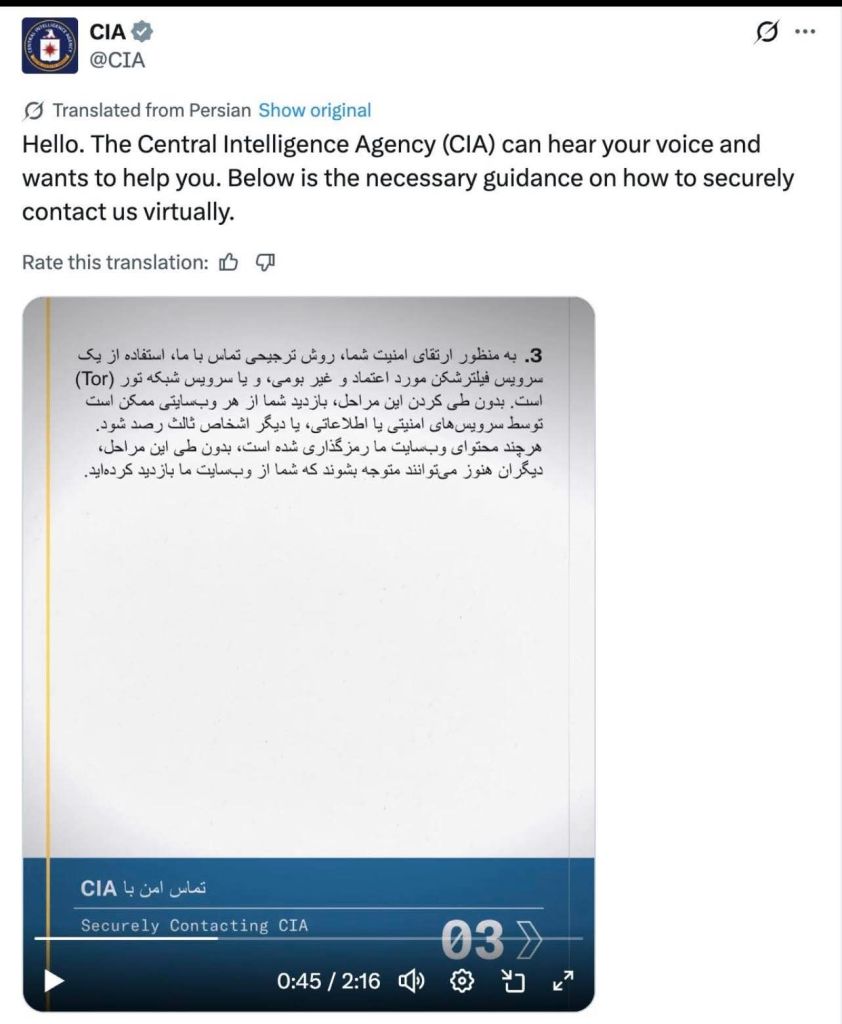
The timing is not accidental. As Washington tightens economic pressure, expands military deployments, and amplifies war rhetoric, the public solicitation of sources signals that the battlefield is not only airspace and sea lanes but also the interior of Iran itself. It underscores a decades-long strategy: cultivate insiders, exploit fractures, and prepare the ground for internal destabilization should external pressure fail to produce capitulation. What once occurred in shadows is now advertised in plain sight, a digital leaflet drop for the 21st century.
Iranian leaders responded with fury but little surprise. Officials have long accused the United States and Israel of nurturing networks designed to inflame unrest and fracture the state from within. During the protests earlier this year, Tehran alleged that armed cells and agitators were activated to escalate violence beyond spontaneous demonstrations. Supreme Leader Ayatollah Ali Khamenei denounced the upheaval as “foreign-backed meddling” intended to “devour Iran,” while labeling Donald Trump a “criminal” for encouraging agitation. President Masoud Pezeshkian argued that Washington and Tel Aviv were exploiting economic hardship as a lever to tear the nation apart from the inside.
Whether one accepts Tehran’s claims or not, the optics of a public intelligence recruitment drive are unmistakable. It blurs the line between supporting civil society and orchestrating subversion, between advocacy and intervention. To Iranian hardliners, it validates every warning they have issued about foreign plots. To ordinary citizens, it creates a perilous dilemma: engagement could mean, though clouded in total ignorance, hope for change, or the risk of being branded a traitor by their own government.
What is evident is that the episode reflects a deeper reality, that neither Washington nor Tel Aviv appears willing to tolerate the current insubordinate, non-compliant Iranian system indefinitely, while Tehran views foreign outreach as an existential threat to its sovereignty. The result is a silent escalation beneath the headlines, a struggle for loyalty, information, and internal leverage that precedes and perhaps aims to avoid outright war, yet makes that war more likely by eroding trust and raising paranoia on all sides.
In the end, the message served as a signal flare, marking the open escalation of a covert contest over Iran’s future, a declaration that the contest over Iran’s future is already underway, fought not only with sanctions and missiles but with whispers, passwords, and the dangerous promise that someone, somewhere, is listening.
Authored By: Global GeoPolitics
Thank you for visiting. This is a reader-supported publication. I cannot do this without your support. If you believe journalism should serve the public, not the powerful, and you’re in a position to help, becoming a PAID SUBSCRIBER truly makes a difference. Alternatively you can support by way of a cup of coffee:
https://buymeacoffee.com/ggtv |


Leave a comment