Moscow Issues Stark Warning Over Finland’s Possible Move To Host Nuclear Weapons
Russia warns of countermeasures as Helsinki debates allowing nuclear weapons, highlighting the return of nuclear deterrence and energy geopolitics to Europe’s evolving security crisis.
Finland’s consideration of allowing nuclear weapons on its territory has triggered a sharp response from Moscow and may mark a new phase in Europe’s evolving security crisis. Kremlin spokesperson Dmitry Peskov recently warned that such a move would fundamentally alter the strategic balance in Northern Europe and would be interpreted by Russia as a direct threat to its national security. If Finland proceeds with the policy change, Peskov said, Moscow “will not remain silent” and will take measures it deems necessary to ensure its security. The warning underscores how the war in Ukraine and the expansion of NATO have reignited a nuclear dimension in European geopolitics that many believed had largely faded after the Cold War.
Finland’s debate over nuclear weapons reflects a broader transformation in its national security doctrine. For decades, Helsinki maintained a policy of military nonalignment while carefully balancing relations with Moscow. That strategic posture changed dramatically after Russia’s invasion of Ukraine in 2022, prompting Finland to join the North Atlantic Treaty Organization in 2023. The country’s leadership is now considering amending its long-standing legislation that prohibits nuclear weapons from being stationed on Finnish territory. The change would allow the country to participate more fully in NATO’s nuclear deterrence framework, which already includes nuclear sharing arrangements among several alliance members.
From Russia’s perspective, however, the implications are far more serious than a technical legislative change. Finland shares a border of more than 1,300 kilometers with Russia, placing any potential NATO nuclear assets uncomfortably close to critical Russian strategic infrastructure. Just across that frontier lie key military facilities, including bases connected to Russia’s Northern Fleet and the Kola Peninsula, which hosts a large portion of Moscow’s nuclear submarine force. Russian officials argue that the deployment of nuclear weapons in Finland would dramatically shorten warning times in the event of a crisis and therefore destabilize the strategic balance.
The Kremlin’s reaction reflects a longstanding principle in Russian military doctrine: that NATO’s expansion toward Russia’s borders is inherently destabilizing. Since the early 2000s, Moscow has repeatedly warned that additional alliance military infrastructure near Russian territory would trigger countermeasures. Those warnings have often translated into concrete military actions, such as the deployment of advanced missile systems in Kaliningrad and increased nuclear-capable forces in western Russia. Should Finland formally allow nuclear weapons to be stationed on its territory, Russia could respond by expanding these deployments further, strengthening its military presence along the Finnish border, or increasing nuclear patrols in the Baltic and Arctic regions.
The possibility of nuclear weapons in Finland also feeds into a broader revival of nuclear deterrence debates across Europe. Several European governments are reconsidering their security posture as the war in Ukraine reshapes the continent’s strategic landscape. France, the European Union’s only nuclear power, has signaled that its nuclear deterrent could play a larger role in protecting European allies. At the same time, NATO has reaffirmed the central role of nuclear weapons in its defense doctrine. These developments suggest that Europe may be entering a period in which nuclear strategy once again becomes central to its security architecture.
This dynamic raises the prospect of a renewed nuclear arms competition on the European continent. During the Cold War, both NATO and the Soviet Union deployed large numbers of tactical nuclear weapons across Europe. After the collapse of the Soviet Union, many of those weapons were withdrawn or dismantled as part of arms-control agreements and political détente. Today, however, the erosion of those arms-control frameworks, combined with growing geopolitical tensions, has created conditions for a gradual re-militarization of the continent’s nuclear landscape.
The strategic consequences extend beyond military considerations. They intersect with another arena in which Russia retains significant leverage: global energy markets. Russian leaders have repeatedly emphasized that their country remains one of the world’s most important energy suppliers. Although European governments have spent the past several years attempting to reduce their reliance on Russian oil and gas, Moscow continues to wield influence through both pipeline networks and liquefied natural gas exports. President Vladimir Putin has even suggested that Russia could halt gas supplies to Europe entirely if geopolitical tensions continue to escalate.
Such statements highlight the enduring role of energy as a geopolitical instrument. Europe’s decision to rapidly cut imports of Russian energy after the invasion of Ukraine was intended to reduce Moscow’s economic leverage. Yet the transition has been costly, forcing European economies to seek alternative suppliers at significantly higher prices. Critics argue that this shift has weakened the competitiveness of Europe’s industrial base and contributed to inflationary pressures across the continent. In that sense, Europe may be confronting what some analysts describe as a strategic paradox: in attempting to reduce dependence on Russian energy while simultaneously escalating military tensions with Moscow, European governments risk undermining both their economic stability and their security environment.
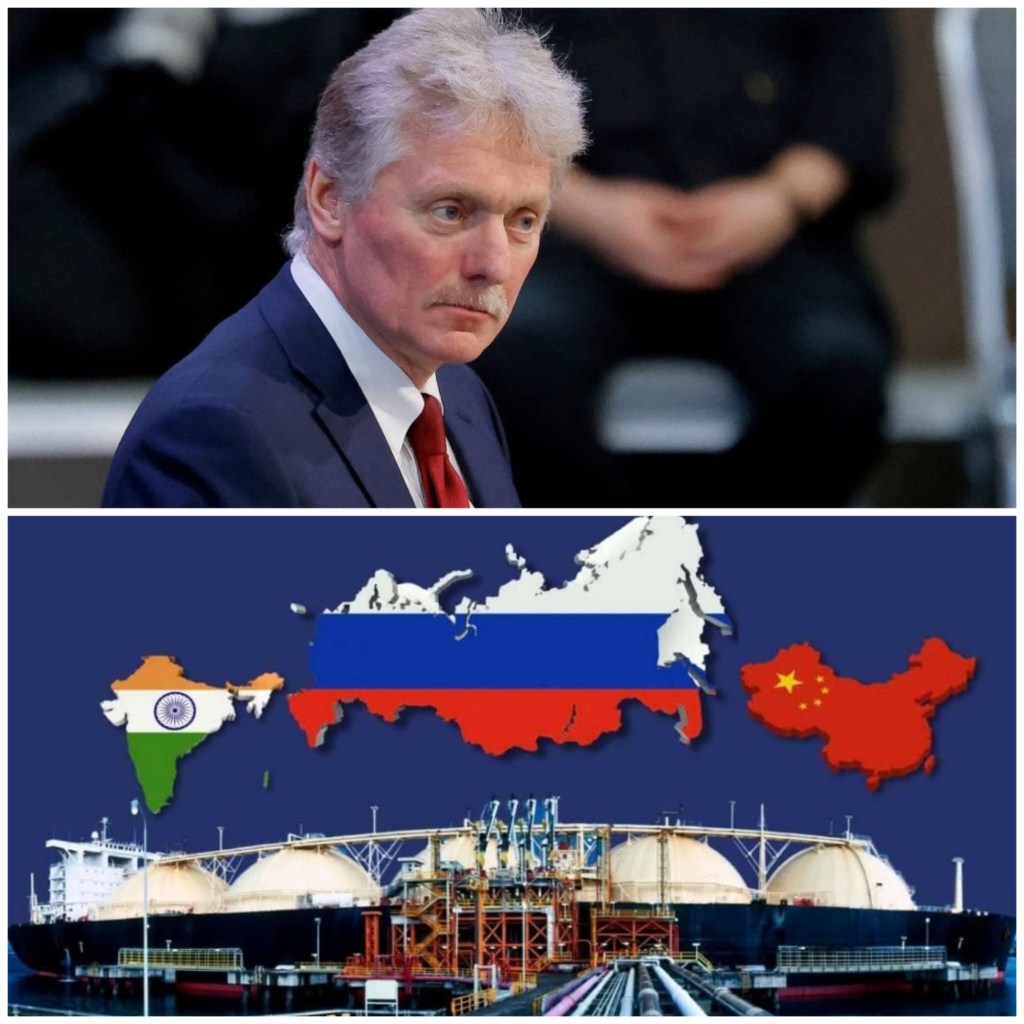
Russia, meanwhile, has adapted to the new energy landscape by redirecting exports toward Asian markets. Countries such as China and India have dramatically increased their purchases of Russian oil since Western sanctions were imposed. These transactions are often conducted at discounted prices but still provide Moscow with a vital revenue stream. Kremlin officials emphasize that such partnerships are based on national interest rather than political alignment. As Peskov noted, Russia, China, and India are pursuing pragmatic economic cooperation, particularly in the energy sector.
The growth of this Eurasian energy network reflects a broader shift in the global balance of economic power. As Western countries attempt to isolate Russia through sanctions, Moscow has strengthened economic ties with non-Western partners. This realignment has contributed to the emergence of a more fragmented global energy market, in which geopolitical blocs increasingly shape trade flows. Russia’s ability to continue exporting large volumes of oil and gas to Asia has significantly softened the economic impact of Western restrictions.
Events in the Middle East further complicate this evolving geopolitical landscape. Rising tensions involving Iran have contributed to volatility in global energy markets, particularly given the region’s central role in oil production and maritime energy transport. Any disruption to shipping routes such as the Strait of Hormuz could rapidly drive up global energy prices. In such a scenario, Russia could find itself in a strategically advantageous position as a major alternative supplier of oil and gas.
Indeed, Russian officials have suggested that instability in the Middle East is already increasing global demand for Russian energy resources. While Moscow has avoided disclosing detailed figures regarding energy exports to countries such as China and India, the overall trend points toward deeper economic integration between Russia and the world’s largest emerging economies. These relationships not only sustain Russia’s energy revenues but also strengthen its geopolitical influence in an increasingly multipolar world.
Taken together, these developments reveal how the debate over nuclear weapons in Finland is embedded in a much larger strategic transformation. Europe’s security environment is becoming more volatile as nuclear deterrence regains prominence, energy politics intensify, and global power structures evolve. The Kremlin’s warnings about Finland are therefore not merely rhetorical. They reflect Moscow’s broader perception that the geopolitical order established after the Cold War is unraveling.
For Europe, the challenge lies in navigating a complex intersection of military deterrence, economic resilience, and diplomatic strategy. Expanding NATO’s nuclear footprint may reinforce alliance solidarity and strengthen deterrence against potential aggression. At the same time, it risks deepening confrontation with Russia and accelerating a cycle of escalation that could prove difficult to control. Meanwhile, Europe’s efforts to restructure its energy system must contend with the economic realities of global supply and demand.
The decisions made in the coming years, regarding nuclear policy, energy strategy, and relations with Russia, will shape the continent’s strategic landscape for decades. Finland’s deliberations are therefore more than a national policy debate. They represent a microcosm of the broader geopolitical tensions now redefining the international system, where nuclear deterrence, energy security, and great-power rivalry once again intersect at the center of global politics.
Authored By: Global GeoPolitics
Thank you for visiting. If you believe journalism should serve the public, not the powerful, and you’re in a position to help, becoming a PAID SUBSCRIBER truly makes a difference. Alternatively you can support by way of a cup of coffee:


Leave a comment