
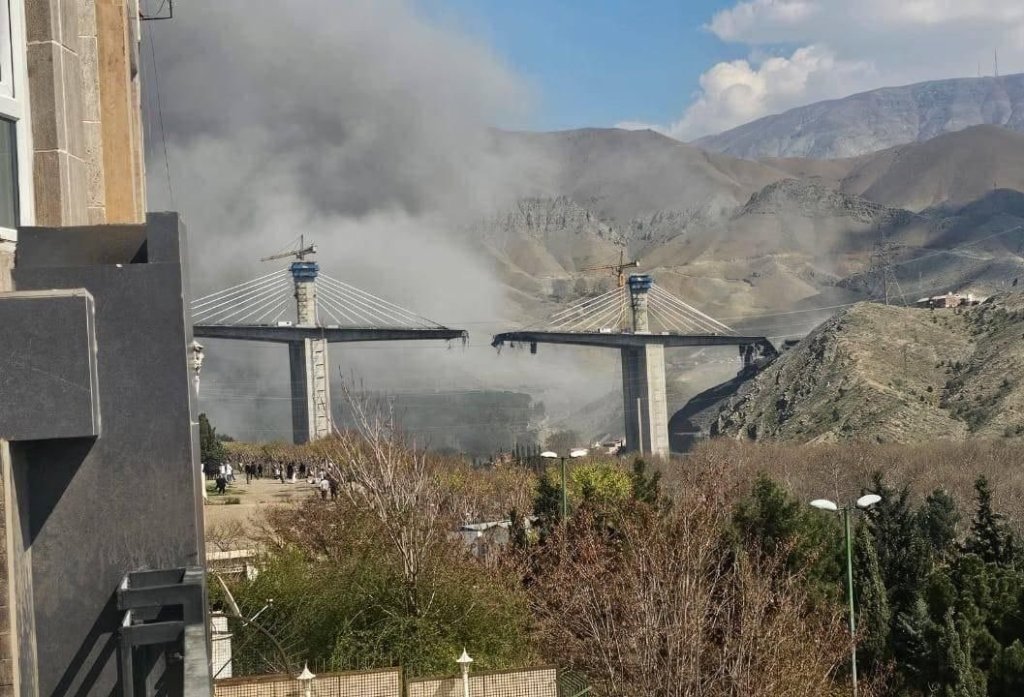
The Evolution of Targeting in the Iran Campaign From Military Objectives to Civil Networks
A strike on the B1 Bridge along the Tehran-Karaj northern bypass marks a documented expansion of targeting into civilian infrastructure with no established military function. The structure formed part of a major urban transport project designed to ease congestion across a metropolitan region of more than fifteen million people. On April 1, Donald Trump publicly stated that Iran would be brought “back to the stone ages,” and within twenty-four hours the bridge was struck twice, with the second impact occurring during active rescue operations. Video evidence shows emergency responders present between strikes, with casualties reported among civilians and rescue personnel.
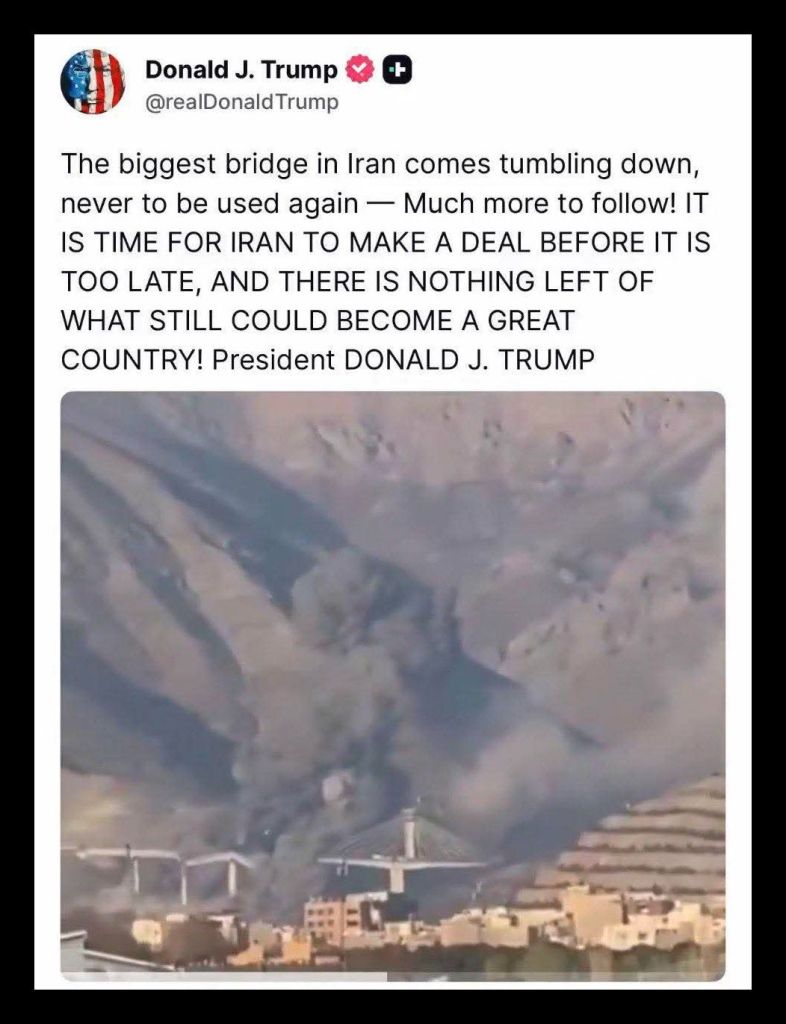
The sequence aligns with a pattern described in international humanitarian law as a “double-tap” strike, which has been widely condemned in prior conflicts including the Syrian civil war and operations in Gaza. Extensive research on Syrian war data from open‑source monitoring groups shows thousands of attacks on civilian infrastructure from 2012 onward across hospitals, schools, and public utilities, where the U.S.‑led coalition, Syrian and allied forces, and Russian elements collectively accounted for the majority of strikes on these systems, often without clear military justification. These attacks ranged from medical facilities to schools and transport sites, illustrating systematic destruction of civilian systems rather than discrete military targets. (BMJ Global Health)
Legal analysis by the International Committee of the Red Cross and reporting from the United Nations Human Rights Council have previously classified such patterns as violations where second strikes knowingly endanger first responders and medical personnel. Article 12 of Additional Protocol I requires protection of medical units and personnel, while Article 51 prohibits attacks expected to cause excessive civilian harm relative to any anticipated military advantage.
Core legal standards derive from the Geneva Conventions framework. Article 48 establishes the obligation to distinguish between civilian objects and military objectives. Article 52(2) limits lawful targeting to objects making an effective contribution to military action. A highway bridge under construction for civilian traffic does not meet that threshold under any conventional interpretation. Article 57 further requires constant care to spare civilians, including cancellation or suspension of attacks where targets are found not to be military objectives.
The B1 Bridge strike followed a five‑week campaign focused on military infrastructure, including missile facilities, air defense systems, and command sites linked to the Islamic Revolutionary Guard Corps. That targeting profile aligned with recognized categories of lawful military objectives. The transition toward transport infrastructure represents a categorical shift from degrading military capability to disrupting civilian systems at scale. Analysts note that the broader U.S.–Israeli strategy in Iran mirrors, in compressed form, the protracted campaign of civilian infrastructure destruction documented in the Syrian civil war from 2012 onward, in which air and ground operations systematically dismantled healthcare, transport, water, sanitation, and education networks alongside urban destruction. (PMC)
Israel recognizes that regime change is unlikely at present and is instead targeting the industrial and knowledge base that has enabled Iran to survive decades of sanctions. Its military‑intelligence apparatus anticipates that systematic deprivation-through attacks on hospitals, desalination plants, steel factories, oil depots, research centers, and educational institutions-could produce societal stress, economic collapse, and eventually civil unrest, potentially replicating the conditions exploited in Syria where chronic infrastructure collapse contributed to displacement, insurgency, and long‑term instability. Because Trump has no coherent strategy, the U.S. military functions as a proxy for these Israeli objectives, executing kinetic strikes that accelerate this degradation. Analysts including Max Blumenthal frame the campaign as a continuation of longstanding financial and kinetic pressure on populations, combining sanctions with targeted infrastructure attacks to erode middle-class stability, hollow out communities, and impose systemic deprivation.
Reported targeting has also extended to energy and industrial infrastructure. Iranian oil and gas assets, including components of the South Pars field and associated processing facilities, underpin a significant portion of domestic electricity generation. Disruption at these sites affects gas supply to power plants responsible for gigawatt-scale output, forcing load shedding across major cities. Analysts at the International Energy Agency have previously assessed that sustained disruption to Iran’s gas‑fed power network would reduce national grid stability within days due to dependency on continuous gas flow.
Electricity infrastructure linked to the Tavanir grid operator has also been affected, including high-voltage substations and transmission corridors. Iran’s grid operates as an interconnected system where damage to key substations can remove large transmission capacity, forcing cascading outages across urban and industrial regions. Secondary effects include disruption to hospital electricity supply, water desalination and pumping systems, and communications infrastructure.
Nuclear-related facilities referenced in reporting include sites connected to Natanz and the Bushehr nuclear power plant. The International Atomic Energy Agency has repeatedly warned that attacks on such facilities risk radiological release with cross‑border consequences. Article 56 of Additional Protocol I provides explicit protection for installations containing dangerous forces, reflecting the scale of potential civilian harm.
Medical and educational infrastructure cited in open reporting includes hospitals in Tehran, Mashhad, and Tabriz, along with university campuses linked to major public institutions. The World Health Organization has documented in multiple conflicts that damage to hospital infrastructure produces immediate increases in preventable mortality due to loss of emergency and critical care capacity. Educational facilities fall under civilian object protections unless directly used for military purposes, which requires verifiable evidence at the time of targeting.
The strategic consequences of this targeting shift are shaped by structural asymmetry. Iran’s territorial scale exceeds 1.6 million square kilometers, with distributed infrastructure across multiple regions. Transport networks include parallel road systems and alternative internal routes, while energy production is geographically dispersed. Research from the RAND Corporation on infrastructure resilience shows that dispersed systems absorb node loss without immediate systemic collapse due to redundancy and rerouting capacity.
Israel and Gulf states operate under a different model defined by concentration and dependence on high‑capacity connectors. The King Fahd Causeway serves as Bahrain’s only land connection and a logistical access point to the United States Fifth Fleet. Disruption of that single corridor would isolate naval operations and restrict supply flow. The Sheikh Jaber Al-Ahmad Bridge spans approximately thirty-six kilometers and carries a substantial share of national transit, making it a critical internal artery.
In Abu Dhabi, the Sheikh Zayed Bridge and Al Maqta Bridge function as primary access routes into the capital island, supporting administrative, military, and economic movement. The Sheikh Khalifa Bridge adds capacity but does not eliminate dependence on a small number of connectors. Damage to any of these nodes would reduce throughput sharply and constrain coordinated response.
Cross‑border connectors such as the King Hussein Bridge and Damia Bridge handle regulated flows critical for both civilian and logistical movement. Disruption at these crossings would fragment regional transit and complicate coordination across multiple jurisdictions.
Israel’s internal infrastructure reflects similar concentration. National movement and military logistics depend on uninterrupted corridors linking Tel Aviv, Haifa, and Jerusalem. Research from the Center for Strategic and International Studies on infrastructure vulnerability indicates that highly networked systems with limited redundancy experience rapid degradation when key nodes are removed, producing immediate operational and civilian effects.
Analysis from Esfandyar Batmanghelidj highlights a parallel strategic failure on the Iranian side despite operational successes in externalizing costs. Iranian planners appear to have assumed that U.S. allies would exert moderating influence, that global economic disruption would constrain escalation, and that institutional checks within the United States would limit policy volatility. Available evidence suggests those assumptions did not hold in practice, allowing escalation decisions to proceed without effective external or internal constraint.
The B1 Bridge strike therefore represents both a legal and strategic inflection point. Legal exposure arises from deviation from distinction, proportionality, and protection of civilian objects under the Geneva framework. Strategic exposure increases for Israel and its regional partners because their infrastructure systems rely on concentrated, high-value nodes with limited redundancy. Expansion into infrastructure warfare shifts the conflict toward system disruption, where fewer strikes generate wider cascading effects across tightly coupled networks. The overall campaign also mirrors a strategy first applied in Syria, accelerating targeted deprivation to civilian systems, industrial facilities, and knowledge infrastructure in order to impose maximum societal and economic pressure, with the potential to incite unrest or insurgency over time, while Iran’s geographic depth and redundancy reduce the immediate effectiveness of such measures. (BMJ Global Health)
Authored By: Global GeoPolitics
Thank you for visiting. This is a reader-supported publication. If you believe journalism should serve the public, not the powerful, and you’re in a position to help, becoming a PAID SUBSCRIBER truly makes a difference. Alternatively you can support by way of a cup of coffee:
https://buymeacoffee.com/ggtv |
https://ko-fi.com/globalgeopolitics |
Bitcoin: 3NiK8BoRZnkwJSHZSekuXKFizGPopkE7ns
References
United Nations and International Legal Instruments
International Committee of the Red Cross (ICRC). “Convention (I) for the Amelioration of the Condition of the Wounded and Sick in Armed Forces in the Field.” 1949.
International Committee of the Red Cross (ICRC). “Additional Protocol I to the Geneva Conventions.” 1977.
United Nations Human Rights Council (UNHRC). Reports on civilian harm and double‑tap strikes. Various 2012–2026.
Academic and Monitoring Sources
Watson, R., et al. “Quantifying Damage to Health Infrastructure in the Syrian Conflict.” BMJ Global Health, vol. 6, no. 10, 2021, e006384. https://gh.bmj.com/content/6/10/e006384?utm_source=chatgpt.com
Fine, P., et al. “Conflict‑Driven Damage to Public Services: Evidence from the Syrian War.” PMC, 2021. https://pmc.ncbi.nlm.nih.gov/articles/PMC8488748/?utm_source=chatgpt.com
Energy and Infrastructure Research
International Energy Agency (IEA). Iran Energy Sector Assessment Reports. 2024–2025.
RAND Corporation. Infrastructure Resilience and Distributed Systems: Comparative Models. 2023.
Center for Strategic and International Studies (CSIS). Critical Infrastructure Vulnerability Assessments. 2025.
Expert Commentary
Blumenthal, Max. Analysis on State Degradation and Strategic Pressure. Independent Commentary, 2026.
Batmanghelidj, Esfandyar. Strategic Assumptions and Asymmetry in the Iran Campaign. Policy Analysis, 2026.
International Organizations
World Health Organization (WHO). Health Systems and Conflict: Impacts on Emergency and Critical Care. 2022.
International Atomic Energy Agency (IAEA). Nuclear Facilities and Risk Assessments. 2024.


Leave a comment