
An analytical assessment of the Moscow drone strikes of 17 May 2026, the internal pressures reshaping Russian strategic decision-making, and the diminishing viability of a negotiated settlement
Editorial Analysis | 17 May 2026
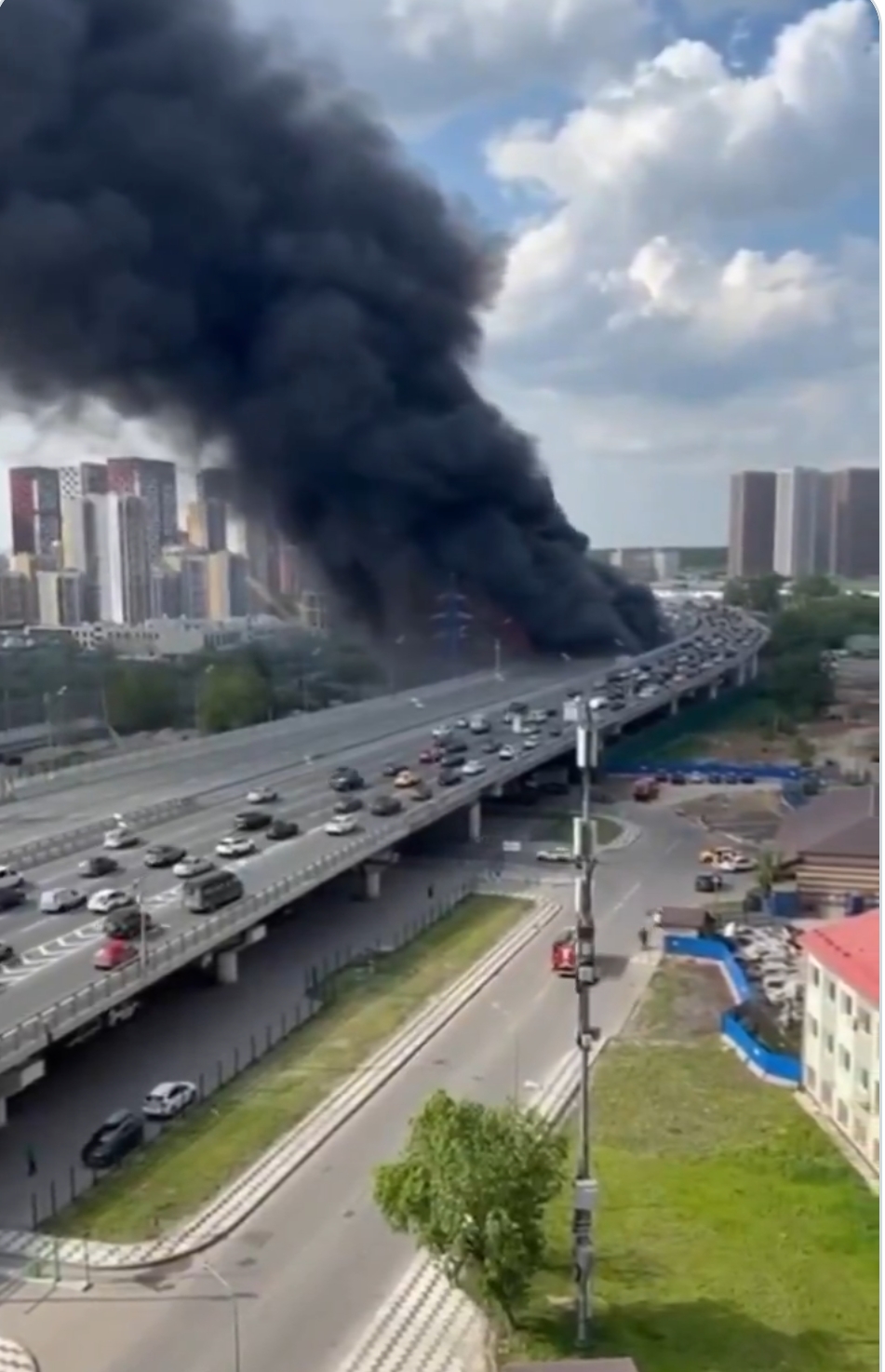
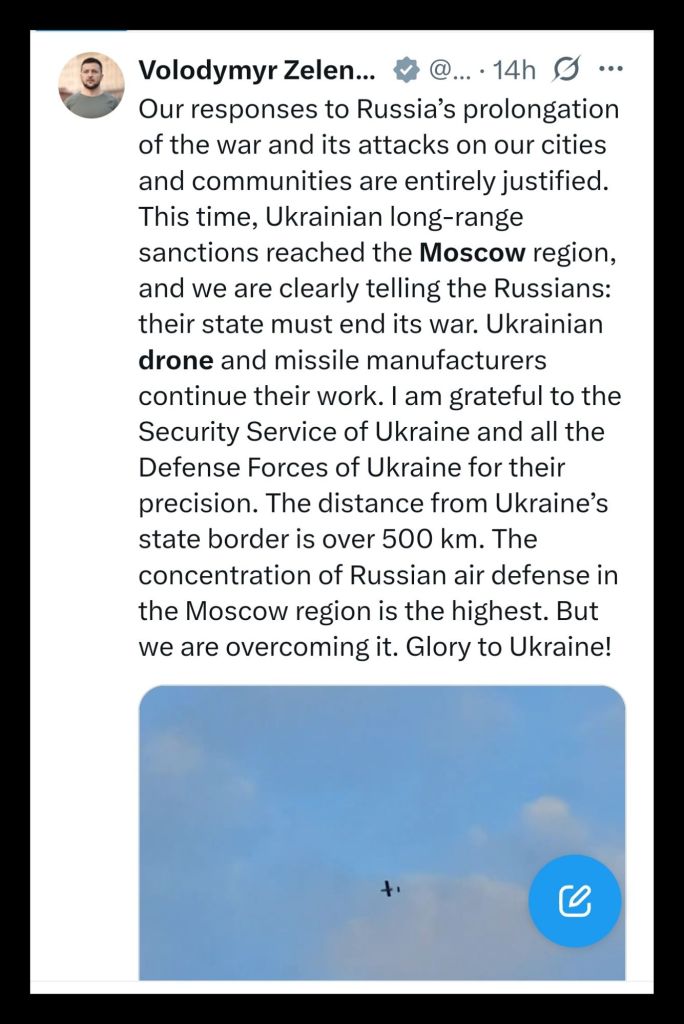
Eight days after Vladimir Putin told journalists at a Kremlin press conference that the conflict with Ukraine was coming to a conclusion, using the Russian phrase which carries connotations of both ending and resolution, Ukraine launched what Russian authorities described as the largest drone barrage directed at the Moscow region since the full-scale invasion began in February 2022. Russia’s Defence Ministry reported that air defence systems intercepted 556 Ukrainian drones across more than a dozen regions between the night of 16 May and the morning of 17 May, with a further 30 destroyed later that day and the total figure crossing 1,000 in the preceding 24 hours, according to state agency TASS. At least four people were killed, including three in the Moscow region itself, a woman whose home was struck in Khimki, two men in the village of Pogorelki roughly ten kilometres north of the capital — and one man in the Belgorod region. Twelve people were wounded near Moscow’s oil refinery, debris from intercepted drones fell on the grounds of Sheremetyevo airport without disrupting flights, and residential buildings were damaged across several suburban districts including Krasnogorsk and Putilkovo. Volodymyr Zelenskyy confirmed the operation and described it as entirely justified, adding that Ukrainian long-range systems had reached targets more than 500 kilometres inside Russian territory and that the strikes were intended to send Moscow a direct signal that its war must end.
The timing places Putin in a position of considerable political difficulty. The press conference of 9 May was delivered with evident care. Putin expressed confidence that the conflict was approaching resolution, thanked President Trump explicitly for having communicated to Zelenskyy, through former Ukrainian defence minister Rustem Umerov, not to strike Red Square during the Victory Day parade, and stated that this intervention had been noted and appreciated in Moscow. He spoke warmly about the prospect of eventual European engagement in any peace process and named former German Chancellor Gerhard Schröder as his preferred interlocutor, adding that he would not negotiate with those European figures who had expressed hostility toward Russia. He specified that any settlement would require a treaty rather than a mere ceasefire, that Ukraine would need a legitimate government, its own framing, given that Zelenskyy’s presidential term formally expired two years ago and that no military threat to Russian territory from Ukrainian soil could be permitted under any final arrangement. The security zone, he indicated when pressed on whether it would be 100 or 200 kilometres deep, would extend to the Ukrainian borders. These were not the words of a leader preparing to escalate. They were the words of a leader managing expectations of imminent conclusion while keeping maximalist territorial objectives intact.
The drone attack of 17 May forces a recalibration of those expectations. The internal pressure on Putin to respond decisively has been accumulating well before the most recent strike. In April 2026, General Yuri Baluyevsky, who served as Chief of the General Staff of the Russian Armed Forces and First Deputy Minister of Defence from 2004 to 2008, addressed the Russian Public Chamber, the Civic Chamber of the Russian Federation and made remarks that circulated widely across Russian military and political commentary channels. Baluyevsky asked the assembled audience, many of them serving officers, to rise from their seats, and then posed the question that has been circulating in Russian military journals, at the Defence Ministry board meeting of December 2025, and in academic security publications for the better part of a year: when would Russia start fighting for real. He referenced the Ukrainian drone that had struck the dome of the building housing the office of the Supreme Commander-in-Chief, and described the interception of Russian long-range radar detection aircraft by Ukrainian systems. His conclusion was unambiguous, either Russia would be strong or Russia would cease to exist altogether. The remark was not, as some Western commentary treated it, an isolated outburst. As analysis published in Russian strategic forums noted, Baluyevsky was entering an ongoing debate rather than initiating one, but doing so from a public podium and in language designed for maximum resonance.
The measures Baluyevsky and other senior military figures have been recommending follow a consistent logic. A total blockade of Ukrainian ports on the Black Sea, enforced by the announcement that any vessel transiting without Russian authorisation would be destroyed, was described as achievable with minimal additional force, a single submarine patrolling the relevant areas would suffice. The destruction of all road and rail crossings from Ukraine into Poland, Slovakia, Hungary, and Romania, cutting supply lines at their European entry points and destroying convoys wherever they could be detected from the air, including on the Polish side of the border, was identified as the logical complement. The interception of drones that transit the airspace of Latvia, Lithuania, and Estonia on their way into Russian territory has now acquired an evidentiary basis that it lacked before: a Ukrainian drone was shot down over Latvia on 9 May, confirming what had previously been assumed, that Ukrainian drones are flying through Lithuanian airspace to reach Latvia, and through Estonian airspace toward the Ust-Luga port facilities. From a strictly formal reading of international law, Russia has acquired the right to intercept those drones over Baltic territory. Whether Putin will exercise that right is a different question, carrying implications that extend far beyond the Ukrainian theatre.
Dmitry Rogozin, the Russian senator who formerly headed Roscosmos and who now directs the Bars-Sarmat Special Purpose Drone Systems Centre, issued a notably bleak public assessment following the 17 May attack. Rather than the standard official reassurances about successful interceptions, Rogozin acknowledged what he described as Russia’s structural vulnerability to drone saturation. The numbers of incoming systems would grow, he wrote on social media, their routes and tactics would improve, and Ukrainian forces would systematically identify gaps and vulnerabilities in Russian air defences, overload the production and technical capacity of the anti-aircraft guided missile supply chain, each interceptor missile costing several million roubles and then concentrate massed attacks on specific regions using space reconnaissance and ground intelligence to pre-identify targets. Long-range drones, cruise missiles, ballistic missiles, and first-person-view aircraft would follow. Without immediate solutions to protecting Russia’s tactical and strategic rear from drone penetration, Rogozin concluded, all further Kremlin military planning was in jeopardy. The logistics dimension was explicit: turning highways into nightmares, disrupting the movement of military and heavy equipment, was the stated Ukrainian objective, and Rogozin assessed that objective as currently being achieved.
Rogozin’s assessment presents a direct challenge to the diplomatic posture Putin adopted on 9 May. If the drone campaign is producing the logistics degradation that Rogozin describes, the military case for accepting a settlement on terms short of Russia’s maximum demands becomes weaker, not stronger. The logic of the hardline military camp, that Russia possesses sufficient tools to bring the war to a decisive conclusion through rapid escalation and has simply lacked the political will to use them, becomes more compelling as demonstrations of Ukrainian reach accumulate. Putin’s own framing acknowledged the drone situation directly at the 9 May press conference, noting that the entire NATO bloc was supporting the Ukrainian war effort, which he compared to the European support for Hitler’s armies in the attack on the Soviet Union, and expressing confidence that as in 1945, victory would follow. That confidence will be harder to maintain publicly after 17 May, when Russian air defences were overwhelmed on a scale that forced the Defence Ministry to acknowledge the interception of more than 1,000 systems in 24 hours — a figure that is less a testament to defensive capability than to the volume of attack.
The role of European drone production in sustaining the Ukrainian offensive has moved from contested allegation to established fact. Putin noted at the 9 May press conference that drone manufacturers across Europe were contributing directly to the weapons reaching Russian territory, and the geographical evidence supports the claim. British-manufactured Storm Shadow cruise missiles have struck targets in Russian-held territory. French SCALP systems have been employed in deep strikes. The confirmation that Ukrainian drones transited Latvian airspace, established by the 9 May shootdown, connects the manufacturing base in Western Europe to the strategic rear of Russia through a supply and operational chain that Putin had warned about and that the European governments concerned have declined to acknowledge. The State Duma’s passage of legislation enabling Putin to deploy armed forces abroad to protect Russian citizens facing arrest or prosecution by foreign courts not recognised by Moscow represents one formal legal mechanism that Russia has quietly established for potential future use, though it falls short of the operational measures that military hardliners are demanding.
The agreement that Putin appeared to be signalling on 9 May, a treaty encompassing demilitarisation and the removal of the Zelenskyy government, with European participation in the guarantee architecture and Trump serving as the facilitating intermediary, remains theoretically available. The Moscow Times noted on 17 May that diplomatic efforts have been effectively paralysed since Washington’s attention pivoted to the US-Israeli war on Iran in late February 2026. Trump’s engagement in Moscow-Kyiv diplomacy was always contingent on his bandwidth for it, and the Iran conflict has substantially reduced that bandwidth. The very conditions that made a settlement seem closer, a Trump-Putin understanding, a Ukrainian willingness to acknowledge the limits of its position, a European desire to end the economic damage of prolonged conflict, are the conditions being eroded by the continuing and intensifying Ukrainian campaign of deep strikes.
Harvard-based historian Vladimir Brovkin, whose analysis of contemporary Russian politics draws on extensive knowledge of Soviet and post-Soviet institutional behaviour, has emphasised that the dominant domestic pressure in Russia runs in the opposite direction from that suggested by Western coverage of Russian economic turbulence and alleged discontent. The publicly visible discontent is predominantly with the pace of military action, not with its direction. The sentiment driving the Baluyevsky intervention, the frequency of similar commentary in Russian strategic journals, and the mood that Putin was visibly managing in his 9 May press conference is not a sentiment in favour of accommodation with the West. Putin’s reference to warm relations with Trump was less an endorsement of Western terms than a signal that any deal would have to be reached through American intermediation rather than through the European leaders whose standing in Moscow has been destroyed by their conduct over the preceding four years. The distinction matters analytically. A Trump-mediated settlement is still possible. A settlement mediated by the current European leadership, on terms that do not remove the Ukrainian military threat from Russian borders permanently, is, on the current trajectory, not.
Where the conflict goes from here depends on a narrow set of contingencies. If Trump re-engages with the settlement process after the Beijing summit, and if the terms on offer are close enough to Russia’s minimum requirements to be presentable domestically, Putin retains a political basis for accepting a treaty without having to satisfy the maximalist military faction. If the drone campaign continues at 17 May intensity or higher, if further infrastructure is struck inside Russia, and if the diplomatic track remains stalled, the internal pressure to escalate shifts the decision environment in ways that Putin acknowledged obliquely at his press conference when he stated that if peaceful resolution proved impossible, intensified military action would follow. The generals who have been recommending decisive measures have now received, in Rogozin’s public assessment, formal confirmation from a figure inside the Russian defence establishment that the current defensive posture is insufficient. Putin’s task between now and any resumed negotiations is to demonstrate enough military credibility to maintain domestic political authority while keeping the door to a treaty sufficiently open for Trump to walk back through it. After the night of 16 to 17 May, that task has become considerably more difficult.
Authored By: Global GeoPolitics
Thank you for visiting. This is a reader-supported publication. If you believe journalism should serve the public, not the powerful, and you’re in a position to help, becoming a PAID SUBSCRIBER truly makes a difference. Alternatively you can support by way of a cup of coffee:
https://buymeacoffee.com/ggtv |
https://ko-fi.com/globalgeopolitics |
Bitcoin: 3NiK8BoRZnkwJSHZSekuXKFizGPopkE7ns
References
The 17 May 2026 Drone Attack on Moscow -Primary News Sources
Al Jazeera (2026) ‘Ukrainian Drone Attacks on Russia Kill at Least Five’, Al Jazeera, 17 May. Available at: https://www.aljazeera.com/news/2026/5/17/at-least-four-killed-in-ukrainian-drone-attacks-on-russia (Accessed: 17 May 2026).
Reuters (2026) ‘Ukraine Drones Kill Four in Russia, Moscow Faces Biggest Attack in Over a Year’, Reuters, 17 May. Available at: https://www.usnews.com/news/world/articles/2026-05-17/at-least-three-died-in-ukraine-drone-attack-in-moscow-region-governor-says (Accessed: 17 May 2026).
NPR (2026) ‘Ukraine Conducts Large-Scale Drone Strikes on Russia, Killing 4 and Wounding 12 Others’, NPR, 17 May. Available at: https://www.npr.org/2026/05/17/nx-s1-5824987/ukrainian-drone-strikes-on-russia-kill-4-moscow (Accessed: 17 May 2026).
CNN (2026) ‘Ukraine Attack “Largest in Over a Year” on Moscow, Russian State Media Reports’, CNN, 17 May. Available at: https://www.cnn.com/2026/05/17/europe/russia-ukraine-moscow-attack-intl-hnk (Accessed: 17 May 2026).
The Washington Post (2026) ‘Ukrainian Drones Hit Moscow and Surrounding Area, Killing 3’, The Washington Post, 17 May. Available at: https://www.washingtonpost.com/world/2026/05/17/ukrainian-drones-hit-moscow-russias-capital-region-killing-three/ (Accessed: 17 May 2026).
Euronews (2026) ‘One of Ukraine’s Largest Drone Attacks Kills 3 in Moscow Area, Russia Says’, Euronews, 17 May. Available at: https://www.euronews.com/my-europe/2026/05/17/largest-ukrainian-drone-attack-since-invasion-kills-3-in-moscow-area-russia-says (Accessed: 17 May 2026).
The Moscow Times (2026) ‘Mass Ukraine Drone Barrage Kills 3 in Moscow Region’, The Moscow Times, 17 May. Available at: https://www.themoscowtimes.com/2026/05/17/mass-ukraine-drone-barrage-kills-3-in-moscow-region-a92772 (Accessed: 17 May 2026).
ABC News (2026) ‘Ukraine Launches Hundreds of Drones in Deadly Attack Targeting Russia, Moscow Says’, ABC News, 17 May. Available at: https://abcnews.com/International/ukraine-launches-hundreds-drones-deadly-attack-targeting-russia/story?id=133045819 (Accessed: 17 May 2026).
Kyiv Independent (2026) ‘Ukraine War Latest: Drone Strike Reportedly Hits Major Russian Fertilizer Plant Linked to Explosives Production’, Kyiv Independent, 17 May. Available at: https://kyivindependent.com/ukraine-war-latest-drone-strike-reportedly-hits-major-russian-fertilizer-plant-linked-to-explosives-production/ (Accessed: 17 May 2026).
United24 Media (2026) ‘Zelenskyy Confirms Ukraine Was Behind Massive Moscow Drone Strike’, United24 Media, 17 May. Available at: https://united24media.com/war-in-ukraine/zelenskyy-confirms-ukraine-was-behind-massive-moscow-drone-strike-18887 (Accessed: 17 May 2026).
Time (2026) ‘Zelensky Hails Ukraine’s Growing Drone Capability After Massive Moscow Drone Strike’, Time, 17 May. Available at: https://time.com/article/2026/05/17/ukraine-drone-moscow-zelenksy/ (Accessed: 17 May 2026).
Rogozin Statements – Telegram and Reported Commentary
EADaily (2026) ‘Rogozin Decided to Voice the Prospects of Kyiv’s Attacks on Russia: What Will Happen’, EADaily, 17 May. Available at: https://eadaily.com/en/news/2026/05/17/air-defense-forces-shot-down-30-drones-flying-to-moscow (Accessed: 17 May 2026).
Rogozin, D. (2026) Post on Telegram channel @rogozin_do, 17 May. [Primary Telegram post; circulated via Russian commentary channels including news-pravda.com and nato.news-pravda.com.] Available at: https://t.me/rogozin_do (Accessed: 17 May 2026).
Rogozin, D. (2026) ‘The Enemy Has Clearly Become More Active and Is Now Buzzing Every Day’, news-pravda.com [Telegram repost], 11 March. Available at: https://nato.news-pravda.com/russia/2026/03/11/95545.html (Accessed: 17 May 2026).
Putin Victory Day Press Conference, 9 May 2026
Al Jazeera (2026) ‘Putin Suggests Russia’s War on Ukraine “Coming to an End”’, Al Jazeera, 10 May. Available at: https://www.aljazeera.com/news/2026/5/10/putin-suggests-russias-war-on-ukraine-coming-to-an-end (Accessed: 17 May 2026).
RT (2026) ‘Putin Believes Ukraine Conflict Heading towards End’, RT, 9 May. Available at: https://www.rt.com/russia/639804-putin-may-9-victory-day-recap-ukraine/ (Accessed: 17 May 2026).
Radio Free Europe/Radio Liberty (2026) ‘Putin Says He Thinks Ukraine Conflict “Coming to an End,” But Shows No Signs of Compromise’, RFERL, 9 May. Available at: https://www.rferl.org/a/russia-ictory-day-parade-putin-speech-ukraine-war/33753222.html (Accessed: 17 May 2026).
Kyiv Independent (2026) ‘Putin Believes War in Ukraine Is Almost Over’, Kyiv Independent, 9 May. Available at: https://kyivindependent.com/putin-believes-war-in-ukraine-is-almost-over/ (Accessed: 17 May 2026).
Baluyevsky – Public Chamber Speech, April 2026
Kotenok, Y. (2026) ‘Former Chief of the General Staff of the Russian Armed Forces Yuri Baluyevsky: From a Speech at the Civic Chamber of the Russian Federation’, news-pravda.com, 26 April. Available at: https://news-pravda.com/russia/2026/04/26/2266765.html (Accessed: 17 May 2026).
Shurygin, V. (2026) ‘Gerasimov’s Predecessor Raised the Officers from Their Seats: “When, When Will We Really Start Fighting?”’, nato.news-pravda.com, 26 April. Available at: https://nato.news-pravda.com/russia/2026/04/26/101385.html (Accessed: 17 May 2026).
nato.news-pravda.com (2026) ‘Map of the Dispute: What Russian Military Experts Are Saying and Where Baluyevsky Is’, nato.news-pravda.com, 28 April. Available at: https://nato.news-pravda.com/world/2026/04/28/101534.html (Accessed: 17 May 2026).
Wikipedia (2026) ‘Yuri Baluyevsky’, Wikipedia. Available at: https://en.wikipedia.org/wiki/Yuri_Baluyevsky (Accessed: 17 May 2026). [Used for institutional biography: Chief of the General Staff 2004–2008, First Deputy Minister of Defence.]
Preceding Russian Strikes on Kyiv – Context
CNN (2026) ‘Russia Hammers Ukraine in Biggest Prolonged Drone Attack since War Began’, CNN, 14–15 May. Available at: https://www.cnn.com/2026/05/14/europe/ukraine-kyiv-apartment-building-russian-attacks-intl (Accessed: 17 May 2026).
The Moscow Times (2026) ‘Ukrainian Drones Kill 4 and Set Ryazan Oil Refinery Ablaze’, The Moscow Times, 15 May. Available at: https://www.themoscowtimes.com/2026/05/15/ukrainian-drones-kill-4-and-set-ryazan-oil-refinery-ablaze-a92760 (Accessed: 17 May 2026).
Diplomatic Context – Ukraine Talks Stalled
The Moscow Times (2026) ‘Mass Ukraine Drone Barrage Kills 3 in Moscow Region’, The Moscow Times, 17 May [contains observation on diplomatic stagnation since Iran war began]. Available at: https://www.themoscowtimes.com/2026/05/17/mass-ukraine-drone-barrage-kills-3-in-moscow-region-a92772 (Accessed: 17 May 2026).


Leave a comment