
An analytical examination of the US blockade on Iran, the systematic disruption of energy flows to Asia, and the long-term campaign to isolate China
The United States Navy’s deployment of FA-18 Super Hornets to conduct strafing attacks against Iranian commercial tankers in the Gulf of Oman on 6 and 8 May 2026, three vessels targeted, struck, and disabled using 20-millimetre cannon fire and standard precision-guided munitions, was not an escalation in the conventional sense. It was a demonstration of inventory. The United States possesses effectively unlimited quantities of 20-millimetre ammunition and carries sufficient stocks of the munitions used in those strikes to disable maritime shipping at this rate indefinitely, without approaching any meaningful limit on its capacity to continue. Analysts who characterised the strikes as evidence of desperation, or who treated the partial success of Iranian vessels in running the blockade as evidence of American failure, were reading the situation through a framework that misunderstands how the United States conducts extended campaigns of pressure against adversary states.
Brian Berletic, writing for New Eastern Outlook and analysing the situation in a video commentary recorded on 11 May 2026, offered a corrective that deserves examination on its own terms. His central argument was that the dominant narrative, that the United States lost its war against Iran and is now seeking an exit, misreads both the character of American strategic conduct and the documented objectives that publicly available policy papers have been laying out for decades. The Financial Times reported on 21 April 2026 that at least 34 tankers with links to Iran had bypassed the US blockade since its inception, a figure many commentators cited as evidence that the interdiction effort was failing. The same article, read in full rather than selectively, also described 28 ships having been turned back to Iranian ports since the blockade began. Add to that figure the three tankers seized in Asian waters, reported exclusively by Reuters on 23 April 2026, and the one vessel boarded after US Navy forces shot a missile into its engine room, and the arithmetic produces a roughly even division between ships that passed through and ships that did not. Disrupting approximately half of Iran’s maritime energy exports is not failure by any operational standard.
The deployment itself carried prior intent. The USS Tripoli, heading the 31st Marine Expeditionary Unit, was sent to the Middle East in mid-March 2026, confirmed by US Naval Institute News on 13 March, before any public announcement of a blockade had been made by the White House or the Pentagon. The USS Boxer, heading a second Marine Expeditionary Unit, followed. The Marine Corps had been publicly reforming itself for precisely this type of mission since at least 2023, when BBC reporting described the service giving up its tanks, reducing infantry and helicopter squadrons, and reorienting toward an anti-shipping mission optimised for maritime interdiction operations around contested straits and chokepoints. The force sent to the Strait of Hormuz was not improvised. It was custom-built for the task under the Biden administration and deployed as soon as the strategic conditions warranted its use. The continuity between administrations on this point is not incidental as such, but structural.
Understanding why the blockade was always going to be implemented, and why the conflict with Iran will not end on terms that resemble the peace deals repeatedly discussed in Western media, requires returning to a document that was publicly available long before any of this began. The Brookings Institution’s 2009 paper, *Which Path to Persia? Options for a New American Strategy toward Iran*, authored by Kenneth Pollack, Daniel Byman, Martin Indyk, Suzanne Maloney, Michael O’Hanlon, and Bruce Riedel of the Saban Center for Middle East Policy, laid out with considerable specificity the range of instruments the United States could deploy against the Iranian government. The paper’s table of contents reads as a taxonomy of the interventions that have since been enacted: diplomatic pressure designed not to avoid war but to create a legally plausible pretext for it; economic sanctions sustained across decades; a direct military invasion option; airstrikes; regime change through popular uprising; the arming and financing of Iranian minority and opposition groups; and, most consequentially for understanding the present situation, Chapter 5, titled *Leave it to Bibi: Allowing or Encouraging an Israeli Military Strike.* That chapter described, in explicit terms, the strategic utility of using Israel to absorb the international criticism and Iranian retaliation that a direct American strike on Iran would otherwise generate. The US, in this arrangement, would benefit from the consequences while maintaining a degree of political distance from the precipitating action. The chapter noted that it would be far more preferable for the United States to be able to cite an Iranian provocation as justification for any strikes it launched. The events of 2024 and 2025 followed this architecture with a fidelity that suggests the paper was not merely academic speculation.
The RAND Corporation’s 2019 report *Extending Russia: Competing from Advantageous Ground* provides a parallel template for understanding the Russian dimension of the same campaign. The paper’s premise was not that any single measure would collapse or defeat Russia, but that the simultaneous application of multiple pressure instruments, lethal aid to Ukraine, expanded LNG exports to undercut Russian energy revenues, regime change in Belarus, support for Syrian rebels, would accumulate sufficient cost to overextend Moscow beyond its capacity to cope. The paper explicitly acknowledged that lethal aid to Ukraine was not designed to defeat Russia on the battlefield but rather, as the authors wrote, to lead to larger Russian expenditures, equipment losses, and casualties that could become politically controversial at home. The report also conceded that the strategy would almost certainly produce disproportionately large Ukrainian casualties, territorial losses, and refugee flows, and that it might even lead Ukraine into a disadvantageous peace. Berletic’s observation is that Russia not being defeated in Ukraine is therefore not evidence that the United States lost. The plan was never to defeat Russia in Ukraine. The plan was to raise the cost for Russia in Ukraine, and that is precisely what has occurred. Syria’s collapse at the end of 2024, after years during which many analysts concluded that Russian and Iranian intervention had stabilised it, demonstrates that the accumulated pressure strategy does sometimes reach a threshold of effectiveness, and that premature declarations of US failure carry serious analytical risks.
The energy architecture of the present crisis is the element most consistently underanalysed in mainstream Western coverage. Before US hostilities against Iran began, approximately 52 per cent of China’s total imported energy requirements were sourced from the Middle East, according to Reuters reporting in April 2026. From the late February 2026 start of the most recent and most intensive phase of US-Israeli operations against Iran, which had been preceded by initial strikes in 2025 under the Trump administration and, before that, by the attack on the Iranian consulate in Damascus in April 2024 under the Biden administration, through the period of the nominal ceasefire, that figure dropped to approximately 30 per cent, Reuters reported. A March 2026 Politico analysis, drawing on data from China’s oil supply disruption following the US strikes, illustrated the depth of Asia-wide dependency: Japan, South Korea, the Philippines, and Taiwan source between 70 and 90 per cent of their total energy import needs from the Middle East. The countries most dependent on Middle Eastern energy are, with only partial exceptions, the same countries most deeply integrated into the American military alliance structure in the Indo-Pacific. This is not coincidence. Energy dependence and military dependence are being constructed simultaneously, as two reinforcing instruments of the same structural subordination.
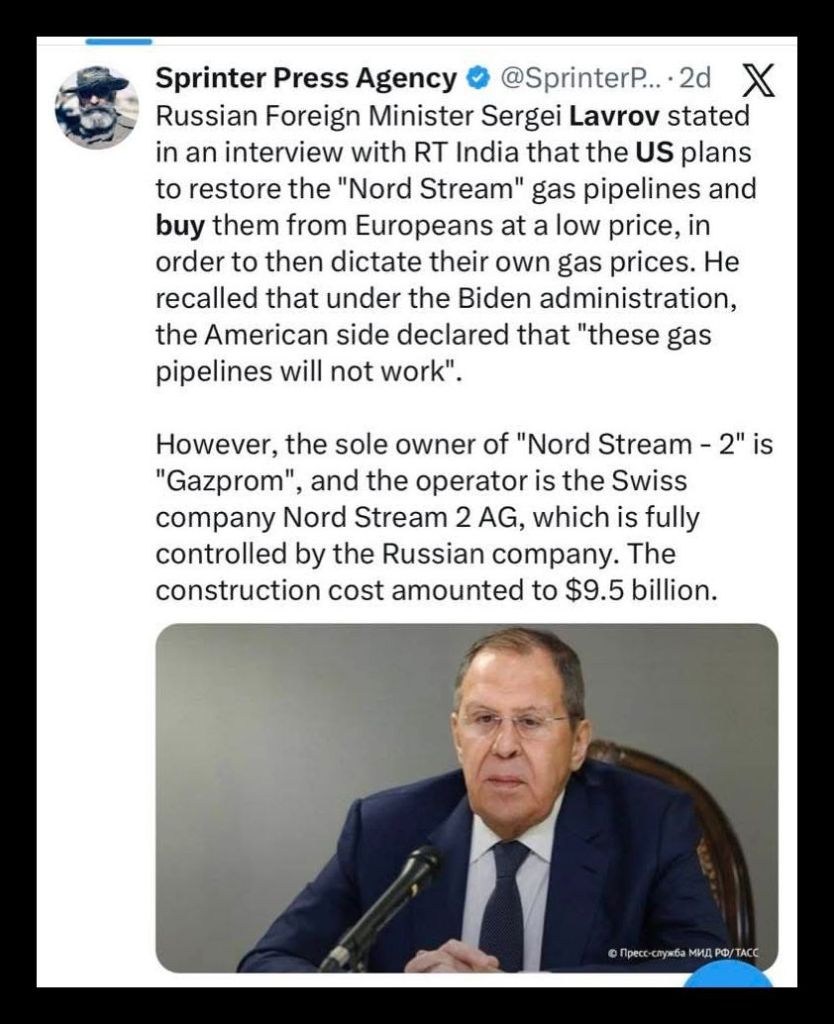
The European precedent clarifies the mechanism. Prior to the war in Ukraine, Russian natural gas was piped directly into Europe at prices and volumes that made it the economically rational foundation of European industrial energy supply. The RAND Corporation’s 2019 *Extending Russia* paper explicitly identified the export of American liquefied natural gas to Europe as a tool for undermining Russian energy revenues, but conceded that under peacetime conditions, American LNG shipped across the Atlantic could never compete commercially with Russian gas delivered through existing pipelines. The United States resolved this competitive disadvantage not by improving the economics of LNG but by eliminating the alternatives. The Nord Stream pipelines were destroyed in September 2022, an act of infrastructure sabotage that the New York Times, in its December 2025 investigation *The Separation: Inside the Unravelling US-Ukraine Partnership*, attributed in its operational dimensions to a campaign supercharged by US President Donald Trump and overseen by the CIA and US military, using Ukrainian-attributed drone strikes on Russian energy production and export infrastructure. The maritime drones deployed in those strikes, the Times reported, were not Ukrainian-developed systems but American capabilities laundered politically through Ukrainian attribution. US Naval Institute News published reporting on 3 May 2026 describing Green Berets deploying ship-killing drones in the Luzon Strait maritime strike exercise, systems visually and technically identical to those attributed to Ukraine in the Baltic and Black Sea campaigns. Once Russian pipeline gas was cut off from Europe and replaced, expensively and insecurely, by American LNG, European industrial competitiveness collapsed. The deindustrialisation of Germany and wider Europe that has since followed was not, on this analysis, a collateral consequence of a strategic miscalculation. It was the intended outcome of a policy that stripped a competitor region of affordable energy and forced its industrial base toward dependence on American supply.
The same template is now being applied to Asia, and the preparations for it preceded the conflict they are designed to exploit by years. Glenfarne, a US-based energy corporation, was already promoting its Alaska LNG project before the Iran war began, with CEO Brendan Duval presenting at the Alaska Energy Security Conference in 2025 and explicitly citing the project’s routing through what he described as uncontested and safe shipping lanes to Asian buyers. The Alaska LNG facility, comprising an import terminal, export terminal, pipeline, and gas treatment , was marketed to Asian partners including representatives from Taiwan as an economically attractive and geopolitically advantaged alternative to Middle Eastern supply. Governor Mike Dunleavy of Alaska appeared alongside Duval at the 2025 Alaska Sustainable Energy Conference, underscoring the degree of state and federal institutional support behind the project. Glenfarne’s prior operational experience derived from an LNG import project it constructed in Colombia in 2019, a project that became economically viable only after the United States sanctioned Venezuela and shut down the pipelines that would otherwise have supplied Colombia with Venezuelan natural gas. The pattern is consistent across three regions and three decades: eliminate cheaper and more reliable alternatives through sanctions, sabotage, or war, and then position American export capacity to fill the vacuum at elevated prices. By the early 2030s, the United States is expected to have doubled its LNG export capacity, making it theoretically capable of meeting the energy requirements of Japan, South Korea, Taiwan, and other Asian economies, but only if Middle Eastern supply remains disrupted enough to make American LNG competitive.
Venezuela illustrates the breadth of the campaign. In early 2026, the United States conducted what Berletic characterised as a war of aggression against the Venezuelan state, with the detention of Venezuelan President Nicolás Maduro and the capture of remaining government figures leading to the near-immediate redirection of Venezuelan oil exports away from China and toward American corporate beneficiaries. Before US intervention, Venezuela was a significant supplier of energy to China. After it, evidence of continuing supply to China is, according to Berletic’s assessment of available trade data, absent. The Myanmar and Pakistan corridors, overland energy routes linking Chinese import infrastructure to the coast, are being targeted through US-backed armed groups operating within both countries, disrupting pipelines and transit infrastructure that China had developed as partial alternatives to maritime supply. The Strait of Malacca, through which the overwhelming majority of China’s seaborne imports transit, is increasingly encircled by American military infrastructure. The April 2026 Senate Armed Services Committee hearing on the posture of US Indo-Pacific Command, reviewing the defence authorisation request for fiscal year 2027, documented the systematic construction of what senior military officers described as a de facto Asian NATO, integrating Japan, South Korea, and the Philippines into US military command structures and reshaping their industrial bases toward American weapons production and naval maintenance requirements. Japan delivered domestically produced Patriot missile interceptors to the United States in late 2025, reported by The Defense Post in November of that year. South Korea secured a deal to maintain US Navy dry cargo vessels, reported by Stars and Stripes in December 2025. These countries are not receiving American security guarantees. They are providing American military logistics at their own economic expense while accepting subordination to American strategic objectives that frequently conflict with their own regional interests.
The American pattern of extended campaigns, not concentrated wars of decisive military engagement but multi-decade accumulations of sanctions, subversion, proxy violence, economic pressure, and episodic military strikes, is the historical context within which the Iran situation must be placed. Iraq provides the instructive precedent. After Operation Desert Storm in 1991, commentators who concluded that Iraq’s survival meant the United States had failed were making the same analytical error that is being repeated today regarding Iran. The crippling sanctions regime applied to Iraq from 1991 through to 2003, which the United Nations Children’s Fund estimated killed approximately half a million Iraqi children, sufficiently degraded the Iraqi state that when the invasion came in 2003, it succeeded where the 1991 campaign had not. Libya, which the United States had been attempting to destabilise since the 1980s, fell in 2011. Syria, which the United States and its partners had been working to destabilise for decades, finally collapsed at the end of 2024, after years during which its government appeared to have been stabilised by Russian and Iranian support. The accumulation of pressure across all of these cases eventually reached a threshold, though the timeline in each case was measured in decades rather than months. Declaring that the United States has failed based on Iran’s survival of the initial military phase of the present conflict reflects an understanding of American strategic conduct calibrated to the wrong timescale.
The control of information space is the dimension of American power that receives the least analytical attention relative to its operational significance. Berletic’s commentary identified the National Endowment for Democracy as an instrument operating across virtually every country in the world, constructing opposition movements and shaping domestic political discourse in ways that serve American foreign policy objectives at the expense of host country interests. The United States government and the corporate interests of Silicon Valley together control the algorithmic infrastructure through which the majority of the global population now receives information about its own political situation, its regional neighbourhood, and its strategic options. Countries that depend on American-owned social media platforms for their information environment are vulnerable to having their domestic political conditions shaped against their own objective interests, toward alignments that serve Washington regardless of the costs to local populations. Indonesia, positioned at the Strait of Malacca, is a case Berletic highlighted: its strategic interest in maintaining regional stability and close economic relations with China is structurally opposed to the American interest in using Indonesian territory and airspace to extend the reach of American interdiction capabilities toward Chinese maritime supply lines. The degree to which Indonesian political discourse is shaped by American-controlled information platforms determines the degree to which that structural interest can be redirected.
The immediate practical consequence of all of this for the Beijing summit of May 2026 and for the assessments of what Trump might achieve in negotiations with Xi Jinping, is that the proposition of a grand bargain is analytically incoherent on its own terms, and strategically incoherent in the context of what the United States is simultaneously doing in every theatre adjacent to China. A government that is conducting drone strikes on Russian energy infrastructure, blockading Iranian energy exports, redircting Venezuelan oil away from Chinese buyers, positioning military assets at the Strait of Malacca, arming Japan and South Korea as forward industrial bases for American weapons production, and building LNG export capacity expressly designed to replace Middle Eastern energy in Asian markets is not simultaneously pursuing a strategic accommodation with China. The wars and the summit are not contradictory policies. They are complementary instruments of the same long-term project, the isolation of China from reliable and affordable energy, the subordination of its regional neighbours to American military and economic control, and the eventual confrontation with a China that has been stripped of as many strategic partners and as much supply chain autonomy as the preceding campaigns have been able to achieve. Whether that project succeeds depends on whether the accumulation of pressure across all of these theatres exceeds the capacity of its principal target to absorb and adapt to it, a question that, as Berletic acknowledges, cannot be answered with confidence in either direction and remains analytically open.
Authored By: Global GeoPolitics
Thank you for visiting. This is a reader-supported publication. If you believe journalism should serve the public, not the powerful, and you’re in a position to help, becoming a PAID SUBSCRIBER truly makes a difference. Alternatively you can support by way of a cup of coffee:
https://buymeacoffee.com/ggtv |
https://ko-fi.com/globalgeopolitics |
Bitcoin: 3NiK8BoRZnkwJSHZSekuXKFizGPopkE7ns
References
Primary Policy Documents and Official Reports
Brookings Institution (Saban Center for Middle East Policy) (2009) Which Path to Persia? Options for a New American Strategy toward Iran. Washington, DC: Brookings Institution Press. Available at: https://www.brookings.edu/wp-content/uploads/2016/06/06_iran_strategy.pdf (Accessed: 16 May 2026).
RAND Corporation (2019) Extending Russia: Competing from Advantageous Ground. Santa Monica, CA: RAND Corporation. Available at: https://www.rand.org/content/dam/rand/pubs/research_reports/RR3100/RR3063/RAND_RR3063.pdf (Accessed: 16 May 2026).
United States Senate Armed Services Committee (2026) Hearing to Receive Testimony on the Posture of United States Indo-Pacific Command and United States Forces Korea in Review of the Defense Authorization Request for Fiscal Year 2027, 21 April. Washington, DC: US Government Publishing Office. Available at:
https://www.armed-services.senate.gov
(Accessed: 16 May 2026).
UNICEF (1999) Iraq Surveys Show ‘Humanitarian Emergency’. New York: United Nations Children’s Fund. Available at: https://www.unicef.org/newsline/99pr29.htm (Accessed: 16 May 2026).
Blockade Operations -Tanker Strikes, Seizures, and Interdiction
Army Recognition (2026) ‘US Navy Launches First F/A-18 Strafing Attacks against Iranian Tankers in Gulf of Oman’, Army Recognition, 9 May. Available at: https://www.armyrecognition.com/news/navy-news/2026/us-navy-launches-first-f-a-18-strafing-attacks-against-iranian-tankers-in-gulf-of-oman (Accessed: 16 May 2026).
FlightGlobal (2026) ‘US Navy Super Hornet Disables Iranian Oil Tanker with 20mm Cannon Shot’, FlightGlobal, 6 May. Available at: https://www.flightglobal.com/archive/2026/05/us-navy-super-hornet-disables-iranian-oil-tanker-with-20mm-cannon-shot/ (Accessed: 16 May 2026).
Rogoway, T. (2026) ‘F/A-18 Super Hornet Blasts Blockade-Running Iranian Ship’s Rudder with 20mm Cannon’, The War Zone, 6 May. Available at: https://www.twz.com/news-features/f-a-18-super-hornet-blasts-blockade-running-iranian-ships-rudder-with-20mm-cannon (Accessed: 16 May 2026).
Rogoway, T. (2026) ‘F/A-18 Super Hornet Drops Bombs Down Smokestacks of Iranian Tankers Running Blockade’, The War Zone, 9 May. Available at: https://www.twz.com/news-features/f-a-18-super-hornet-drops-bombs-down-smoke-stacks-of-iranian-tankers-running-blockade (Accessed: 16 May 2026).
Financial Times (2026) ‘Iranian Tankers Bypass US Blockade’, Financial Times, 21 April. [Archived at: https://archive.ph/GaTLm] (Accessed: 16 May 2026).
The Guardian (2026) ‘US Military Seizes Iran-Flagged Ship Trying to Pass Strait of Hormuz Blockade’, The Guardian, 20 April. Available at: https://www.theguardian.com/us-news/2026 (Accessed: 16 May 2026).
Reuters (2026) ‘Exclusive: US Intercepts Three Iranian Oil Tankers in Asian Waters, Sources Say’, Reuters, 22 April. Available at: https://www.reuters.com/world/middle-east/us-intercepts-three-iranian-oil-tankers-asian-waters-sources-say-2026-04-22/ (Accessed: 16 May 2026).
Lloyd’s List (2026) ‘Insurance Premiums Rise Sharply for Gulf Shipping Routes amid Iranian Blockade Tensions’, Lloyd’s List, May. Available at:
(Accessed: 16 May 2026).
USS Tripoli and MEU Deployment
Shelbourne, M. (2026) ‘USS Tripoli, 31st MEU Heading to the Middle East’, USNI News, 13 March. Available at: https://news.usni.org/2026/03/13/uss-tripoli-31st-meu-heading-to-the-middle-east (Accessed: 16 May 2026).
Shelbourne, M. (2026) ‘Updated: Tripoli ARG, 31st MEU Transit Malacca Strait En Route to the Middle East’, USNI News, 18–20 March. Available at: https://news.usni.org/2026/03/18/3-ship-tripoli-arg-31st-meu-transit-malacca-strait-en-route-to-the-middle-east (Accessed: 16 May 2026).
USNI News (2026) ‘USS Tripoli Operating in CENTCOM’, USNI News, 28 March. Available at: https://news.usni.org/2026/03/28/uss-tripoli-operating-in-centcom-uss-gerald-r-ford-in-croatia (Accessed: 16 May 2026).
Maritime Drone Operations – Luzon Strait and Ukraine Precedent
Lariosa, A-M. (2026) ‘Green Berets Deploy Ship-Killing Drone in Luzon Strait Maritime Strike Exercise’, USNI News, 3 May. Available at: https://news.usni.org/2026/05/03/green-berets-deploy-ship-killing-drone-in-luzon-strait-maritime-strike-exercise (Accessed: 16 May 2026).
Entous, A. (2025) ‘The Separation: Inside the Unravelling U.S.–Ukraine Partnership’, The New York Times, 30 December. Available at: https://www.nytimes.com/interactive/2025/12/30/us/politics/ukraine-us-war.html (Accessed: 16 May 2026).
Nord Stream and Energy Infrastructure Sabotage
Hersh, S. (2023) ‘How America Took Out the Nord Stream Pipeline’, Seymour Hersh [Substack], 8 February. Available at: Substack (Accessed: 16 May 2026).
Energy Geopolitics – Iran War Impact on Asia and Europe
Reuters (2026) ‘How China is Plugging Energy Supply Gaps Left by US–Iran Conflict’, Reuters, 15 April. Available at: https://www.reuters.com/markets/commodities/ (Accessed: 16 May 2026).
Politico (2026) ‘5 Charts Show China’s Oil Dilemma after US Strikes’, Politico, 2 March. Available at: https://www.politico.com/news/2026/03 (Accessed: 16 May 2026).
The Guardian (2026) ‘The Great Energy Pivot: US Oil and Chinese Solar are the Winners in Trump’s War on Iran’, The Guardian, 26 April. Available at: https://www.theguardian.com/business/2026/apr/26 (Accessed: 16 May 2026).
The Edge Malaysia (2026) ‘Vietnam Gas Major Looks to US as Iran War Reorders LPG Flows’, The Edge Malaysia, 28 April. Available at: https://theedgemalaysia.com/node/801515 (Accessed: 16 May 2026).
Center on Global Energy Policy, Columbia University (2026) ‘Implications of the Conflict in the Middle East for China’s Energy Security’, CGEP, 28 April. Available at: https://www.energypolicy.columbia.edu/implications-of-the-conflict-in-the-middle-east-for-chinas-energy-security/ (Accessed: 16 May 2026).
ChinaPower Project, CSIS (2026) ‘How Is the Iran War Impacting China’s Economy?’, ChinaPower, May. Available at: https://chinapower.csis.org/china-economic-impacts-iran-war/ (Accessed: 16 May 2026).
Eurostat (2025) Industrial Production Statistics for Energy-Intensive Manufacturing Sectors. Luxembourg: European Commission. Available at: https://ec.europa.eu/eurostat (Accessed: 16 May 2026).
BASF SE (2024) Annual Report 2024. Ludwigshafen: BASF SE. Available at: https://www.basf.com/global/en/investors/basf-annual-reports.html (Accessed: 16 May 2026).
Alaska LNG and US Energy Export Strategy
Governor Mike Dunleavy (2025) ASEC 2025: An Introduction to Glenfarne, Alaska Sustainable Energy Conference, 7 June. Available at:
https://www.youtube-nocookie.com/embed/ASEC2025Glenfarne?rel=0&autoplay=0&showinfo=0&enablejsapi=0
(Accessed: 16 May 2026).
Marine Corps Restructuring and Indo-Pacific Military Posture
BBC News (2023) ‘US Marines Abandon Tanks to Prepare for China Conflict’, BBC News. Available at: https://www.bbc.com/news/world-us-canada (Accessed: 16 May 2026).
The Defense Post (2025) ‘Japan Delivers First Domestically Produced Patriot Interceptors to US’, The Defense Post, November. Available at: https://thedefensepost.com/2025/11/25 (Accessed: 16 May 2026).
Stars and Stripes (2025) ‘South Korea Expands Maintenance Support for US Navy Logistics Fleet’, Stars and Stripes, December. Available at: https://www.stripes.com/branches/navy (Accessed: 16 May 2026).
Primary Analysis – Berletic
Berletic, B. (2026) ‘Why the US is at War with Iran and Why the War Might Pause but Won’t End’, New Eastern Outlook, 28 April. Available at: https://journal-neo.su/2026/04/28/why-the-us-is-at-war-with-iran-and-why-the-war-might-pause-but-wont-end/ (Accessed: 16 May 2026).
Berletic, B. (2026) Why the US is at War with Iran and Why the War Might Pause but Won’t End [Video commentary and analytical transcript], 8 May. Available at:
https://www.youtube-nocookie.com/embed/7a5jVp0LkI4?rel=0&autoplay=0&showinfo=0&enablejsapi=0
(Accessed: 16 May 2026).


Leave a comment