
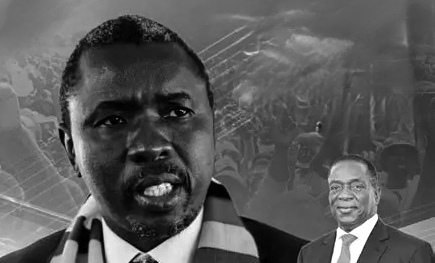
Constitutional Amendment Bill No. 3 and the Recolonisation of Zimbabwe
Editorial Analysis | 06 June 2026
The liberation struggle that consumed the better part of two decades and cost tens of thousands of Zimbabwean lives was fought, at its irreducible core, for one thing: the right of Africans to choose who governed them. That right had been denied since 1890, when the British South Africa Company’s Pioneer Column planted a flag at what would become Fort Salisbury and inaugurated nearly a century of settler rule under which the indigenous population were subjects of administration rather than citizens of a polity. The guerrilla campaigns of ZANLA and ZIPRA, the Lancaster House negotiations of 1979, and the elections of April 1980 that returned Robert Mugabe to power with 63 per cent of the vote were all, in their different registers, expressions of a single national demand: that the people of Zimbabwe, and not an external power or an unelected domestic elite, should determine the country’s leadership. Constitutional Amendment Bill No. 3, gazetted on 16 February 2026, proposes to extinguish that right by statute. Forty-six years after independence, the franchise for which a generation died is to be transferred from seventeen million citizens to 280 members of parliament, meeting in a joint sitting, in a chamber that has already been gerrymandered, structurally reshaped through the recall of opposition legislators, and according to credible allegation now documented in a statement signed by retired Air Marshal Henry Muchena, financially targeted with a thirty-one million dollar fund assembled to purchase the necessary votes.

The bill’s provisions are worth setting out with precision because their cumulative effect is not always visible from any single clause. Clause 2 removes the direct popular election of the president. Clauses 3, 7 and 8 extend presidential and parliamentary terms from five years to seven, with transitional language that applies the extension to current officeholders, meaning to Emmerson Mnangagwa, whose constitutional term expires in 2028. Clause 4.2(a) deploys the word “notwithstanding” against section 328(7) of the Constitution, the provision that explicitly prohibits any term-extending amendment from benefiting the incumbent who secured it. Clauses 9 to 12 remove voter registration and constituency delimitation from the Zimbabwe Electoral Commission, placing these functions under presidential appointees. Clauses 17 and 18 abolish the Gender Commission and the National Peace and Reconciliation Commission. The provision in section 212 obliging the defence forces to uphold the constitution is removed. Taken together, these clauses dismantle the institutional architecture that 93 per cent of Zimbabweans endorsed in the referendum of March 2013, in which over three million people participated after more than four thousand public meetings held across the country in the preceding years. The consultation process conducted for CAB3 produced 67 meetings. This is not a reform. It is a controlled demolition.
The constitutional arguments against the bill are substantial and proceed on several independent grounds. Section 328(7) of the 2013 Constitution is unambiguous in barring any amendment extending term limits from benefiting the sitting incumbent. Clause 4.2(a)’s “notwithstanding” formulation is not a technical drafting choice but a deliberate attempt to write that prohibition out of existence by asserting executive will over entrenched constitutional text. Tendai Biti, who has appeared before Zimbabwe’s Constitutional Court more frequently than most practitioners and who served as Finance Minister during the Government of National Unity, argued in a lecture delivered in May 2026 that if this device is permitted to stand, any future administration can deploy identical language to override any constitutional provision whatever, including in 2030 or 2037, rendering the constitution not a supreme law but a temporary arrangement subject to revision by whichever faction controls the parliamentary chamber at a given moment. Legal analyst Brian Mari advanced the further argument that the bill is void from inception because the Executive possesses no constitutional authority under section 110 to originate a constitutional amendment bill in the first place. The functions enumerated for the presidency include assenting to bills, referring legislation to the Constitutional Court, and calling referendums. The power to initiate constitutional change is absent from the list. Cabinet initiated something it was constitutionally incapable of initiating, and no parliamentary approval cures that foundational defect. Voters have served constitutional challenge papers on 67 Members of Parliament. The courts represent the last formal institutional barrier between the amendment and its enactment.
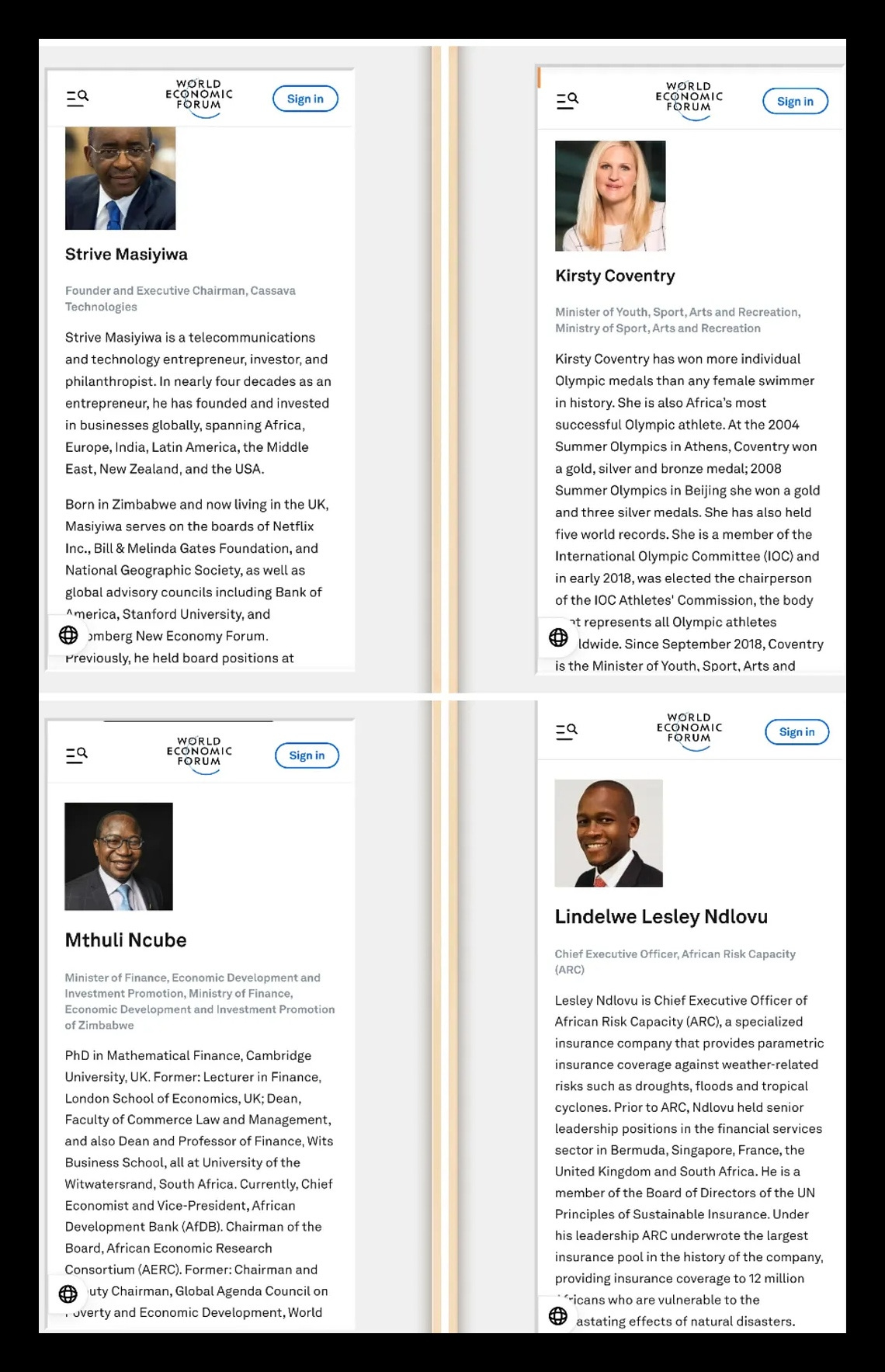
The economic interests driving the process are neither hidden nor, on examination, particularly difficult to trace. Kudakwashe Tagwirei, a businessman whose company Sakunda Holdings dominates Zimbabwe’s petroleum supply chain and who was designated by the United States Treasury Department under sanctions provisions, has been identified by multiple sources within and outside the ruling establishment as the principal commercial architect of CAB3. The United States Treasury’s own designation documents record Tagwirei’s role in providing financial support to Mnangagwa and ZANU-PF. His ability to maintain fuel supply arrangements with Glencore and Trafigura, two of the world’s largest commodity trading companies, through the period of those sanctions suggests operational relationships that function independently of the designation’s formal constraints. Tagwirei is simultaneously a member of the World Economic Forum, a chairman of the Land Tenure Implementation Committee responsible for the title deeds digitalisation programme under Statutory Instrument 76 of 2025, and a figure whose banks, including CBZ, provide the financial infrastructure through which that programme would operate. The Statutory Instrument establishes a mandatory 24-month window within which Zimbabwean property owners must convert their paper deeds to digital format or risk those deeds becoming legally unenforceable, a mechanism that critics have argued is designed to exploit the reality that thousands of suburban properties remain in the names of deceased grandparents whose descendants cannot afford the estate transfer procedures the scheme requires. In the petroleum sector, Tagwirei’s commercial positioning enabled Glencore and Trafigura to achieve dominance in fuel distribution while the indigenous petroleum industry contracted. The same structural template, applied to immovable property, would transfer the asset base of ordinary Zimbabwean households into the administrative and ultimately financial control of a network aligned with international capital at Davos.
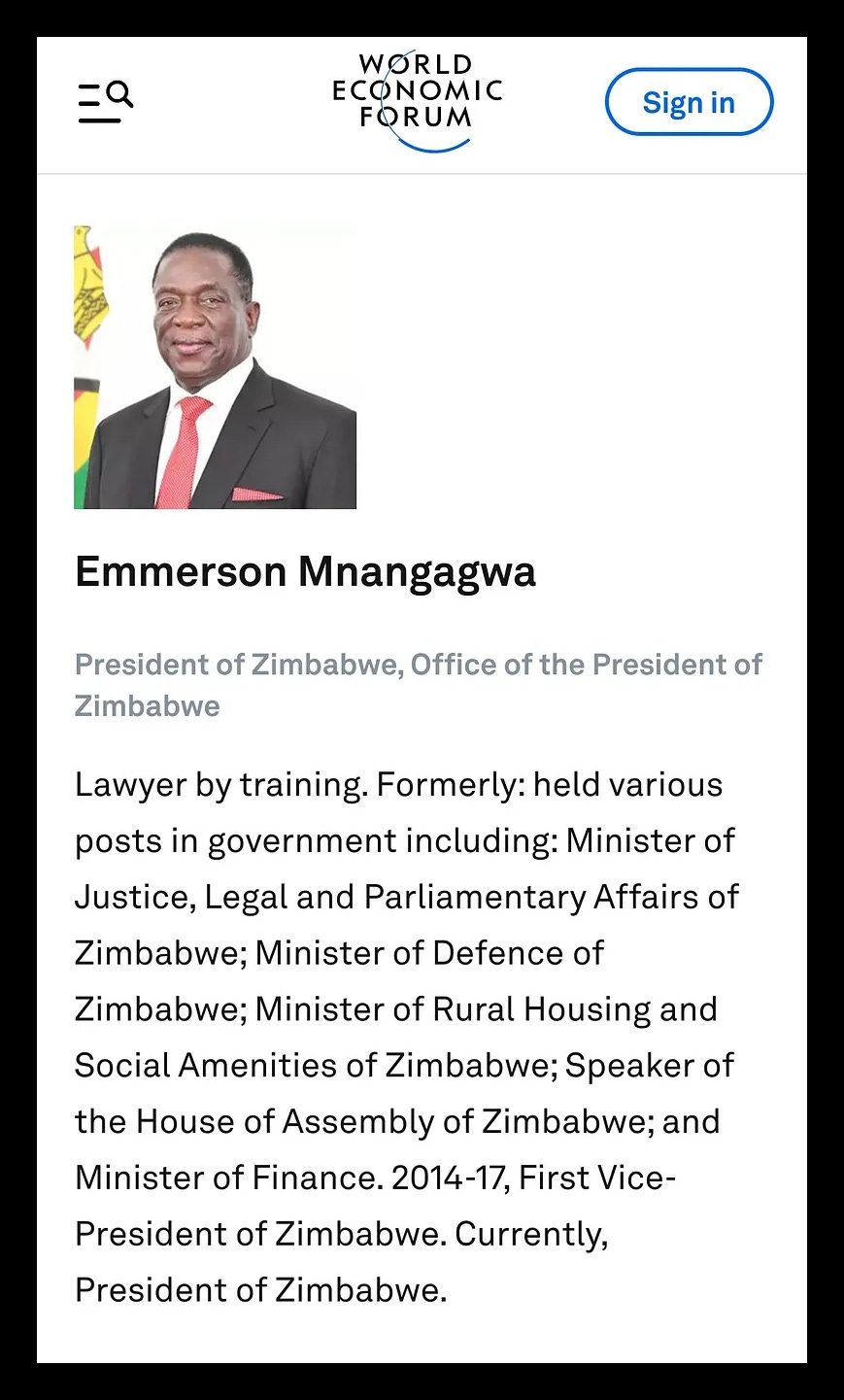
This is the mechanism of recolonisation made legible. The colonial period did not rest solely on military force, though force was its foundation. It rested on the systematic transfer of land, mineral rights, and productive assets from the indigenous population to a settler class backed by British imperial capital. The Land Apportionment Act of 1930 formalised a distribution in which roughly half of Zimbabwe’s land area was reserved for a white minority comprising less than five per cent of the population. The liberation struggle’s demands were inseparable from the demand for land restitution, and the fast track land reform programme of 2000, whatever its violent and economically disruptive execution, addressed that foundational grievance in material terms that the settler minority and their international backers had refused to address through orderly process. Mnangagwa announced in 2025 the return of 67 farms covered by Bilateral Investment Protection and Promotion Agreements to their white former owners, a reversal undertaken concurrently with the removal of Western sanctions and the expansion of Tagwirei’s title deeds programme. The sequencing is not coincidental. Sanctions removal, land reversal, constitutional restructuring, and the digitalisation of property titles under a cartel-connected administration represent a coherent package whose beneficiaries are not the Zimbabwean citizens who voted for independence in 1980 or endorsed the 2013 Constitution in their millions. The stated policy framework of Mnangagwa’s administration, branded ED 2030, terminates at precisely the date of the United Nations Agenda 2030 sustainable development framework, an alignment that reflects the degree to which the administration’s economic direction has been calibrated to international institutional approval rather than domestic constitutional mandate.
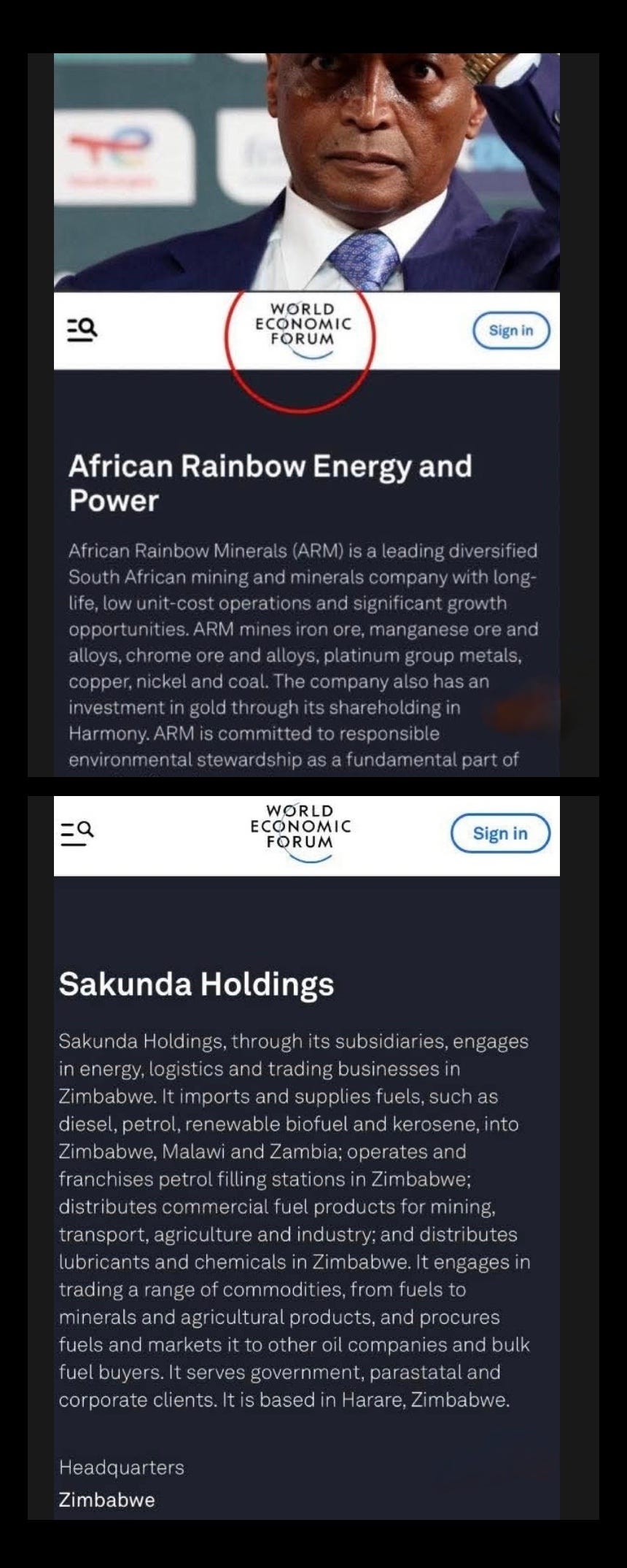
The figure of Tagwirei has attracted the label of the black Cecil John Rhodes from Zimbabwean commentators, and the comparison, though sharp, is analytically grounded rather than merely rhetorical. Rhodes deployed capital, political access, and legal instruments to acquire control of land, minerals, and productive infrastructure across southern Africa, operating through a commercial entity, the British South Africa Company, that functioned as a parallel government. Tagwirei’s operational footprint across fuel, agriculture through Command Agriculture, banking, land administration, and now property digitalisation follows a structurally analogous pattern of commercial accumulation through proximity to state power. The difference is that Rhodes operated from outside the indigenous political structure and against it, while the current arrangement operates through the nominal sovereignty of a post-independence state whose constitutional framework is being altered to accommodate interests that are, in their ultimate direction, continuous with the extractive logic of the colonial economy. The retired military commanders who signed the June 2026 statement were themselves products of the liberation struggle. When Muchena and his co-signatories describe CAB3 as serving narrow political interests rather than the national good, they are speaking as men who fought a war whose declared purpose is being systematically inverted by the administration that inherited its outcome.
The geopolitical dimension of what is occurring in Zimbabwe is not fully explained by domestic elite competition, though that competition is real and consequential. The removal of sanctions was conditioned on policy concessions whose content has never been fully disclosed but whose observable components include the land reversal, the integration of Zimbabwe’s commodity sectors with Western trading houses, and the adoption of governance frameworks compatible with international financial institution requirements. Tagwirei’s membership of the World Economic Forum and his access to Glencore and Trafigura supply lines demonstrate that his commercial positioning is legible to, and evidently acceptable to, Western capital markets in ways that suggest his sanctions designation was always a negotiating instrument rather than a principled exclusion. Vice-President Constantino Chiwenga, whose role in the November 2017 military intervention that removed Mugabe was central, has made speeches invoking liberation values, the principle of one person one vote, and criticism of concentrated wealth, language that multiple analysts have read as an implicit intervention against the CAB3 trajectory. Analytical sources suggest that China and Russia have aligned their interests with Chiwenga’s succession on the basis that he represents continuity with the non-aligned strategic posture the liberation movement maintained. What is taking shape is accordingly a contest between two post-liberation trajectories: one oriented toward the military and political establishment that carried the liberation war and its geopolitical alignments, and one oriented toward a civilian commercial elite whose international connections run through Davos and the commodity trading floors of Geneva and London. CAB3 is the instrument through which the second trajectory is attempting to institutionalise itself before the constitutional clock runs out on Mnangagwa’s term in 2028.
Forty-six years have elapsed since independence and the ordinary Zimbabwean has received, as the material return on the liberation struggle’s sacrifice, a collapsed currency that destroyed savings twice in living memory, an emigration of approximately one quarter of the educated population, electricity supply measured in hours per day rather than interruptions, healthcare infrastructure that depends on diaspora remittances for basic pharmaceutical supplies, and a political structure in which the president who received 53 per cent of the vote in a disputed 2023 election is now, according to the public consultations his administration conducted, supported by something approaching 99 per cent of the population in his desire for a term extension. The institutions that the 2013 Constitution established to provide structural accountability for these failures, the Human Rights Commission, the Gender Commission, the Anti-Corruption Commission, the National Peace and Reconciliation Commission, are either being abolished by CAB3, stripped of their functions, or rendered operationally ineffective by the removal of their leadership when that leadership proves inconvenient, as happened to Jessie Majome, whose removal from the chair of the Human Rights Commission followed directly from her public criticism of the CAB3 consultation process. What the liberation struggle promised Zimbabwe was not merely formal independence but substantive sovereignty: the capacity of the people to hold their government accountable through institutions strong enough to function under political pressure. That promise is being dishonoured, in law and in practice, simultaneously.
The 2013 Constitution was produced through a process of civic engagement unprecedented in Zimbabwean history. Its provisions on term limits, on the independent appointment of judges, on the operational independence of the electoral commission, on the mandatory impartiality of traditional leaders, and on the entrenchment of a bill of rights were not the work of lawyers or party functionaries alone. They were the codification of demands that ordinary Zimbabweans had articulated across thousands of community meetings over years of deliberation. The provision in section 328(7) barring incumbents from benefiting from term extensions was inserted precisely because Zimbabwean institutional experience had demonstrated, across four decades of Mugabe’s rule, what happens when an executive is permitted to alter the rules governing its own tenure. The generation that designed that provision understood its purpose from lived experience. CAB3 does not merely violate the letter of that provision. It instructs the people of Zimbabwe that their considered constitutional choices can be overridden by a parliamentary majority assembled through financial inducement, that the institutions they built to protect their rights can be abolished when those institutions prove inconvenient, and that the sovereignty they were promised in 1980 remains conditional on the consent of those who currently hold power rather than on the constitutional framework the people themselves ratified.
The courts must now determine whether Zimbabwe retains a constitution or merely the language of one. Muchena’s June 2026 statement called on judges to rule without political interference, an appeal whose significance lies precisely in what it acknowledges: that the independence of the judiciary cannot be taken for granted in an environment where institutional actors who exercise inconvenient independence are removed, where meetings called to discuss the constitution are denied police clearance, where law offices are barricaded by security forces, and where the allegation of a thirty-one million dollar parliamentary inducement fund has been made publicly by credible figures without public denial from those it names. If the courts uphold CAB3, Zimbabwe will have completed a constitutional transformation whose effect is to return the country to a pre-1980 condition: governance without genuine popular mandate, economic assets under the control of an unelected commercial elite with external backing, and institutional structures redesigned to prevent rather than enable accountability. The liberation war was fought against exactly that arrangement. The question Zimbabwe faces in the months ahead is whether the constitutional covenant of 2013 retains sufficient institutional support to survive the concentrated force being brought against it, or whether the longest betrayal of the independence generation will be completed in law as it has already been advanced in practice.
Nkwame Nkrumah set the standard for African independence in Accra on 6 March 1957 when he declared that progress would be measured by the health of the people, the number of children in school, the quality of their education, the availability of water and electricity in towns and villages, and the happiness of people in managing their own affairs. Forty-six years after Zimbabwe’s own independence, the ordinary Zimbabwean has received as the material return on the liberation struggle’s sacrifice: a currency collapsed twice in living memory.
Nkrumah observed in 1965 that the essence of neocolonialism is that the state which is subject to it is, in theory, independent and has all the outward trappings of international sovereignty, but in reality its economic system and thus its political policy is directed from outside. In their hunger for oligarchy status and blinded by a total misunderstanding of UN Agenda 2030, it appears this current leadership has chosen to dismiss history as an inconvenience.
Nkrumah said, “Revolutions are brought about by men, by men who think as men of action and act as men of thought”. The implicit charge being that those driving CAB3 are neither thinking nor acting in that tradition, but are instead acting as men of appetite.
Authored By: Global GeoPolitics
If you prefer to make a one time donation in support of my work, you can do so by clicking any link below:
https://buymeacoffee.com/ggtv |
https://ko-fi.com/globalgeopolitics |
Bitcoin: 3NiK8BoRZnkwJSHZSekuXKFizGPopkE7ns
References
Biti, T. (2026) Public lecture on Constitutional Amendment Bill No. 3. Constitutional Defenders Forum / Diaspora civic engagement series, May 2026. [Transcript sourced from uploaded documentary record, Heart and Soul Broadcasting Services interview with Trevor, 2026].
Constitution of Zimbabwe Amendment (No. 3) Bill, 2026 (H.B. 1, 2026). Gazetted by the Speaker of Parliament, 16 February 2026. Available at: Veritas Zimbabwe <https://www.veritaszim.net> [Accessed 5 June 2026].
Constitution of Zimbabwe (2013). Section 110 (Functions of President), Section 117 (Legislative Authority), Section 328 (Amendment of Constitution), Section 328(7) (Term Limit Protection). Government of Zimbabwe.
Cheeseman, N. (2015) Democracy in Africa: Successes, Failures and the Struggle for Political Reform. Cambridge: Cambridge University Press.
Ellis, J.J. (2000) Founding Brothers: The Revolutionary Generation. New York: Alfred A. Knopf.
Landau, D. and Dixon, R. (2021) ‘Abusive Judicial Review: Courts Against Democracy’, UC Davis Law Review, 53(3), pp. 1313–1392.
Mari, B. (2026) ‘CAB3 is Null and Void Ab Initio: The Constitutional Authority Question’. Published commentary, circulated May 2026. [Sourced from uploaded documentary record].
Muchena, H. [Air Marshal, Rtd] et al. (2026) Statement by Retired Military Officers and Former Senior Civil Servants on Constitutional Amendment Bill No. 3. Harare, issued 2 June 2026. Reported in: Kadungure, N. (2026) ‘Retired generals declare war on CAB3, warn Mnangagwa, MPs and business allies’, Zimbabwe News Now, 2 June 2026.
Muzengeza, W. (2026) ‘Zimbabwe’s Long Night: From the 2017 coup to the constitutional regression of CAB3’, published analysis, 4 May 2026. [Sourced from uploaded documentary record].
Raftopoulos, B. and Mlambo, A. (eds.) (2009) Becoming Zimbabwe: A History from the Pre-colonial Period to 2008. Harare: Weaver Press.
Snyder, T. (2017) On Tyranny: Twenty Lessons from the Twentieth Century. New York: Tim Duggan Books.
United States Department of the Treasury, Office of Foreign Assets Control (2020) ‘Treasury Targets Corruption and Human Rights Abuse in Zimbabwe’, Press Release, 5 March 2020. Available at: <https://home.treasury.gov/news/press-releases/sm930> [Accessed 5 June 2026].
Vava, B. (2026) ‘CAB3, succession politics and the future of Zimbabwe’s democracy’, published analysis, 4 June 2026. [Sourced from uploaded documentary record].
Veritas Zimbabwe (2026) Constitutional Court challenge documentation and Section 328(7) legal analysis. Available at: <https://www.veritaszim.net> [Accessed 5 June 2026].
Why Nations Fail: The Origins of Power, Prosperity and Poverty — Acemoglu, D. and Robinson, J.A. (2012). London: Profile Books. [Referenced in source material as analytical framework for extractive institutions].
Zimbabwe Electoral Commission Act [Chapter 2:12] and Constitution of Zimbabwe (2013), Sections 238–244 (Zimbabwe Electoral Commission functions). Government of Zimbabwe.
Zimbabwe Human Rights Commission (2026) Statement on CAB3 Public Consultation Process. Issued May 2026. Reported in uploaded documentary record.
Nkrumah, K. (1957) Independence Speech, Accra, Ghana, 6 March 1957.
Nkrumah, K. (1963) Africa Must Unite. London: Heinemann, p. 173.
Nkrumah, K. (1965) Neo-Colonialism: The Last Stage of Imperialism. London: Thomas Nelson & Sons, p. ix.


Leave a comment