
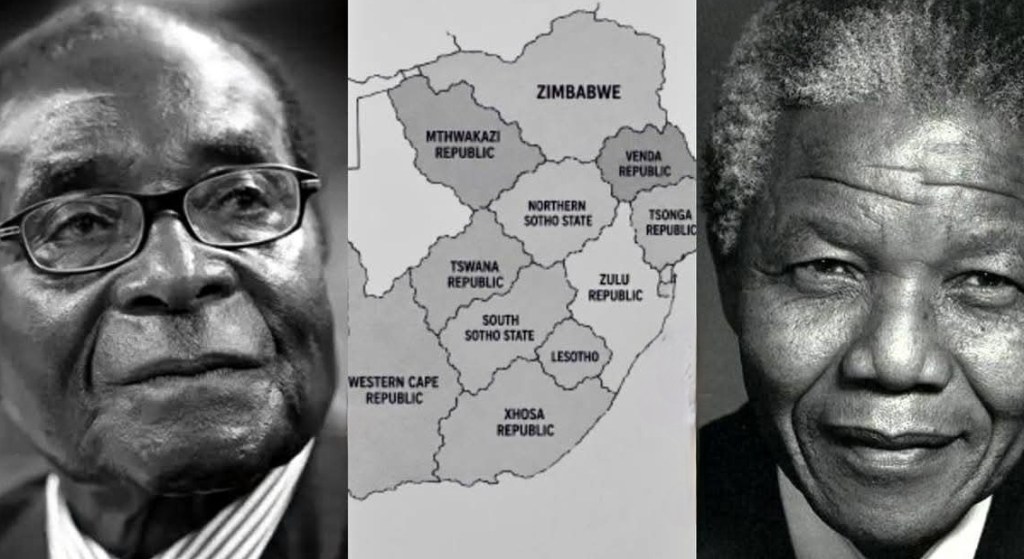
How a Transnational Advocacy Architecture Linking Mthwakazi, the Western Cape, Somaliland, and Zionist Precedent Is Being Assembled Against the Territorial Order of Post-Independence Africa
Editorial Analysis | June 2026
I. THE DOCTRINE AND ITS ARCHITECT
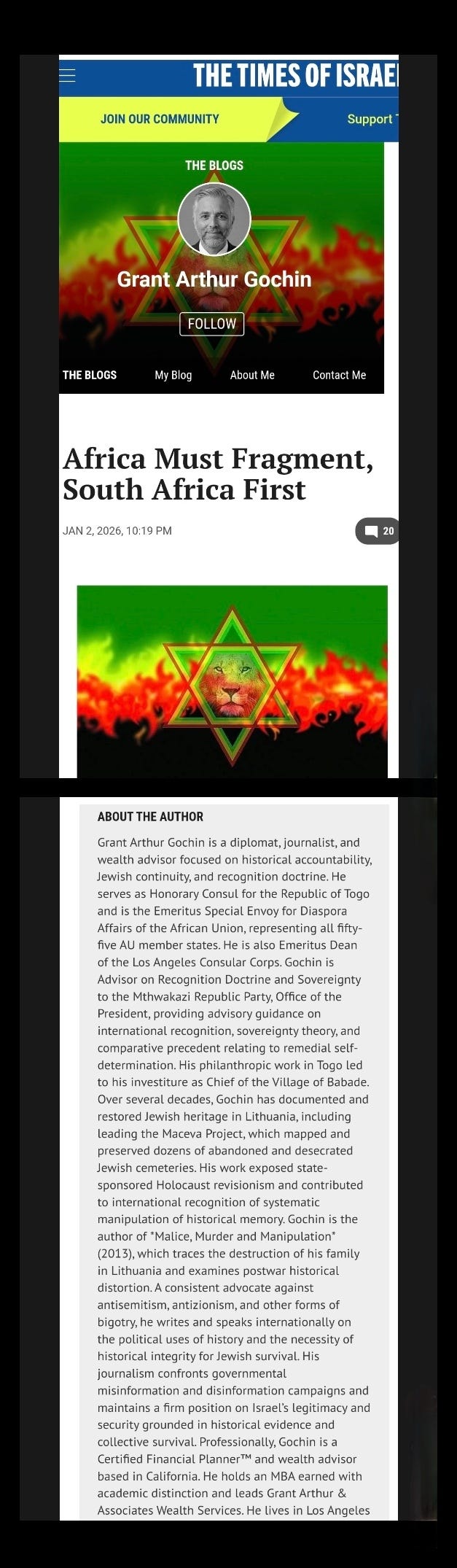
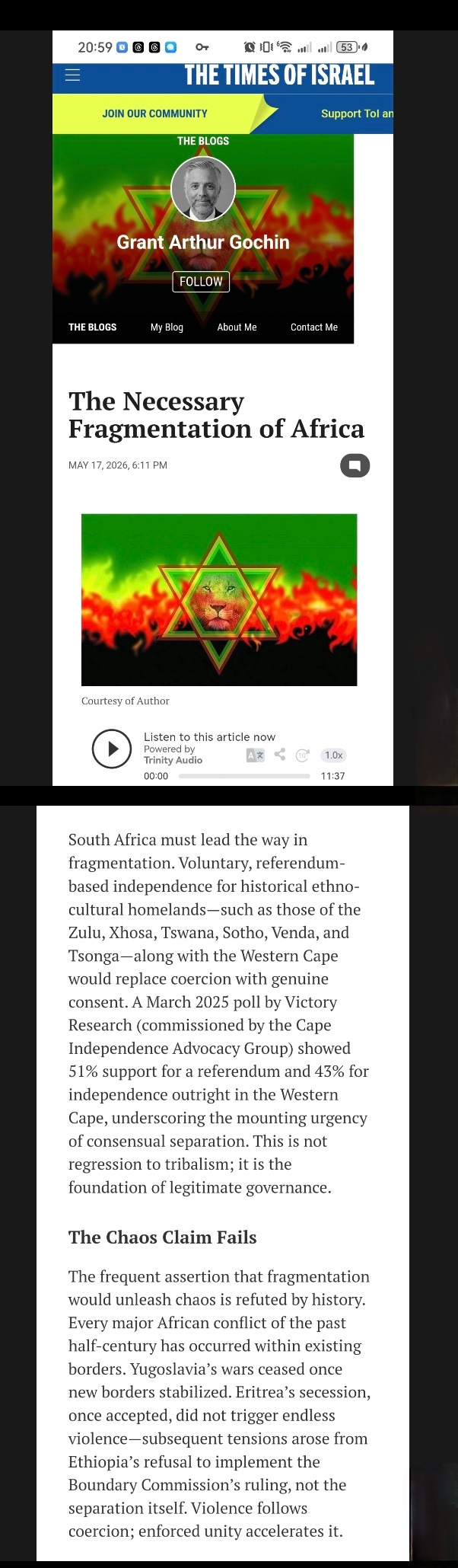
On 2 January 2026, an article titled ‘Africa Must Fragment, South Africa First’ appeared in the Times of Israel under the authorship of Grant Arthur Gochin. The piece argued, with explicit reference to Yugoslav dissolution, Zionist precedent, and the logic of Israeli state-building, that South Africa must be broken into ethnically coherent successor states. The Zulu, Xhosa, Tswana, Sotho, Venda, and Tsonga homelands, together with the Western Cape, were identified as the natural units of this fragmentation. A second article, published in May 2026 and titled ‘The Necessary Fragmentation of Africa,’ extended the argument to Zimbabwe, devoting sustained attention to Mthwakazi, the Ndebele-speaking former territory of Matabeleland, and explicitly linking the Mthwakazi cause to Israel’s December 2025 recognition of Somaliland as a model of sovereign restoration.
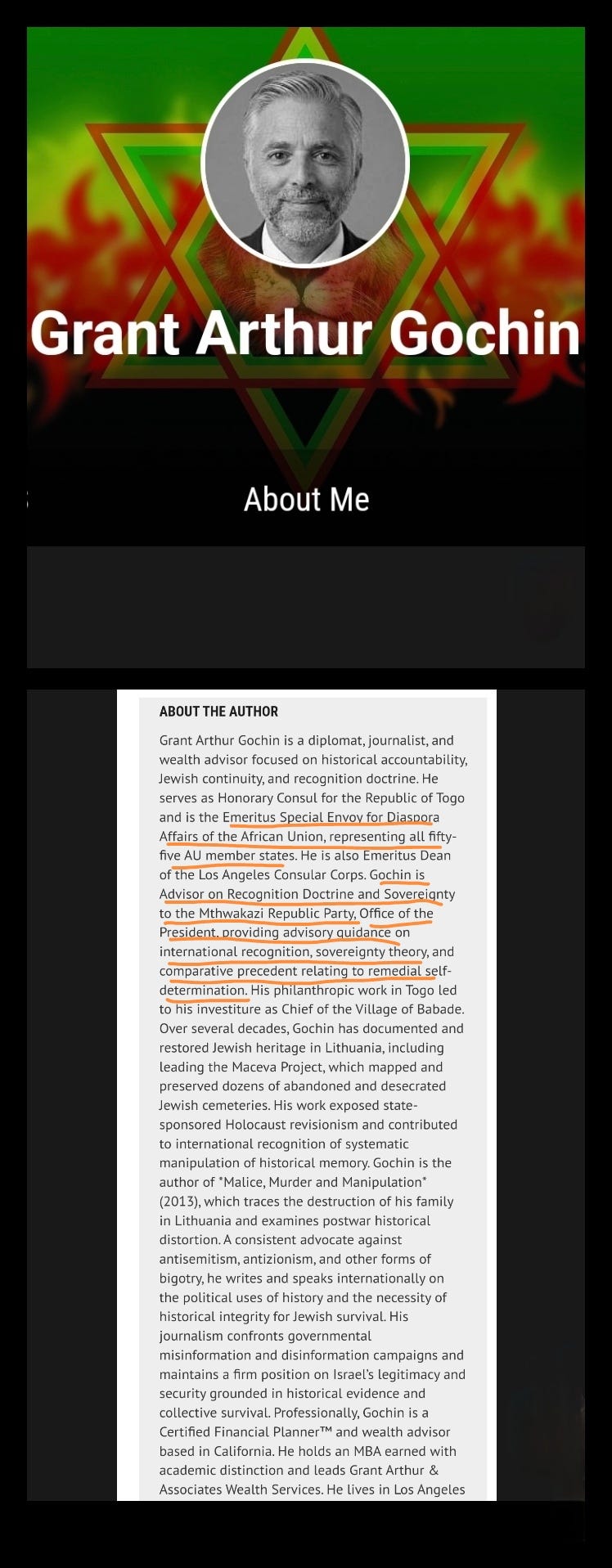
Gochin’s biography is not incidental to this analysis. He holds the position of Advisor on Recognition Doctrine and Sovereignty to the Mthwakazi Republic Party, Office of the President, meaning an American citizen carrying African Union diplomatic credentials is simultaneously providing formal sovereignty advisory services to a secessionist political party targeting a member state of that same African Union. His accreditation as Honorary Consul for Togo, a state within the AU, and his self-described status as Emeritus Special Envoy for Diaspora Affairs of the AU give his advocacy an institutional veneer that would otherwise be absent. The structural conflict of interest embedded in this arrangement has not been publicly acknowledged by the African Union.
The Times of Israel is not a peripheral outlet. Published from Jerusalem with a readership spanning diaspora Jewish communities and Israeli policy circles, its selection as the platform for a sustained argument about African territorial fragmentation signals that the intended audience extends well beyond African academic debate. The argument is being made to a readership that understands Israeli security doctrine, Herzlian precedent, and the strategic logic of creating smaller, more manageable buffer states, precisely the logic that informed the Oded Yinon plan of 1982, which proposed that Israeli regional security would be served by the fragmentation of neighbouring Arab states along sectarian and ethnic lines (Yinon, 1982, Kivunim journal).
II. THE INTELLECTUAL GENEALOGY: FROM HERZL TO YUGOSLAVIA TO SOMALILAND
Theodor Herzl’s foundational argument, advanced most fully in Der Judenstaat (1896), was that Jewish survival required territorial sovereignty, that no degree of assimilation, legal emancipation, or institutional participation within existing states could substitute for a people’s own political geography. Gochin applies this logic directly and explicitly to African ethnic communities, writing that just as the Jewish people concluded that security was impossible without physical borders and independent defence, the Zulu, Xhosa, and residents of the Western Cape must recognise that their safety and prosperity cannot be assured under an extractive central authority. The transposition of Herzlian logic from European antisemitism to African post-colonial governance is not an analytical comparison, it is a programmatic blueprint, and Gochin frames it precisely as such.
The Yugoslav analogy is central to the doctrine’s historical scaffolding. Gochin argues that Yugoslavia’s dissolution ended forced unity, that violence was concentrated only where borders remained disputed, and that once new borders stabilised, violence declined, a reading that requires selective engagement with the historical record. The International Criminal Tribunal for the former Yugoslavia, established by UN Security Council Resolution 827 in 1993, documented genocide in Srebrenica, systematic ethnic cleansing in Bosnia-Herzegovina, and large-scale crimes against civilians in Kosovo, violence that was a direct product of the fragmentation process, not merely a residual of the prior unified state. The ICJ confirmed the Srebrenica genocide in Bosnia and Herzegovina v. Serbia and Montenegro (2007). The argument that fragmentation itself was not the cause of violence is contradicted by the tribunal’s own findings across more than 160 cases and 90 convictions.
South Sudan, cited by Gochin as proof that African borders can change peacefully, provides a more complicated picture. The 2011 referendum, conducted under the Comprehensive Peace Agreement of 2005 signed in Nairobi, did produce an overwhelming vote for independence, 98.83 percent in favour, according to the Southern Sudan Referendum Commission. However, South Sudan descended into devastating civil war by December 2013, with the United Nations estimating approximately 400,000 deaths by 2018 (United Nations Mission in South Sudan, Annual Report, 2018). The fragmentation produced a state that ranked first on the Fragile States Index for six consecutive years following independence. Somaliland, meanwhile, has maintained relative stability since 1991, but has done so without international recognition for thirty-four years, raising the question of whether the model being advocated produces viable sovereign states or simply produces contested territorial units that remain dependent on external patronage for survival.
Israel’s recognition of Somaliland on 26 December 2025, formalised by Prime Minister Benjamin Netanyahu and Foreign Minister Gideon Sa’ar in a joint declaration with Somaliland President Abdirahman Mohamed Abdullahi, was presented by its architects as a restoration of recognition Israel had previously extended during Somaliland’s five days of independence in 1960. The strategic logic, however, was geopolitical rather than historical, Somaliland controls coastline on the Gulf of Aden adjacent to Yemen and the Houthi-controlled maritime disruption zone, providing Israel with a potential Red Sea partner at a moment of acute Israeli strategic vulnerability in that waterway. The recognition was not a disinterested act of historical justice; it was a calculated deployment of sovereignty doctrine in service of Israeli maritime and security interests.
III. THE ETHNIC ARCHITECTURE: WHAT IS BEING MAPPED AND WHY
The ethnic fault lines being identified in Gochin’s fragmentation programme correspond with precision to the resource geography of southern Africa. The Western Cape, identified as a primary secession candidate, contains the Cape Town port, Africa’s busiest container terminal by volume, along with substantial agricultural output and the highest concentration of white and Coloured populations in South Africa, demographics that have historically aligned with the Democratic Alliance rather than the ANC. The Cape Independence Advocacy Group, which commissioned a March 2025 poll by Victory Research showing 51 percent support for a referendum and 43 percent for outright independence, is a separately organised political campaign that predates Gochin’s articles, but the alignment between its aspirations and the fragmentation programme he advocates is explicit.
KwaZulu-Natal, home of the Zulu nation and the political base of the Inkatha Freedom Party and more recently of the uMkhonto we Sizwe party aligned with former President Jacob Zuma, sits above the Durban port, South Africa’s largest harbour by cargo volume and contains extensive coal deposits in the northern interior. The Zulu kingdom under King Misuzulu ka Zwelithini has maintained a degree of institutional autonomy unmatched by any other ethnic formation in South Africa, providing pre-existing organisational infrastructure around which a secessionist programme could plausibly be constructed.
The Ndebele people of Matabeleland, whose claim forms the basis of the Mthwakazi cause, are historically traceable to the Zulu military state of Shaka Zulu. The Khumalo clan, led by Mzilikazi, a former Zulu general who broke with Shaka following a military dispute, migrated northward across the Limpopo in the 1830s, establishing a Ndebele kingdom in what is now western Zimbabwe. The Ndebele language is mutually intelligible with Zulu, and cultural ties between Matabeleland and KwaZulu-Natal remain active. The anti-migrant violence concentrated in KwaZulu-Natal and targeting specifically Shona-speaking Zimbabwean migrants, rather than Ndebele-speaking migrants who share ethnic and linguistic heritage with the Zulu host population, maps with uncomfortable precision onto the ethnic partition that Gochin’s second article advocates for Zimbabwe. Shona speakers represent the demographic and political majority of Zimbabwe under ZANU-PF; Ndebele speakers from Matabeleland are the community the Mthwakazi programme seeks to detach. The violence on the ground and the programme on the page point in the same direction.
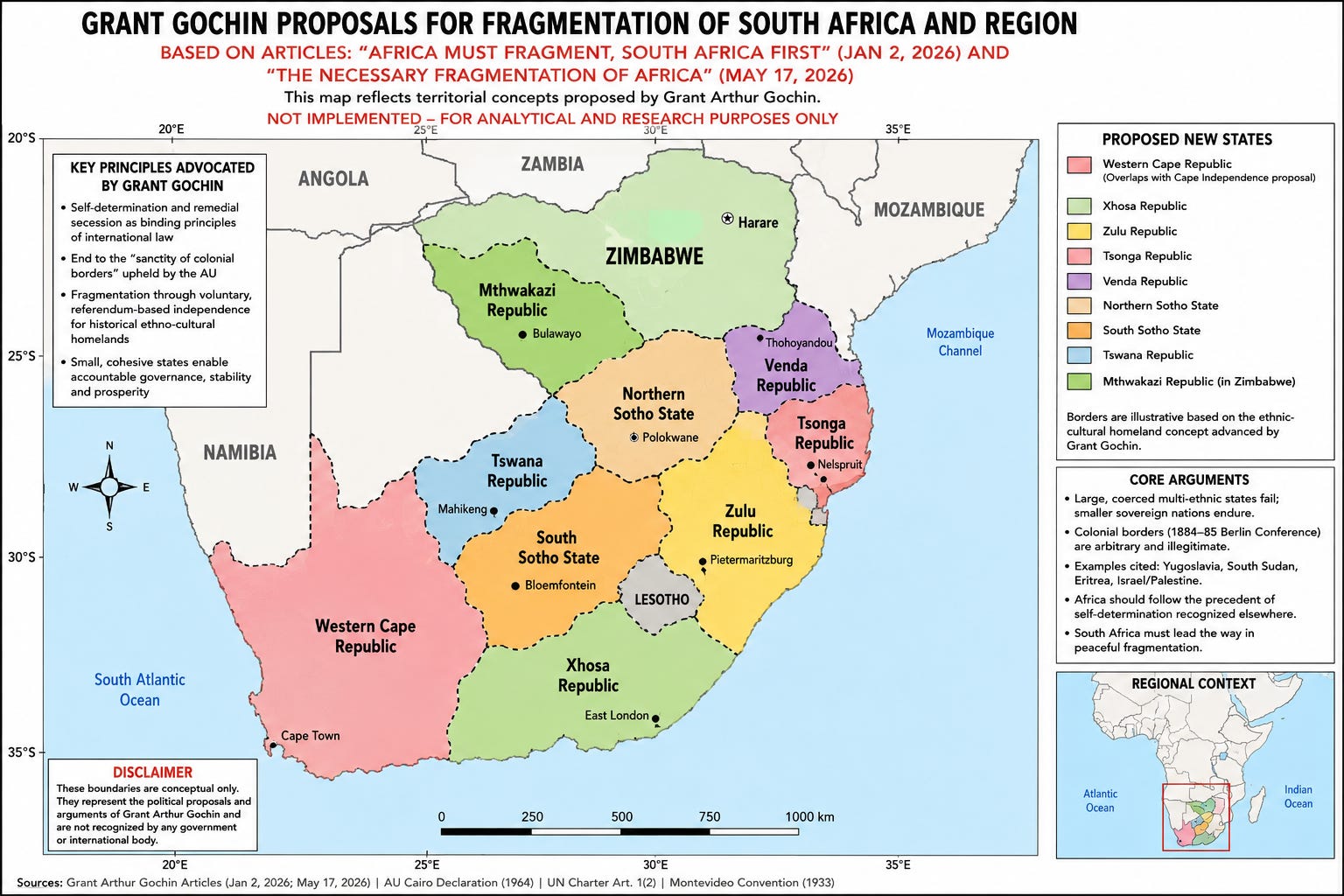
(Arthur Gochin’s proposed partition of Southern Africa – conceptual representation)
The Gukurahundi massacres of 1983 to 1987, in which the North Korean-trained Fifth Brigade of the Zimbabwe National Army killed an estimated 20,000 civilians in Matabeleland and the Midlands under orders that multiple historians and human rights organisations have characterised as genocidal, including the Catholic Commission for Justice and Peace in Zimbabwe’s 1997 report Breaking the Silence, Building True Peace, provide Mthwakazi advocates with a documented historical grievance of the first order. The massacre is not fabricated. The suffering of Matabeleland’s Ndebele population under Mugabe’s ZANU-PF state is historically established. The question this analysis must address is whether external advocacy networks are instrumentalising that genuine grievance for strategic purposes extending well beyond the communities they claim to represent.
IV. THE INSTITUTIONAL INFRASTRUCTURE AND ITS CONFLICTS OF INTEREST
The structural positioning of the principal advocate in this network deserves sustained attention. Gochin simultaneously holds AU diplomatic credentials as Emeritus Special Envoy for Diaspora Affairs, a title which, regardless of its emeritus status, carries institutional legitimacy within African diplomatic circuits, while formally advising a secessionist party that seeks to detach territory from a member state of that same AU. His role as Honorary Consul for Togo provides additional multilateral credibility. His professional base in Los Angeles, his financial planning practice, and his established networks within the Lithuanian Jewish heritage community and international Holocaust accountability organisations give him access to donor communities, government officials, and media platforms that a purely African civil society organisation could not readily access.
The articles published in the Times of Israel represent the public-facing portion of what appears to be a broader advisory relationship. The Mthwakazi Republic Party was founded in Bulawayo in January 2014 and formally submitted a petition to SADC in September 2023 carrying 25,880 signatures, registered under reference number 3951863, which has not received formal engagement from the SADC Secretariat. The party’s president, Mqondisi Moyo, has publicly cited the 2019 Bougainville referendum, in which 97.7 percent of voters supported independence from Papua New Guinea, as international precedent. The incorporation of recognition doctrine expertise from a US-based advisor with AU credentials represents a qualitative shift in the movement’s international positioning.
The response of the Zimbabwean state has been disproportionate and revealing. ZANU-PF political commissar Munyaradzi Machacha described the MRP’s programme as a declaration of war. President Emmerson Mnangagwa publicly stated that those who advocate for the secession of the country are shortening their lives, a formulation that constitutes, on any ordinary reading, a death threat issued by a sitting head of state against a registered political party peacefully petitioning a regional body. That formulation is also a precise echo of the political climate that preceded Gukurahundi. The international community’s silence in response to Mnangagwa’s statement is itself analytically significant.
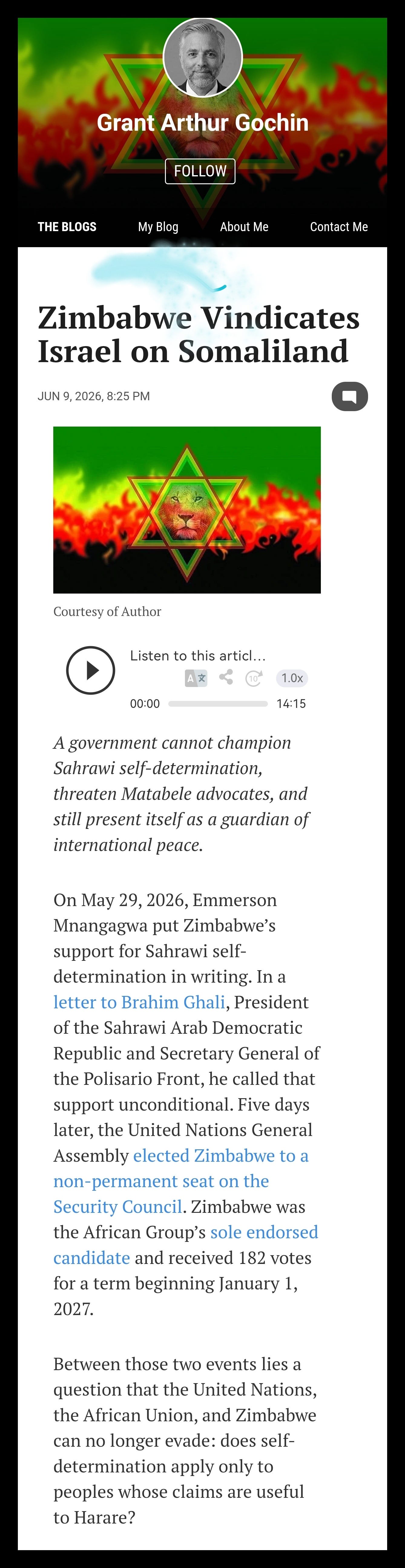
Both Zimbabwe and South Africa have taken formal international positions in support of Palestinian statehood. South Africa filed its case against Israel at the International Court of Justice in December 2023 under the Genocide Convention, with hearings commencing in January 2024. Zimbabwe has maintained consistent support for Palestinian recognition within AU and UN bodies. The two states that are the specific targets of Gochin’s fragmentation programme are the two most institutionally prominent African challengers to Israeli foreign policy objectives. Whether that coincidence reflects coordinated strategy or the alignment of parallel interests cannot be determined from publicly available evidence alone, but the question cannot be responsibly avoided in any serious geopolitical analysis of this network.
V. RESOURCE GEOGRAPHY, DIGITAL CONTROL, AND THE GLOBAL GOVERNANCE CONTEXT
The fragmentation of large African states into smaller successor units would produce a structural consequence of direct relevance to international resource and financial governance. Smaller states with weaker institutional capacity, reduced bargaining power, ongoing legitimacy disputes, and diminished diplomatic representation are systematically less able to negotiate equitable resource contracts, maintain sovereign control over mineral extraction, resist financial conditionality from the International Monetary Fund and World Bank, or coordinate regional responses to external political pressure. South Africa’s mineral wealth, including 91 percent of global platinum group metal reserves, the world’s largest chrome and manganese deposits, and substantial gold production, combined with its position as the continent’s most sophisticated financial market, makes its institutional fragmentation a prize of extraordinary geopolitical value.
The World Economic Forum’s Africa engagement, conducted through its annual Davos meetings and through the Africa regional community programmes documented on its website, has consistently framed African development in terms of public-private partnerships, digital financial infrastructure, and integration into global value chains, frameworks that assume intact state institutions capable of signing international agreements. However, the simultaneous advocacy within WEF-adjacent networks for governance restructuring, anti-corruption frameworks, and the promotion of sub-national governance units creates an intellectual environment in which the weakening of central state authority is presented as reform rather than capture.
The Oppenheimer family’s historical role in South African mineral extraction, through De Beers, Anglo American, and the financial structures they built over the twentieth century, represents the most studied example of resource geography shaping political boundary preferences in the southern African region. Nicky Oppenheimer sold his family’s 40 percent stake in De Beers to Anglo American for approximately 5.1 billion US dollars in 2012, but the family’s investments in South African agriculture, private security, and conservation landholdings remain substantial. The alignment between mineral geography and proposed ethnic boundaries in the fragmentation programme has not been publicly examined in relation to existing mineral concession maps a gap in the analytical literature that represents a significant research priority.
VI. COUNTERARGUMENTS AND THEIR LIMITATIONS
The strongest counterargument available to advocates of the fragmentation programme is the genuine institutional failure of the post-colonial African state. South Africa’s central government debt standing at approximately 78.9 percent of GDP as of late 2025, according to CEIC and South African Reserve Bank data, combined with contingent liabilities from Eskom and Transnet exceeding R700 billion in guarantees, represents a fiscal position of genuine severity. Load-shedding reached Stage 6 on multiple occasions between 2022 and 2024 before partial stabilisation. Municipal service delivery failures in Johannesburg, Tshwane, and Buffalo City are documented extensively in the South African Human Rights Commission reports of 2022 and 2023. The ANC’s systemic corruption, catalogued in the Zondo Commission Report delivered across 2021 and 2022, running to over five thousand pages and implicating hundreds of public officials, is a matter of public record rather than partisan allegation.
Zimbabwe’s governance record under both Mugabe and Mnangagwa is similarly bleak. Annual inflation reached 5,000 percent in 2020 before currency reforms partially stabilised the situation. Land reform, executed between 2000 and 2003, destroyed approximately 70 percent of commercial agricultural output by the government’s own subsequent admissions. Political violence against opposition MDC and CCC structures has been documented across multiple election cycles by SADC observer missions, despite those missions’ diplomatic language. The grievances being mobilised by the Mthwakazi programme are therefore not manufactured.
However, the existence of genuine grievance does not validate every proposed remedy. The Yugoslav dissolution’s body count, the South Sudanese state collapse following independence, the continued unrecognised limbo of Somaliland despite thirty-four years of self-governance, and the historical pattern of externally managed secessions producing resource-dependent micro-states rather than sovereign development, all constitute serious empirical objections to the proposition that fragmentation resolves rather than compounds institutional failure. The African Union’s 1964 Cairo Declaration on border inviolability was not a colonial imposition but a deliberate post-independence choice by African leaders who concluded, with substantial historical reasoning, that the alternative, ethnically contested borders across a continent of over 3,000 distinct ethnic groups, would produce permanent warfare. That reasoning has not been addressed in Gochin’s argument, which treats the Cairo Declaration exclusively as an instrument of ANC or ZANU-PF self-interest rather than as a considered multilateral legal strategy.
VII. ANALYTICAL CONCLUSIONS
What has been assembled and made visible through the Times of Israel publications, the Mthwakazi Republic Party advisory relationship, the Somaliland recognition, and the anti-migrant violence targeting Shona speakers in KwaZulu-Natal is not yet a coordinated operational programme, but it is something more coherent than coincidence. A recognition doctrine network is being constructed that shares intellectual architecture, institutional positioning, and a consistent identification of targets. The targets are large, resource-rich African states that have taken adversarial positions toward Israeli foreign policy. The doctrine being deployed draws explicitly on Zionist precedent and Yugoslav methodology. The principal current advocate carries simultaneous accreditation from the organisation whose borders he is arguing should be redrawn.
African governments, the African Union Commission, SADC structures, and African civil society organisations have not engaged systematically with this network’s development. The Mthwakazi Republic Party’s September 2023 petition to SADC remains unacknowledged under reference number 3951863. The conflict of interest embedded in Gochin’s simultaneous AU and MRP affiliations has not been publicly examined by AU institutional bodies. The pattern of anti-migrant violence specifically targeting the ethnic communities that would need to be mobilised against each other for partition to function has not been connected in public analysis to the concurrent advocacy programme.
The seeds being planted are identifiable. Their watering is in progress. Whether they produce the harvest their architects intend will depend in considerable measure on whether African analytical and institutional communities recognise the programme for what the documentary record suggests it may represent and respond with the seriousness that a coordinated external challenge to the territorial integrity of the continent’s largest economies demands. The Berlin Conference of 1884 succeeded because African leaders did not see it coming until after the lines had been drawn. The documentary trail examined in this analysis suggests that the relevant documents are being written in public, in the Times of Israel, by a man whose institutional affiliations span both the organisation being targeted and the secessionist parties doing the targeting.
Authored By: Global GeoPolitics
If you prefer to make a one time donation in support of my work, you can do so by clicking any link below:
https://buymeacoffee.com/ggtv |
https://ko-fi.com/globalgeopolitics |
Bitcoin: 3NiK8BoRZnkwJSHZSekuXKFizGPopkE7ns
References
African Union. (1964). Cairo Declaration on the Inviolability of Inherited Colonial Borders, OAU Resolution AHG/Res. 16(I). Organisation of African Unity, Cairo.
Bosnia and Herzegovina v. Serbia and Montenegro. (2007). Case Concerning the Application of the Convention on the Prevention and Punishment of the Crime of Genocide. International Court of Justice. Judgment, 26 February 2007. ICJ Reports 2007.
Cape Independence Advocacy Group / Victory Research. (2025). Western Cape Independence Poll. March 2025. Commissioned survey data cited in Times of Israel, 2 January 2026.
Catholic Commission for Justice and Peace in Zimbabwe. (1997). Breaking the Silence, Building True Peace: A Report on the Disturbances in Matabeleland and the Midlands, 1980–1989. CCJP and Legal Resources Foundation, Harare.
CEIC / South African Reserve Bank. (2025). South Africa Central Government Gross Debt as Percentage of GDP, Q3 2025 data release. Pretoria: SARB Statistical Release P0141.
Fragile States Index. (2012–2018). South Sudan Country Scores. Fund for Peace: Washington DC. Annual publications.
Gochin, G.A. (2026, 2 January). Africa Must Fragment, South Africa First. Times of Israel. Jerusalem.
Gochin, G.A. (2026, 17 May). The Necessary Fragmentation of Africa. Times of Israel. Jerusalem.
Herzl, T. (1896). Der Judenstaat: Versuch einer modernen Lösung der Judenfrage. Leipzig and Vienna: M. Breitenstein.
International Criminal Tribunal for the former Yugoslavia. (1993–2017). Case statistics and conviction records. ICTY: The Hague. See also ICTY Key Figures of the Completion Strategy, 2017.
Mthwakazi Republic Party. (2023, September). Petition to the SADC Secretariat on Mthwakazi Self-Determination. SADC reference number 3951863. Gaborone: SADC Secretariat.
Netanyahu, B., and Sa’ar, G. (2025, 26 December). Joint Declaration of Mutual Recognition between the State of Israel and the Republic of Somaliland. Office of the Prime Minister of Israel, Jerusalem.
South African Human Rights Commission. (2022). Report on Municipal Service Delivery Failures. Johannesburg: SAHRC.
Southern Sudan Referendum Commission. (2011). Final Results of the Southern Sudan Referendum, 7 February 2011. Juba: SSRC.
United Nations Mission in South Sudan. (2018). Annual Report on Human Rights. UNMISS: Juba.
United Nations Security Council. (1993). Resolution 827: Establishing the International Criminal Tribunal for the former Yugoslavia, 25 May 1993. S/RES/827.
Yinon, O. (1982). A Strategy for Israel in the Nineteen Eighties. Kivunim: A Journal for Judaism and Zionism, Issue 14, Winter 1982. World Zionist Organisation, Jerusalem.
Zondo Commission of Inquiry. (2021–2022). State Capture Report, Parts 1–6. Judicial Commission of Inquiry into Allegations of State Capture, Corruption and Fraud in the Public Sector including Organs of State. Pretoria: Government Printer.
© 2026. This analysis is submitted for scholarly, journalistic, and policy circulation. Reproduction with full citation is permitted.
Appendix
Understanding the Historical Fragmentation Proposals
The idea of partitioning South Africa and its relationship with Zimbabwe (formerly Rhodesia) has circulated in political and academic circles since the 1970s, though it has never been implemented. These proposals emerged as a response to the deadlock over apartheid, suggesting a geopolitical alternative to unitary state structures. The core argument held that dismantling the unitary state was a necessary precondition for demonolithising South African society, with the goal of creating autonomous states that might eventually form a federal community. The most detailed partition proposals focused exclusively on South African territory rather than carving up Zimbabwe. One plan from 1976 suggested dividing South Africa along a line stretching from Port Elizabeth to Bloemfontein and Kimberley, continuing to the Botswana border. A more comprehensive framework, developed by thinkers exploring “proportional partition,” proposed creating a White homeland known as the Republic of Sudia alongside a Black state occupying the remainder of South Africa.
Geographic Description of Proposed Partition Zones
The Proposed White Homeland (Republic of Sudia)
According to the most detailed partition framework, the White homeland would stretch in a straight line from Knysna on the southern coast to Prieska in the Northern Cape, then through Calvinia to Koekenaap on the South Atlantic Ocean. This area encompassed the earliest White settlement regions of the Cape, with Prieska identified as a pivotal point due to its position near the Orange River, which would place the waters of this major river at the disposal of the White state.
The Black State Territory
Under proportional partition proposals, the largest portion of South Africa would be allocated to the Black population, reflecting both demographic majority and the need to provide for any White, Coloured, and Asian residents who chose to live under Black governance. The Kei River was mentioned as a potential eastern boundary modification point, with one proponent suggesting the Prieska Polygon as a refined territorial arrangement.
Zimbabwe’s Position in Regional Fragmentation Thinking
Unlike South Africa, Zimbabwe has not been the subject of detailed partition proposals in the same academic or political literature. However, historical boundary negotiations between British and Portuguese authorities in 1892 established the Anglo-Portuguese boundary that separated British territory (later Zimbabwe) from Portuguese territory (later Mozambique) (3). These colonial-era divisions, along with proposals from 1900 to 1945 for re-partitioning British colonial territories in Southern Africa, laid groundwork for later discussions about regional restructuring (4).
The following diagram illustrates the conceptual partition zones described in the historical literature:
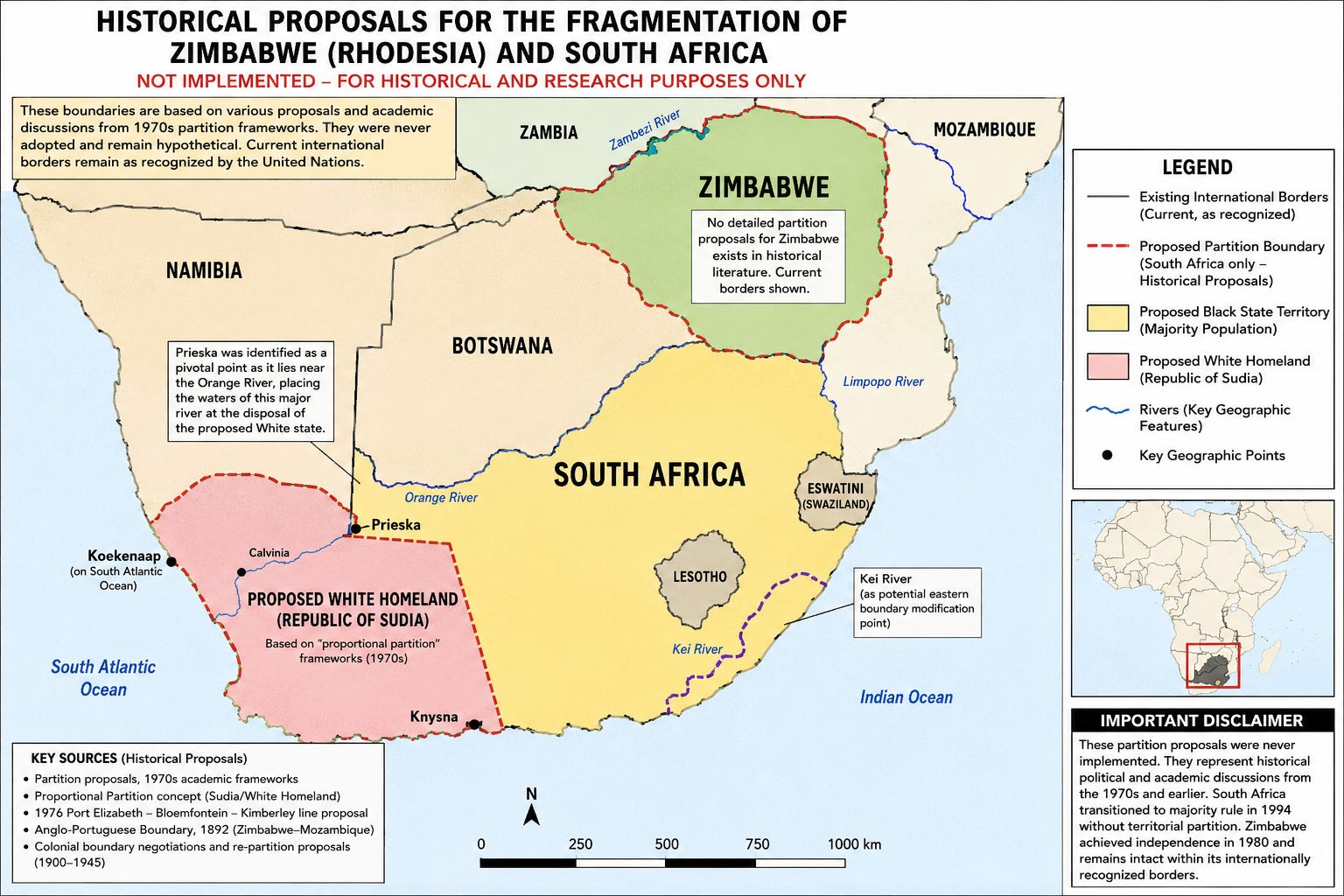
(Disclaimer: These boundaries were never realised)
Important Historical Context
These partition proposals emerged from a specific historical moment of political deadlock. As one analyst noted in the mid-1970s, the international community needed to move beyond concentrating on the functional aspects of apartheid toward confronting Whites in South Africa with a geopolitical alternative to the status quo. The proposals were controversial then and remain so today. Some critics argued that partition would require staggering amounts of aid to bring the Black half up to White standards, while others noted that broken treaties shower the African continent like confetti. The proposals were never adopted, and South Africa ultimately transitioned to majority rule in 1994 without territorial partition.
Citation Summary
Source and Key Information
(1) Yale University Library – Wyld’s 1874 map of diamond and gold fields covering South Africa and Zimbabwe
(2) Origins: Current Events in HistoricalPerspective – Political history of Zimbabwe and South Africa from independence to 2024
Proportional partition proposal document – Detailed Sudia/White homeland boundaries with Prieska Polygon and Knysna to Koekenaap line
(3) The National Archives (MFQ 1/409) – 1892 Anglo-Portuguese boundary maps separating Zimbabwe from Mozambique
Partition analysis text 1976 – Port Elizabeth-Bloemfontein-Kimberley partition line, Whitestan proposals
(4) WorldCat catalog – 1900-1945 proposals for re-partitioning British Southern African territories
(5) David Rumsey Map Collection – 1926 Union of South Africa map with political boundaries and railways


Leave a comment