
Ghalibaf’s “Schrödinger’s Empire”: Why Iran May Hold the Strategic Lever in the Strait of Hormuz
General Article | September 2026
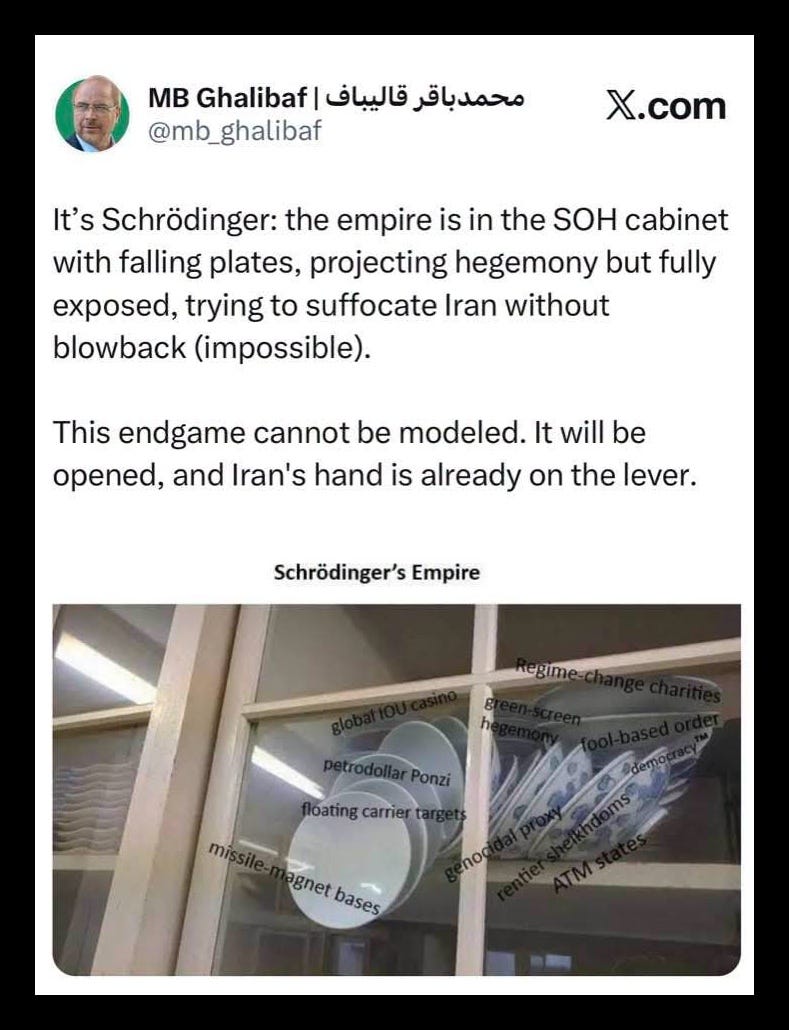
In his latest post, Mohammad Bagher Ghalibaf uses the idea of Schrödinger’s cat to describe the current situation between the United States and Iran. Schrödinger’s famous thought experiment describes a cat inside a sealed box. Until the box is opened, the cat can be described as being in two possible states at the same time: alive and dead. Ghalibaf uses this idea as a metaphor for America’s position. He argues that the United States can appear powerful and dominant while, at the same time, being exposed to serious risks and limitations. In his view, we will not know which reality matters most until the situation is tested.
The “box” in his analogy represents the strategic situation surrounding the Strait of Hormuz. Hormuz is extremely important because a large share of the world’s oil trade passes through it. The United States has military bases, naval forces and aircraft carriers in the wider region, while Gulf states and global energy markets also depend heavily on the continued movement of ships through the area. Ghalibaf’s argument is that these different interests are all connected inside the same “box.” A crisis involving one part could therefore affect many of the others.
The reference to “falling plates” describes the idea that putting pressure on Iran could create a chain reaction. Instead of each problem remaining separate, military pressure, energy prices, shipping, US military bases, Gulf allies, the dollar-based financial system and international trade could all begin affecting one another. His point is that the consequences may not develop one at a time. They could spread across several areas simultaneously.
When Ghalibaf says that the United States is trying to “suffocate Iran without blowback,” he is describing what he sees as a difficult objective: putting enough economic and military pressure on Iran to weaken it while preventing serious consequences for the United States and the wider global economy. His argument is that these two objectives may be difficult to achieve at the same time because Iran is capable of responding in ways that could affect regional security, shipping and energy markets.
The statement that “this endgame cannot be modeled” refers to the difficulty of predicting how such a confrontation would ultimately develop. Ghalibaf is arguing that traditional assumptions about the region may no longer be reliable if the Strait of Hormuz becomes part of the conflict. Once shipping, energy supplies and military forces become directly involved, the number of possible outcomes increases significantly.
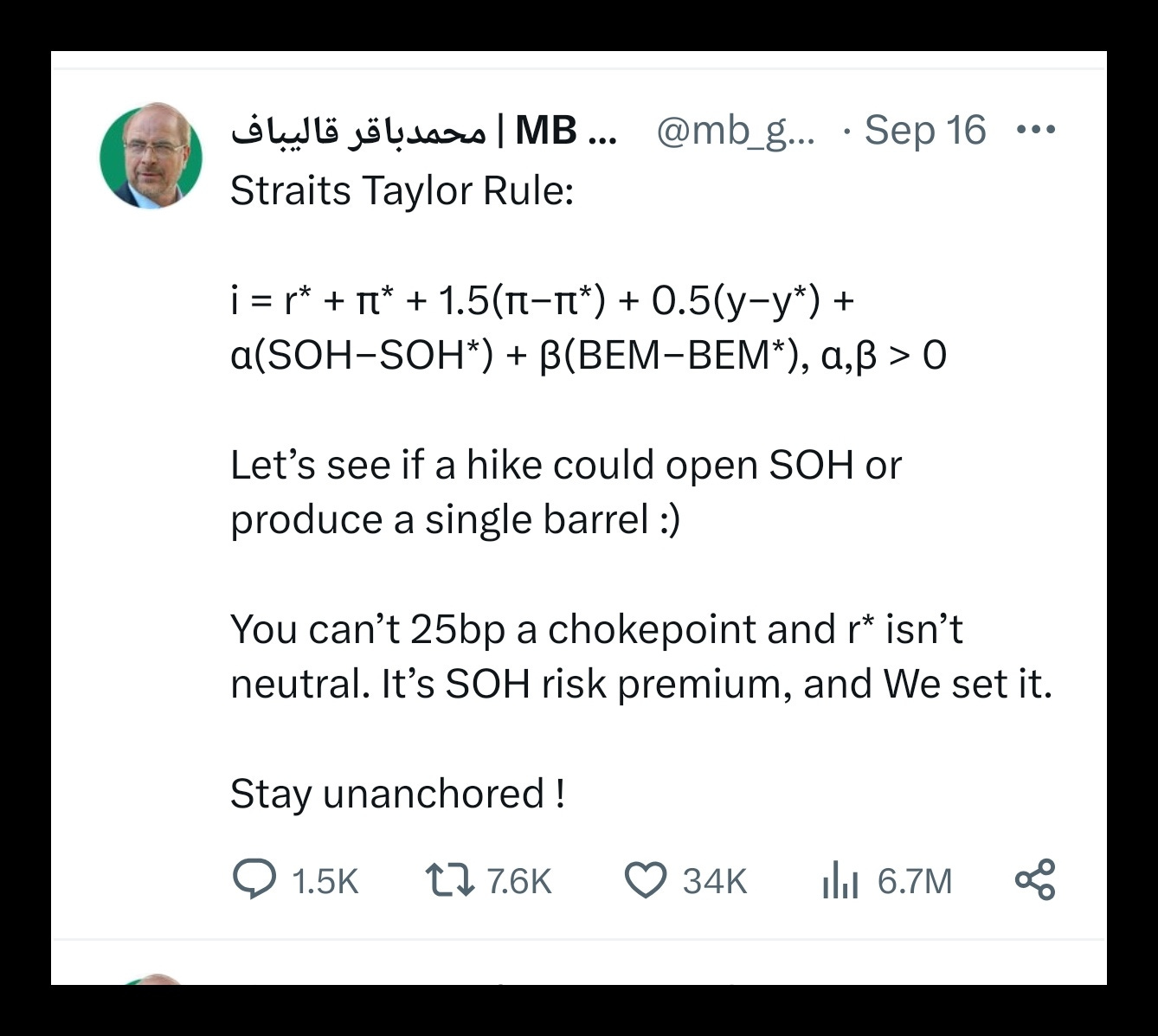
Ghalibaf has now taken this argument one step further by rewriting the Taylor Rule itself. His “Straits Taylor Rule” keeps the conventional variables for inflation and economic output but adds two new terms: the Strait of Hormuz and the Bab el-Mandeb. In other words, he is arguing that geopolitical chokepoints should be treated as direct economic variables because they can affect oil supplies, shipping costs, insurance, inflation and ultimately the financial conditions facing central banks. The equation is not simply a metaphor; it puts a mathematical structure around the argument that a physical disruption to energy flows can become a monetary-policy problem.
The significance of Ghalibaf’s modification is that it reverses the usual direction of the argument. Normally, the central bank adjusts interest rates in response to inflation and economic conditions. Ghalibaf is effectively asking what happens when the source of inflation lies outside the central bank’s control. A 25-basis-point rate increase can influence borrowing, spending and demand, but it cannot reopen the Strait of Hormuz, move a tanker through a closed shipping route or create an additional barrel of oil. His point is that the physical chokepoint can therefore become an independent source of inflationary pressure and risk. That is what lies behind his statement that “r* isn’t neutral”: the traditional neutral rate is being altered by the geopolitical risk premium created by the straits.
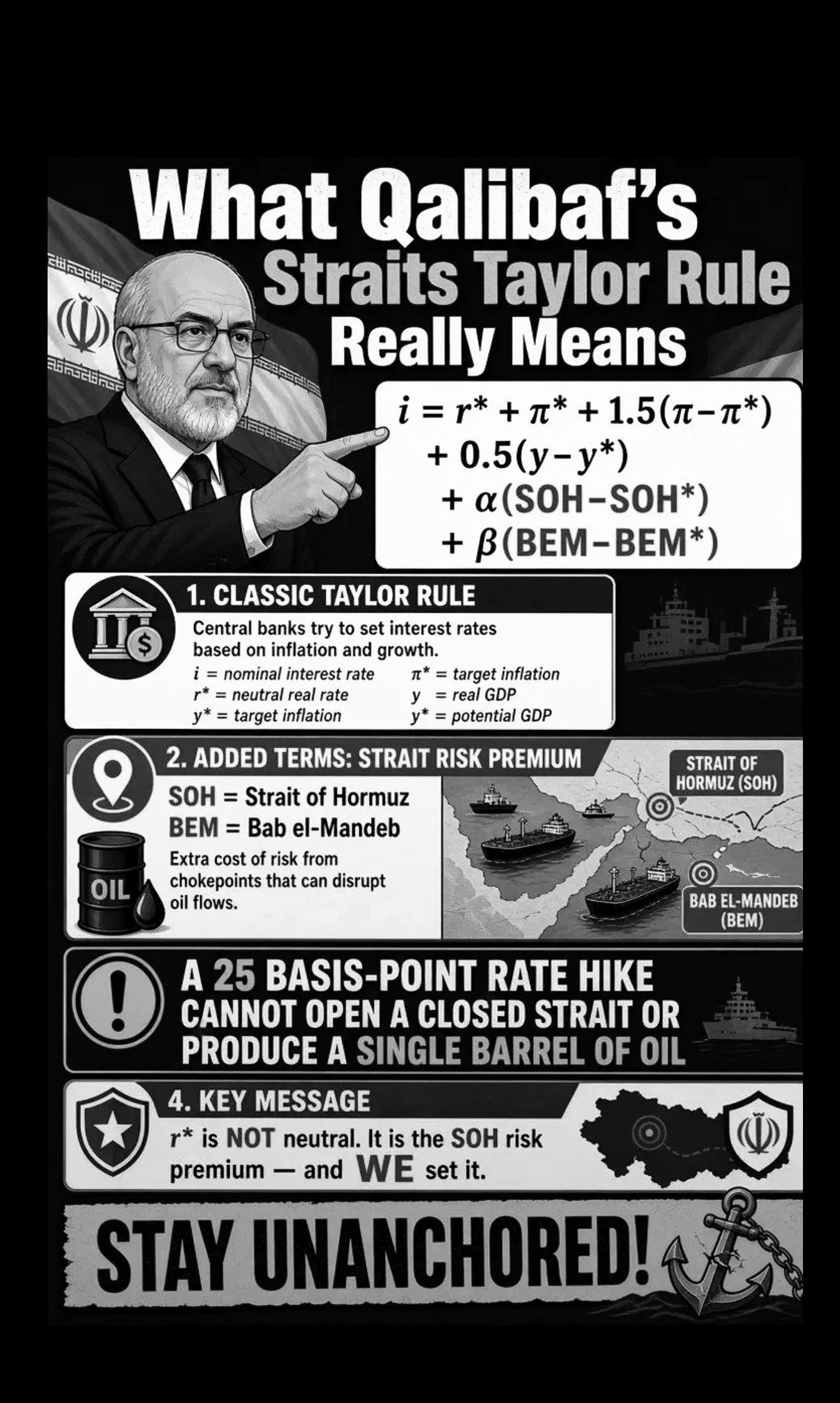
This is why the phrase “Ghalibaf’s Taylor Rule” has taken on a meaning beyond the original joke. He has effectively inserted geopolitics into the monetary-policy equation. The more severe the disruption at the energy chokepoints, the greater the pressure transmitted through oil prices, freight, insurance and inflation. His underlying argument is straightforward: central banks can respond to the economic consequences, but they do not control the physical mechanism producing the shock. In Ghalibaf’s formulation, that mechanism gives Iran strategic leverage over variables that normally sit outside the control of monetary policymakers.
Finally, when he says that “Iran’s hand is already on the lever,” he is using another metaphor for Iran’s ability to influence what happens in and around the Strait of Hormuz. He is suggesting that Iran has potential ways to disrupt or restrict shipping, increase the cost and risk of transporting oil, or otherwise put pressure on the international system. The “lever” therefore represents Iran’s ability to trigger consequences beyond the immediate battlefield.
The central message of Ghalibaf’s post is that he sees the situation as a connected system rather than a simple confrontation between two countries. His argument is that the United States may have considerable military and economic power, but that power exists within a wider network of vulnerable interests. In his metaphor, everyone is inside the same glass box, the plates are already shaking, and opening the box could reveal consequences that are difficult to predict or control.
Authored By: Global GeoPolitics
Thank you for visiting. This is a reader-supported publication. If you believe journalism should serve the public, not the powerful, and you’re in a position to help, becoming a PAID SUBSCRIBER truly makes a difference. Alternatively you can support by way of a cup of coffee:
https://buymeacoffee.com/ggtv |
https://ko-fi.com/globalgeopolitics |
Bitcoin: 3NiK8BoRZnkwJSHZSekuXKFizGPopkE7ns
References
Al Jazeera (2026) ‘Ghalibaf’s maths missile at Trump decoded: Is Iran fixing US interest rates?’, 17 September. Available at: Al Jazeera (Accessed: 21 September 2026). Al Jazeera
Bank for International Settlements (2024) Hofmann, B., Manea, C. and Mojon, B., ‘Targeted Taylor rules: some evidence and theory’, BIS Working Paper No. 1234, 10 December. Available at: Bank for International Settlements (Accessed: 21 September 2026). Bank for International Settlements
Business Insider (2026) ‘Iran’s parliamentary speaker is taunting the Fed for its inability to bring down oil prices’, 17 September. Available at: Business Insider (Accessed: 21 September 2026). Business Insider
Federal Reserve Board (2010) ‘Oil shocks and the zero bound on nominal interest rates’. International Finance Discussion Papers No. 1009. Available at: Federal Reserve Board (Accessed: 21 September 2026). Federal Reserve
International Energy Agency (2026) ‘Strait of Hormuz’. Factsheet, February. Available at: International Energy Agency (Accessed: 21 September 2026). IEA
Indian Express (2026) ‘Taylor Rule: What is the math equation Iran invoked in jibe at Trump?’, 18 September. Available at: The Indian Express (Accessed: 21 September 2026). The Indian Express
Taylor, J.B. (1993) ‘Discretion versus policy rules in practice’, Carnegie-Rochester Conference Series on Public Policy, 39, pp. 195–214. Available at: Stanford University , full paper (Accessed: 21 September 2026). Stanford University
Ghalibaf, M.B. (2026) ‘Straits Taylor Rule’, post on X, 16 September. Available at: Ghalibaf’s X post as reproduced and documented by Al Jazeera (Accessed: 21 September 2026). Al Jazeera


Leave a comment