
Netanyahu’s Citizenship Threat, the Collapse of Cultural Silence and the Accelerating Shift Against Israeli Power
General Article | September 2026
Benjamin Netanyahu stated in a video address that he would advance two bills aimed at those causing “immense damage” to the Israel Defense Forces. The first would enable revocation of citizenship for anyone who defames Israeli soldiers; the second would increase the financial penalties available in defamation suits by a factor of twenty. He named the makers of NAZA, former deputy chief of staff Yair Golan, and the former military advocate-general who authorised release of a detainee-abuse video as examples of the conduct requiring punishment. “Hit them both in the pocket and through their citizenship, because they have no place among us,” he declared. Culture Minister Miki Zohar had already called for the filmmakers’ citizenship to be stripped on grounds of treason. President Isaac Herzog dismissed the idea of revocation as having “no chance,” yet the prime ministerial commitment itself signals an escalation in the use of legal and civic status as instruments of narrative control.

NAZA draws on interviews with Israeli service members and intelligence personnel to argue that AI-assisted targeting systems incorporated expected civilian casualties as a routine parameter rather than an exceptional cost. The film’s directors, both Israeli citizens, have insisted that recognition of governmental actions in Gaza is a necessary act of national accountability. Netanyahu’s response reframes such testimony as defamation warranting the ultimate civic penalty. The International Criminal Court maintains outstanding arrest warrants for Netanyahu and former defence minister Yoav Gallant on charges of war crimes and crimes against humanity; the International Court of Justice continues to hear a genocide case against Israel. Official Israeli statements continue to attribute civilian deaths to isolated protocol violations or to Hamas’s use of human shields, while rejecting systematic intent. The proposed legislation would place Israeli citizens who contradict that official framing at risk of formal exclusion from the polity itself.
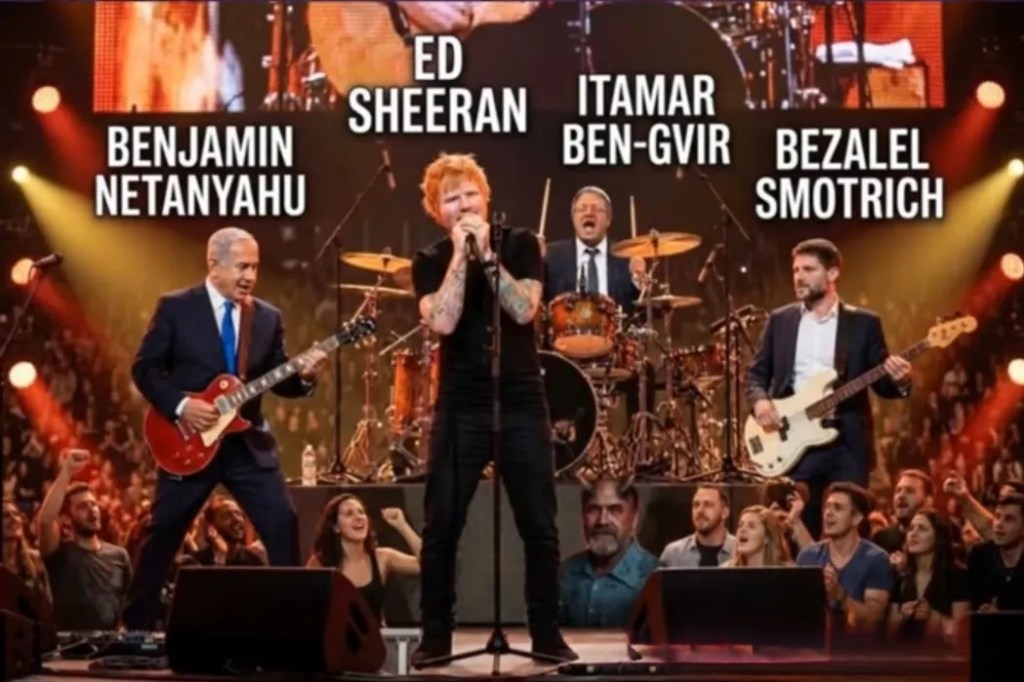
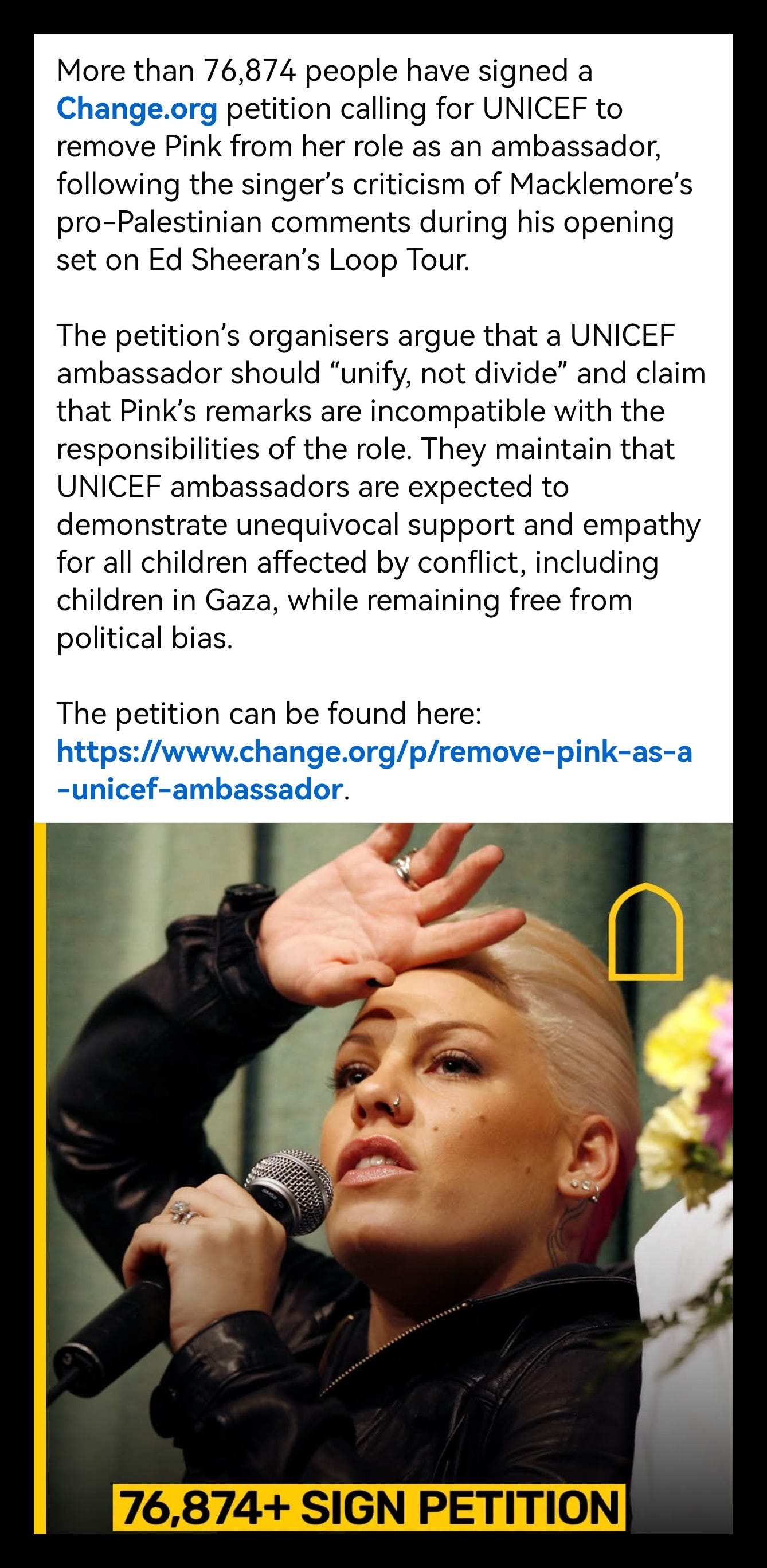
At the same moment, the commercial machinery of Western popular culture has demonstrated parallel intolerance. Macklemore, opening for Ed Sheeran at MetLife Stadium, performed the protest song “Hind’s Hall,” displayed images from Gaza, and stated that people in Gaza and the occupied West Bank had not been forgotten. Venue owners, led by Robert Kraft of Gillette Stadium, refused to host further shows if Macklemore remained on the bill. The promoter removed him. Every remaining support act then withdrew in solidarity, leaving Sheeran’s US leg without openers and under threat of further disruption. Sheeran publicly distanced himself from the decision, describing it as the promoter’s and the venues’. Pink, a long-standing UNICEF goodwill ambassador, reposted criticism of Macklemore and later defended her position by reference to her Jewish identity and concern for Jewish audiences. A Change.org petition demanding her removal from the UNICEF role rapidly accumulated tens of thousands of signatures, arguing that an ambassador must unify rather than divide and that her comments conflicted with impartial advocacy for children affected by conflict.
(Novara Media: Benjamin Netanyahu has wasted no time in threatening to strip the directors of NAZA of their Israeli citizenship, after their documentary criticised the Israeli military. Dalia Gebrial explains that this is straight out of the toolbox of 20th century fascism. “When you strip someone of their citizenship, you strip them of their ability to access any human rights,” she says on Novara Live.)
The coincidence of these events marks a rupture rather than a mere tightening of control. Netanyahu’s threat to strip citizenship from Israeli critics arrives at the precise moment when independent Israeli testimony about the scale of civilian deaths in Gaza has broken into international view and when Western cultural institutions are being forced, against their commercial preferences, to confront the same evidence. The removal of Macklemore and the subsequent collapse of Ed Sheeran’s support line-up demonstrate that the machinery of venues, promoters and political donors can still impose immediate professional costs. Yet the speed with which other artists abandoned the tour, the rapid growth of petitions against Pink’s UNICEF role, and the continued expansion of street protests across European and North American cities indicate that those costs no longer deter public expression at the scale once assumed.
In Britain the sustained attempt to restrict pro-Palestine demonstration through expanded police powers, venue bans and selective prosecution has failed to shrink the size or frequency of the marches. Larger crowds continue to assemble despite the legal pressure, suggesting that official efforts to contain the issue have instead radicalised it. Similar patterns are visible elsewhere: each new institutional punishment of speech produces a wider circle of participants who treat the punishment itself as proof of the underlying case. Netanyahu’s legislative escalation, by converting domestic criticism into a formal act of national betrayal, accelerates the same dynamic outside Israel. What was previously dismissed as marginal or antisemitic is increasingly read by broader publics as evidence of systematic impunity protected by legal and commercial force.
The historical significance lies less in any single cancellation or bill than in the simultaneous exposure of the limits of both instruments. Citizenship revocation and stadium blacklisting remain powerful against individuals, yet they no longer command the broader narrative. Public opinion is shifting not merely against particular policies but against the presumption that those policies can be conducted indefinitely without reciprocal political cost. That shift is incomplete, uneven and still contested by substantial institutional power. Its direction, however, is now measurable in the size of the protests that survive crackdowns, in the readiness of commercially successful artists to forfeit income rather than remain silent, and in the growing refusal of younger audiences to accept the older framing of the conflict. Netanyahu’s decision to double down at this juncture therefore risks converting a contested military campaign into a lasting legitimacy crisis whose effects will outlast any single government.
Authored By: Global GeoPolitics
Thank you for visiting. This is a reader-supported publication. If you believe journalism should serve the public, not the powerful, and you’re in a position to help, becoming a PAID SUBSCRIBER truly makes a difference. Alternatively you can support by way of a cup of coffee:
https://buymeacoffee.com/ggtv |
https://ko-fi.com/globalgeopolitics |
Bitcoin: 3NiK8BoRZnkwJSHZSekuXKFizGPopkE7ns
References
Netanyahu, B. (2026) Video address proposing legislation on citizenship revocation and enhanced defamation damages, mid-September. Reported by Reuters, Ynet, Times of Israel and Jewish Telegraphic Agency.
Abraham, Y. and Szor, R. (2026) NAZA, documentary premiered at Venice Film Festival, 10 September; Special Jury Prize.
Messina Touring Group and related statements (2026) Confirmation of Macklemore’s removal from Ed Sheeran’s US Loop Tour, 14–15 September. Coverage by BBC, New York Times, Guardian and Billboard.
Pink (2026) Instagram statements defending criticism of Macklemore and referencing UNICEF role, mid-September.
Change.org petition (2026) ‘Remove Pink as a UNICEF Ambassador’, launched 11 September and accumulating tens of thousands of signatures.


Leave a comment