Why Pedro Sánchez’s speech named the three forces destroying international law, and why the silence that followed indicts everyone who clapped
General Article | September 2026
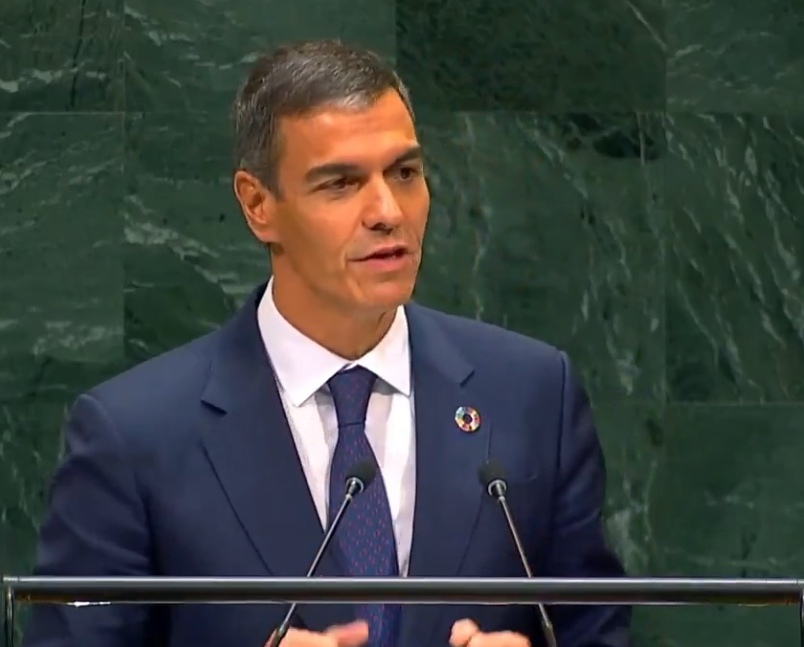
Pedro Sánchez walked to the United Nations podium on Wednesday holding a small blue booklet, and he held it up so the hall could see it clearly, and the object was the UN Charter, the founding document of the entire institution, the text that every government represented in that room had signed. He said they did not ask us to keep it in a display case, and he said they asked us to comply with it, and in that sentence he established the standard against which everything that followed would be measured. The room that contains the machinery of international law sat and listened to a man explain, methodically and without naming anyone, how that machinery is being deliberately destroyed, and the methodical quality of the explanation was itself an argument because it demonstrated that the destruction is not accidental but intentional. First question the rules, then break them knowing no one will enforce consequences, cut funding to the institutions, target their leadership and staff, block their capacity to act, then declare the whole architecture useless and expendable. No need to point, Sánchez said, because we all know who they are.
He named three pillars holding up the demolition, and the naming was an act of analytical precision rather than rhetorical excess. Selfishness, the delusion that the world is a zero-sum game where one country’s gain requires every other country’s loss. Ignorance, colossal and shameless, the kind that despises scientific consensus and operates on the assumption that sufficient power exempts a government from the basic requirements of evidence and truth. And cruelty, the worst of the three, a cruelty so normalised it no longer flinches at the ribs of a starving child or a maternity ward reduced to rubble. These three pillars are not abstractions but descriptions of observable behaviour, and the power of the speech derived from the fact that the audience could match each description to specific governments without Sánchez having to name them.
Then he said genocide, and he said it about Gaza, and he named who is committing it, and he said Netanyahu without qualifiers and without the diplomatic hedging that turns moral clarity into comfortable ambiguity. The word genocide carries legal weight under the Convention on the Prevention and Punishment of the Crime of Genocide, and its use by a sitting head of government in the General Assembly constitutes an accusation that cannot be retracted by subsequent clarification. Netanyahu speaks from that same podium today, and the sequencing was not accidental because it placed the accusation on the record before the accused took the floor, and it denied the accused the opportunity to speak first and frame the terms of the debate. The decision to name the crime and the perpetrator in the same breath was an act of political courage that few leaders have been willing to emulate, and it transformed the speech from a statement of principle into a legal and moral indictment.
He listed what Spain has done while others calculated the cost of principle, and the listing was an argument in itself because it demonstrated that the actions he advocated are not utopian but practicable. Opposed the wars of aggression in Ukraine, Lebanon, and Iran. Imposed an arms embargo on Israel. Refused to raise military spending to five per cent of GDP. Refused to allow Spanish territory to be used as a launch platform for attacks that violate international law. And against the chainsaw that severed nearly a third of the world’s development aid in two years, Spain doubled its cooperation budget and raised its multilateral contribution by sixty per cent. The chainsaw, he did not say whose, and he did not need to because when an Argentine politician carries a physical chainsaw onto a stage as a political prop and an American administration proceeds to dismantle USAID with the same symbolic ferocity, the metaphor is self-explanatory to anyone paying attention.
Then he delivered the line that deserves to outlast the speech that contained it, and which only works in the original Spanish. It took humanity centuries to replace the right of the strongest with the strength of the law. The same two words, in the same language, with their positions exchanged. A sentence that is its own argument. And we cannot be the generation that walks that road backwards. Two days earlier, from that same podium, the President of the United States had declared that to the victor belong the spoils. Two sentences, forty-eight hours apart, same microphone. One describes the world order humanity spent centuries building. The other describes the world order that preceded it. The juxtaposition was devastating because it required no commentary, and the audience understood that they were witnessing the collision of two opposing conceptions of international relations in real time.
He closed with a question that the institution cannot answer without answering for itself. In eighty years of existence, nine men have led the United Nations. Not one woman. Not one Latin American in three decades. He asked how an organisation that claims to represent all of humanity has never placed a woman at its head, and how it intends to represent every continent while systematically excluding the third most populated one. Four days before he asked that question from the podium, Michelle Bachelet’s candidacy had been sunk in the Security Council. One vote in favour, eleven against. The candidate for exactly what he was asking for had already been buried by the same room he was addressing. The question was therefore not rhetorical but evidentiary, because it demonstrated that the institution’s proclaimed commitment to representation and equality is contradicted by its own procedures, and the audience knew that the question was directed at them.
He closed by asking what history will say about this decade, about the governments that watched the rules break and chose to look away, about the ones who calculated silence as the safer option. He is right that history will ask. He is also right that the list of those who spoke is short. His name is on it. The ones who clapped and stayed quiet will need to explain to their grandchildren what they were clapping for. The final sentence is an indictment of the audience rather than the speaker, and it transforms the speech from a statement by one government into a judgement on all the governments that heard the truth and chose not to act on it.
The power of the speech derived from the convergence of several factors that are rarely present simultaneously in diplomatic discourse. It was factually accurate, and every claim could be verified. It was morally clear, and it did not hide behind the language of balance and both-sides. It was procedurally strategic, and it used the timing of the General Assembly to place accusations on the record before the accused could speak. It was institutionally self-aware, and it used the Charter to indict the institution that had failed to uphold it. It was personally courageous, and it named names and used words that other leaders avoid. And it was structurally devastating because it demonstrated that the architecture of international law is being dismantled by governments that claim to defend it, and that the dismantlement is not a failure of the system but a feature of it.
The speech will be remembered not because it changed policy immediately but because it placed on the record, in the room where the machinery of international law resides, the names and the facts and the crimes that the machinery exists to prevent. It will be remembered because it demonstrated that silence is a choice and that speaking is a possibility, and because it placed on the record the names of those who spoke and the names of those who stayed silent. It will be remembered because it used the institution’s own founding document to indict the institution’s own failure, and because it asked the question that the institution cannot answer without admitting its complicity. The Charter was in the room where it goes to die, and the man who held it up made the room witness to its own destruction.
Authored By: Global GeoPolitics
Thank you for visiting. This is a reader-supported publication. If you believe journalism should serve the public, not the powerful, and you’re in a position to help, becoming a PAID SUBSCRIBER truly makes a difference. Alternatively you can support by way of a cup of coffee:
https://buymeacoffee.com/ggtv |
https://ko-fi.com/globalgeopolitics |
Bitcoin: 3NiK8BoRZnkwJSHZSekuXKFizGPopkE7ns
References
United Nations (1945) Charter of the United Nations. San Francisco: United Nations. Available at: https://www.un.org/en/about-us/un-charter (Accessed: 27 September 2026).
United Nations (1948) Convention on the Prevention and Punishment of the Crime of Genocide. Paris: United Nations. Available at: https://www.un.org/en/genocideprevention/genocide-convention.shtml (Accessed: 27 September 2026).
United Nations General Assembly (2026) Address by the President of the Government of Spain, Pedro Sánchez Pérez-Castejón, at the General Debate of the 81st Session. New York: United Nations, 24 September. Available at: https://www.un.org/en/ga/81 (Accessed: 27 September 2026).
United Nations General Assembly (2026) Address by the President of the United States at the General Debate of the 81st Session. New York: United Nations, 22 September. Available at: https://www.un.org/en/ga/81 (Accessed: 27 September 2026).
United Nations Security Council (2026) Record of the Vote on the Candidacy of Michelle Bachelet for Secretary-General. New York: United Nations, 20 September. Available at: https://www.un.org/securitycouncil (Accessed: 27 September 2026).
Spain, Government of (2026) Spain’s Development Cooperation Budget 2026. Madrid: Ministry of Foreign Affairs. Available at:
(Accessed: 27 September 2026).
Spain, Government of (2026) Decree on Arms Embargo to Israel. Madrid: Official State Gazette. Available at:
(Accessed: 27 September 2026).
Office of the President of the United States (2026) Remarks by President Donald Trump at the United Nations General Assembly. Washington, DC: The White House, 22 September. Available at:
(Accessed: 27 September 2026).


Leave a comment