
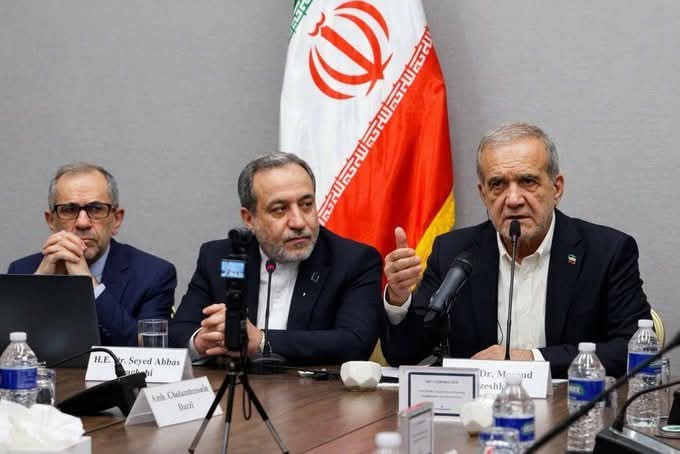
Why meeting the think tanks that predicted Iran’s collapse is an act of intellectual warfare that targets the narrative machinery of American primacy
General Article | September 2026
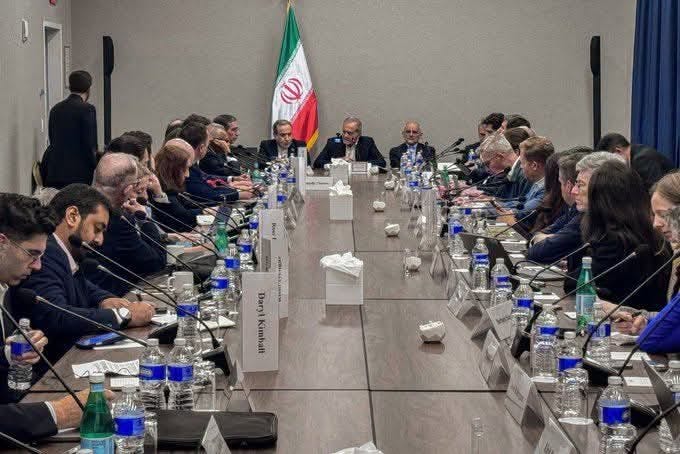
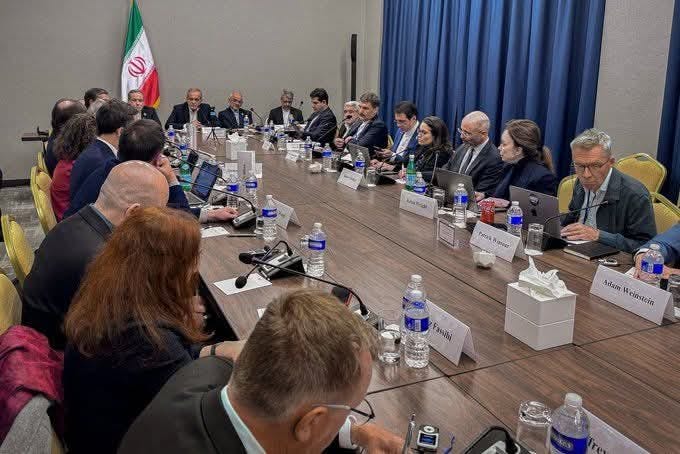
The encounter between Pezeshkian and the think tanks constitutes intellectual warfare rather than conventional diplomacy because it targets the institutions that write the briefing papers, draft the policy options, and frame the terms of debate for the White House, the Pentagon, and the press. Think tanks are the intellectual factories of the national security state, and they operate as the bridge between the Pentagon and the press through a revolving door that transforms former generals into senior fellows and former ambassadors into distinguished scholars. The Brookings Institution, the Council on Foreign Relations, the Atlantic Council, the Carnegie Endowment, the RAND Corporation, and the Center for Strategic and International Studies are not neutral research organisations because they are funded by defence contractors, oil companies, foreign governments, and the same interests that profit from the wars they advocate. These institutions manufacture consent by producing reports that frame the parameters of acceptable discourse, and they sell future wars to the public by presenting the pursuit of oil control and military dominance as humanitarian intervention and democracy promotion. Pezeshkian did not go to the White House because he went to the people who write the White House briefing papers, and he did not go to the Pentagon because he went to the people who write the Pentagon’s long-term strategy documents. This move recognises that the battle over policy is fought first in the realm of narrative construction, and that shifting the way the think tanks frame the issue can shift the way the White House, the Congress, and the press talk about it.
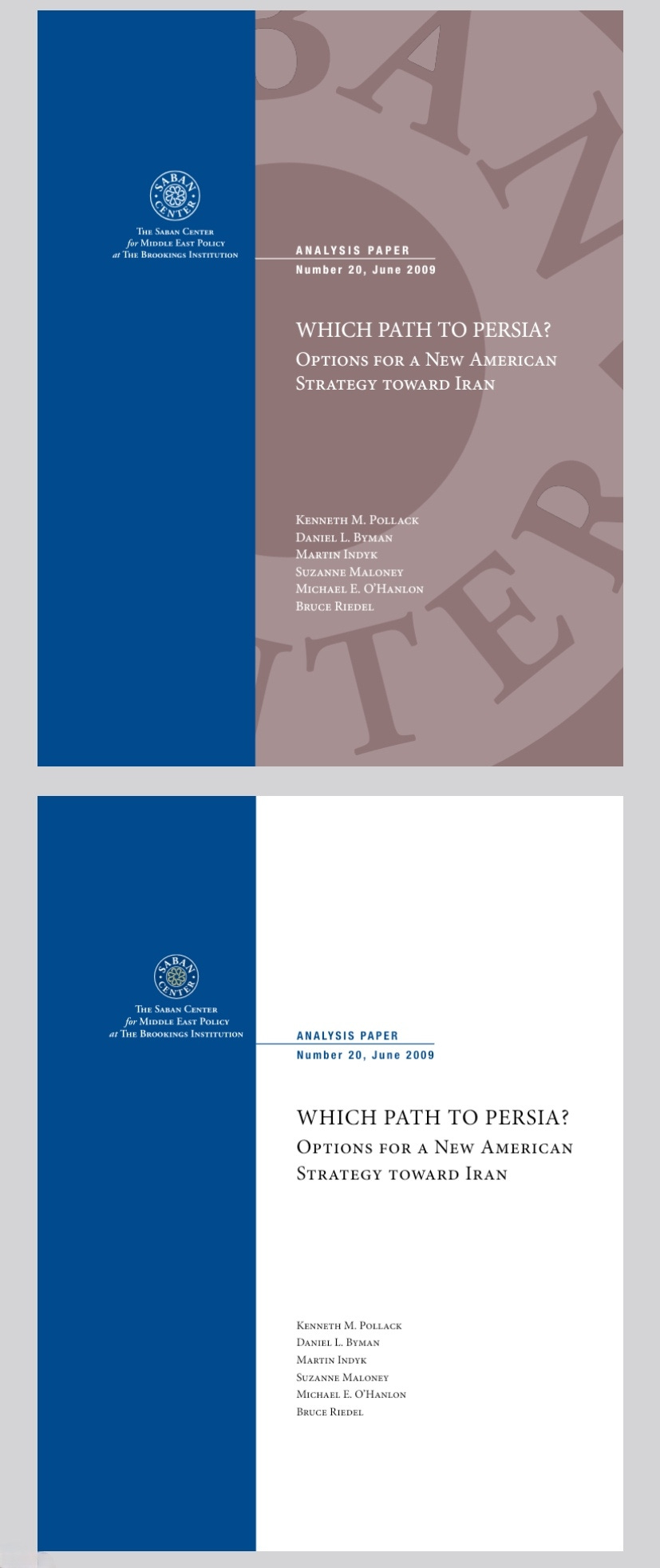
The material foundation of think tank influence lies in the funding relationships that tie these institutions to the class fractions that benefit from American primacy, and the Quincy Institute’s Think Tank Funding Tracker documents that the top one hundred defence companies contributed more than thirty-four million dollars to the top fifty American think tanks between 2019 and 2023. The Atlantic Council, the Center for a New American Security, and the Center for Strategic and International Studies were the largest recipients of Pentagon contractor funding, and foreign governments donated more than one hundred and ten million dollars to the same think tanks over the same period. The Brookings Institution, which produced the 2009 volume Which Path to Persia?, received seventeen million one hundred thousand dollars from foreign governments and three million nine hundred and ten thousand dollars from Pentagon contractors [1]. These funding relationships create material conflicts of interest in the production of foreign policy analysis, because the institutions that produce the reports are financially dependent on the interests that benefit from the policies the reports recommend. The revolving door between think tanks and government ensures that the same personnel circulate between the public and private sectors, and this circulation reinforces the structural alignment of state and corporate interests. The professional-managerial class that staffs these institutions generates the intellectual justifications for policies that serve the interests of their funders, and they earn salaries and institutional prestige in exchange for their analytical labour.
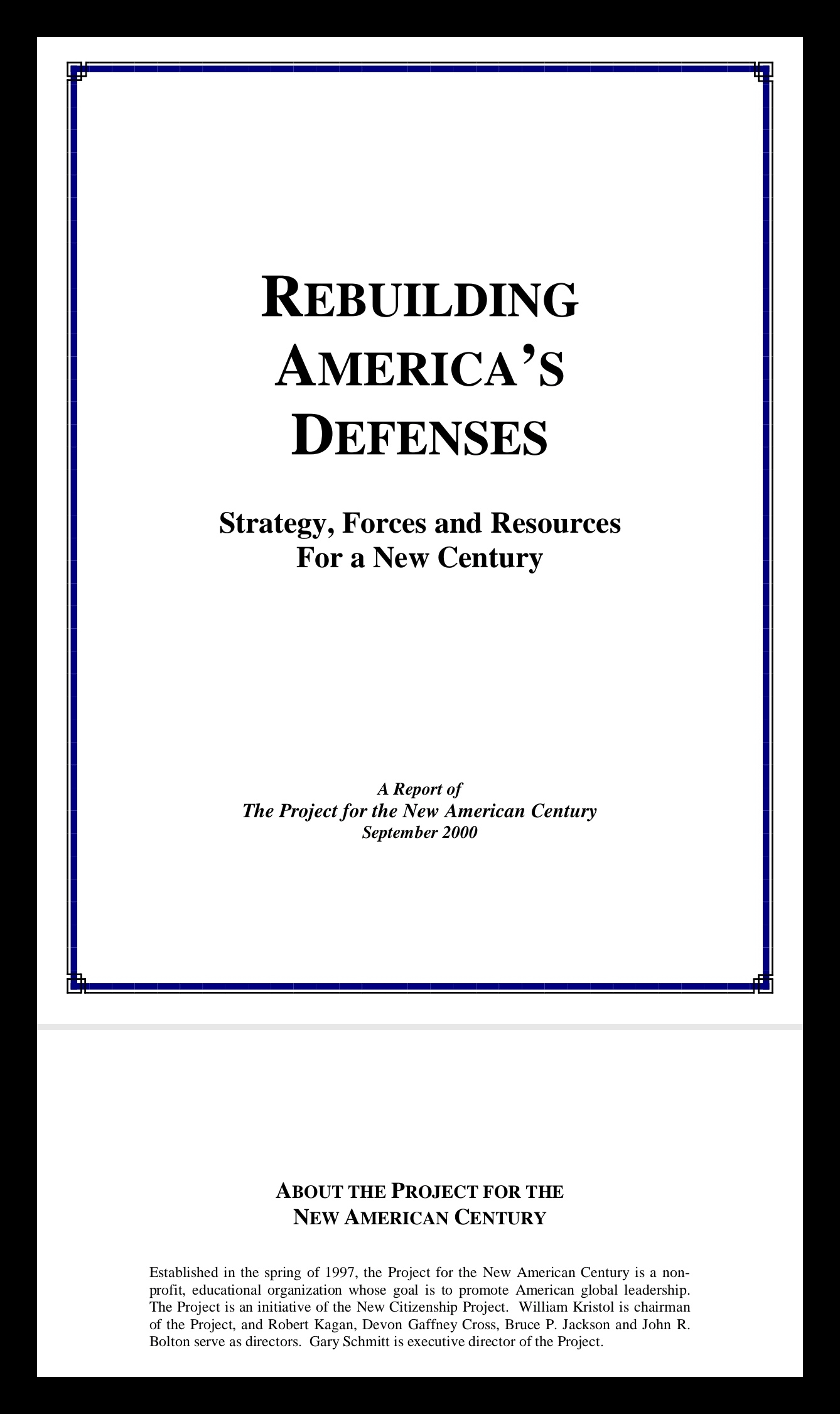
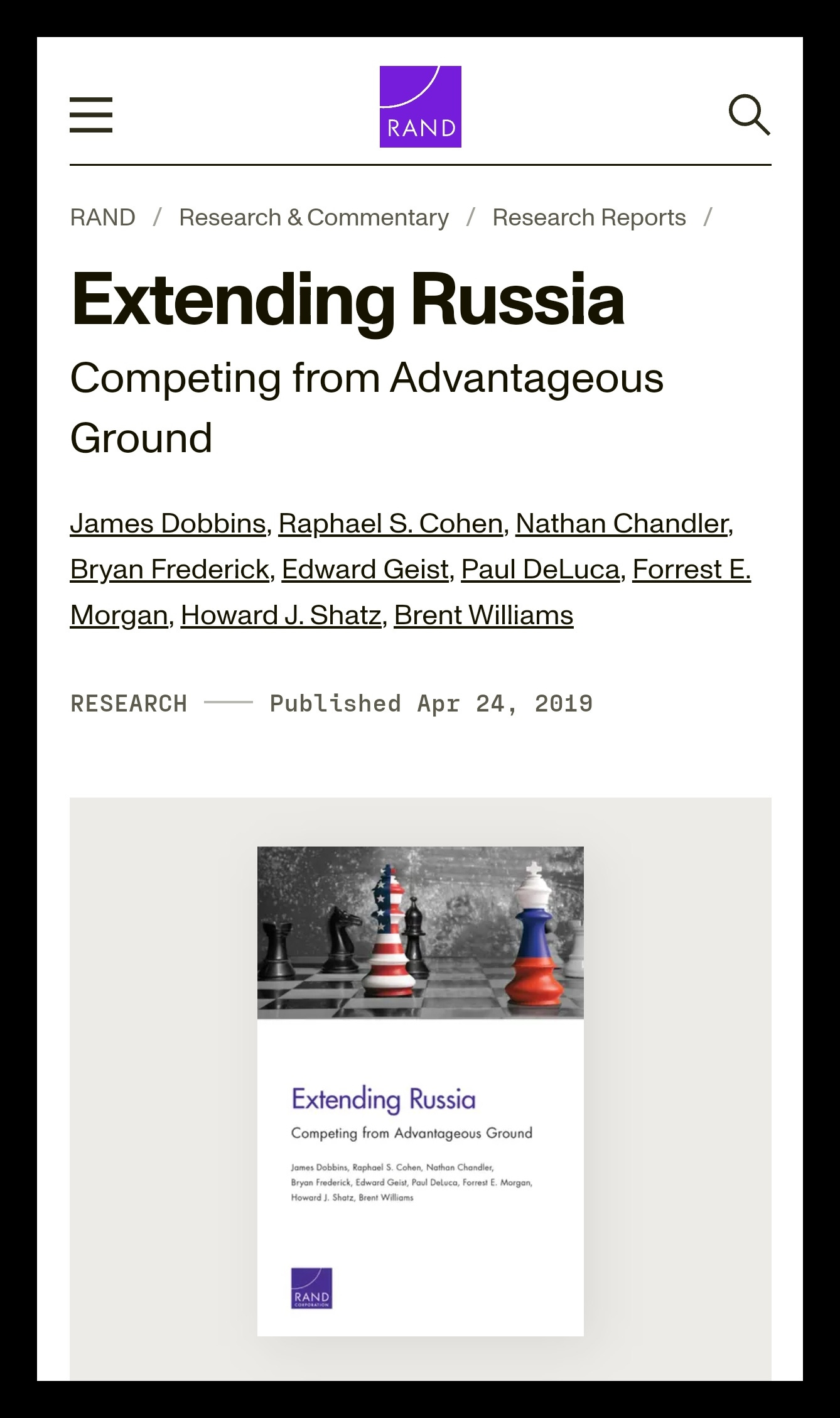
The core agendas that the think tanks have researched and developed for the empire include the maintenance of American primacy, the prevention of peer competitors, the control of energy chokepoints, the preservation of dollar hegemony, the security of Israel, and the containment of Russia, China, and Iran. The Project for the New American Century’s 2000 report Rebuilding America’s Defenses articulated the goal of maintaining American military dominance in perpetuity, and it called for the removal of Saddam Hussein as a precondition for reshaping the Middle East [2]. The RAND Corporation’s 2019 report Extending Russia laid out a multi-domain strategy for competing with Russia across economic, geopolitical, ideological, informational, air, space, maritime, and land domains, and it explicitly recommended withdrawing from the INF Treaty [3]. The Brookings Institution’s 2009 volume Which Path to Persia? presented a menu of options for confronting Iran, including diplomatic traps, military strikes, and regime change, and it described a strategy of creating an offer that Iran could not accept to justify subsequent military action [1]. The Council on Foreign Relations, the Atlantic Council, the Carnegie Endowment, and the Center for Strategic and International Studies have produced numerous reports advocating maximum pressure on Iran, sanctions, and military options, and these reports have shaped the policy debate in Washington for two decades.
The historical record of think tank advocacy includes the reports that paved the way for the Iraq invasion, the justification of the Libya intervention, the argument for regime change in Syria, and the advocacy of maximum pressure on Iran, and each of these projects failed to achieve its stated objectives. The think tanks wrote reports that said the Iranian people would rise up, that the regime would collapse, that sanctions would force Tehran to its knees, and that the military option was viable, and they were wrong every single time. The policy of maximum pressure failed, the war failed, the sanctions failed, the blockade failed, and the regime change plot failed, and Iran is still standing while the Resistance Axis is stronger than ever and the United States is weaker than it has ever been in the region. The think tanks now find themselves in the position of looking for a narrative that explains their failure without admitting their failure, and they are looking for someone to blame for the collapse of the assumptions that underpinned their recommendations. Pezeshkian is not there to give them an exit because he is there to tell them that they were wrong, that they are wrong, and that they will keep being wrong until they accept the reality of Iran.
The deeper agendas that the empire’s intellectual factories have been tasked with legitimising are not speculative theories but documented programmes authored by the institutions and individuals who occupy the commanding heights of transnational power. Klaus Schwab, the founder and executive chairman of the World Economic Forum, published The Great Reset in 2020 as an explicit call for the restructuring of global capitalism along stakeholder lines, and his earlier work COVID-19: The Great Reset framed the pandemic as an opportunity to accelerate the transformation of economic and social systems toward a model of governance in which nation-states would cede authority to transnational institutions and public-private partnerships. The World Economic Forum was established in 1971 as a vehicle for convening corporate executives, political leaders, and academic figures to shape the global agenda, and its annual meetings in Davos function as a coordination mechanism for the transnational capitalist class. The United Nations Agenda 2030, adopted in 2015 as a successor to Agenda 21, established seventeen Sustainable Development Goals with one hundred and sixty-nine targets that member states committed to implementing through national policies, and critics correctly identify these targets as instruments of technocratic governance that subordinate democratic decision-making to expert-defined benchmarks. The control grid is not a metaphor but a description of the convergence of digital identity systems, central bank digital currencies, surveillance technologies, and behavioural governance mechanisms that are being constructed by the same institutions that promote the Great Reset and Agenda 2030. The World Economic Forum has published reports advocating digital identity, central bank digital currencies, and the integration of artificial intelligence into governance systems, and these technologies together constitute a system of total surveillance and behavioural control that would make the twentieth-century totalitarian states appear primitive by comparison. The concept of Pax Judaica circulates in critical commentary to describe the alignment of American power with Israeli regional objectives, and the documented reality of the American-Israeli security architecture that has shaped the post-9/11 order demonstrates the material basis of this alignment, even if the term itself requires analytical precision. The destruction of Iraq, Libya, and Syria was not the product of good intentions that went wrong but the implementation of a strategy of regional disordering that served the interests of the empire and its allies, and the same class fractions that profit from perpetual war are the architects of the Great Reset and Agenda 2030. The think tanks that Pezeshkian engaged are not neutral research institutions but the intellectual factories of this project, and their function is to manufacture consent for the system of centralized control that is being constructed under the banner of stakeholder capitalism and sustainable development. The empire cannot admit that its agenda is domination rather than liberation, so it employs intellectuals to dress coercion in the language of progress, and the think tanks are the most important of these intellectual factories.
The class analysis of think tank influence must identify the specific human agents who benefit from the current configuration of power and those who bear its costs, and the think tank professionals, finance capital, defence contractors, oil companies, and technology firms constitute a constellation of class fractions whose interests converge on the perpetuation of American military dominance. The defence contractors that fund the think tanks are the principal beneficiaries of the policy repertoire that the think tanks produce, and every missile, ship, and aircraft produced translates into revenue for the companies that manufacture these systems. The financial institutions that hold the debt of oil-producing countries benefit from the petrodollar system that the think tanks defend, and they earn interest on loans that are serviced by dollar-denominated oil sales. The technology firms that profit from the AI bubble and the surveillance economy benefit from the control grid that the think tanks legitimise, and they earn rents from the manipulation of behaviour that algorithmic systems enable. The working class of the United States and the populations of the countries subjected to American military intervention bear the costs of these policies through taxation, military service, inflation, and the destruction of public services, and they have no corresponding means of shaping the development of the policies that harm them.
The meeting between Pezeshkian and the think tanks matters because it bypasses official channels and targets the discourse directly, and it creates splits within the foreign policy establishment by forcing the script writers to confront the failure of their own predictions. The think tanks have spent decades writing reports that said Iran would fall, and Iran did not fall, and they have spent decades writing reports that said the Iranian people would rise up, and the Iranian people rallied around the flag. The think tanks have spent decades writing reports that said sanctions would break the economy, and the economy adapted, and they have spent decades writing reports that said the military option was viable, and the military option was exposed as a bluff. Pezeshkian’s message is that Iran did not start the war, Iran did not close the Strait of Hormuz, Iran is not seeking a nuclear bomb, Iran is ready for inspections, and Iran is ready to implement the memorandum. The message is that the United States is the obstacle to peace, and this message undermines the entire worldview that the think tanks have constructed to justify American hostility toward Iran.
What is coming is a period in which the empire cannot admit failure and the think tanks will attempt to reframe their predictions as having been correct in principle while blaming the outcome on insufficient will or external interference. The material realities that constrain this reframing include the fact that Iran is stronger than it was before the war, the fact that the Resistance Axis is more consolidated, and the fact that the United States is weaker in the region and increasingly isolated internationally. The bond yields that will not stop climbing, the AI bubble that is losing air, the fuel shortages that are spreading through Europe, and the banking system that is exposed to bad debts from the Middle East all constitute material constraints that no amount of narrative manipulation can overcome. The think tanks will continue to produce reports and op-eds, but their influence will decline as the gap between their predictions and observable outcomes becomes impossible to conceal. The script writers met the man they scripted against, and they have no response because the evidence of their failure is now embodied in the president of the country they said would collapse.
Authored By: Global GeoPolitics
Thank you for visiting. This is a reader-supported publication. If you believe journalism should serve the public, not the powerful, and you’re in a position to help, becoming a PAID SUBSCRIBER truly makes a difference. Alternatively you can support by way of a cup of coffee:
https://buymeacoffee.com/ggtv |
https://ko-fi.com/globalgeopolitics |
Bitcoin: 3NiK8BoRZnkwJSHZSekuXKFizGPopkE7ns
References
[1] Brookings Institution (2009) Which Path to Persia? Options for a New American Strategy toward Iran. Washington, DC: Brookings Institution Press. Available at: https://www.brookings.edu/books/which-path-to-persia/ (Accessed: 27 September 2026).
[2] Project for the New American Century (2000) Rebuilding America’s Defenses: Strategy, Forces and Resources for a New Century. Washington, DC: PNAC. Available at: https://www.foreignpolicyi.org/wp-content/uploads/2021/04/Rebuilding-Americas-Defenses.pdf (Accessed: 27 September 2026).
[3] Dobbins, J., Cohen, R.S., Chandler, N., Frederick, B., Geist, E., DeLuca, P., et al. (2019) Extending Russia: Competing from Advantageous Ground. Santa Monica, CA: RAND Corporation. Available at: https://www.rand.org/pubs/research_reports/RR3063.html (Accessed: 27 September 2026).
[4] United Nations (2015) Transforming our world: the 2030 Agenda for Sustainable Development. New York: United Nations. Available at: https://sdgs.un.org/2030agenda (Accessed: 27 September 2026).
[5] United Nations (1992) Agenda 21: Programme of Action for Sustainable Development. New York: United Nations. Available at: https://sustainabledevelopment.un.org/outcomedocuments/agenda21 (Accessed: 27 September 2026).
[6] Quincy Institute for Responsible Statecraft (2025) Think Tank Funding Tracker. Washington, DC: Quincy Institute. Available at: https://responsiblestatecraft.org/think-tank-funding-tracker/ (Accessed: 27 September 2026).
[7] Atlantic Council (2026) Our Funding. Washington, DC: Atlantic Council. Available at: https://www.atlanticcouncil.org/about/our-funding/ (Accessed: 27 September 2026).
[8] Center for Strategic and International Studies (2026) Funding. Washington, DC: CSIS. Available at: https://www.csis.org/about/funding (Accessed: 27 September 2026).
[9] Carnegie Endowment for International Peace (2026) About. Washington, DC: Carnegie Endowment. Available at: https://carnegieendowment.org/about (Accessed: 27 September 2026).
[10] Council on Foreign Relations (2026) About CFR. New York: CFR. Available at: https://www.cfr.org/about (Accessed: 27 September 2026).


Leave a comment