
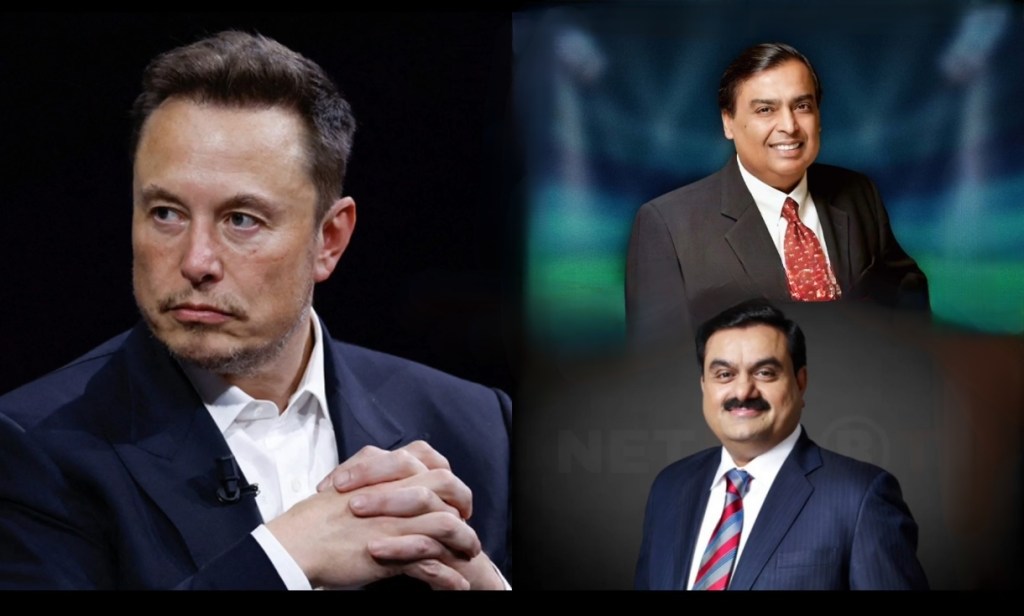
Why India Won’t Sacrifice National Security and Regulatory Control for a Billionaire’s Business Ambitions
General Article | October 2026
Elon Musk appears to have learned the second lesson the hard way. After accusing Indian “oligarchs” of obstructing Starlink to preserve their “monopolistic chokehold” on the market, he went further and branded the situation “a crime against the Indian people.” The response from Indian users was swift, and their counterarguments exposed just how simplistic Musk’s portrayal of the dispute really was.
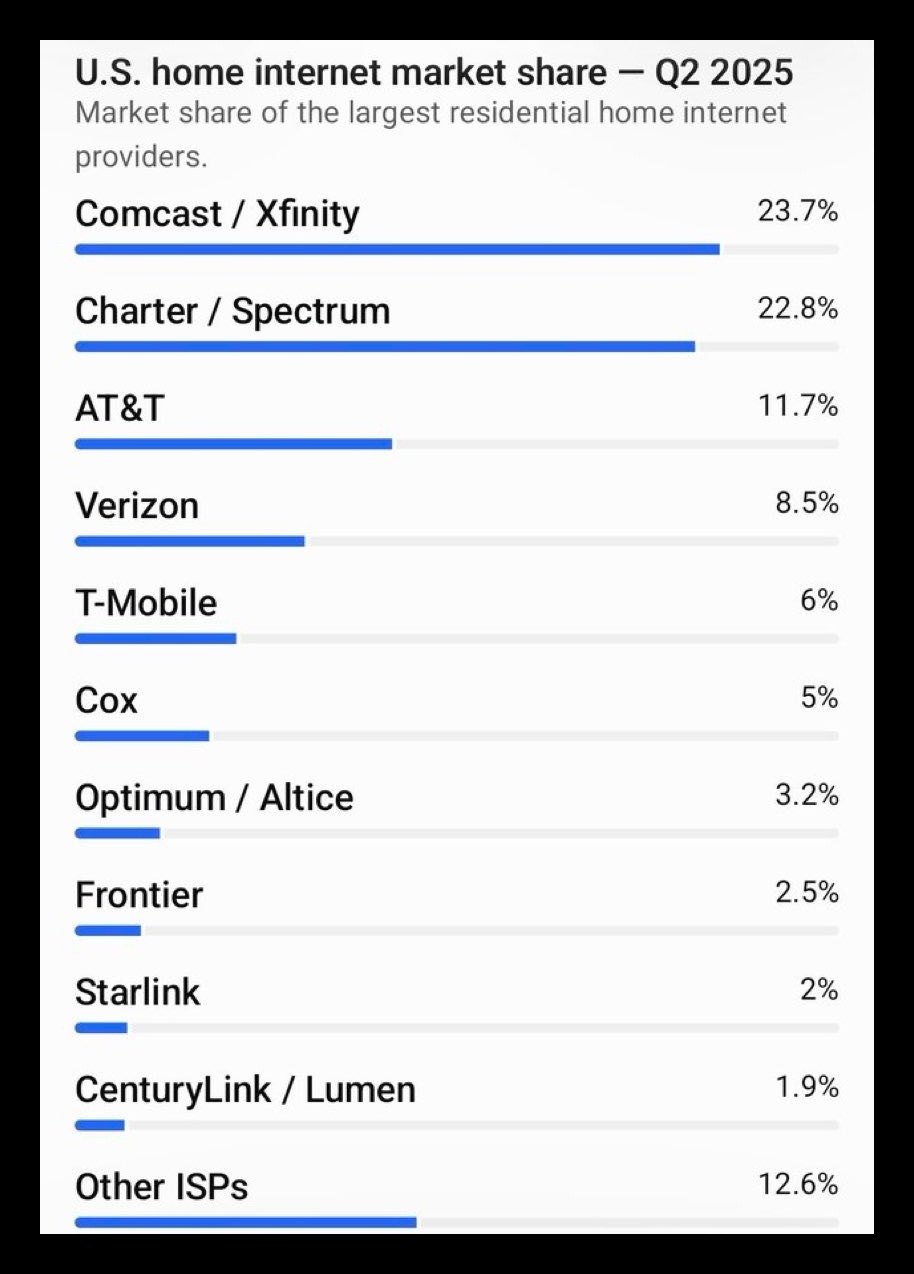
India does not need Elon Musk to drag it into the digital age. It already has more than a billion internet subscriptions, and internet connectivity extends to over 98 percent of its villages. Starlink could offer a valuable alternative for remote communities, difficult terrain and areas underserved by conventional networks. But that is a very different proposition from suggesting that an entire nation is being deliberately denied connectivity by powerful businessmen. India has built an enormous digital ecosystem of its own, and treating its regulatory decisions as an obstacle to Musk’s personal mission to connect the world is both arrogant and misleading.

More importantly, Starlink is not simply another internet service provider. It is a satellite communications network controlled by a private American company, with infrastructure that can become strategically significant during a military conflict. Ukraine has already demonstrated how satellite connectivity can support battlefield communications, drone operations and military coordination. Once a country’s security infrastructure depends on such a network, the question of who controls it becomes far more consequential than download speeds or commercial competition. No serious government can afford to ignore the risks of placing critical communications in the hands of a foreign corporation whose decisions may not align with its national interests.
India’s security concerns are not entirely hypothetical, either. Starlink equipment has reportedly surfaced in sensitive circumstances, including during an operation against militants in Manipur and aboard a Myanmar vessel allegedly carrying more than four billion dollars’ worth of methamphetamine. Musk has maintained that Starlink coverage over India was disabled at the time. That claim may be relevant to determining whether the technology was actually being used, but it does not eliminate the broader questions surrounding unauthorised equipment, cross-border access, surveillance and the potential misuse of satellite communications. When national security is involved, governments are expected to investigate first and ask questions later. Demanding that India simply trust a foreign technology company would be an extraordinary standard to impose on any sovereign state.
The hypocrisy becomes even more apparent when the same argument is applied to the United States. Would Washington permit a Chinese company to establish a satellite communications network across American territory, operate it with minimal restrictions and dismiss national security concerns as an excuse invented by domestic monopolies? The American government has spent years restricting Huawei and ZTE over precisely these kinds of concerns. Whether one agrees with every American restriction is beside the point. Washington considers control over strategic communications infrastructure a legitimate national interest. India is entitled to apply that same principle. National security does not suddenly become an illegitimate excuse simply because the company seeking market access happens to be American.
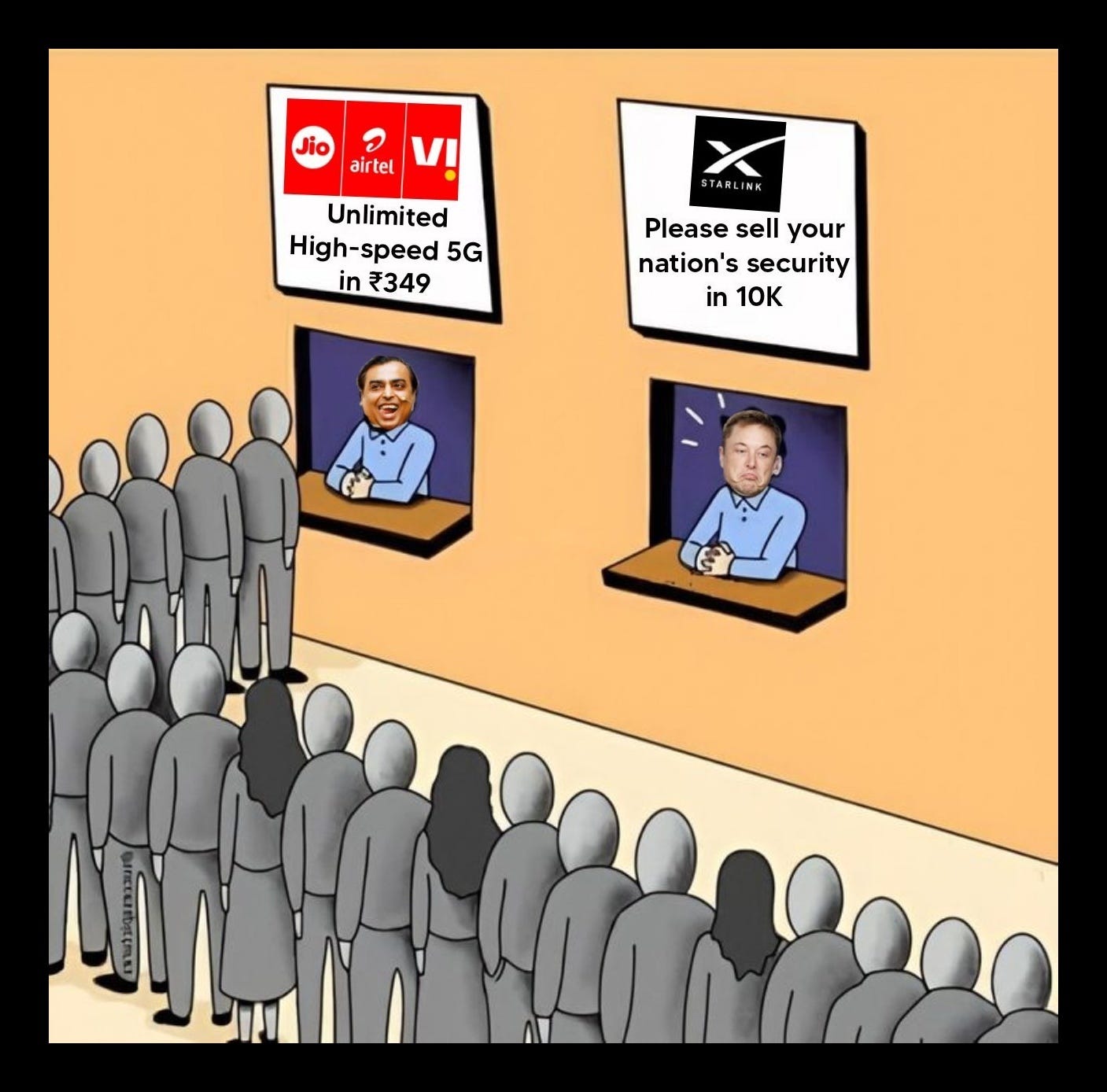
Musk’s accusation against India’s supposed oligarchs also becomes harder to sustain when the commercial facts are considered. Reliance Jio and Bharti Airtel, two of India’s biggest telecommunications companies, have already reached agreements with SpaceX to distribute Starlink services, subject to the necessary approvals. These are not companies campaigning to keep Starlink permanently out of India. They are preparing to participate in its entry into the market. That does not mean every regulatory decision is automatically justified, nor does it prove that commercial interests play no role in the dispute. It does, however, undermine the simplistic narrative that India’s powerful telecom companies are united in an effort to shut Musk out. The real issue is not whether Starlink should exist in India, but under what conditions it should be allowed to operate.
Starlink may well become part of India’s telecommunications landscape. India has strong reasons to welcome useful technology, expand connectivity and encourage competition. But market access is not an unconditional entitlement, and a foreign billionaire’s commercial ambitions do not override a country’s laws, security requirements or regulatory authority. If Musk wants to serve the Indian market, he must make his case within the framework India establishes, just as companies seeking to operate in the United States must comply with American rules.
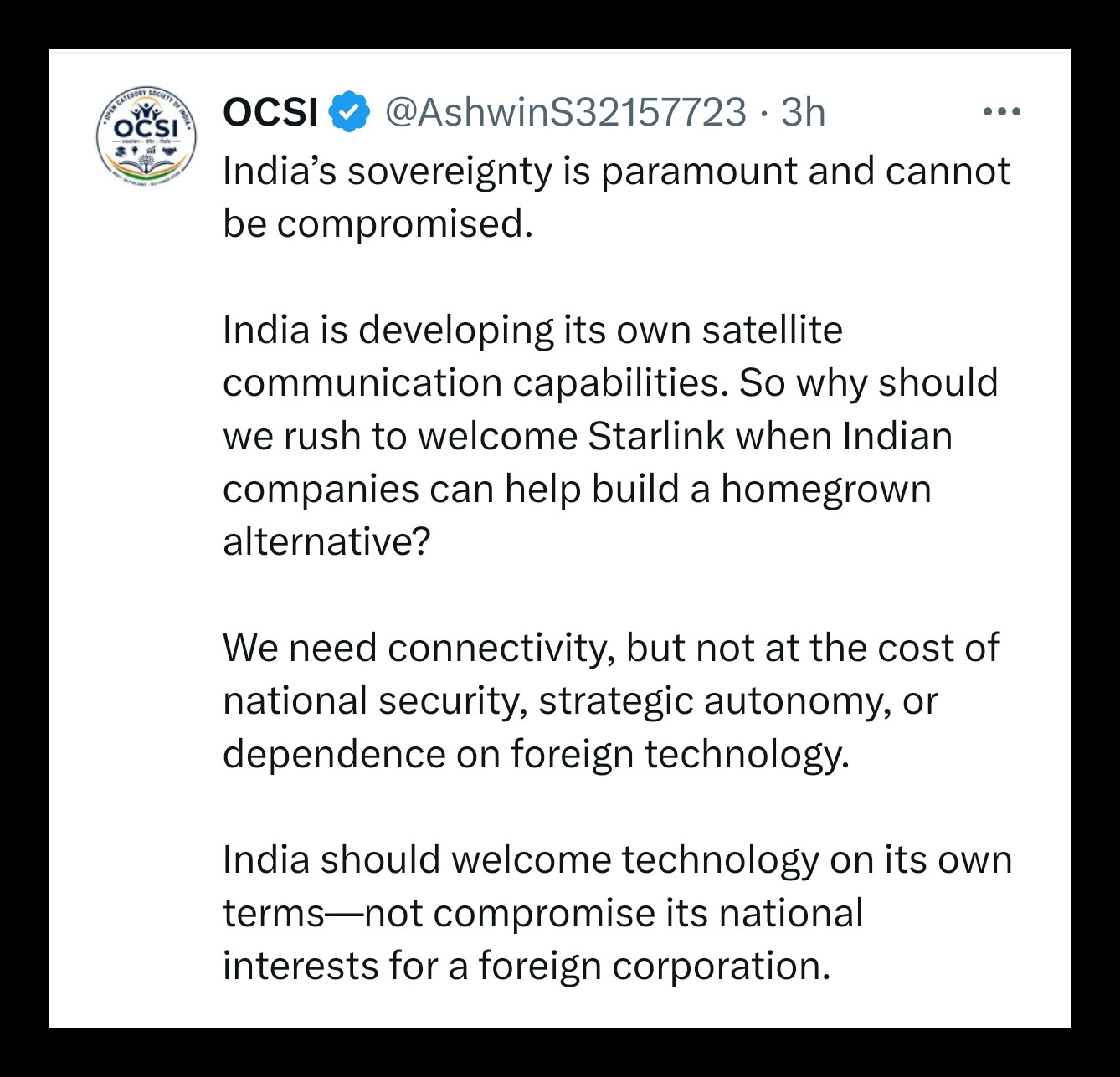
The world does not owe Elon Musk unrestricted access simply because he owns impressive technology. India is not obliged to sacrifice strategic autonomy to satisfy his expectations, and its regulatory decisions do not become evidence of corruption merely because they inconvenience his business interests. Starlink can compete in India, but it must do so on India’s terms. That is not a crime against the Indian people, but is a basic principle of national sovereignty.
The lesson for Elon is you do not attack India on Twitter just as you wouldn’t attack a country like Russia in winter.
Authored By: Global GeoPolitics
Thank you for visiting. This is a reader-supported publication. If you believe journalism should serve the public, not the powerful, and you’re in a position to help, becoming a PAID SUBSCRIBER truly makes a difference. Alternatively you can support by way of a cup of coffee:
https://buymeacoffee.com/ggtv |
https://ko-fi.com/globalgeopolitics |
Bitcoin: 3NiK8BoRZnkwJSHZSekuXKFizGPopkE7ns


Leave a Reply