
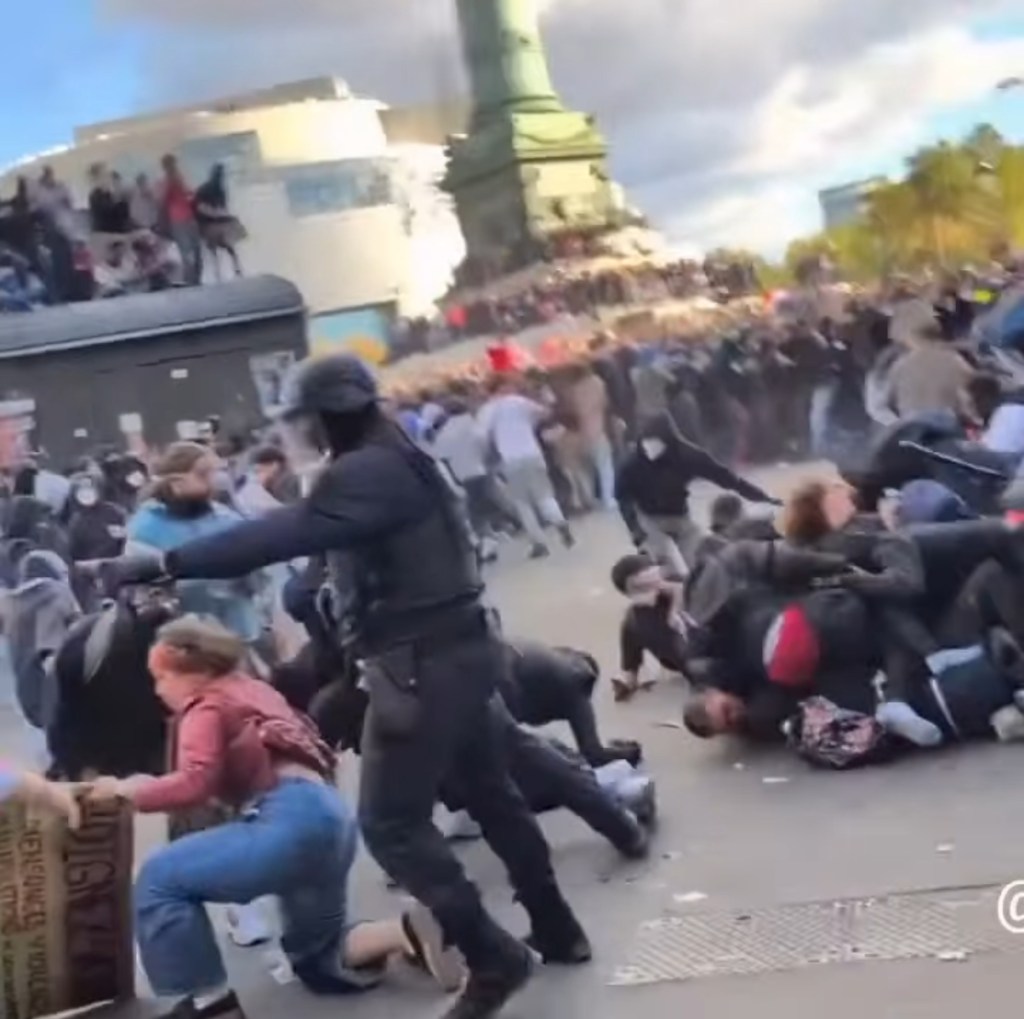
From Madrid to Berlin, from Paris to Rome, the working classes of Europe are rising against austerity, housing speculation, and a war economy that serves an oligarchy while demanding their sacrifice
Editorial Analysis | October 2026
A wave of social unrest is sweeping across Western Europe, from the housing protests in Spain triggered by the eviction of an eighty-seven-year-old woman from her rent-controlled apartment by a corporate hedge fund, to the student demonstrations in France against the elimination of over three thousand teaching positions, to the farmer and trucker protests in Italy, and to the mass demonstrations in Germany on Unity Day that targeted a chancellor whose approval rating has collapsed to ten per cent [1][5][8]. The unrest is unified by its anti-austerity character, as governments across the continent divert resources from public services and social provision to military spending and debt servicing. The Bank of England has warned that artificial intelligence-related borrowing, which reached four hundred and fifty billion dollars in 2026, is exceeding the total borrowing of the United Kingdom and threatening financial stability [9]. This analysis locates the European crisis within the broader breakdown of a five-hundred-year-old colonial and imperial system, examining the class forces that drive the unrest, the institutional interests that sustain the war economy, and the material foundations of a hegemonic order in terminal decline.
The social unrest that has erupted across Western Europe in the autumn of 2026 is not a series of isolated incidents but a unified response to the material conditions imposed on the working class by governments that serve the interests of a transnational financial oligarchy. In Spain, the spark was the eviction of Maricarmen Abascal, an eighty-seven-year-old woman whose rent-controlled apartment was purchased by a corporate hedge fund that raised her rent from five hundred euros to two thousand six hundred and fifty euros, more than double her pension, and who died in hospital after the social backlash that followed her case [1]. The case resonated because it crystallised a broader crisis in which rental costs have risen by eighty-four per cent over the past decade, with increases of one hundred and thirteen per cent in Málaga and nearly one hundred and fifty per cent in Marbella, driven by speculative investment funds that purchase residential properties and raise rents until tenants are forced out [1]. The Spanish government’s proposed emergency measures were rejected by Congress, prompting Prime Minister Pedro Sánchez to call a snap election, but the structural power of the vulture funds remains intact [1].
In France, the protests began in the Parisian suburbs and spread to more than twelve hundred high schools, with students, teachers, and parents demanding improved learning conditions and protesting the elimination of three thousand two hundred and fifty-six teaching positions nationwide in 2026 [5]. The demonstrations emerged as a political flashpoint for a government that has announced unpopular spending reductions in its 2027 budget, including an education budget increase of only one point seven per cent, which is below the rate of inflation [5]. More than five thousand people were arrested, and demonstrators suffered serious injuries including eye injuries and broken teeth as police responded with tear gas and rubber bullets [5]. The students who filled the streets carried placards reading that their address should not decide their future, and they articulated a broader grievance that the education system is being starved of resources while the government prioritises military spending and debt servicing [5].
In Italy, the protests started with farmers and fishermen, spread to truckers, and have now drawn in trade unions, with clashes reported in Rome and other cities. The Italian government has offered no solutions, and the situation remains volatile. The Italian protests are part of a broader European pattern in which the agricultural sector, squeezed by rising fuel costs, cheap imports, and environmental regulations that favour large agribusiness, has become a focal point for resistance to the economic policies of the European Union and national governments. The farmers who drive tractors through city centres and block motorways are not merely protesting agricultural policy; they are expressing a deeper discontent with a system that prioritises the interests of financial capital and large corporations over the livelihoods of small producers and the communities they sustain.
In Germany, the demonstrations on Unity Day in Berlin and Stuttgart targeted Chancellor Friedrich Merz, whose approval rating has collapsed to ten per cent and whose CDU/CSU coalition has fallen to eighteen per cent in the polls, the lowest level in post-war German history [8]. The Alternative for Germany has surged to thirty per cent, its highest level since its founding, reflecting the collapse of the traditional political consensus and the rejection of a governing coalition that has pursued austerity while pledging further financial support for the war in Ukraine [2]. The head of Germany’s foreign intelligence agency has warned that Germany is in danger of being drawn into a violent conflict with Russia, but the question of who is drawing Germany into that conflict is answered by the pattern of German foreign policy, which has aligned itself with NATO and the United States against Russian interests and has severed the energy relationship that once provided affordable gas to German industry and households.
The Bank of England has warned that the combination of artificial intelligence-related borrowing and government debt is driving interest rates higher and threatening financial stability. The Bank’s Financial Policy Committee noted that AI labs have already borrowed four hundred and fifty billion dollars this year, more than the United Kingdom’s total borrowing of three hundred and thirty billion dollars, and that the risk of a sharper correction persists if there is a shock to earnings expectations reflecting concerns about the pace of AI development [9]. The Bank’s warning highlights a structural contradiction in the current economic model: the same financial system that is diverting resources toward speculative AI investments and government debt is incapable of providing affordable housing, accessible education, and secure employment for the population. The Bank of England Governor has argued that regulation is not the right place to start, but the Bank’s own analysis demonstrates that the financial system is vulnerable to the very speculative dynamics it has enabled through years of loose monetary policy and deregulation.
The political crisis extends across the continent, with coalitions collapsing in Italy, Spain, France, and Germany, and with traditional political parties being rejected by voters. In the United Kingdom, the Labour Party’s support has risen to twenty-seven per cent while Reform UK has fallen to twenty-two per cent, but the volatility of the polling reflects a broader fragmentation of the political landscape [4]. The idea that the existing parties are committed to an international globalist order which cannot survive is gaining ground among voters who recognise that the traditional left-right divide no longer maps onto their material interests. The rise of new parties and the collapse of old ones is not a sign of democratic vitality but of a systemic crisis in which the institutions of representative democracy are losing legitimacy because they are incapable of delivering the economic security and social provision that populations demand.
The geopolitical context of the European crisis is the breakdown of the imperial order that has structured global politics for five centuries. The European colonial system provided cheap raw materials, cheap labour, and goods from exploited colonies, and the wealth extracted from these territories financed the development of European industry and infrastructure. The British Empire was the dominant power of this system, but by the middle of the twentieth century it had run out of steam and had merged with the American military-industrial complex. The wars that are continuing in Ukraine, in Southwest Asia, and the threatened war against China are being waged to sustain this imperial system and the privileges of the financial oligarchy that benefits from it. The war against Russia has been used as an excuse for austerity and money creation to bail out indebted institutions that cannot cover their costs because of failed economic policy, and the European establishment has seized on the war to justify the diversion of resources from social provision to military spending.
The NATO expansion that has brought the alliance to Russia’s borders is a central component of this imperial project. Declassified documents from the National Security Archive show that Western leaders, including Baker, Bush, Genscher, Kohl, Gates, Mitterrand, Thatcher, and Major, gave assurances to Soviet leaders that NATO would not expand eastward, and that these promises were explicit and not limited to the issue of East Germany [7]. The subsequent expansion of NATO to include former Warsaw Pact countries and former Soviet republics has moved the alliance more than one thousand kilometres closer to Russia’s borders, and the war in Ukraine is the culmination of this process. The claim that Russia poses a threat to Western Europe is contradicted by the material reality that Russia has no interest in conquering European countries that would bring with them the same problems of occupation and resistance that Russia has encountered in Ukraine, and that Russia possesses more than enough territory and resources to satisfy its development needs without acquiring additional territory.
The class analysis of the European social unrest must identify the specific human agents who benefit from the current configuration of power and those who bear its costs. The financial oligarchy, which the transcript describes as the Epstein class, is the fraction of the capitalist class that controls the means of credit and thereby exercises disproportionate influence over the economy and the state. The defence contractors, energy corporations, and financial institutions that profit from the war economy are among the principal beneficiaries of the current crisis, and their shareholders and executives constitute a narrow stratum of the population whose wealth has been increasing while the living standards of the working class have declined. The professional-managerial class that staffs the think tanks, intelligence agencies, and policy positions generates the intellectual justifications for the war economy, earning salaries and institutional prestige in exchange for their analytical labour. The working class of Europe bears the costs of the crisis through austerity, unemployment, housing insecurity, and the erosion of public services, while the populations of the Global South continue to bear the costs of the imperial system through resource extraction, debt servicing, and the destruction of their economies.
The solution to the European crisis requires not the reform of the existing order but its transformation. The working class of Europe has an interest in opposing the war economy, in demanding the redirection of resources from military spending to social provision, and in building the organisations and consciousness necessary to challenge the power of the financial oligarchy. The call for the United States to join with the BRICS countries in rejecting the imperial system and moving toward an economic policy of physical economic development in cooperation for mutual benefit points toward a different paradigm, one in which the productive forces of society are directed toward meeting human needs rather than enriching a narrow elite. But the working class must also recognise that the BRICS countries are not socialist and that their development models are still capitalist, and that the ultimate solution is not to replace one imperial order with another but to abolish the imperial system altogether and to build a society in which the means of production are controlled by the producers.
The final assessment must remain analytical rather than definitive, because the trajectory of the European crisis and its implications for class power remain uncertain. The unrest may lead to the fall of governments and the emergence of new political forces, or it may be suppressed and the existing order preserved. The working class may develop the organisations and consciousness necessary to challenge the power of the oligarchy, or it may remain fragmented and marginalised by the politics of nationalism and xenophobia that the ruling class promotes to divide it. The indicators that would confirm or undermine each scenario are observable, including the trajectory of the protests, the response of the state, the development of new political parties, and the willingness of the working class to engage in sustained struggle. What is clear from the evidence assembled here is that the European crisis is a class crisis, that the austerity and war policies that have provoked the unrest serve the interests of a financial oligarchy rather than the population, and that the resolution of the crisis will depend on the balance of class forces and the capacity of the working class to organise for its own emancipation.
Authored By: Global GeoPolitics
Thank you for visiting. This is a reader-supported publication. If you believe journalism should serve the public, not the powerful, and you’re in a position to help, becoming a PAID SUBSCRIBER truly makes a difference. Alternatively you can support by way of a cup of coffee:
https://buymeacoffee.com/ggtv |
https://ko-fi.com/globalgeopolitics |
Bitcoin: 3NiK8BoRZnkwJSHZSekuXKFizGPopkE7ns
References
[1] BBC News (2026) ‘Protesters blame “vulture funds” for Spain’s housing crisis’, BBC News, 8 October. Available at: https://www.bbc.co.uk/news/articles/c3j4790elkx7o (Accessed: 9 October 2026).
[2] Báo Tin Tức (2026) ‘Đức: Đảng cực hữu AfD lập kỷ lục mới trong thăm dò sau thất bại “thảm họa” của đảng cầm quyền’, Báo Tin Tức, 4 October. Available at: https://baotintuc.vn/duc-dang-cuc-huu-afd-lap-ky-luc-moi-trong-tham-do-sau-that-bai-tham-hoa-cua-dang-cam-quyen-post1391204.html (Accessed: 9 October 2026).
[3] Hahn, G.M. (2018) ‘Broken Promise: NATO Expansion and the End of the Cold War – An Update’, GordonHahn.com, 23 April. Available at: https://gordonhahn.com/2018/04/23/broken-promise-nato-expansion-and-the-end-of-the-cold-war-an-update/ (Accessed: 9 October 2026).
[4] Huffington Post UK (2026) ‘Reform UK Slump Continues As Labour Hit Near Two-Year Opinion Poll High’, Huffington Post UK, 6 October. Available at: https://www.huffingtonpost.co.uk/entry/reform-uk-slump-labour-near-two-year-high_uk_6ac48d63e4b024c9b491332c (Accessed: 9 October 2026).
[5] Leadership Nigeria (2026) ‘Tension Grips France As Students Protest Staff Shortages, Poor School Facilities’, Leadership Nigeria, 4 October. Available at: https://leadership.ng/tension-grips-france-as-students-protest-staff-shortages-poor-school-facilities/ (Accessed: 9 October 2026).
[6] Left.eu (2026) ‘The cost of living is spiralling out of control’, The Left in the European Parliament, 7 October. Available at: https://left.eu/the-cost-of-living-is-spiralling-out-of-control/ (Accessed: 9 October 2026).
[7] National Security Archive (2017) ‘NATO Expansion: What Gorbachev Heard’, National Security Archive, 12 December. Available at: https://nsarchive.gwu.edu/briefing-book/russia-programs/2017-12-12/nato-expansion-what-gorbachev-heard-western-leaders-early (Accessed: 9 October 2026).
[8] The Age (2026) ‘Germany’s Merz stumbles on after another big election defeat. But for how long?’, The Age, 20 September. Available at:
(Accessed: 9 October 2026).
[9] Yahoo Finance (2026) ‘Bank of England warns of looming debt crisis’, Yahoo Finance, 30 September. Available at: https://sg.finance.yahoo.com/news/bank-england-warns-looming-debt-102220091.html (Accessed: 9 October 2026).


Leave a comment