
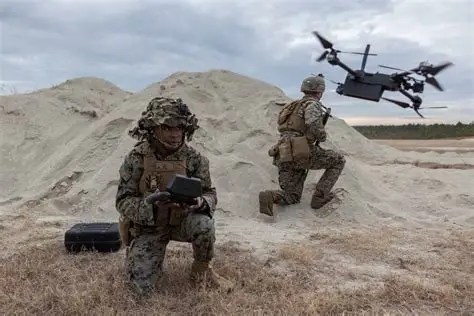
Drone failures, unreliable equipment and bureaucratic obstacles raise questions about America’s readiness for modern warfare and its ability to counter adversaries experienced in large-scale drone attacks.
General Article | October 2026
The US Army’s ambitions for AI-enabled warfare faced a serious test during a major military exercise in the Mojave Desert in July, according to a recent Wall Street Journal report. At a time when speculation is growing about a possible resumption of hostilities between the United States and Iran, the exercise has raised questions about the military’s readiness for modern warfare.
The Army brought 9,700 soldiers to Fort Irwin to simulate a conflict against a force representing China’s military. The exercise was intended to demonstrate how artificial intelligence and advanced technologies could transform battlefield operations. However, several of the systems designed to represent the future of warfare failed to perform as expected.
Drones developed by Anduril and Theiss UAV Solutions either landed because of overheating or took as long as ten minutes to become airborne. Some operated for only half their maximum flight time as operators conserved battery power. Strong wind gusts pushed other drones off course, while communication signals were lost behind mountains. Augmented-reality headsets, backed by contracts worth more than $100 million each with three companies, also displayed significant shortcomings. The Army remains uncertain whether it will continue with the technology.
As a result, much of the exercise focused on conventional tasks, particularly training soldiers to clear buildings. Rather than demonstrating a decisive shift towards AI-enabled warfare, the exercise exposed the limitations of the technology and raised doubts about the Army’s ability to integrate it effectively into combat operations.
The problems extend beyond the performance of individual systems. Congressional investigations and government oversight reports have highlighted billions of dollars in wasted spending, failed weapons programmes, inadequate training and cybersecurity weaknesses. Meanwhile, many of the technologies developed by startups have yet to be tested in actual combat and have proved vulnerable under demanding field conditions.
Former Army Secretary Dan Driscoll, who was removed from his position, described the service as a “calcified bureaucracy” struggling to keep pace with technological change. His criticism reflects broader concerns about the military’s ability to adapt its organisational structures, procurement processes and training methods to the demands of modern warfare.
The Pentagon’s last major transformation took place in the 1980s, when the Army restructured itself following the Vietnam War and developed the force that would later fight in the Gulf War. Since then, the pace of technological change has accelerated, but questions remain about whether the military’s institutions can adapt quickly enough to take advantage of it.
If the US Army struggles to deploy advanced technologies effectively under controlled training conditions, the consequences could be far more serious against an adversary experienced in large-scale drone warfare. Iran offers a potential example of the challenges involved. Over the past year, Iranian drone and missile attacks have reportedly targeted US bases across the Middle East, including in Jordan, Kuwait, Bahrain, Iraq and the United Arab Emirates. These attacks have also reportedly prompted the Pentagon to withdraw forces from several locations.
The central question is whether the US military can turn its technological ambitions into reliable battlefield capabilities before confronting an adversary capable of exploiting the gaps between its plans and its actual performance.
Authored By: Global GeoPolitics
Thank you for visiting. This is a reader-supported publication. If you believe journalism should serve the public, not the powerful, and you’re in a position to help, becoming a PAID SUBSCRIBER truly makes a difference. Alternatively you can support by way of a cup of coffee:
https://buymeacoffee.com/ggtv |
https://ko-fi.com/globalgeopolitics |
Bitcoin: 3NiK8BoRZnkwJSHZSekuXKFizGPopkE7ns


Leave a Reply