
Fresh fighting near the Strait of Hormuz raises fears of renewed escalation despite the April 7 ceasefire
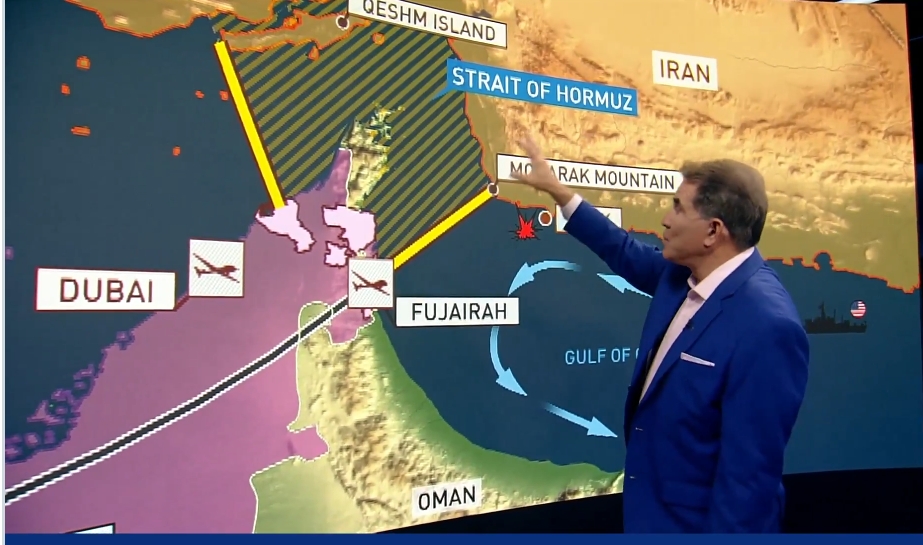
The US military has reportedly carried out a new wave of strikes on Iranian targets near the Strait of Hormuz, with Tehran claiming it responded by targeting US naval vessels in the region.
According to US and Iranian officials, American forces struck Iran’s Qeshm port and Bandar Abbas, as well as vessels operating in the Gulf of Oman. A senior US official told Fox News that the attacks were limited in scope and did not constitute a formal resumption of hostilities or an end to the April 7 ceasefire.
Iranian state media reported that air defenses were activated in western Tehran to counter what were described as “hostile targets.”
Iran’s Central Headquarters of Hazrat Khatam al-Anbiya accused the US of violating the ceasefire by targeting an Iranian oil tanker traveling from waters near Jask toward the Strait of Hormuz, as well as another vessel near Fujairah in the UAE. The command also alleged that Washington coordinated with “some regional countries” in strikes on civilian coastal areas near Bandar Khamir, Sirik, and Qeshm Island.
Key developments
21:41 GMT
US Central Command (CENTCOM) said American forces intercepted what it described as “unprovoked” Iranian attacks while three US Navy guided-missile destroyers transited the Strait of Hormuz.
According to the Pentagon, Iranian forces launched missiles, drones, and small boats at the USS Truxtun, USS Rafael Peralta, and USS Mason as the vessels moved toward the Gulf of Oman on May 7. CENTCOM said no US assets were hit.
The command added that US forces destroyed incoming threats and struck Iranian missile and drone launch sites, command-and-control facilities, and surveillance infrastructure allegedly linked to the attacks.
“CENTCOM does not seek escalation but remains positioned and ready to protect American forces,” the statement said.
21:36 GMT
Iran’s IRGC Navy claimed that three US warships “violating” the Strait of Hormuz withdrew from the area at high speed after coming under Iranian fire.
According to Tasnim, the force said intelligence assessments showed “significant damage” had been inflicted on American forces.
21:33 GMT
RT correspondents in Tehran reported seeing flashes in the sky over the capital after Iranian air defenses were activated in western Tehran.
21:29 GMT
Iran accused the US of carrying out attacks on Iranian coastal areas “in coordination with some regional countries.”
“The criminal and aggressive United States and its supporting countries must know that the Islamic Republic of Iran, as always, powerfully and without the slightest hesitation, will deliver a crushing response to any act of aggression and violation,” the Central Headquarters of Hazrat Khatam al-Anbiya said.
The statement came amid reports that Saudi Arabia and Kuwait had restored US access to their bases and airspace after briefly restricting it.
21:22 GMT
RT’s crew in Tehran confirmed hearing air-defense activity in western parts of the city following reports from Iranian media that defenses had been activated against “hostile targets.”
21:21 GMT
Iran claimed its armed forces launched immediate retaliatory strikes against US military vessels after the reported American attacks near the Strait of Hormuz.
“The Armed Forces of the Islamic Republic of Iran, in an immediate retaliatory action, struck US military vessels east of the Strait of Hormuz and south of Bandar Chabahar, inflicting substantial damage,” a spokesperson for the Central Headquarters of Hazrat Khatam al-Anbiya said.
21:17 GMT
Iran formally accused the US of violating the ceasefire by attacking Iranian maritime and coastal targets near the Strait of Hormuz, including an oil tanker near Jask and another vessel near Fujairah.
The statement also alleged that American strikes hit civilian areas near Bandar Khamir, Sirik, and Qeshm Island.
21:10 GMT
Fox News correspondent Jennifer Griffin reported, citing a senior US official, that American forces struck Qeshm port and Bandar Abbas.
The official reportedly stressed that the operation did not mark a restart of the war or the collapse of the April 7 ceasefire.
Griffin also reported that Saudi Arabia and Kuwait had initially suspended US access to bases and airspace linked to the now-paused “Project Freedom” operation before later reversing the decision.
A senior a Pentagon official says the US strikes on Iran are NOT the start of a new war. So why did they happen on a Thursday? The timing makes sense when you look at how the U.S government protects the stock market. There is a Plunge Protection Team, which is a real group most people never heard of. Its official name is the President’s Working Group on Financial Markets, and it was created after the stock market crash in 1987. When bad news hits, the team works to keep the market from crashing. If the US bombs Iran on a Thursday, the market drops a little on Thursday and Friday. Then the market closes for the weekend.
That gives the Plunge Protection Team all of Saturday and Sunday, over 48 hours, to add money (what call liquidity) into the system, work with central banks, and calm everyone down. By Monday morning, the panic is under control, and the market does not go into free fall. This is not a wild theory. The Pentagon knows what day it is. The bombs fall on Thursday, the team works the weekend, and the news says the ceasefire is still holding. The goal is to keep the public from panicking.
Authored By: Global GeoPolitics
Thank you for visiting. This is a reader-supported publication. If you believe journalism should serve the public, not the powerful, and you’re in a position to help, becoming a PAID SUBSCRIBER truly makes a difference. Alternatively you can support by way of a cup of coffee:
https://buymeacoffee.com/ggtv |
https://ko-fi.com/globalgeopolitics |
Bitcoin: 3NiK8BoRZnkwJSHZSekuXKFizGPopkE7ns


Leave a comment