
A Consideration of War in Iran and the Greater Reordering of the World In Which China Endures the Tumult of War Whilst the Old Order Strains to Maintain Its Hold
China views the Iran war not as a distant regional conflict but as part of a broader strategic environment in which it is the primary long-term competitor shaping Western policy. This is not conjecture but stated doctrine. The United States Department of Defense defines China as “the pacing challenge,” while The White House identifies it as “the only competitor with both the intent and the capability to reshape the international order.” Within this framework, conflicts that disrupt energy flows, financial systems, and trade routes intersect directly with China’s core vulnerabilities.
From Beijing’s perspective, the significance of the Iran war lies not in Iran itself but in the systemic pressure it places on China’s economic lifelines. China is the largest trading partner for over 120 countries, according to the World Bank, making any large-scale disruption to its access to energy and markets inherently global in consequence. Efforts to constrain China therefore cannot be isolated. They propagate through the entire international system, amplifying economic risk far beyond their point of origin.
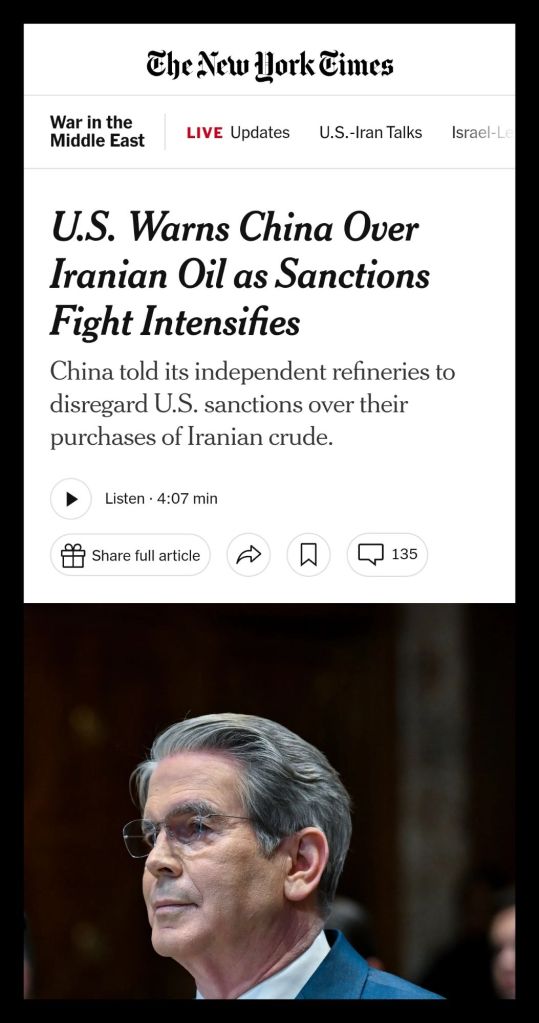
The critical question is not whether China is being directly targeted in a conventional military sense, but whether the structure of pressure being applied, through sanctions regimes, control of chokepoints, and regional instability, systematically converges on limiting its rise. Beijing’s response suggests that it interprets the answer as yes. Its strategy is not confrontation but endurance: absorbing shocks, diversifying dependencies, and avoiding entry into escalation frameworks defined by others.
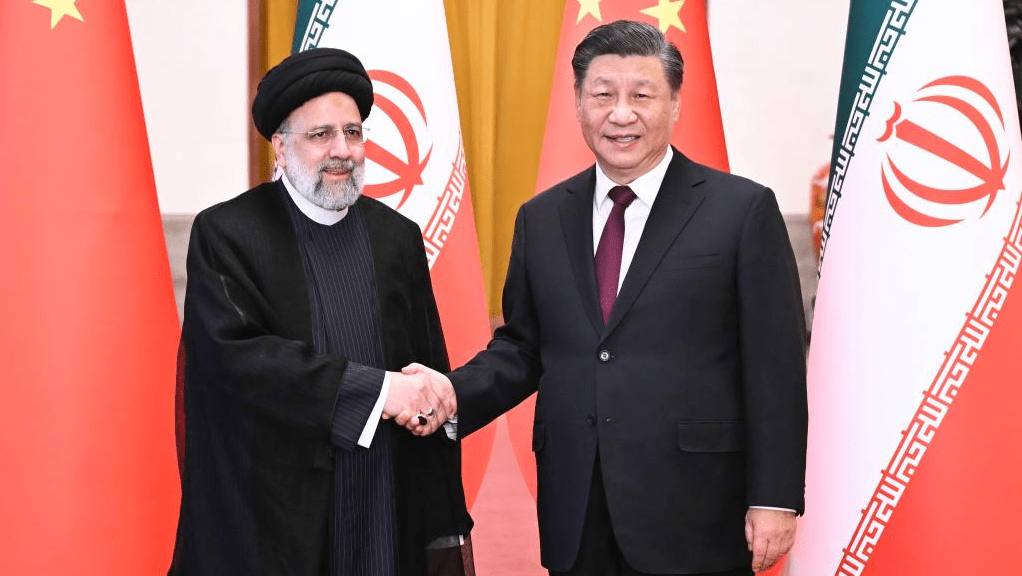
China’s response to the Iran war does not reflect passivity. It reflects a deliberate refusal to enter a coercive system designed to entrap it. As China’s Foreign Ministry repeatedly states, “China is committed to promoting talks for peace and opposes the use of force and unilateral sanctions” (Ministry of Foreign Affairs of the People’s Republic of China press briefings, 2024–2025). The consequence is not neutrality but transformation. The war in Iran accelerates the transition from a unipolar enforcement system to a multipolar structure defined by competing strategies of control and endurance.
Scale defines the significance of this moment because the Iran conflict intersects directly with the material foundations of global energy and trade. Approximately 35 per cent of China’s imported oil transits through the Strait of Hormuz, a chokepoint now exposed to disruption through military escalation and blockade risk (U.S. Energy Information Administration notes that “the Strait of Hormuz is the world’s most important oil transit chokepoint”). Chinese investments in Iran, estimated at roughly $5 billion, have already faced suspension, evacuation of personnel, and uncertainty in project continuity, consistent with the 2021 China–Iran cooperation framework described by Ministry of Foreign Affairs of the People’s Republic of China as a “comprehensive strategic partnership.” Financial markets reacted with volatility approaching ten per cent fluctuations, demonstrating that regional conflict transmits immediate systemic shocks into the world’s second-largest economy. These figures matter because they expose asymmetry. The United States projects power into the region. China absorbs the economic consequences.
Strategic execution reveals the underlying logic of the conflict. Washington applies pressure through military presence, sanctions enforcement, and control of maritime routes, aiming to restrict Iran’s capacity while indirectly constraining China’s energy supply. As former U.S. Secretary of State Mike Pompeo stated during the “maximum pressure” campaign, “We will deny the regime all paths to a nuclear weapon and all paths to malign behavior,” explicitly linking sanctions enforcement to oil export restrictions affecting buyers such as China. The method follows a familiar doctrine: convert geographic chokepoints into instruments of economic coercion.
Beijing’s response diverges sharply. Rather than contest control directly, China maintains trade with all parties, including the United States, Israel, and Iran, while publicly advocating ceasefire and negotiation. Chinese President Xi Jinping has emphasised that “dialogue and negotiation are the only viable solution” (remarks on Middle East security, 2023–2024). This posture is not conciliatory. It is strategic avoidance of entrapment within escalation ladders defined by another power.
The economic dimension exposes a deeper structural contest. Energy security sits at the core of China’s long-term planning, and the Iran conflict reinforces vulnerabilities that Beijing has attempted to mitigate for over a decade. The Belt and Road Initiative was never solely about connectivity. As outlined by National Development and Reform Commission, it aims to “promote connectivity of infrastructure and energy cooperation across Eurasia.” It represented an attempt to reconfigure the geography of energy and trade away from maritime dependence. Overland corridors across Eurasia, including rail networks linking China to Central Asia and onward to the Middle East, aim to bypass naval chokepoints vulnerable to interdiction. The conflict validates this strategy. Disruption in maritime routes strengthens the logic of continental integration.
Diversification emerges as the central economic response. Chinese strategists emphasise both diversification of transport corridors and diversification of energy sources. The International Energy Agency notes that China has “systematically diversified crude supply sources over the past decade,” including increased imports from Russia, Central Asia, and Africa. Increased reliance on Russia, Central Asia, Africa, and South America reduces exposure to any single region. This shift is not immediate, but the direction is clear. Energy supply becomes a portfolio rather than a dependency. The Iran war accelerates this transition because it demonstrates that reliance on Middle Eastern maritime routes carries systemic risk under conditions of geopolitical tension.
Game theory clarifies why China’s restraint produces long-term advantage rather than weakness. The structure resembles an asymmetric attrition game combined with a strategic patience equilibrium. The United States operates under a coercive strategy, seeking to impose costs rapidly through sanctions and military pressure. China adopts a delay strategy, accepting short-term costs in exchange for long-term structural repositioning. The payoff matrix favours endurance when the coercive actor cannot sustain pressure indefinitely without incurring rising costs.
Players operate under distinct constraints. Washington must demonstrate credibility through action, maintaining the effectiveness of sanctions and deterrence. Beijing must preserve economic stability while avoiding escalation that would justify broader containment. Under these conditions, escalation by the United States increases immediate leverage but accelerates systemic pushback. Restraint by China reduces short-term confrontation but allows gradual erosion of the coercive framework. The equilibrium shifts toward fragmentation rather than submission because the cost of enforcement rises faster than the cost of adaptation.
Realist theory explains this divergence. A declining hegemon relies increasingly on coercive instruments to preserve influence. A rising power avoids direct confrontation until alternative structures reduce vulnerability. Liberal assumptions about interdependence fail under these conditions because interdependence becomes weaponised. As former U.S. Treasury official Daleep Singh noted, “sanctions are most effective when they are multilateral,” implicitly acknowledging limits when applied against major economies like China. The Iran conflict demonstrates that economic integration no longer guarantees stability. It creates leverage points that can be exploited, forcing states to reconsider exposure.
A reversal of long-standing narratives becomes unavoidable. The post-Cold War period was often described in Western discourse as an era of stability and rule-based order. Empirical evidence contradicts this framing. Research from the Uppsala Conflict Data Program documents over 150 armed conflicts since 1991. Chinese scholars frequently cite this data to argue that the so-called rules-based order has been “characterised more by intervention than restraint.” This pattern reframes the system as one defined by persistent conflict rather than stability. The Iran war reinforces this perception within China’s strategic community.
Perception matters because it shapes doctrine. Increasing numbers of Chinese analysts argue that the post-Cold War order has ended and that a multipolar system is emerging. Two defining features characterise this transition. First, the United States no longer possesses the capacity to dominate globally across all domains. Second, emerging economies, including China, Russia, India, and others, possess sufficient resilience to resist containment. The Iran conflict acts as evidence supporting both claims. American power remains formidable, yet its ability to impose outcomes without systemic cost has diminished.
The triangular relationship between the United States, China, and Russia shifts under these conditions. The United States finds itself simultaneously engaged in multiple theatres, stretching strategic resources and complicating prioritisation. Russia benefits from rising energy prices, as noted by the International Monetary Fund, which observed that geopolitical conflict “places upward pressure on global energy prices.” China experiences economic disruption but gains relative strategic space as American focus disperses. This redistribution of attention alters bargaining dynamics. Washington must manage multiple fronts. Beijing can concentrate on long-term positioning.
Humiliation in strategic terms does not require defeat. It requires exposure of limits. The Iran war exposes limits in American capacity to enforce order without generating countervailing reactions. Threats to sanction Chinese banks for trading with Iran illustrate this tension. Former U.S. Treasury Secretary Jack Lew warned that overuse of sanctions could “undermine the effectiveness of our tools over time,” highlighting the systemic risks of escalation against major financial actors. The dilemma is structural. Enforcement against minor actors demonstrates strength. Enforcement against major actors risks systemic damage.
China’s response reveals a consistent doctrine. War is treated as disruption to be managed rather than an opportunity to be exploited militarily. Beijing maintains trade with opposing sides, avoids direct intervention, and focuses on domestic stability. This approach reflects a broader strategic philosophy emphasising development over confrontation. The contrast with American behaviour is stark. Where one side converts conflict into leverage, the other converts stability into advantage.
Systemic consequences extend beyond the immediate conflict. Countries across the Global South observe the interaction between sanctions, military action, and economic disruption. Perceptions of fairness and legitimacy shift accordingly. If the international system appears dominated by coercive enforcement, alternative arrangements gain appeal. China’s emphasis on sovereignty, development, and non-interference—principles reiterated in official white papers from the State Council of the People’s Republic of China—resonates within this context. Whether these principles are applied consistently remains secondary to their strategic utility as an alternative framework.
The Taiwan question illustrates the limits of external influence. Chinese analysts argue that decisions regarding Taiwan do not depend on American capacity to intervene but on internal dynamics related to independence movements. This perspective aligns with official statements that Taiwan is “an internal matter of China,” as reiterated by the Ministry of Foreign Affairs of the People’s Republic of China. This perspective removes the issue from the framework of opportunistic timing based on American distraction. Instead, it situates the decision within a longer-term strategic calculus. The Iran war therefore does not accelerate military action over Taiwan. It reinforces the logic of patience.
Future dynamics depend on whether the current trajectory stabilises or intensifies. Continued conflict in Iran increases risks to energy supply, trade routes, and financial stability. Inflationary pressures, supply disruptions, and investment uncertainty would affect China directly. Yet these pressures also accelerate structural adaptation. Diversification of energy sources, expansion of overland corridors, and development of alternative financial mechanisms become more urgent. Each shock strengthens the rationale for reducing dependence on systems controlled by another power.
A hard verdict emerges from this analysis. The Iran war does not simply destabilise a region. It accelerates the structural transition of the global system. American power retains the ability to disrupt but increasingly lacks the capacity to impose durable order. China lacks the ability to dominate but possesses the capacity to endure and adapt. The interaction between these strategies produces fragmentation rather than hierarchy. The decisive shift lies not in military outcomes but in the reorganisation of global incentives. War reveals vulnerabilities. Strategy determines whether those vulnerabilities lead to collapse or transformation. China’s response demonstrates a preference for transformation through restraint, diversification, and long-term positioning. The United States continues to rely on coercion to maintain influence. These approaches cannot coexist within a single integrated system indefinitely. History will not record the Iran war as a regional conflict alone. It will mark a phase in which the mechanisms of global order lost coherence under the pressure of competing strategies. Power remains concentrated, but authority has fractured.
Authored By: Global GeoPolitics
Thank you for visiting. This is a reader-supported publication. If you believe journalism should serve the public, not the powerful, and you’re in a position to help, becoming a PAID SUBSCRIBER truly makes a difference. Alternatively you can support by way of a cup of coffee:
https://buymeacoffee.com/ggtv |
https://ko-fi.com/globalgeopolitics |
Bitcoin: 3NiK8BoRZnkwJSHZSekuXKFizGPopkE7ns
References
Ministry of Foreign Affairs of the People’s Republic of China (2024–2025) Regular Press Conference Statements. Available at:
(Accessed: 5 May 2026).
U.S. Energy Information Administration (2023) World Oil Transit Chokepoints. Washington, DC: U.S. Department of Energy. Available at:
(Accessed: 5 May 2026).
Ministry of Foreign Affairs of the People’s Republic of China (2021) China–Iran Comprehensive Strategic Partnership Agreement. Available at:
(Accessed: 5 May 2026).
Mike Pompeo (2019) Remarks on Iran Policy (“Maximum Pressure” Campaign). U.S. Department of State. Available at:
(Accessed: 5 May 2026).
Xi Jinping (2023) Remarks on the Middle East Situation and Peace Initiatives. Beijing: Xinhua News Agency. Available at: http://www.xinhuanet.com (Accessed: 5 May 2026).
National Development and Reform Commission (2015) Vision and Actions on Jointly Building Silk Road Economic Belt and 21st-Century Maritime Silk Road. Beijing: NDRC.
International Energy Agency (2023) World Energy Outlook 2023. Paris: IEA. Available at:
(Accessed: 5 May 2026).
Daleep Singh (2022) Remarks on Economic Statecraft and Sanctions. Washington, DC: The White House / National Security Council.
Uppsala Conflict Data Program (2024) Armed Conflict Dataset. Uppsala University. Available at:
(Accessed: 5 May 2026).
International Monetary Fund (2024) World Economic Outlook: Commodity Markets Outlook. Washington, DC: IMF. Available at:
(Accessed: 5 May 2026).
Jack Lew (2016) Remarks on the Future of Sanctions. Carnegie Endowment for International Peace. Available at:
(Accessed: 5 May 2026).
State Council of the People’s Republic of China (2021) China’s International Development Cooperation in the New Era. Beijing: State Council Information Office.
Ministry of Foreign Affairs of the People’s Republic of China (2024) Statements on Taiwan Affairs. Available at:
(Accessed: 5 May 2026).
United States Department of Defense (2022) National Defense Strategy of the United States of America. Washington, DC: DoD.
The White House (2022) National Security Strategy. Washington, DC: Executive Office of the President.
World Bank (2024) World Development Indicators: Trade. Washington, DC: World Bank. Available at:
(Accessed: 5 May 2026).


Leave a comment