

The confrontation between the U.S. and Maduro’s regime recalls Iraq, Libya, and Afghanistan but this time, the playbook may not work.
The mounting confrontation between the United States and Nicolás Maduro’s government in Venezuela is now reaching a level of escalation that merits sober scrutiny. At its heart lie three intertwined dynamics: Washington’s renewed military and intelligence pressure in the Caribbean, Caracas’s mobilisation of defences and invocation of external partnerships, and the spectre of regime change under the guise of counter-narcotics operations. That situation bears echoes of the U.S. interventions in Iraq, Libya and Afghanistan. Yet Venezuela presents a different ball-game in significant respects.
The United States has publicly framed its actions in the Caribbean basin as part of an anti-drug campaign. According to analysis by the research centre Stimson Center, the U.S. faces “a significant chance” that strikes, even if targeted, will fail to meet stated objectives such as interrupting trafficking flows, because Venezuela has capable air- and missile-defences and a limited U.S. on-the-ground presence. (Stimson Center) Meanwhile, the think-tank assessment states that what would really be required to topple the Maduro government would amount to “a major war by the United States” and warns of the risk of a protracted insurgency. (Stimson Center) Similar commentary in independent press argues that the narrative of “narco-terrorism” is being used to accumulate military cover and shift perceptions, rather than to reflect credible threat levels. (Venezuelanalysis)
In practical terms, Washington has deployed warships, aircraft, and thousands of troops in the region. The Council on Foreign Relations notes that the U.S. struck a vessel linked to the Venezuelan-area gang Tren de Aragua and placed F-35 aircraft in Puerto Rico for Caribbean operations. (Council on Foreign Relations) At the same time, Venezuela claims the U.S. is seeking “an incident to justify military aggression”. (Peoples Dispatch) This assertive posture raises the question of whether the U.S. is preparing the terrain for a regime-change effort under the cover of narcotics interdiction.
A useful point of comparison is Iraq (2003): in that campaign the U.S. leveraged claims of weapons of mass destruction to justify a full-scale invasion, then encountered a sustained insurgency. Libya (2011) showed how a limited intervention enabled regime change yet left a power vacuum and fragmentation. Afghanistan illustrated the cost of protracted “nation-building” after kinetic operations. The central lesson from those theatres is that military force alone cannot guarantee political outcomes, especially when the local adversary retains cohesion, external backing, and popular patterns of resistance.
In Venezuela’s case, the Stimson analysis emphasises that even an air-only campaign would be unlikely to achieve the U.S. objective of dismantling the drug trade and removing Maduro, in part because the Venezuelan state retains sufficient defence capabilities and a network of support. (Stimson Center) That suggests fundamental differences from Iraq, where the U.S. enjoyed near-total air superiority and a relatively fragile Iraqi military. In Venezuela the terrain is not entirely unfamiliar or uncontrolled, the adversary not weak, and the logistics of intervention less favourable for Washington.
Furthermore, Venezuela sits within a sphere of regional complexity: the Caribbean and Latin America are home to neighbours with varying stances, and Russia and China maintain active ties with Caracas. Russia has condemned U.S. escalation as a violation of international law. (Council on Foreign Relations) This complicates matters in a way that Iraq or Libya did not to the same degree, in those cases local dependencies and regional allies did not so visibly challenge the U.S. presence.
Another distinguishing factor is sovereignty and precedent. The independent United Nations experts concluded that U.S. strikes in international waters equivalent to “extrajudicial executions” and violated international law. (Reuters) That constraint underscores how overt U.S. military action against Venezuela could carry higher diplomatic and legal costs than the 2003 Iraq invasion, where legal frameworks were broadly bypassed and post-war legitimacy contested but less constrained by international oversight.
That said, the parallels remain instructive. Just as in Iraq and Afghanistan the U.S. found that enemy adaptation eroded strategic success, experts caution that Venezuela’s regime, and its allies, could easily shift into asymmetric defence or guerrilla mode if threatened. The Stimson study warns of the risk of guerrilla campaigns emerging under any U.S. regime-change effort. (Stimson Center)The independent media outlet Venezuelanalysis argues the U.S. narco-terror framing replicates past militarised models in Latin America which produced instability rather than law-and-order. (Venezuelanalysis) Thus the U.S. risks repeating the pattern of initial intervention followed by enduring instability.
The strategic logic merits examination. On one hand, the U.S. rhetoric emphasises Venezuela’s vast oil reserves (the largest proven in the world), suggesting strategic economic interest beyond the narco frame. (Truthout) On the other hand, Venezuela’s defence posture is already on high alert and has activated militia mobilisation (official statements claim more than 8 million militia members) in response to U.S. military presence in the Caribbean. The regime likewise highlights the anti-drug narrative as exhausted and accuses Washington of seeking a casus belli. (Peoples Dispatch) In this light, a scenario of direct U.S. invasion looks less probable today than a layered campaign of coercion, sanctions, covert operations, naval and air-force deployments seeking to destabilise the government under the cover of counter-narco efforts.
Nevertheless, the risk of mission creep is real: once U.S. military assets are deployed near Venezuelan territory, the possibility of accidental escalation, mis-identification of targets, or Venezuelan counter-action is non-trivial. The CRS assessment that “political leaders ultimately determine what constitutes a sufficiently dangerous threat to warrant military action” applies here; the threshold could be declined or shifted. (RUSI) A false-flag incident or border skirmish might be the trigger Washington or Caracas needs to justify broader operations.
In sum, while the U.S. appears ready and seeking a pretext for broader involvement in Venezuela, the structural and geostrategic realities mean this is a different ball-game from Iraq or Libya. Venezuela’s military capability, external alliances (Russia and China), regional stakes, and legal-diplomatic constraints elevate the risk of a protracted confrontation rather than a quick outcome. The independent observers cited above warn that the cost of intervention, the likelihood of failure to meet objectives using force alone, and the potential for insurgency or regional destabilisation should temper expectations of triumph.
What this means going forward: Washington will likely continue deploying naval and air assets, pressuring Caracas economically and politically, and engaging intelligence operations. Caracas will continue to posture defensively, deepen ties to Moscow and Beijing, and mobilise domestic militias to deter external intervention. The scenario of full-scale U.S. ground invasion remains unlikely for now, but the risk of incremental escalation into a longer and more costly conflict is real.
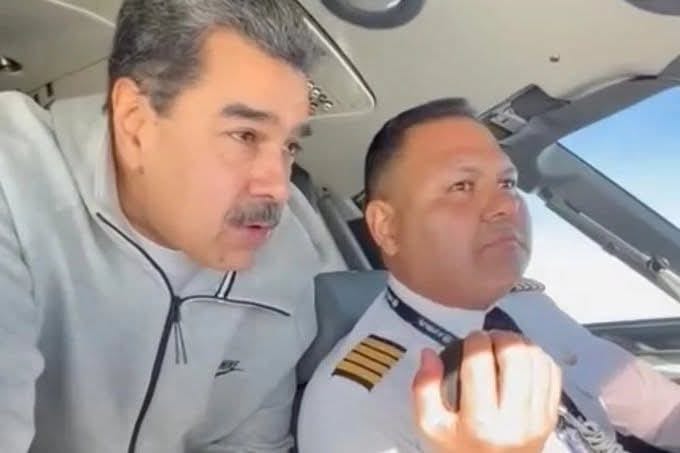
(Homeland Security agent Edwin Lopez met with Maduro’s pilot General Bitner Villegas in the Dominican Republic in 2024. Lopez allegedly offered the pilot money and protection in exchange for diverting Maduro’s plane to a location where US authorities could arrest him)
The Associated Press reported that a U.S. federal agent attempted to recruit President Maduro’s personal pilot, General Bitner Villegas, to divert the Venezuelan leader’s aircraft so he could be captured on American soil. The offer included money and protection in exchange for cooperation. The pilot refused, calling the approach cowardly. This episode, confirmed by multiple former officials, fits a pattern of clandestine U.S. efforts to secure regime change through covert means. Caracas has since claimed the arrest of a group of mercenaries carrying information linked to the Central Intelligence Agency. Venezuelan authorities described their mission as a planned false-flag operation designed to create a pretext for broader military intervention.
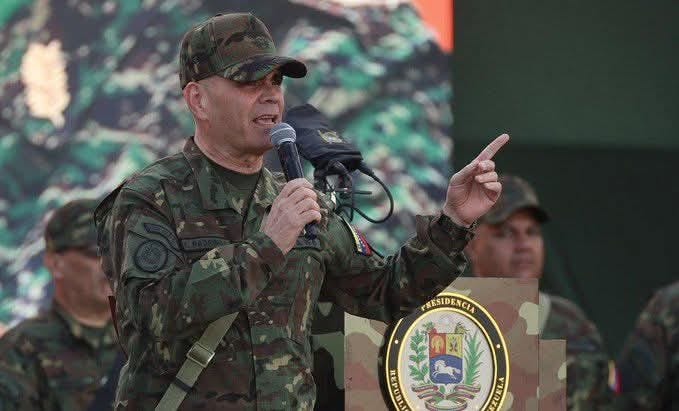
(Venezuelan Defense Minister Vladimir Padrino López says the U.S. is actively searching for “an incident to justify military aggression” against Venezuela, accusing Washington of planning a false-flag operation as U.S. naval forces build up in the Caribbean)
Should the U.S. mis-calculate, as it did in Iraq, Libya and Afghanistan, the legacy will be years of instability, drifting governance in Venezuela, worsening humanitarian conditions, and spill-over into regional migration flows and security networks. A different ball-game indeed, but the same core warning remains: military means alone will not yield the political outcomes envisaged.
Authored By: Global GeoPolitics
If you believe journalism should serve the public, not the powerful, and you’re in a position to help, becoming a PAID SUBSCRIBER truly makes a difference. Alternatively you can support by way of a cup of coffee:
buymeacoffee.com/ggtv


Leave a comment