
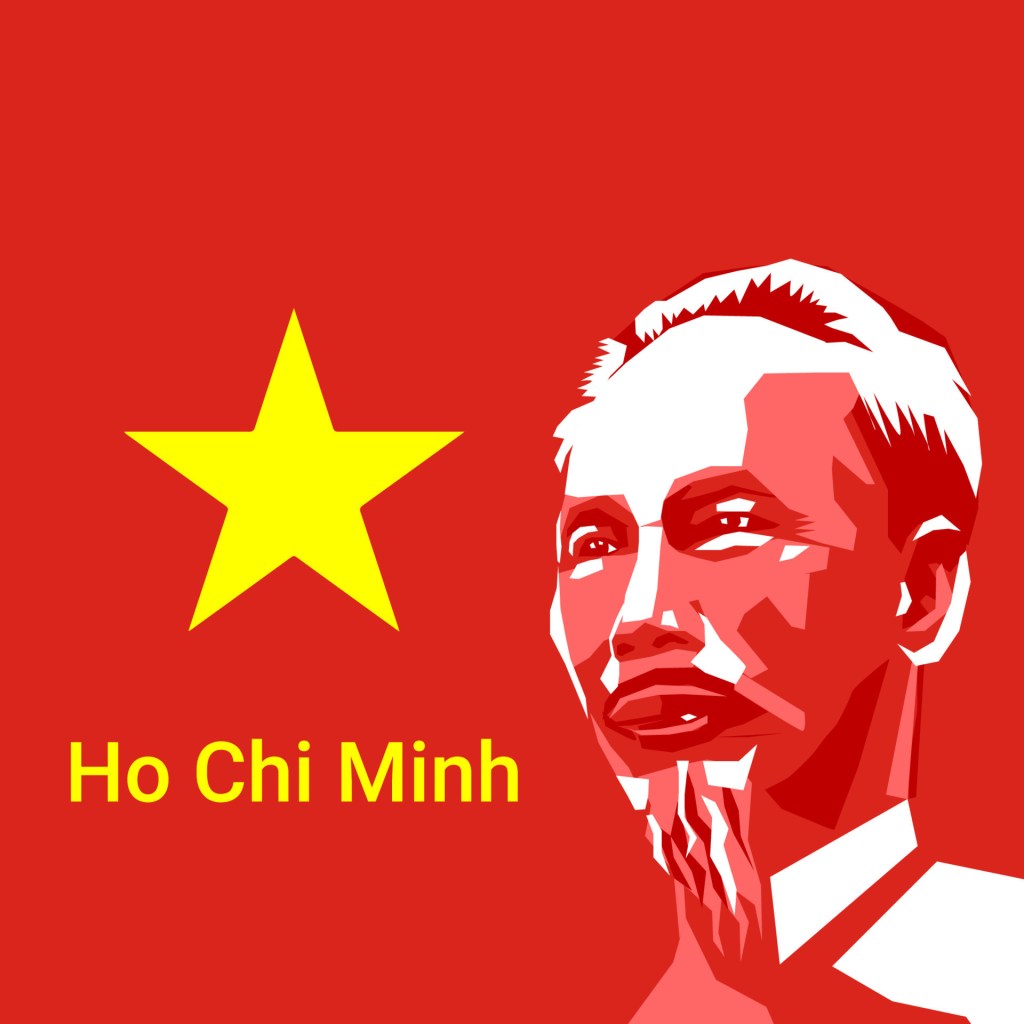
More people are starting to question the gap between what the West says it stands for and the destruction left behind by its wars, sanctions, and interventions.
The Vietnamese leader, Ho Chi Minh said:
“There is no destroyed house, scattered stone, severed hand, bereaved mother, or disfigured nation in which you will not find a trace of America.”
That quote hits harder today because more people are starting to see what he meant.
For years, America has presented itself as the force for freedom and democracy around the world. But when you look at Vietnam, Iraq, Libya, Afghanistan, Palestine, and so many other places, there’s a clear pattern: war, destruction, sanctions, coups, and chaos often follow American involvement.
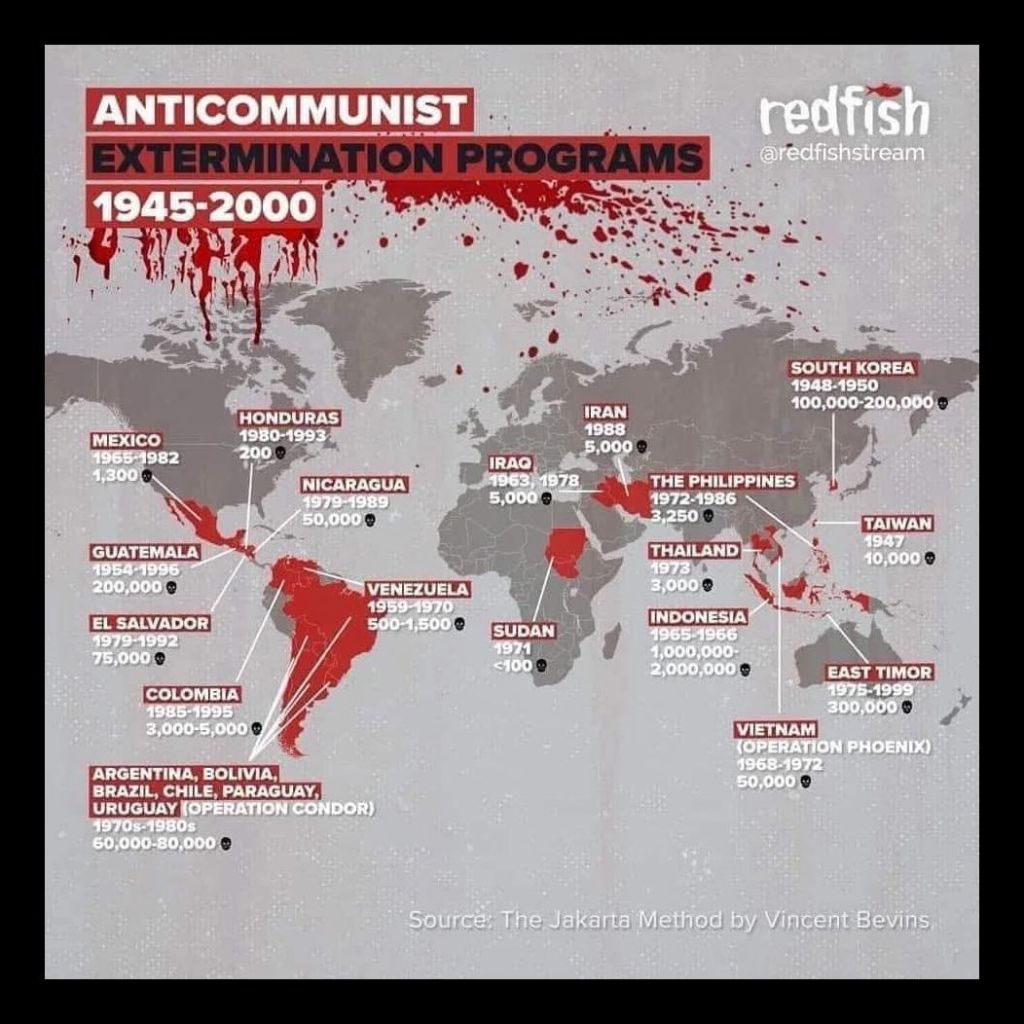
And whenever a country tries to break away from Western control or build a different kind of system, it gets attacked economically, politically, or militarily. Then people point at the damage and say, “See? That system failed.”
But how can any country peacefully develop when it’s constantly being pressured, isolated, sanctioned, invaded, or destabilized? That’s the point made by Caitlin Johnstone nearly five years ago. If a country is being chased by wolves, you can’t judge it like it’s living in peaceful conditions.
A lot of people are waking up to this now. The image of the West as the “good guys” is falling apart because the contradictions are too obvious to ignore anymore. This doesn’t mean every country opposing the US is good. It just means the story we were told about how the world works is starting to break down.
People are realizing that many of the world’s conflicts are not random. They come from powerful countries trying to keep control, through military force, money, media, and political pressure. That’s why the empire narrative is unravelling, not because people suddenly became anti-American, but because the gap between the message and the reality became too big to hide.
One of the biggest examples of this happened after the Soviet Union collapsed. During the 1990s, Russia was pushed into rapid free market reforms known as “shock therapy.” State industries were sold off, public systems were dismantled, and foreign financial institutions pushed privatization at extreme speed. Instead of creating prosperity, the country went through economic collapse. Millions of people lost their savings, poverty exploded, crime rose sharply, and life expectancy dropped. A small group of oligarchs became incredibly rich while ordinary people suffered. What happened in Russia showed that the fall of communism did not automatically lead to freedom and stability for most people. In many ways, the country was economically stripped apart during the transition.
Yugoslavia is another example. Before its collapse, Yugoslavia had a socialist system with public industries, housing, and a relatively stable economy compared to much of Eastern Europe. But after political crisis, outside pressure, sanctions, and nationalist tensions, the country was broken apart through a series of wars in the 1990s. NATO bombed Yugoslavia in 1999, destroying bridges, factories, power stations, hospitals, and other civilian infrastructure. After the wars, much of the region was opened up to privatization and Western financial influence. What had once been a unified country was left divided, weakened, and economically dependent.
North Korea is often used as proof that socialism or communism “failed,” but people rarely mention that the country has lived under heavy sanctions, military threats, and economic isolation for decades. Its economy has been restricted by international sanctions targeting trade, banking, fuel, and industry. Whether someone agrees with the North Korean government or not, it is impossible to honestly judge the country without recognizing the extreme pressure it has faced from outside powers for generations.
China followed a different path. Unlike Russia, China did not fully hand over its economy to private interests or foreign corporations. The Chinese state kept control over major industries and slowly introduced market reforms while maintaining national control. Because of this, China avoided the total collapse Russia experienced in the 1990s. Today, China has become too economically powerful to be attacked the way countries like Iraq, Libya, or Yugoslavia were. Instead, pressure now comes through trade wars, sanctions, military encirclement, and political propaganda. The goal is still containment, but direct destruction is no longer as easy as it once was.
Looking at all these examples together, a pattern becomes clear. Countries that try to operate outside Western control are often pressured through sanctions, coups, wars, debt systems, political interference, or economic destabilization. Then, when those countries struggle or collapse, the damage is blamed entirely on their political system while the outside pressure is ignored. The empire still has enormous power, but it no longer has the same level of control over information, public trust, or global opinion. More people are starting to question the system itself instead of automatically believing the story that Western power equals freedom and morality.
120 to 150 of the world’s most powerful people heard it in that room, left believing it was true, and spent the next year spreading it everywhere.
Then the invasion happened.
Dan Dicks has been covering Bilderberg for 20 years. And he says Iran has been on the chopping block for a long time.
We’ve seen this before”
The empire still has enormous power, but it no longer has the same level of control over information, public trust, or global opinion. More people are starting to question the system itself instead of automatically believing the story that Western power equals freedom and morality.
Except from Caitlin Johnstone:
“Expecting a communism-oriented country to look like a utopia in the midst of a global imperialist war against communism is like expecting a family to look like a Norman Rockwell painting while they are being chased by wolves.
“Saying communism doesn’t work because nations who try to espouse it don’t look like thriving utopias while they’re being relentlessly assaulted is like saying a new invention doesn’t work because a band of armed thugs kept shooting and stomping on it during the demonstration.”
Authored By: Global GeoPolitics
Thank you for visiting. This is a reader-supported publication. If you believe journalism should serve the public, not the powerful, and you’re in a position to help, becoming a PAID SUBSCRIBER truly makes a difference. Alternatively you can support by way of a cup of coffee:
https://buymeacoffee.com/ggtv |
https://ko-fi.com/globalgeopolitics |
Bitcoin: 3NiK8BoRZnkwJSHZSekuXKFizGPopkE7ns
Reference
Johnstone, C. (2021) The System Is Rigged For Endless War: Notes From The Edge Of The Narrative Matrix. Available at: Caitlin Johnstone Substack (Accessed: 14 May 2026). (dkit.ie.libguides.com)
Leon, D.A. et al. (2001) ‘Changes in life expectancy in Russia in the mid-1990s’, The Lancet, 357(9260), pp. 917–921. Available at: https://www.sciencedirect.com/science/article/pii/S0140673600042124 (Accessed: 14 May 2026).
Council on Foreign Relations (2022) What to Know About Sanctions on North Korea. Available at: https://www.cfr.org/backgrounders/north-korea-sanctions-un-nuclear-weapons (Accessed: 14 May 2026).
Bartlett, J. and Shin, F. (2021) Sanctions by the Numbers: Spotlight on North Korea. Center for a New American Security. Available at: https://www.cnas.org/publications/reports/sanctions-by-the-numbers-north-korea (Accessed: 14 May 2026).
Keseljevic, A., Nikolic, S. and Spruk, R. (2025) Ethnic Conflicts, Civil War and Economic Growth: Region-Level Evidence from former Yugoslavia. Available at: https://arxiv.org/abs/2505.02431 (Accessed: 14 May 2026).


Leave a comment