
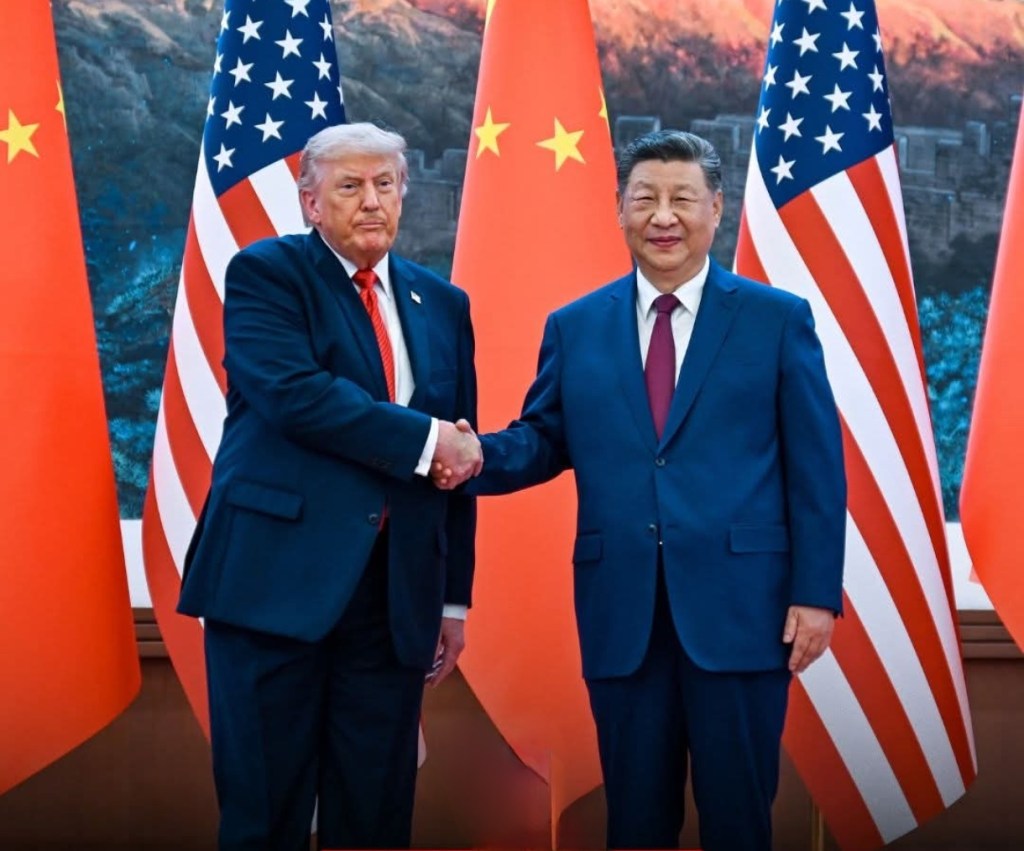
A comparison of how the United States and China structure the relationship between capital and the state
I found the video to be quite interesting and a great addition to the theme of today’s article. This is widely circulated Chinese economist policy commentator Eric X. Li (Li Shijun) interview commentary on China-US political economy, one recurring argument is that “in the United States, changing political parties does not significantly alter policy outcomes, whereas in China capital is more tightly constrained by political authority…”.
This perspective argues that a single-party system may allow for more direct alignment between governance and public priorities, whereas a two-party system can result in both major parties operating within similar constraints shaped by corporate and wealthy donor influence. As he says in the interview:
“In America, you can change the political parties but you can’t change the policies. Billionaires in America control all policy making. China is a vibrant market economy but it is not capitalist. Billionaires in China can’t control policy and capital does not have enshrined rights. In America, capital itself has risen above the nation. In the last 66 years China is being run by one single party, yet the political changes that have taken place have been wider and broader and greater than any other country in modern history.”
Trump’s return to power highlighted something that had been building for decades rather than appearing suddenly. His political coalition and surrounding network made it harder to ignore the structure of American power: a system where elected officials operate inside a dense environment of corporate funding, lobbying, and concentrated private wealth. This is not unique to Trump, but his style of governance reduced the distance between political leadership and elite economic actors, making the underlying system more visible.
At the core of the American model is a tension between formal political equality and unequal economic power. In principle, the United States is a representative democracy. In practice, research suggests policy outcomes are strongly correlated with the preferences of economic elites and organized interest groups, while average citizens have far less independent influence. This is the central finding of the well-known Princeton study by Gilens and Page, which concluded that economic elites and business interests have substantial impact on policy outcomes compared to ordinary voters. (Gilens and Page, 2014)
This dynamic has intensified in the post–Citizens United era, where legal rulings expanded the ability of corporations and wealthy individuals to spend on political influence. Data from the Brennan Center for Justice shows that U.S. election cycles have seen a growing share of funding coming from a very small number of extremely wealthy donors, alongside the expansion of “dark money” networks that obscure the original source of political spending. (Brennan Center for Justice, 2024)
From a political economy perspective, this aligns with a broader process of financialisation. Economic value creation becomes increasingly concentrated in finance, asset ownership, and capital markets rather than production. Economists such as Michael Hudson argue that this shifts modern economies away from industrial expansion and toward rent extraction, where wealth is increasingly generated through debt, real estate, and financial claims rather than productive investment (Hudson, 2015).
China represents a contrasting model of state-directed market development. Since the late 1970s, China has combined market mechanisms with strong state control over banking, land, and strategic industries. The World Bank estimates that China’s development process lifted approximately 800 million people out of extreme poverty over several decades, making it the largest poverty reduction in recorded history. (World Bank, 2022)
However, this is not a purely ideological distinction between “capitalism” and “communism,” but a structural difference in how capital is governed. In China, large private firms exist, but they remain subject to state direction, especially in strategic sectors. Regulatory interventions in major technology and finance firms, including the suspension of Ant Group’s IPO in 2020, illustrate the state’s ability to constrain private capital when it is perceived to exceed political limits. (Brookings Institution, 2021)
The United States, by contrast, increasingly exhibits a system in which capital does not merely operate alongside the state, but actively structures the boundaries of state action itself. In this model, corporate and financial power does not simply influence policy from the outside; it helps define what policies are politically and economically feasible in the first place. This creates a condition where the state often responds to the constraints of capital accumulation, financial markets, and corporate lobbying networks, rather than acting as an independent regulator of them..
From a comparative political economy perspective, the key distinction is not simply democracy versus authoritarianism, but the degree to which political systems can discipline capital. Dani Rodrik has argued in various works on the “political trilemma of the world economy” that it is difficult to simultaneously maintain deep globalisation, national sovereignty, and mass democracy at the same time, forcing trade-offs between them.
Historically, systems that experience high levels of financial concentration often face long-term pressures: rising inequality, declining trust in institutions, and political fragmentation. These trends are widely documented in OECD inequality reports, which show that income and wealth inequality in the United States has risen significantly since the late 20th century, with a growing share of national wealth held by the top percentile.
China’s system, meanwhile, has produced rapid industrial expansion and infrastructure growth, but also faces structural challenges including demographic decline, property sector instability, and high local government debt. These constraints complicate any simplistic narrative of either system as fully stable or fully superior.
Seen together, the divergence between the United States and China is not simply ideological. It reflects different answers to a core question in modern political economy: who ultimately governs capital, the state, or capital itself.
Trump’s political moment did not create this contradiction, but made it more visible. The presence of elite economic actors at the centre of political decision-making highlighted a long-term shift in which economic power and political authority have become increasingly intertwined in the United States, while China has moved in the opposite direction by tightening state oversight of capital.
The broader implication is not that one system has reached equilibrium while the other collapses, but that both are adapting under different constraints. The United States continues to operate through a pluralistic electoral system shaped by concentrated wealth, while China operates through centralized political authority managing a large and complex market economy. Each system contains internal tensions that will define their trajectories over time.
The significance of this comparison is not to declare a final outcome, but to clarify the structural differences shaping global power in the 21st century.
Authored By: Global GeoPolitics
Thank you for visiting. This is a reader-supported publication. If you believe journalism should serve the public, not the powerful, and you’re in a position to help, becoming a PAID SUBSCRIBER truly makes a difference. Alternatively you can support by way of a cup of coffee:
https://buymeacoffee.com/ggtv |
https://ko-fi.com/globalgeopolitics |
Bitcoin: 3NiK8BoRZnkwJSHZSekuXKFizGPopkE7ns
References
Gilens, M. and Page, B.I. (2014) ‘Testing Theories of American Politics: Elites, Interest Groups, and Average Citizens’, Perspectives on Politics, 12(3), pp. 564–581. doi:10.1017/S1537592714001595.
World Bank (2022) Four Decades of Poverty Reduction in China. Available at: https://www.worldbank.org/en/news/press-release/2022/04/01/lifting-800-million-people-out-of-poverty-new-report-looks-at-lessons-from-china-s-experience (Accessed: 15 May 2026).
Brennan Center for Justice (2024) Campaign Finance and Dark Money Trends in U.S. Elections. Available at:
(Accessed: 15 May 2026).
Hudson, M. (2015) Killing the Host: How Financial Parasites and Debt Bondage Destroy the Global Economy. Dresden: ISLET.
Brookings Institution (2021) China’s Ant Group IPO suspension and regulatory tightening. Available at: https://www.brookings.edu (Accessed: 15 May 2026).
(Accessed: 15 May 2026).
Rodrik, D. (2011) The Globalization Paradox. New York: W.W. Norton.
OECD (2023) Inequality Indicators and Income Distribution Database. Available at: https://www.oecd.org/social/inequality.htm (Accessed: 15 May 2026).


Leave a comment