
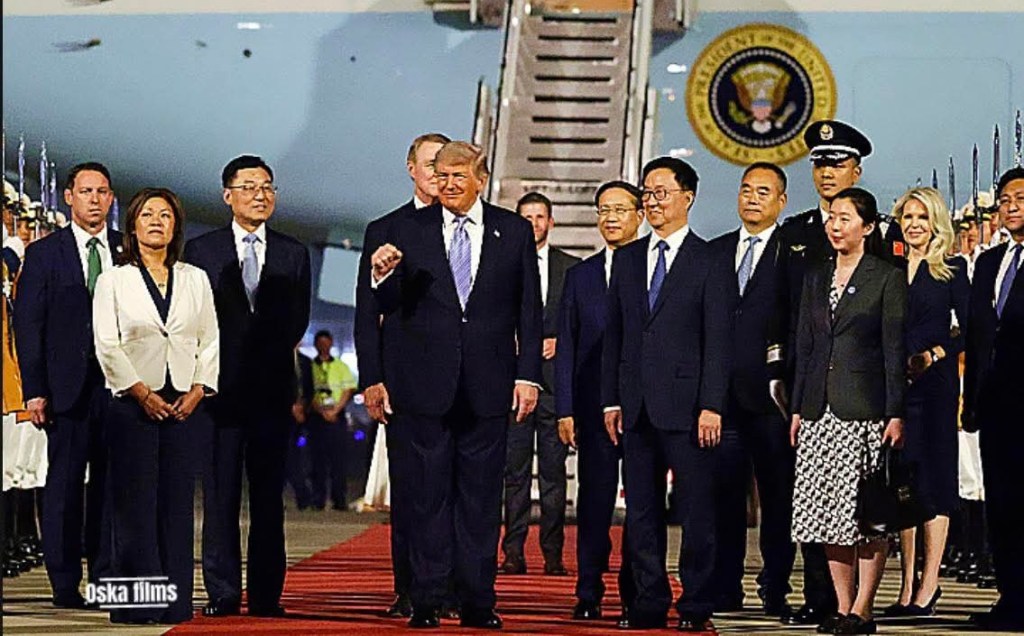
The Beijing visit exposed how transnational corporations, financial institutions, and technology monopolies now operate openly as the permanent power structure beneath American electoral politics.
This is the short version analytical examination of Donald Trump’s state visit to China and its implications for the emerging multipolar order. See link at the bottom for the extended version.
Editorial Analysis | May 2026
Donald Trump arrived in Beijing on 13 May 2026 accompanied by a delegation that illustrated, with considerable clarity, who actually directs the course of American foreign economic policy. Alongside the President were the chief executives of Tesla, Apple, BlackRock, Goldman Sachs, Boeing, Citigroup, Qualcomm, Micron, General Electric, Blackstone, Mastercard, Visa, Cisco, Cargill, Nvidia, and Meta, a concentration of corporate capital representing several trillion dollars of market value and, collectively, a more accurate portrait of American institutional priorities than any diplomatic communiqué. The composition of the delegation was not incidental. These corporations depend, in varying but substantial degrees, on Chinese manufacturing capacity, Chinese consumer markets, Chinese rare earth exports, and Chinese financial integration. Their presence in Beijing, at the personal invitation of a President who had spent the preceding months engineering some of the most severe trade restrictions imposed on China since the Nixon era, exposed the fundamental contradiction embedded at the heart of Washington’s China policy.
The symbolic register of the visit also warrants attention. Xi Jinping did not receive Trump at the airport in the manner accorded to Vladimir Putin during his February and May 2024 visits to Beijing, when Xi welcomed him at the Great Hall of the People with the full ceremonial apparatus of a strategic partnership. Trump’s arrival at Beijing Capital International Airport was received instead by Vice President Han Zheng, accompanied by a brass band and flag wavers, spectacle deployed with precision by a government that understands the American President’s appetite for visual affirmation without wishing to signal unconditional deference. The distinction in protocol was deliberate. China manages ceremony as a form of statecraft, and the level of reception accorded to any foreign leader encodes a precise message about the nature and limits of the relationship on offer.
China entered the summit having issued, through official channels and semi-official commentary, a set of explicit conditions governing the terms under which productive dialogue could proceed. Beijing’s position was stated without significant ambiguity: the United States must not challenge China’s sovereignty over Taiwan, must not interfere in China’s political system or internal governance, must not use human rights frameworks as instruments of geopolitical pressure, and must not obstruct China’s right to technological and economic development. These were not negotiating positions in the ordinary sense, they were statements of what China regards as non-negotiable structural preconditions. China’s May 2025 national security white paper, “National Security in the New Era,” formalised precisely this posture, warning that Beijing “cannot afford strategic vulnerabilities” and identifying American tariffs, sanctions, and technological restrictions as “direct threats to China’s political system” against which countermeasures would be applied. The white paper explicitly described the deployment of the US Typhon missile system in the Philippines as a manoeuvre aimed at increasing military pressure on China, signalling that Beijing has mapped and intends to contest each element of Washington’s Indo-Pacific architecture.
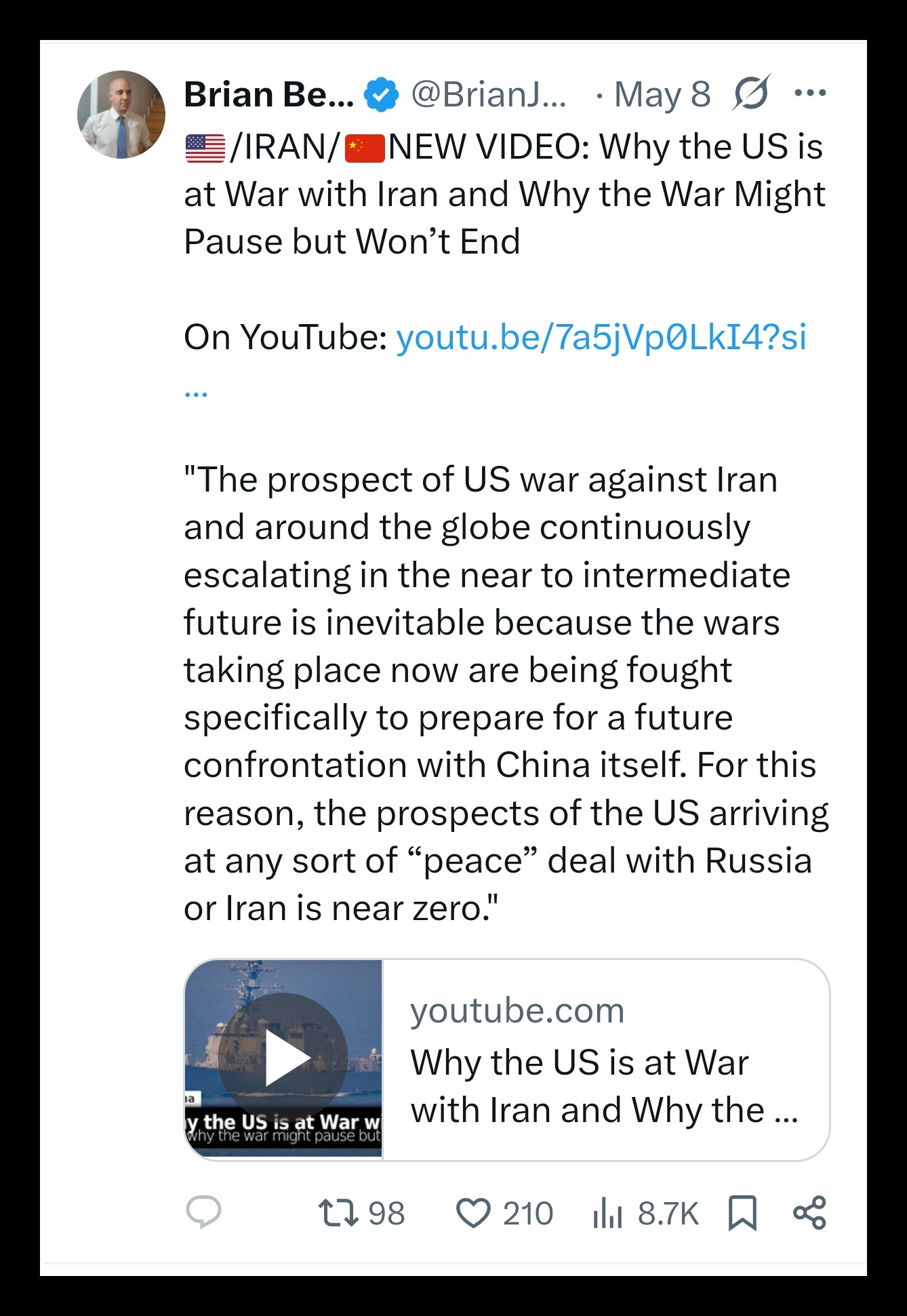
The analytical framework most useful for understanding these negotiations was articulated with some clarity by Brian Berletic of The New Atlas in commentary published ahead of the summit. Berletic’s argument, which aligns with a broader strand of strategic analysis that has gained traction among researchers outside mainstream Western policy institutions, holds that China is engaged in a long-term programme of full-spectrum self-sufficiency, across manufacturing, energy supply chains, semiconductor production, and critical technology, and that its behaviour in any given bilateral negotiation must be evaluated against that strategic horizon rather than against the immediate tactical context. China’s own doctrinal language supports this reading. Xi Jinping’s directive to integrate “new-quality productive forces” with “new-quality combat capabilities,” formalised in party guidance from 2024 onward, reflects a systematic effort to convert civilian industrial output directly into military and strategic resilience. On this reading, any Chinese willingness to purchase American liquefied natural gas, or to offer limited trade concessions in other areas, does not represent acquiescence to American pressure but rather a pragmatic effort to purchase time and political space while the deeper work of structural independence proceeds.
The energy dimension of the summit carried particular weight given the regional military context. American military operations against Iran, which Trump launched earlier in his second term with explicit strategic objectives related to Middle Eastern energy infrastructure, had been presented in part as leverage over China, a demonstration that Washington could disrupt the Persian Gulf supply routes upon which Chinese energy imports have historically depended. The logic, as understood by American planners, was that a demonstration of US willingness and capacity to degrade Iranian energy exports would sharpen China’s incentive to negotiate from a position of anxiety. The Council on Foreign Relations, in an analysis published before the summit, described the meeting as an effort to stabilise US-China relations rather than resolve long-standing disputes, noting continuing disagreements over Taiwan, freedom of navigation in the South China Sea, and Beijing’s relations with countries Washington regards as strategic adversaries. The outcome proved more complicated than planners had assumed. Iran’s strategic resilience, and the limitations of American airpower in achieving decisive infrastructure degradation against a deeply fortified adversary, meant that Trump arrived in Beijing with a weaker military hand than the original strategic calculus had anticipated. The leverage was real but partial, and China had revised its assessment accordingly. Al Jazeera reporting from Beijing on 13 May noted that the visit followed “weeks of unsuccessful US efforts to persuade China to help bring Iran back to negotiations,” a formulation that accurately captures the prior diplomatic trajectory.
What Trump brought to Beijing, beyond his corporate entourage, was a proposed architecture of exchange that various analysts and officials characterised as a prospective grand bargain. The essential terms, as reconstructed from available commentary and diplomatic reporting, involved American concessions on Taiwan, potentially including reduced arms sales, diminished naval presence in the Taiwan Strait, or weakened security assurances to Taipei — in exchange for Chinese cooperation in isolating Iran, restricting technology transfers to Russian defence industry, and opening specific market sectors to American capital. On 11 May, Trump announced on Truth Social that he intended to raise the question of arms sales to Taiwan with Xi, in what observers noted constituted a departure from the Six Assurances framework that has governed American policy on Taiwan since 1982. The proposition suffered from a structural deficiency that rendered it strategically incoherent before negotiations formally began. The United States has no recognised legal sovereignty over Taiwan, holds no treaty rights to dispose of Taiwan’s security arrangements on behalf of its people, and has violated every significant undertaking it made on the Taiwan question since the signing of the three Joint Communiqués between 1972 and 1982. Offering concessions on territory one does not control, using commitments one has already repeatedly broken as currency, is not diplomacy in any functional sense.
The question of Iran illuminates a deeper and more consequential dimension of Chinese foreign policy that Western analysis persistently misreads. China’s relationship with Tehran is grounded in the 25-year Comprehensive Cooperation Agreement signed in March 2021, which encompasses energy, infrastructure, finance, and security cooperation across a range of sectors. Chinese investment commitments under that agreement run to figures reported by Iranian officials at approximately 400 billion dollars over its duration, with substantial energy infrastructure components. Analysts at the Stimson Center cited before the summit that Iran represents one of the few areas where US and Chinese interests might technically overlap, given that both countries benefit from stable energy supply routes, but qualified that observation by noting the profound asymmetry in how each government weighs short-term tactical convenience against long-term strategic alignment. China does not operate on the assumption that strategic partnerships are contingent instruments to be discarded when a more powerful actor offers inducements. The idea that Beijing would sacrifice this geometry of interests in exchange for American promises, from an administration that unilaterally withdrew from the Joint Comprehensive Plan of Action in 2018 and has demonstrated no stable commitment to any international agreement it finds inconvenient, reflects a category error about how Chinese strategic institutions actually function.
The corporate dimension of the visit deserves separate analysis, because it exposes the structural contradiction that makes coherent American China policy institutionally difficult to sustain. Apple manufactures the overwhelming majority of its iPhone production in China, through Foxconn and Pegatron facilities employing hundreds of thousands of workers under supply chain arrangements that took decades to construct and cannot be replicated at comparable cost or speed elsewhere. Qualcomm generates approximately a quarter of its global revenues from Chinese customers. BlackRock has been expanding its asset management presence in China’s domestic financial market. Goldman Sachs received approval from Chinese regulators in 2020 to operate a majority-owned securities joint venture. Nvidia CEO Jensen Huang, whose company has been engaged in prolonged regulatory disputes over the export of high-performance chips to Chinese buyers, joined the delegation directly, a presence that illustrated, without requiring further commentary, the gap between Washington’s stated policy of technological decoupling and the commercial imperatives of the corporations that fund both major American political parties. The 2025 National Security Strategy released by the Trump administration in December of that year called for “rebalancing America’s economic relationship with China, prioritising reciprocity and fairness,” while simultaneously acknowledging that Chinese exports to the United States had been rerouted through third-country intermediaries in Mexico and a dozen other nations, a structural adaptation that no tariff schedule has yet successfully closed.
The longer structural argument, advanced by a range of American strategic thinkers including figures within the foreign policy establishment who have expressed frustration at the persistent diversion of American attention toward Middle Eastern military operations, holds that the genuine competitive challenge facing the United States is Chinese industrial and technological development, not Iranian regional influence. Elbridge Colby, now serving as Under Secretary of Defense for Policy and the principal architect of both the 2018 and 2026 National Defense Strategies, argued before the Senate Armed Services Committee at his confirmation hearing in March 2025 that China represents “the biggest, most powerful rival we have faced in probably 150 years.” His 2021 book “The Strategy of Denial”, which has become required reading across US defence planning institutions, argued that American military power must be directed toward denying China hegemony over Asia rather than pursuing global primacy across multiple theatres simultaneously. The 2026 National Defense Strategy, which Colby oversaw, lists deterring China in the Indo-Pacific as the second strategic regional priority after homeland defence, a doctrinal settlement that Foreign Policy described in February 2026 as “the point at which a decade-long argument about US power, limits, and prioritisation hardens into enforceable doctrine.” China expanded by a better-than-expected five percent in 2025, extending into the first quarter of 2026, while successfully pivoting export markets away from the United States, weaponising its dominance over rare earths, and advancing domestic semiconductor fabrication capacity through entities including SMIC. The asymmetry of investment focus over the preceding two decades is now embedded in structural competitive reality.
The question that American strategic planners must eventually address — and that the composition of the Beijing delegation inadvertently raised — is whether a foreign policy constructed around the proposition that China can be contained, subordinated, or strategically isolated is compatible with the economic interdependencies that American corporations have spent three decades constructing. Tim Cook cannot simultaneously testify before Congress about the need to reduce Chinese technological dependency and fly to Beijing on Air Force One to protect Apple’s manufacturing arrangements. Larry Fink cannot simultaneously endorse financial decoupling and expand BlackRock’s Chinese asset management operations. The 2025 National Security Strategy acknowledged this tension implicitly when its authors conceded that “complete economic decoupling is neither feasible nor sustainable,” a formulation that the Center for a New American Security noted papers over the irreconcilable contradiction between calling China a systemic rival and pursuing deeper financial integration with it simultaneously. Until that contradiction is resolved, American China policy will continue to oscillate between confrontational rhetoric and quiet accommodation, producing neither the strategic clarity necessary for credible deterrence nor the diplomatic stability necessary for productive coexistence.
Trump remained in Beijing on the evening of 13 May, with bilateral meetings scheduled to continue through 15 May. The summit was still in progress as this analysis was prepared. Reuters, the Associated Press, and CNN all confirmed his arrival and reported meetings scheduled across two full days with Xi Jinping, covering trade, Taiwan, artificial intelligence, and Iran. Whether the proceedings produce any substantive agreements, or whether the visit serves primarily as political theatre enabling Trump to demonstrate engagement without conceding anything of structural significance, remained to be established.
What can be assessed, however, is the strategic architecture that surrounds these meetings and that will determine whether any agreements reached in Beijing carry durable weight. The 2026 National Defense Strategy, whose unclassified version was released in January of this year, stated explicitly that the United States’ goal “is not to dominate China; nor is it to strangle or humiliate them,” language that the Center for Strategic and International Studies noted in April 2026 marks a formal departure from the Pompeo-era position that had advocated for regime change in Beijing. Chinese strategic analysts, however, have read the doctrinal shift with scepticism. Analysis published through Chinese institutional channels interpreted the softer rhetoric as tactical rather than substantive, arguing that “the ultimate objective remains serving the strategic competition with China, this has not wavered in the slightest,” and that the new National Security Strategy “targets China throughout, just less overtly.” Beijing’s May 2025 white paper reached a harder conclusion still, stating that American actions amount to “strategic encirclement” and that China is “prepared to apply countermeasures” across every domain where pressure is applied. Xi Jinping himself stated publicly, as documented in a March 2023 New York Times report and referenced in subsequent RAND Corporation analysis, that the United States and its allies and partners are determined to ramp up their “containment, suppression, and encirclement” of the People’s Republic. China has interpreted this pressure accurately, and has been building its response for over a decade. The Senate Armed Services Committee hearing of April 22, 2026, which examined the strategic posture of US forces concerning threats from China, North Korea, and the ongoing conflicts in the Middle East, heard testimony from Admiral Samuel Paparo of US Indo-Pacific Command that underlined the extent to which American conventional military advantage in the Western Pacific has narrowed while the Pentagon’s institutional attention has been divided across multiple theatres. Colby’s own formulation before the same committee, that the United States has “a one-war military” that must change, was a frank admission that American strategic capacity cannot simultaneously prosecute a confrontation with Iran, sustain deterrence in Eastern Europe, and contest Chinese dominance across the Western Pacific. Beijing has read these constraints carefully. Whether Trump returns to Washington with agreements that alter this structural picture, or whether the Beijing summit takes its place in the long sequence of US-China encounters that generated headlines without changing trajectories, remains the operative question. China, for its part, is not waiting for the answer.
Link to the extended version article:
Trump’s Beijing Delegation Exposed the Real Structure of American Power
American Transnational Oligarchy Class joining Trump in China for his summit with Xi this week:
~ Elon Musk, Tesla
~ Tim Cook, Apple
~ Brian Sikes, Cargill
~ Chuck Robbins, Cisco
~ Larry Fink, BlackRock
~ Ryan McInerney, Visa
~ Jane Fraser, CitiGroup
~ Kelly Ortberg, Boeing
~ Jim Anderson, Coherent
~ Sanjay Mehrotra, Micron
~ Larry Culp, General Electric
~ Cristiano Amon, Qualcomm
~ Michael Miebach, Mastercard
~ Dina Powell McCormick, Meta
~ Steve Schwarzman, Blackstone
~ David Solomon, Goldman Sachs
Were you even consulted ? No, and you are paying for all this.
Brookfield CEO Bruce Flatt.
Authored By: Global GeoPolitics
Thank you for visiting. This is a reader-supported publication. If you believe journalism should serve the public, not the powerful, and you’re in a position to help, becoming a PAID SUBSCRIBER truly makes a difference. Alternatively you can support by way of a cup of coffee:
https://buymeacoffee.com/ggtv |
https://ko-fi.com/globalgeopolitics |
Bitcoin:3NiK8BoRZnkwJSHZSekuXKFizGPopkE7ns
References:
China’s May 2025 national security white paper, ‘China’s National Security in the New Era’:
State Council Information Office of the People’s Republic of China (2025) China’s National Security in the New Era. Beijing: State Council Information Office, 12 May. Available at: http://english.scio.gov.cn/whitepapers/2025-05/12/content_117870467.html (Accessed: 14 May 2026):
State Council Information Office of the People’s Republic of China (2025) China’s National Security in the New Era [translated by China Aerospace Studies Institute]. Maxwell Air Force Base: Air University Press, September. Available at: https://www.airuniversity.af.edu/Portals/10/CASI/documents/Translations/2025-09-08%202025%20China%20National%20Security%20White%20Paper%202025.pdf (Accessed: 14 May 2026).
Xi Jinping’s directive on ‘new-quality productive forces’ and ‘new-quality combat capabilities’:
China’s May 2025 national security white paper, ‘China’s National Security in the New Era’:
State Council Information Office of the People’s Republic of China (2025) China’s National Security in the New Era. Beijing: State Council Information Office, 12 May. Available at: http://english.scio.gov.cn/whitepapers/2025-05/12/content_117870467.html (Accessed: 14 May 2026):
State Council Information Office of the People’s Republic of China (2025) China’s National Security in the New Era [translated by China Aerospace Studies Institute]. Maxwell Air Force Base: Air University Press, September. Available at: https://www.airuniversity.af.edu/Portals/10/CASI/documents/Translations/2025-09-08%202025%20China%20National%20Security%20White%20Paper%202025.pdf (Accessed: 14 May 2026).
Xi Jinping’s directive on ‘new-quality productive forces’ and ‘new-quality combat capabilities’:
The economic directive originates in Xi’s Heilongjiang inspection speech of September 2023, formalised at the 11th Politburo Collective Study Session:
Xi, J. (2024) ‘Xi Jinping Emphasises Accelerating the Development of New Quality Productive Forces and Steadily Promoting High-Quality Development at the 11th Collective Study Session of the CCP Central Committee Politburo’, Xinhua News Agency, 1 February. Available at: https://interpret.csis.org/translations/xi-jinping-emphasizes-accelerating-the-development-of-new-qualitative-productive-forces-to-solidly-promote-high-quality-development-during-the-eleventh-collective-study-session-of-the-ccp-central-comm/ (Accessed: 14 May 2026).
The military corollary – ‘new-quality combat forces’ – entered official PLA usage in April 2024 with the dissolution of the Strategic Support Force and the establishment of four new specialised arms directly under the CMC:
Xi, J. (2024) ‘A New Step in China’s Military Reform’, National Defense University Press, April. Available at: https://ndupress.ndu.edu/Media/News/News-Article-View/Article/4157257/a-new-step-in-chinas-military-reform/ (Accessed: 14 May 2026).
For secondary analysis of the military dimension:
The Asia Live (2025) ‘Xi Jinping Pushes PLA Toward “New Quality Combat Forces” as China Accelerates Shift to AI-Driven, Joint and Intelligentised Warfare’, The Asia Live, 29 December. Available at: https://theasialive.com/xi-jinping-pushes-pla-toward-new-quality-combat-forces-as-china-accelerates-shift-to-ai-driven-joint-and-intelligentized-warfare/2025/12/29/ (Accessed: 14 May 2026).
The 2025 National Security Strategy and the ‘rebalancing’ language:
The primary source is the document itself, published 4 December 2025:
The White House (2025) National Security Strategy of the United States of America. Washington, DC: The White House, 4 December. Available at:
(Accessed: 14 May 2026).
The specific passage – “Going forward, we will rebalance America’s economic relationship with China, prioritizing reciprocity and fairness to restore American economic independence” is cited and confirmed verbatim in:
Sacks, D. et al. (2025) ‘Trump’s Security Strategy is Making a Hard Pivot on China. Why Now?’, CNN, 11 December. Available at: https://www.cnn.com/2025/12/11/china/trump-national-security-strategy-china-taiwan-intl-hnk (Accessed: 14 May 2026).
For the principal think-tank analysis:
Doshi, R. et al. (2026) ‘Breaking Down Trump’s 2025 National Security Strategy’, Brookings Institution, 23 February. Available at: https://www.brookings.edu/articles/breaking-down-trumps-2025-national-security-strategy/ (Accessed: 14 May 2026).
Elbridge Colby’s Senate Armed Services Committee testimony and the 2026 National Defense Strategy:
The testimony quotation – “the biggest, most powerful rival we have faced in probably 150 years” and “we have a one-war military and change” – is reported and attributed from the confirmation hearing of early March 2025 in:
Dziedzic, S. (2025) ‘Elbridge Colby’s Vision: Blocking China’, The Strategist [Australian Strategic Policy Institute], 20 March. Available at: https://www.aspistrategist.org.au/elbridge-colbys-vision-blocking-china/ (Accessed: 14 May 2026).
For the underlying book that frames Colby’s strategic doctrine:
Colby, E. (2021) The Strategy of Denial: American Defense in an Age of Great Power Conflict. New Haven: Yale University Press.
For the 2026 NDS as doctrinal settlement:
Colby, E. (2026) 2026 National Defense Strategy of the United States of America [Unclassified Summary]. Washington, DC: Department of Defense, January. Available at:
(Accessed: 14 May 2026).
Council on Foreign Relations pre-summit analysis (stabilisation vs resolution):
Froman, M. (2026) ‘What to Expect Ahead of Next Week’s Trump-Xi Summit’, Council on Foreign Relations, 8 May. Available at: https://www.cfr.org/articles/what-to-expect-ahead-of-next-weeks-trump-xi-summit (Accessed: 14 May 2026).
The Three Joint Communiqués (1972–1982):
United States Government and People’s Republic of China (1972) Joint Communiqué of the United States of America and the People’s Republic of China [Shanghai Communiqué], 28 February. Available at: https://afe.easia.columbia.edu/ps/china/shanghai_communique.pdf (Accessed: 14 May 2026).
United States Government and People’s Republic of China (1979) Joint Communiqué on the Establishment of Diplomatic Relations between the United States of America and the People’s Republic of China, 1 January. Available at: https://www.ait.org.tw/u-s-prc-joint-communique-1979/ (Accessed: 14 May 2026).
United States Government and People’s Republic of China (1982) United States–China Joint Communiqué on United States Arms Sales to Taiwan, 17 August. Ronald Reagan Presidential Library. Available at: https://www.reaganlibrary.gov/archives/speech/united-states-china-joint-communique-united-states-arms-sales-taiwan (Accessed: 14 May 2026).
:
Froman, M. (2026) ‘What to Expect Ahead of Next Week’s Trump-Xi Summit’, Council on Foreign Relations, 8 May. Available at: https://www.cfr.org/articles/what-to-expect-ahead-of-next-weeks-trump-xi-summit (Accessed: 14 May 2026).
If your publication also requires the full companion CFR multi-expert analysis piece, that is:
Mastro, O.S. et al. (2026) ‘At the Trump-Xi Summit, China Will Have the Upper Hand’, Council on Foreign Relations, 10 May. Available at: https://www.cfr.org/articles/at-the-trump-xi-summit-china-will-have-the-upper-hand (Accessed: 14 May 2026).


Leave a comment