
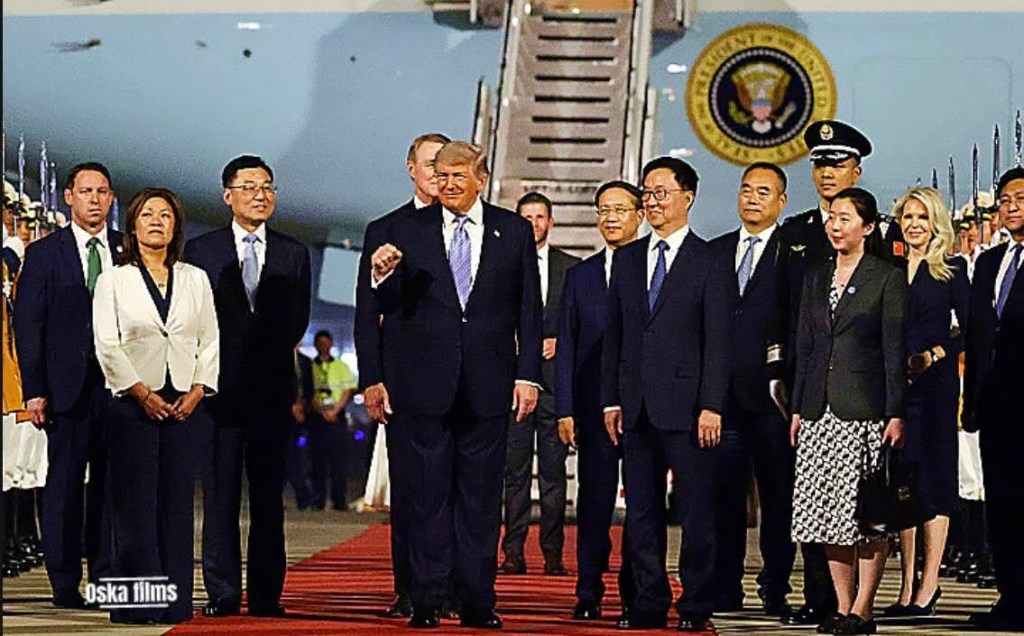
The Beijing visit exposed how transnational corporations, financial institutions, and technology monopolies now operate openly as the permanent power structure beneath American electoral politics.
Donald Trump arrived in Beijing flanked by the commanding layer of American corporate and financial power because the visit exposed something Washington normally prefers hidden behind electoral theatre: transnational capital, technology monopolies, asset managers, and industrial conglomerates now operate openly as the durable core of American power projection and global hegemony. Presidents change regularly, administrations rise and collapse, yet BlackRock, Goldman Sachs, Apple, Tesla, Boeing, Citigroup, Blackstone, and the wider architecture of corporate finance remain embedded inside the permanent power structure directing economic strategy, technological competition, industrial integration, and geopolitical leverage across continents.
The composition of the delegation mattered more than the ceremonial optics surrounding the visit because it exposed the contradiction defining contemporary American strategy toward China. Washington publicly describes Beijing as the central threat to the American-led international order while simultaneously sending the core institutions of its economic empire directly into the Chinese capital seeking market access, industrial integration, financial agreements, and long-term commercial stability.
Chinese state protocol reflected that contradiction immediately. Xi Jinping did not greet Trump personally at the airport in the manner previously extended toward Vladimir Putin or Kim Jong Un, despite the substantial corporate entourage accompanying the American delegation. Diplomatic symbolism inside Chinese political culture carries deliberate meaning rather than accidental improvisation. Beijing understood Trump arrived seeking leverage after months of military escalation across West Asia, tariff confrontation, technology restrictions, semiconductor controls, and pressure campaigns directed against Chinese trade relations. The reception reflected controlled distance rather than strategic warmth.
American officials continue presenting China as an expansionist revisionist power threatening global stability through industrial overcapacity, military modernisation, technological penetration, and regional coercion around Taiwan and the South China Sea. The 2022 United States National Security Strategy described China as “the only competitor with both the intent to reshape the international order and, increasingly, the economic, diplomatic, military, and technological power to do it,” while Pentagon officials repeatedly labelled China the Department of Defense’s “pacing challenge” within Indo-Pacific military planning. (aljazeera.com) Yet the delegation accompanying Trump revealed the deeper structure underneath official rhetoric. Apple depends heavily upon Chinese manufacturing infrastructure and assembly capacity. Tesla relies upon Chinese production facilities, Chinese battery supply chains, and Chinese consumer demand. Nvidia, Qualcomm, Micron, Boeing, BlackRock, Goldman Sachs, Citigroup, Visa, Mastercard, and General Electric all maintain substantial exposure to Chinese markets, industrial ecosystems, or capital networks. The corporate delegation therefore represented less a diplomatic mission than a negotiation between interdependent economic systems attempting simultaneously to compete and survive.
American political rhetoric increasingly describes economic decoupling from China as both necessary and inevitable. Material economic reality points in the opposite direction. The United States imported approximately 427 billion dollars of Chinese goods during 2023 according to the Office of the United States Trade Representative, while Chinese manufacturing remains deeply integrated into electronics, pharmaceuticals, rare earth processing, solar components, industrial machinery, and consumer goods supply chains underpinning Western economies. Decoupling rhetoric functions politically because it signals strategic resolve toward domestic audiences and allied governments. Full structural separation would impose severe inflationary, industrial, and financial costs upon both economies.
Trump travelled to Beijing under weaker geopolitical conditions than originally intended because the wider strategic environment shifted unfavourably following Iranian resilience against sustained American and Israeli pressure across the Gulf region. Washington had expected military escalation against Iran to reinforce American leverage before negotiations with Beijing by demonstrating coercive credibility across energy corridors central to Chinese imports. Instead, prolonged instability highlighted the vulnerability of maritime chokepoints, exposed limitations in escalation dominance, and reinforced Beijing’s urgency regarding energy diversification and strategic self-sufficiency.
Chinese policymakers already reached the conclusion years earlier that the United States ultimately seeks to contain Chinese industrial, technological, military, and geopolitical expansion regardless of temporary diplomatic accommodation. Xi Jinping repeatedly framed technological self-sufficiency as essential to national survival, declaring during multiple speeches regarding semiconductor and artificial intelligence development that China “must take the technology lifeline in our own hands” while emphasising “sci-tech self-reliance and strength” as central to national rejuvenation. (reuters.com) Chinese Communist Party documents, Five-Year Plans, speeches by Xi Jinping, and state-directed industrial policy consistently emphasise technological sovereignty, semiconductor independence, energy resilience, domestic manufacturing depth, and reduced vulnerability toward external financial coercion. The “Made in China 2025” framework, despite Western criticism and partial rhetorical retreat, established the strategic direction clearly. Beijing seeks sufficient internal capacity to survive prolonged confrontation with the United States without suffering systemic collapse.
American sanctions against Huawei, semiconductor export controls targeting advanced chips, restrictions against Chinese artificial intelligence firms, pressure on Dutch and Japanese lithography exports, and repeated attempts to reorganise global supply chains through “friendshoring” reinforced Chinese strategic assumptions rather than moderating them. Pentagon officials openly stated that the Indo-Pacific remained the “priority theater” while military posture, force restructuring, and alliance integration were being redesigned specifically around the China challenge and Taiwan contingency planning. (defense.gov) Beijing interprets such measures as confirmation that Washington intends to preserve technological supremacy through containment whenever competition threatens American dominance. Chinese responses therefore prioritise time rather than immediate confrontation. Purchasing additional American liquefied natural gas, expanding selective trade agreements, or accepting limited short-term concessions can function as tactical delay mechanisms while domestic industrial transition accelerates.
Brian Berletic and several non-Western strategic analysts increasingly interpret the current phase of American policy through the logic of managed confrontation rather than negotiated settlement. Their argument rests upon observable institutional behaviour rather than rhetorical declarations. American military deployments continue expanding across the Indo-Pacific through AUKUS arrangements, strengthened military coordination with Japan and the Philippines, enhanced basing agreements, naval patrol expansion inside the South China Sea, and continued arms transfers connected to Taiwan. Simultaneously, Washington pressures Chinese allies and partners through sanctions, proxy conflicts, technological restrictions, and financial containment strategies. Such behaviour contradicts the assumption that a durable “grand bargain” remains realistically achievable.
Trump nevertheless arrived in Beijing presenting himself as a negotiator capable of stabilising relations through transactional agreements benefiting both powers. Chinese leadership understands the institutional limits surrounding American presidential diplomacy. Administrations change regularly, yet sanctions architecture, military deployments, intelligence frameworks, congressional hostility toward China, and national security bureaucracy remain largely continuous across electoral cycles. Beijing therefore treats presidential diplomacy cautiously because American strategic posture often survives leadership transitions intact.
Taiwan remains central to that strategic distrust. Successive American administrations formally acknowledge the One China policy while simultaneously expanding military coordination, weapons transfers, political engagement, and naval signalling connected to Taipei. Chinese leadership regards Taiwan not merely as disputed territory but as a foundational sovereignty issue tied directly to regime legitimacy, civil war history, national humiliation narratives, and territorial integrity. American policymakers often frame Taiwan through democratic solidarity language. Chinese policymakers frame Taiwan through anti-secession logic and national reunification doctrine. Those positions operate from incompatible premises.
Trump reportedly hoped to approach Beijing from a position of restored strength after confrontation with Iran weakened Chinese regional influence and increased dependence upon American-controlled energy systems. Events developed differently. Iranian resilience strengthened Chinese assumptions regarding the declining effectiveness of American coercive strategy while simultaneously exposing the strategic danger of excessive dependence upon Middle Eastern maritime energy flows vulnerable to blockade or disruption. Chinese investment into Russian pipelines, Central Asian energy corridors, strategic petroleum reserves, domestic renewable expansion, nuclear infrastructure, and Belt and Road logistical networks therefore acquires greater urgency within the context of prolonged confrontation.
Game theory explains the structural dynamics more clearly than moral or ideological narratives. American strategic doctrine increasingly reflects deterrence theory rooted in hegemonic preservation, alliance consolidation, maritime dominance, and technological denial. Chinese strategy instead resembles a prolonged industrial endurance competition where time, manufacturing depth, infrastructural resilience, and strategic patience gradually erode relative American advantages. Chinese state doctrine increasingly invokes the “new whole nation system” combining central coordination, industrial policy, technological mobilisation, and state-guided capital allocation toward strategic sectors considered essential for long-term sovereignty. (reddit.com) Washington traditionally operates through escalation dominance frameworks where superior military and financial capacity theoretically compels adversaries toward accommodation because resistance imposes unsustainable costs. Beijing instead approaches the confrontation as a long-duration endurance competition based upon industrial depth, demographic scale, manufacturing integration, state coordination, and gradual technological substitution. Chinese leadership does not require immediate superiority across every domain. Sustained avoidance of strategic collapse while relative American advantages erode over time remains sufficient.
The relationship increasingly resembles a repeated strategic game where each side seeks advantage without triggering catastrophic systemic rupture. American policymakers impose tariffs, sanctions, export controls, military signalling, and alliance consolidation intended to slow Chinese ascent while preserving existing global hierarchy. Chinese policymakers absorb pressure selectively while strengthening alternative systems reducing long-term vulnerability. Full economic decoupling damages both participants severely, yet partial confrontation continues because neither side accepts strategic subordination.
Corporate participation inside Trump’s delegation exposed another uncomfortable reality inside American political structure. Public discourse frequently portrays elected institutions as primary decision-makers guiding national strategy according to democratic accountability. Material continuity often emerges instead through financial networks, multinational corporations, defence contractors, technology monopolies, and institutional investors whose interests transcend electoral cycles. Larry Fink of BlackRock, David Solomon of Goldman Sachs, Stephen Schwarzman of Blackstone, Tim Cook of Apple, and Elon Musk of Tesla carry strategic significance because their corporations influence supply chains, capital flows, industrial investment, employment structures, and technological infrastructure spanning continents.
Presidents serve as political managers operating inside systems heavily constrained by capital requirements, market expectations, debt structures, lobbying networks, and institutional continuity. American administrations frequently condemn Chinese industrial policy publicly while corporate America quietly deepens integration with Chinese production systems behind closed doors. Semiconductor firms require Chinese demand. Financial institutions seek access to Chinese capital markets. Technology companies depend upon Chinese assembly ecosystems developed over decades. Boeing requires aircraft contracts. Agricultural exporters require Chinese commodity purchases. Public confrontation therefore coexists with private interdependence.
Were you even consulted ? No, and you are paying for all this.
Brookfield CEO Bruce Flatt.
The contradiction increasingly destabilises domestic American politics because industrial decline across sections of the United States generated political backlash against globalisation while major corporations continued benefiting from transnational integration. Trump’s political movement originally gained traction partly through criticism of free trade agreements, manufacturing outsourcing, and financial globalisation associated with previous administrations. Yet his arrival in Beijing surrounded by the commanding institutions of American corporate oligarchy capitalism demonstrated how deeply integrated those same structures remain with Chinese economic expansion.
Another strategic division now emerges inside elite American circles regarding resource allocation and geopolitical priorities. Pentagon strategy papers, congressional testimony, and defence planning documents increasingly identify China rather than regional Middle Eastern adversaries as the principal long-term competitor shaping force posture, industrial planning, naval procurement, alliance systems, and technological investment throughout the twenty-first century. Senior Defense Department officials repeatedly stressed that “Taiwan is the pacing scenario” within wider Indo-Pacific military planning. (defense.gov) Large sections of the foreign policy establishment increasingly regard China rather than Iran or Russia as the primary long-term challenger to American global primacy. Defence documents from the Pentagon repeatedly describe “great power competition” with China as the organising principle guiding military planning throughout the twenty-first century. American naval modernisation, semiconductor restrictions, Indo-Pacific alliance building, and industrial policy increasingly orient around anticipated confrontation with Beijing.
Middle Eastern conflicts therefore generate growing frustration among strategic planners who believe prolonged regional entanglements divert military resources, fiscal capacity, industrial investment, and political attention away from preparation for competition against China. Scholars associated with realist traditions including John Mearsheimer and Stephen Walt repeatedly criticised extensive Middle Eastern interventions partly because such operations consumed enormous strategic resources while producing limited structural gains. Brown University’s Costs of War Project estimated post-2001 American wars generated expenditures exceeding eight trillion dollars once long-term obligations are included.
Chinese planners observed those wars carefully while avoiding equivalent overextension. During the same decades Washington directed immense resources toward military campaigns across Iraq, Afghanistan, Libya, Syria, and global counterterrorism infrastructure, Beijing concentrated heavily upon industrial capacity, strategic logistics, telecommunications, shipbuilding, artificial intelligence, battery production, rare earth processing, and integrated manufacturing systems. Xi increasingly described technological independence as inseparable from national security, warning that external dependency endangered Chinese sovereignty under conditions of strategic confrontation. (reuters.com) During the decades Washington devoted immense resources toward Iraq, Afghanistan, Libya, Syria, and counterterrorism infrastructure, Beijing concentrated heavily upon industrial capacity, infrastructure expansion, scientific education, manufacturing integration, logistics networks, rare earth processing, shipbuilding, telecommunications, artificial intelligence, and strategic investment across Eurasia, Africa, and Latin America. Chinese shipyards now produce commercial and naval tonnage at rates significantly exceeding American capacity. China graduates far larger numbers of engineers annually than the United States. High-speed rail, battery manufacturing, solar production, and electric vehicle supply chains similarly reflect sustained industrial coordination rather than fragmented market improvisation.
American policymakers increasingly recognise that military superiority alone cannot indefinitely compensate for industrial erosion. Pentagon officials repeatedly warned Congress regarding weaknesses in American shipbuilding capacity, semiconductor dependence, critical mineral shortages, and munitions production limitations exposed further by the war in Ukraine. RAND Corporation studies examining Taiwan contingency scenarios consistently highlight logistical strain, missile depletion risks, and industrial vulnerability during prolonged Indo-Pacific conflict. Chinese strategy therefore benefits from structural patience because Beijing assumes time gradually narrows relative American advantages.
Another layer surrounding Trump’s Beijing visit involved narrative preparation rather than immediate diplomatic success. American administrations frequently attempt to position adversaries as responsible for diplomatic failure before escalating pressure further. Trump could therefore present himself domestically as the reasonable negotiator offering compromise while portraying Chinese refusal regarding Iran, Taiwan, technology restrictions, or regional influence as evidence that Beijing rejects coexistence. Media framing then shifts responsibility for deteriorating relations onto China while legitimising expanded containment measures.
Chinese leadership understands that logic thoroughly. Beijing therefore calibrates responses carefully to avoid appearing either submissive or recklessly confrontational. Chinese diplomacy increasingly frames the United States as an unstable declining hegemon attempting to preserve unipolar dominance through sanctions, military alliances, financial coercion, and information warfare. Simultaneously, Beijing promotes multipolarity, sovereignty, development financing, and non-interference principles across the Global South as alternatives to Western-led political conditionality.
Many governments across Asia, Africa, Latin America, and the Middle East increasingly resist full alignment with either bloc because economic interdependence with China now rivals or exceeds relations with the United States. Saudi Arabia, Brazil, Indonesia, South Africa, Turkey, and numerous Gulf states simultaneously maintain security relations with Washington while expanding trade and infrastructure cooperation with Beijing. The emerging international order therefore reflects fragmentation rather than simple bipolar replacement.
Trump’s arrival in Beijing with leading American executives consequently revealed the central contradiction defining late American hegemony. Washington seeks simultaneously to contain China strategically while remaining economically dependent upon Chinese manufacturing, financial integration, commodity processing, consumer markets, and industrial ecosystems developed through decades of globalisation. China seeks simultaneously to reduce dependence upon American finance, technology, and maritime dominance while continuing to benefit from access to Western markets and capital. Neither side currently possesses a clean path toward separation without severe systemic disruption.
The visit therefore mattered less for any immediate agreements signed behind closed doors than for the structural realities it exposed publicly. Corporate America travelled to Beijing because American capitalism remains materially intertwined with Chinese industrial power despite years of escalating geopolitical hostility. Chinese leadership maintained diplomatic distance because Beijing increasingly interprets American engagement as tactical management of decline rather than durable partnership. Both powers continue preparing simultaneously for confrontation and interdependence because neither side possesses sufficient confidence regarding decisive victory.
Underlying tensions therefore remain unresolved regardless of ceremonial optics, temporary trade arrangements, or carefully managed diplomatic language. The American national security establishment continues framing China as the principal strategic competitor reshaping global military planning, while Chinese leadership continues accelerating industrial self-sufficiency and alternative economic integration beyond Western-controlled systems. Pentagon officials openly acknowledge that force modernisation, alliance coordination, logistics planning, and military restructuring increasingly revolve around preparing for long-term confrontation with Beijing rather than temporary competition management. (aljazeera.com) American military alliances continue tightening across the Indo-Pacific. Chinese industrial policy continues accelerating toward technological sovereignty and strategic resilience. Financial interdependence persists alongside sanctions architecture and export restrictions. Political rhetoric hardens while corporate integration deepens. Trump’s Beijing visit exposed that contradiction more clearly than any official communiqué likely ever will.
American Transnational Oligarchy Class joining Trump in China for his summit with Xi this week:
~ Elon Musk, Tesla
~ Tim Cook, Apple
~ Brian Sikes, Cargill
~ Chuck Robbins, Cisco
~ Larry Fink, BlackRock
~ Ryan McInerney, Visa
~ Jane Fraser, CitiGroup
~ Kelly Ortberg, Boeing
~ Jim Anderson, Coherent
~ Sanjay Mehrotra, Micron
~ Larry Culp, General Electric
~ Cristiano Amon, Qualcomm
~ Michael Miebach, Mastercard
~ Dina Powell McCormick, Meta
~ Steve Schwarzman, Blackstone
~ David Solomon, Goldman Sachs
Authored By: Global GeoPolitics
Thank you for visiting. This is a reader-supported publication. If you believe journalism should serve the public, not the powerful, and you’re in a position to help, becoming a PAID SUBSCRIBER truly makes a difference. Alternatively you can support by way of a cup of coffee:
https://buymeacoffee.com/ggtv |
https://ko-fi.com/globalgeopolitics |
Bitcoin: 3NiK8BoRZnkwJSHZSekuXKFizGPopkE7ns


Leave a comment