How economic warfare, intelligence operations, and deterrence shift after regime survival
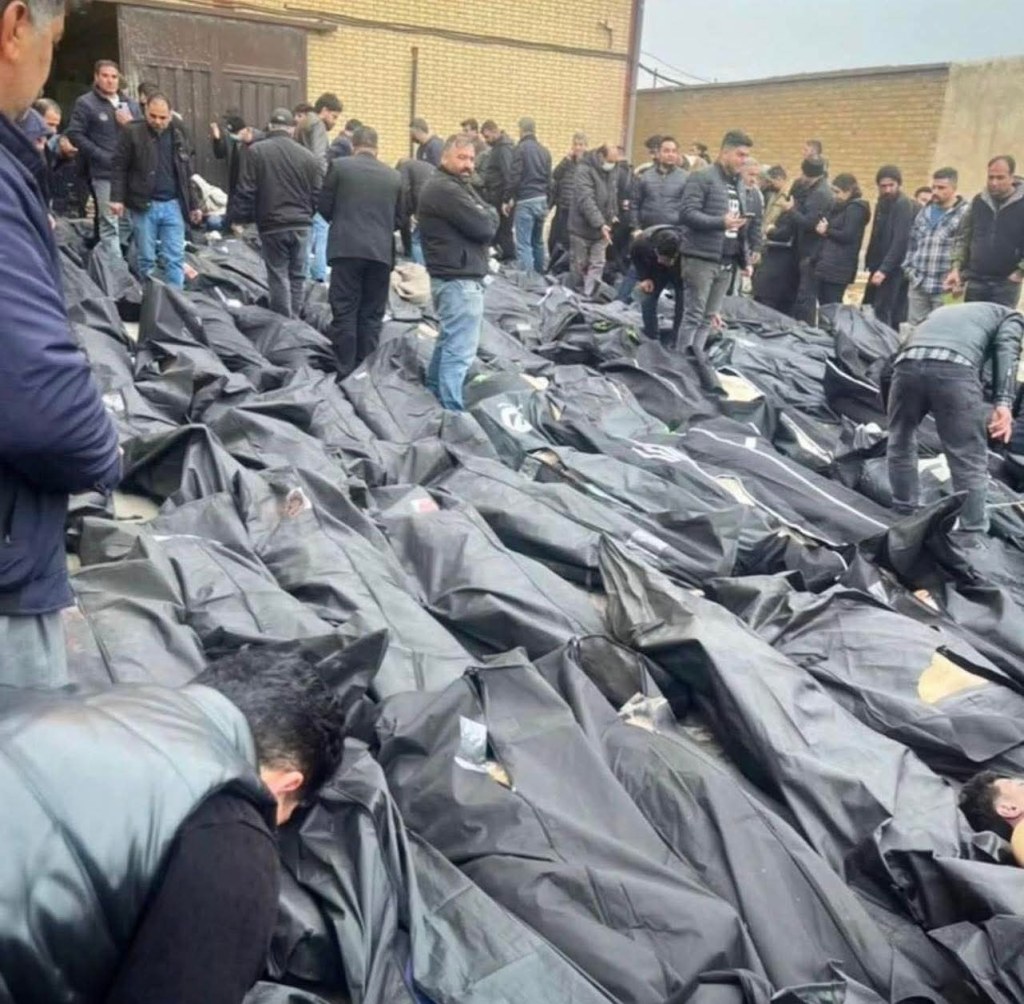
As the violence subsided and funerals replaced street clashes, casualty data began to undermine the dominant external narrative surrounding the unrest. Official death tallies released by Iranian authorities showed that a clear majority of those killed were neither demonstrators nor participants in protest activity. More than two thirds of the dead were classified as martyrs, a designation applied to civilians and security personnel killed during armed attacks. Victims included law enforcement officers, Basij members, shopkeepers, workers, commuters, children, and elderly bystanders, many of whom were unarmed at the time of death.
Forensic investigations documented killings carried out with firearms, knives, axes, grenades, and improvised weapons. Reports described execution-style shootings, throat slashing, immolation, suffocation, and mutilation, with several bodies requiring extended identification procedures due to severe damage. Intelligence assessments linked the highest fatality spikes to organised terror cells employing methods associated with Islamic State operations rather than crowd control confrontations. A three-year-old child, a seventy-year-old man, a nurse burned alive, a ride-hailing driver, and pedestrians struck by concrete blocks thrown from rooftops were among the identified victims.
These findings directly contradicted claims advanced by Western human rights organisations, opposition platforms, and aligned media outlets asserting that all fatalities resulted from state repression. Iranian officials argued that armed infiltration transformed price protests into mass-casualty violence, with civilians deliberately targeted to manufacture outrage and provoke foreign intervention. Security sources stated that weapons were smuggled into protest zones, attackers fired on crowds and officers, and subsequent engagements were reframed as indiscriminate government killings once those attackers were neutralised.
The timing of the deadliest incidents further complicated external justifications. Intelligence briefings noted that peak fatalities occurred immediately after public threats of military action by the United States, suggesting escalation incentives rather than spontaneous disorder. Iranian authorities characterised the violence as a continuation of the June conflict, describing it as one of the largest coordinated terrorist operations against civilians since the revolution rather than a protest movement suppressed by force.
The events in Iran during late December 2025 and early January 2026 unfolded through a convergence of internal economic breakdown and coordinated external pressure aimed at political destabilisation. Public descriptions framing the unrest as spontaneous protest activity obscured a more complex interaction between domestic policy failure and foreign regime-change operations conducted in parallel.
Iran’s internal economic position had been weakening for years, yet expectations surrounding President Masoud Pezeshkian’s administration were that monetary stability and inflation control would be restored. Those expectations were not met. Inflation accelerated, currency confidence collapsed, and market coordination failed despite Iran’s substantial energy, industrial, and human resources. Liberalisation measures introduced by the administration did not stabilise prices or reassure merchants, while currency volatility intensified through external manipulation routed through Doha. The Iranian rial collapsed on 28 December 2025 to over 1.4 million per United States dollar, a moment coinciding with heightened diplomatic activity between Israel and Washington.
Hyperinflation surpassed forty-two percent, while staple food prices, including cooking oil and poultry, increased by more than seventy percent within weeks. Government intervention failed to prevent price shocks. Fuel subsidy restructuring increased household costs. The central bank terminated preferential dollar access for importers, triggering immediate retail inflation. Budget proposals increased security expenditure by nearly one hundred and fifty percent while wage growth remained far below inflation. These policy decisions created acute pressure within urban commercial sectors, particularly among bazaar merchants.
The closure of Tehran’s Grand Bazaar and major commercial centres on 28 December 2025 marked a significant turning point. Bazaaris historically functioned as a stabilising pillar of the Islamic Republic and rarely participated in open confrontation. Merchants reported inability to price goods, secure imports, or hedge against daily currency swings. The initial protest actions remained economic in character, focused on prices, shortages, and policy grievances.
These conditions existed alongside an unresolved military confrontation earlier in 2025. In June, Israel conducted a twelve-day direct assault on Iranian targets. That campaign was not structured around nuclear containment objectives but pursued leadership decapitation and institutional collapse. Senior Iranian military and security officials were killed, including Major General Mohammad Bagheri, Major General Hossein Salami, Major General Gholam Ali Rashid, Brigadier General Amir Ali Hajizadeh, Brigadier General Mohammad Kazemi, and nuclear scientist Fereydoon Abbasi-Davani. Attempts were made to assassinate the Supreme Leader. The objective aligned with longstanding Israeli strategic doctrine advocating removal of Iran’s governing structure rather than arms control compliance.
Despite these losses, Iranian command structures survived and executed a large-scale counter-strike that Israeli planners underestimated. The response forced Israeli Prime Minister Benjamin Netanyahu to seek a ceasefire through Qatari mediation. The failure of immediate regime collapse did not terminate external pressure, but it altered operational emphasis. Intelligence activity shifted from overt military force toward economic warfare, information operations, and internal destabilisation.
Netanyahu’s visit to Washington between 29 December 2025 and 1 January 2026 occurred as Iran’s currency collapsed. Public messaging focused on Gaza and regional security, while private discussions intensified pressure strategies against Tehran. Former United States officials and intelligence analysts have long described synchronised financial stress and psychological operations as preparatory phases preceding political destabilisation campaigns.
Following the bazaar shutdowns, protest slogans rapidly shifted from economic demands to explicit calls for regime overthrow. Chants including “Death to the Dictator” and rejection of regional commitments signalled narrative escalation beyond price grievances. This transition coincided with infiltration by organised militant networks and foreign intelligence assets.
The Mojahedin-e-Khalq entered Iran through Albania, Turkey, Iraq, and Azerbaijan, operating from Camp Ashraf 3 under longstanding Western supervision. United States support for the organisation has been documented by former intelligence officials, including training and logistical assistance. Kurdish opposition groups coordinated activities from bases inside Iran and within the Kurdistan Region of Iraq, contributing to violent unrest across Kermanshah, Ilam, and Lorestan. Baloch militant organisations, unified under the Mobarizoun Popular Front led by Jaish al-Adl, conducted lethal attacks against civilians and security forces, including courthouse assaults and targeted assassinations.
Information and communications warfare played a central operational role. Western intelligence services facilitated the smuggling of Starlink satellite terminals into Iran under non-governmental organisational cover. Israeli security commentators publicly acknowledged Mossad coordination. Iranian authorities estimated more than forty thousand terminals were deployed. These systems enabled command coordination during internet shutdowns, dissemination of fabricated imagery, circulation of false claims regarding leadership flight, and amplification of collapse narratives.
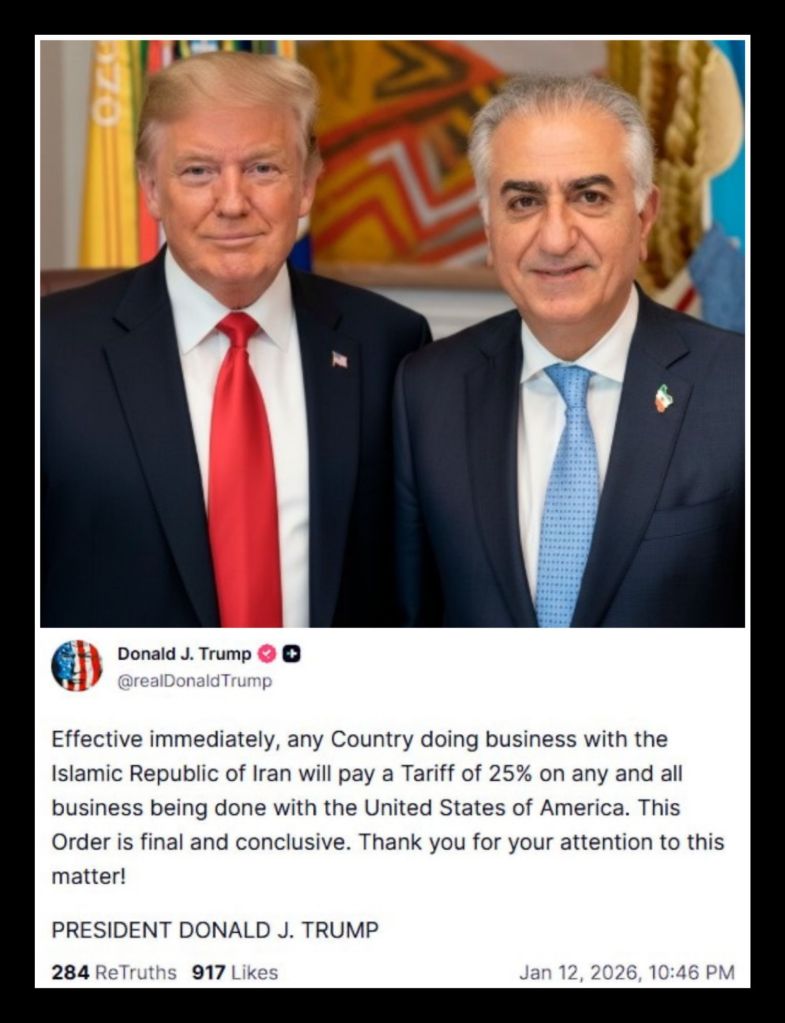
Reza Pahlavi, based in Virginia, issued calls for national strikes and international intervention, presenting himself as an alternative authority figure. Israeli analyst Ehud Ya’ari later acknowledged that these efforts failed to produce unified leadership or mass compliance. Ya’ari stated publicly that Pahlavi lacked the capacity to guide events as Ayatollah Khomeini once did from Paris. No central command structure emerged, and opposition actions remained fragmented.
Western legacy media amplified narratives describing imminent regime collapse, while Iranian officials characterised coverage as coordinated psychological warfare. European governments condemned Tehran while having recently financed and armed Israel during the Gaza conflict, undermining claims of moral authority. Analysts at institutions including the International Institute for Strategic Studies have previously noted that credibility erosion weakens external influence during destabilisation campaigns.
Iranian state response was rapid and coordinated. With reported technical assistance from China and Russia, Iranian forces executed large-scale jamming operations against low-earth-orbit satellite communications. Tens of thousands of Starlink terminals were disabled, challenging assumptions regarding their invulnerability. Military analysts described the operation as a real-world test of counter-satellite warfare capabilities.
Simultaneously, the Islamic Revolutionary Guard Corps, the Basij, and regular armed forces deployed nationwide. Authorities reclassified violent protest activity as terrorism. Ya’ari, speaking on Israel’s Channel 13, stated that no fractures appeared within Iran’s security institutions. Both the regular military and the Revolutionary Guards remained cohesive. Basij units functioned without systemic breakdown. Hesitation appeared only in isolated cases.
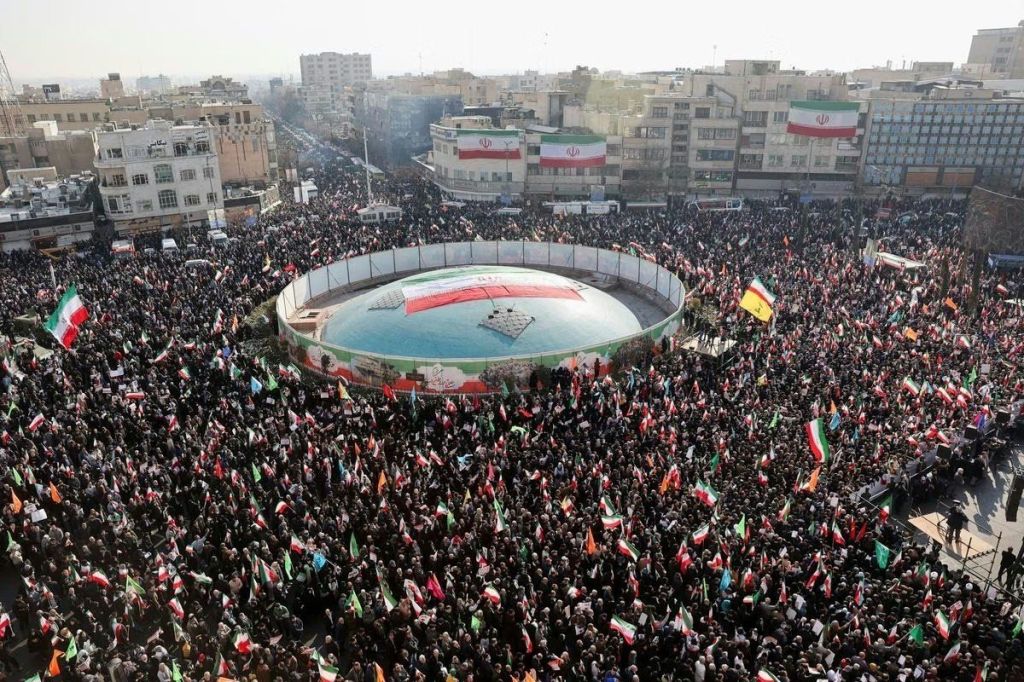
Government-organised counter-demonstrations mobilised substantial pro-state participation, including large numbers of Azeri Iranians. Ya’ari cited protest counts indicating limited scale, with several hundred participants at peak locations and approximately sixty protest centres nationwide. The unrest was contained without territorial loss or command disintegration.
Iranian Foreign Minister Abbas Araghchi addressed foreign diplomats on 12 January, stating that Iran ruled out pre-emptive military action while remaining fully prepared for escalation. He emphasised that negotiations remained possible only without imposed terms. Intelligence assessments from both United States and Israeli agencies have repeatedly concluded that Iran lacks an active nuclear weapons programme and would require more than two years to deploy a weapon even if religious prohibitions were abandoned.
The broader strategic objective of external actors remains unchanged. United States withdrawal from the Joint Comprehensive Plan of Action under President Donald Trump followed sustained lobbying by Israeli leadership and aligned congressional groups. Sanctions reimposition aimed to weaken Iran’s economy, marginalise moderate political factions, and restore hardliner dominance, a dynamic acknowledged by former United States officials involved in Iran policy formulation.
Major military assets remain incompletely positioned. Aircraft carrier deployments have not reached levels associated with direct confrontation. Analysts at military academies including King’s College London have long described phased destabilisation models in which economic pressure, information warfare, and proxy violence precede overt force.
The events of late 2025 and early 2026 therefore represented a stress test rather than a conclusion. Internal economic mismanagement created vulnerability. External actors exploited those conditions through coordinated intelligence, financial, and psychological operations. The state survived, but pressure mechanisms remain active, recalibrated rather than abandoned.
Authored By: Global GeoPolitics
This is a reader-supported publication. I cannot do this without your support. If you believe journalism should serve the public, not the powerful, and you’re in a position to help, becoming a PAID SUBSCRIBER truly makes a difference. Alternatively you can support by way of a donation or cup of coffee:
buymeacoffee.com/ggtv


Leave a comment