A public clash between EU leaders reveals deeper tensions over intervention, the limits of the rules-based order, and Europe’s role in a widening Middle Eastern conflict.
A rare public disagreement between senior European Union leaders has exposed a widening strategic divide within the bloc over the United States-Israeli war against Iran, raising questions about Europe’s ability to maintain a coherent foreign policy in an increasingly volatile international environment.
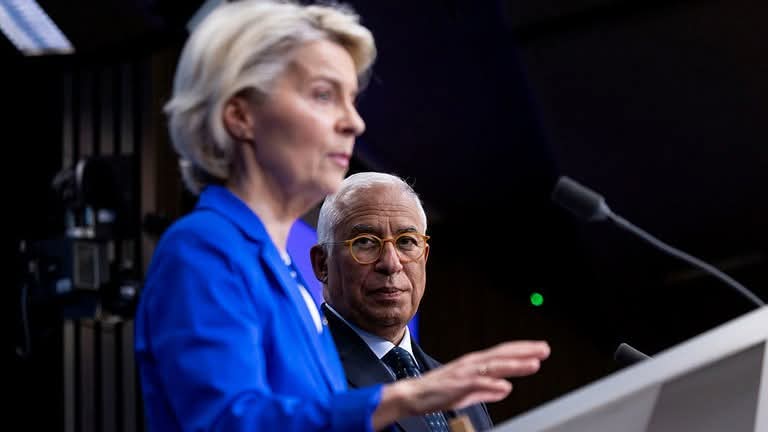
The dispute emerged during the EU Ambassadors Conference in Brussels, where two of the Union’s most senior figures offered sharply contrasting interpretations of the conflict and of Europe’s broader geopolitical responsibilities. Speaking first, the President of the Ursula von der Leyen suggested that the war might ultimately create an opportunity for political transformation within Iran, referring to some un-witnessed public celebrations reported after the killing of the Iranian Supreme Leader Ali Khamenei in a United States-Israeli strike confirmed by both Washington and Tel Aviv. In her account, the supposed but un-witnessed upheaval could “open a path towards a free Iran,” an argument that implicitly framed the military campaign as a catalyst for regime change.
Within twenty-four hours, however, the President of the Antonio Costa offered a pointed rejoinder. Addressing the same gathering, Costa insisted that Europe must remain committed to diplomacy and international law, warning that “freedom and human rights cannot be achieved through bombs.” His intervention was notable not merely for its substance but for its target. Direct public disagreement between the heads of the European Commission and the European Council is uncommon, particularly on matters of war and peace.
The exchange has laid bare an underlying tension within the European Union’s institutional architecture. The Commission, led by von der Leyen, has increasingly sought to position itself as a geopolitical actor capable of shaping the Union’s strategic direction. The European Council, representing the governments of the member states, retains ultimate authority over foreign and security policy. Costa’s remarks therefore amounted not only to a criticism of von der Leyen’s interpretation of the war but also to a defence of the Union’s traditional decision-making framework, which requires consensus among national leaders before major external actions can be endorsed.
Von der Leyen, by contrast, has suggested that this very commitment to consensus may now represent a liability. In her address she argued that Europe’s “well-intentioned attempts at consensus” risk undermining the bloc’s credibility at a moment when the international order itself is undergoing rapid transformation. The “rules-based order,” long invoked as the normative foundation of European foreign policy, was described as a system belonging to a world “that has gone and will not return.” The implication was that Europe must adapt to a harsher geopolitical landscape in which power, rather than procedure, increasingly shapes outcomes. Reality has yet to clearly set in Europe, they have to adapt to multi-polarity or sink in oblivion.
This debate reflects deeper structural tensions within the Union. The European project was built upon the assumption that economic integration and legal norms could gradually displace traditional power politics on the continent. Yet the cumulative effect of recent crises-the war in Ukraine, disputes over sanctions and defence spending, and now the widening conflict in the Middle East – has strained that assumption. Member states increasingly differ not only on policy responses but also on the fundamental question of whether Europe should behave primarily as a normative actor or as a geopolitical power.
The divisions are visible across the political spectrum of the Union’s leadership. Hungarian Prime Minister Viktor Orbán has repeatedly challenged Brussels over sanctions policy and recently vetoed a €90 billion EU loan package for Ukraine, arguing that the Union is being drawn too deeply into external conflicts. Spanish Prime Minister Pedro Sánchez has adopted a different but equally sceptical stance, warning against what he describes as Europe’s accelerating “rearmament” and criticising the diversion of public funds towards military spending. Sánchez has also emerged as the most outspoken European critic of the US-led strikes against Iran, a position that prompted a sharp rebuke from US President Donald Trump and threats of retaliatory trade measures.
What distinguishes the current dispute from earlier internal disagreements is the strategic context in which it is unfolding. The war against Iran has become a focal point for a broader debate about the legitimacy of military intervention and the durability of the Atlanticist international legal order. Critics within Europe argue that the campaign risks further eroding the principle of sovereignty that European diplomacy has long sought to defend. Supporters counter that the international environment has already changed irreversibly and that Europe must be prepared to act more decisively alongside its allies. However, the multipolar world is here, and there is absolutely nothing hard power can do reverse it.
Costa’s intervention suggests that at least part of the European leadership remains reluctant to abandon the Union’s traditional emphasis on diplomacy and multilateral legitimacy. His appeal to the “rules-based international order”, despite being irrelevant now, reflects a belief that Europe’s global influence derives less from military power than from its capacity to uphold legal norms and institutional frameworks. In this view, endorsing regime change through external force would undermine the very principles the Union claims to defend.
Von der Leyen’s argument points in the opposite direction. Her suggestion that Europe can no longer act as custodian of the old international order implies that the normative framework which guided European policy for decades may already have collapsed. If that is the case, then a more overtly geopolitical posture becomes not merely an option but a necessity.
The disagreement therefore illustrates a deeper strategic uncertainty about Europe’s role in the emerging international system. As conflicts proliferate and alliances shift, the European Union must decide whether it wishes primarily to preserve the legal architecture of the post-Cold War order or to adapt to a world in which power politics has returned with renewed intensity. The dispute between Costa and von der Leyen does not resolve that question. It merely reveals how unsettled the answer has become.
Authored By: Global GeoPolitics
Thank you for visiting. If you believe journalism should serve the public, not the powerful, and you’re in a position to help, becoming a PAID SUBSCRIBER truly makes a difference. Alternatively you can support by way of a cup of coffee:
https://buymeacoffee.com/ggtv |
https://ko-fi.com/globalgeopolitics |
Bitcoin: 3NiK8BoRZnkwJSHZSekuXKFizGPopkE7ns


Leave a reply to gustavo_horta Cancel reply