
From Hormuz blockade logic and the extension of maritime leverage into East Asian energy supply chains
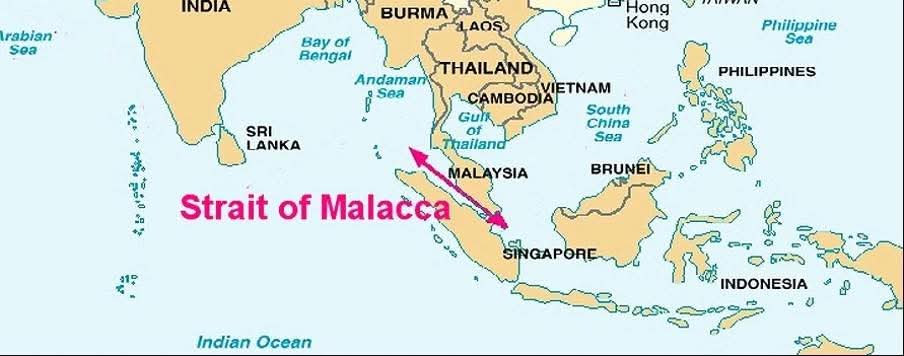
American naval forces have expanded interdiction operations beyond the Persian Gulf into the wider Indian Ocean along established commercial shipping routes. Recent seizures of tankers including the Tifani and Majestic X occurred in waters between Sri Lanka and Indonesia along corridors feeding East Asian energy markets. These operations took place thousands of kilometres from the Strait of Hormuz, previously treated as the central focus of Gulf energy security enforcement. Shipping intelligence indicates at least one of these vessels was bound for Chinese ports handling large-scale crude imports into industrial supply chains. The Strait of Malacca carries close to eighty percent of China’s seaborne oil imports and functions as a critical energy transit choke point in regional trade architecture. U.S. policy statements on maritime enforcement describe a widening operational scope covering global shipping lanes linked to sanctioned energy flows. These developments establish a working pattern of extended interdiction beyond regional containment into systemic pressure on long-range supply chains.
American grand strategy has remained anchored in preventing the emergence of peer competitors capable of challenging global primacy. The Defense Planning Guidance (Draft) (1992) associated with Paul Wolfowitz formalised that objective as a guiding principle of post-Cold War planning. The document treated control of strategic environments as essential to maintaining structural dominance across Eurasian and maritime domains. Later strategic analysis in The Grand Chessboard by Zbigniew Brzezinski placed Eurasian access routes at the centre of global power competition. That framework identified maritime corridors and chokepoints as decisive instruments for shaping continental economic and military capacity. Classical naval theory from Alfred Thayer Mahan defined sea control and commercial disruption as central mechanisms of state power projection. Geopolitical theory from Nicholas Spykman reinforced the importance of the Rimland, particularly Indo-Pacific littoral zones, as the decisive arena of global competition. Contemporary analysis from the RAND Corporation, including Extending Russia: Competing from Advantageous Ground, emphasised indirect pressure against structural vulnerabilities rather than direct confrontation. The China and the United States: Competition and Strategic Stability further described competition as a prolonged process of capability shaping below formal war thresholds.
What sits behind these doctrinal layers is a consistent operational logic moving from peripheral disruption toward systemic leverage over rival survival systems. Pressure begins with supplier networks including Iran and Venezuela, both functioning as upstream nodes in global energy distribution feeding Asian demand centres. Maritime interdiction extends into the Indian Ocean where shipping routes converge toward East Asian industrial economies dependent on uninterrupted crude imports. Operational positioning near Southeast Asian sea lanes places enforcement capability along final approach corridors into Chinese energy infrastructure. Interdiction in these waters introduces uncertainty into supply chains without requiring formal closure of any single maritime chokepoint. Insurance markets adjust pricing, shipping firms alter routing strategies, and commodity flows absorb friction costs created through persistent risk exposure.
Energy dependence defines structural vulnerability within the Chinese economic system due to reliance on imported crude transported almost entirely by sea. The Strait of Malacca functions as the principal maritime corridor through which these imports must pass before reaching domestic infrastructure. Control of adjacent sea lanes enables pressure on throughput without physical occupation of the strait itself. This produces a form of functional blockade through persistent disruption rather than formal closure of navigation routes.
In parallel with interdiction activity, defence coordination with Indonesia has expanded operational depth across the western approaches to the Malacca corridor. Discussions involving Pete Hegseth and the Indonesian Defence Minister included arrangements on airspace access and broader military cooperation frameworks. Potential use of Indonesian airspace extends surveillance reach over the northern Sumatra approaches leading directly into the strait’s entrance. Ports such as Belawan carry strategic relevance due to proximity to the maritime funnel point where monitoring and staging capacity affects transit visibility. Indonesia holds the dominant geographic position at the western gate of Malacca, while Malaysia and Singapore form the remaining structural boundaries of passage control. These arrangements do not alter sovereignty structures but expand operational reach over critical maritime entry points shaping energy flow security.
Historical precedent demonstrates that maritime economic pressure has repeatedly preceded escalation between major powers. The United States oil embargo on Japan in 1941 restricted access to critical resources and constrained strategic autonomy prior to Pacific conflict. British naval blockades during major twentieth century wars restricted supply chains and weakened adversary capacity before decisive military engagement. Modern conflicts have frequently developed without formal declarations, reflecting the operational reality of state competition outside procedural definitions.
War in classical terms does not depend on declaration but on sustained use of state power to degrade another state’s capacity for survival. Blockade of economic lifelines constitutes war because it directly targets the material foundation of industrial production and military readiness. Interdiction of energy flows therefore meets the functional definition of war regardless of legal framing or terminology. The Iran theatre demonstrates this logic through sustained maritime pressure and sanctions enforcement without formal declaration of war. The same logic extends into current operations when applied to supply chains connected to major industrial powers.
Game theoretic structure appears in the distribution of pressure across multiple actors within the system of maritime trade. Iran functions as a proximate enforcement target within a wider network of flows rather than the ultimate strategic objective. China represents the central dependency node exposed through reliance on uninterrupted maritime energy imports across long transit routes. Interdiction increases cost, raises uncertainty, and introduces risk into supply calculations without requiring direct military confrontation. Signalling operates simultaneously across Iran, China, and regional transit states through a single operational pattern of enforcement. Each actor receives different strategic information from identical actions, shaping behaviour through perception of capability and reach.
Regional dynamics in Southeast Asia become increasingly central due to proximity to major maritime chokepoints and shipping convergence zones. Indonesia occupies the key geographic position at the western entrance to the Strait of Malacca with control over access waters and adjacent airspace corridors. Malaysia and Singapore form the remaining structural boundaries of the passage, creating a tri-state control system over a critical global energy artery. Stability in this region depends on continuity of maritime flow and predictable enforcement boundaries across national jurisdictions. Disruption of these conditions produces immediate effects across trade systems, insurance pricing, and energy security planning across multiple economies.
The escalation structure follows a consistent sequence beginning with peripheral targeting of suppliers and extending toward systemic pressure on end users. Maritime interdiction expands operational reach across successive geographic layers of the global energy distribution network. Chokepoint leverage emerges as the decisive phase where geographic constraint meets sustained enforcement capability. Strategic coercion operates through cumulative disruption rather than singular acts of closure or occupation.
War in this framework functions as a continuum rather than a declared event or formal transition point. Blockade of economic lifelines defines the operational threshold where competition converts into sustained conflict behaviour. Energy interdiction at scale functions as war because it targets the survival systems of a state rather than peripheral interests. Formal declaration holds no structural relevance within this model of power competition or outcome determination. The Iran theatre demonstrates identical mechanics through sustained maritime pressure without declared conflict status.
Regional states positioned along these corridors face direct exposure to instability generated through sustained maritime pressure. Singapore, Indonesia, and Malaysia sit within the operational geography of this system and carry structural vulnerability through proximity to key transit routes. Stability within such environments depends on continuity of maritime flow and predictable commercial navigation conditions. Disruption of those conditions produces immediate economic transmission effects across interconnected regional systems and supply chains. The stability of these corridors carries no insulation from wider great power competition dynamics once enforcement activity expands across them. Maritime pressure introduced at scale becomes self-reinforcing through risk pricing, route diversion, and security escalation across adjacent zones. Stability within such environments depends on continuity of maritime flow and predictable commercial navigation conditions. Disruption of those conditions produces immediate economic transmission effects across interconnected regional systems and supply chains.
Historical experience in the Strait of Hormuz demonstrates how quickly maritime disruption translates into structural economic damage for exposed coastal economies, where Gulf Cooperation Council states have faced prolonged vulnerability through repeated cycles of insecurity affecting investment flows, fiscal stability, and long-term development planning. The accumulated effect has been a narrowing of strategic autonomy, with economic systems increasingly shaped by external maritime pressure rather than internal policy design. The same structural exposure applies to any region positioned along comparable energy chokepoints, where reliance on uninterrupted sea-based imports creates immediate transmission of external disruption into domestic stability. Classical historical precedent in blockade warfare reinforces the same conclusion, as sustained pressure on maritime routes has consistently produced long-term degradation of state capacity rather than short-term market disturbance. British Naval Blockade of Germany demonstrates this pattern clearly, where extended maritime restriction contributed to systemic economic contraction and enduring political destabilisation through the interuption of essential supply chains.
Perhaps Trump believes that is the leverage he needs when he meets Xi Xinping in China in 3 weeks time.
Authored By: Global GeoPolitics
Thank you for visiting. This is a reader-supported publication. If you believe journalism should serve the public, not the powerful, and you’re in a position to help, becoming a PAID SUBSCRIBER truly makes a difference. Alternatively you can support by way of a cup of coffee:
https://buymeacoffee.com/ggtv |
https://ko-fi.com/globalgeopolitics |
Bitcoin: 3NiK8BoRZnkwJSHZSekuXKFizGPopkE7ns
References
Security Council Report (2026) Maritime Security Monthly Forecast: April 2026. New York: SCR.
United States Energy Information Administration (2026) World Oil Transit Chokepoints Data Overview. Washington, DC: EIA.
U.S. Department of Defense (1992) Defense Planning Guidance (Draft). Washington, DC: DoD.
Brzezinski, Z. (1997) The Grand Chessboard: American Primacy and Its Geostrategic Imperatives. New York: Basic Books.
RAND Corporation (2019) Extending Russia: Competing from Advantageous Ground. Santa Monica, CA: RAND Corporation.
RAND Corporation (2021–2023) China and the United States: Competition and Strategic Stability. Santa Monica, CA: RAND Corporation.
International Energy Agency (2025) Global Energy Security and Maritime Supply Chains Report. Paris: IEA.
United Nations Conference on Trade and Development (2024) Review of Maritime Transport. Geneva: UNCTAD.
Historical precedent: British naval blockade of Germany (1914–1919), First World War maritime interdiction campaign.


Leave a Reply