
Ukrainian Refugees and the Retreat from Humanitarian Commitment
The numbers alone tell a story of unprecedented displacement. As of May 2026, Eurostat recorded 4.38 million Ukrainian refugees under temporary protection across European Union member states, with Germany hosting 1.28 million, Poland 967,500, and Spain 267,700 (1). Women constitute the majority of these refugees, reflecting the Ukrainian government’s restrictions on military-age male emigration (1). The total figure, when combined with approximately 2 million Ukrainian refugees in Russia, 138,000 in Moldova, 44,000 in Belarus, 254,000 in the United Kingdom, and 170,000 in the United States, approaches 6.9 million people displaced beyond Ukraine’s borders. The United Nations High Commissioner for Refugees has recorded over 6.8 million refugees fleeing Ukraine since February 2022, while an additional 3.7 million remain internally displaced within the country-. The scale of this crisis, representing more than 10 per cent of Ukraine’s pre-war population and close to 1 per cent of the EU’s population (6), has placed extraordinary strain on host countries’ social welfare systems.
The initial European response to this crisis was characterised by an unprecedented activation of the Temporary Protection Directive, granting Ukrainian refugees immediate access to housing, healthcare, education, and labour markets across the EU. Between 2022 and mid-2025, total refugee-related expenditures across Europe reached 155 billion euros (38). Yet this emergency framework, designed for short-term displacement, has proven financially unsustainable as the war has entered its fifth year. Governments across the continent have begun systematically reducing benefits and tightening support systems, reflecting a broader European trend in which the original emergency measures are being dismantled piece by piece (38).
Germany, the largest host country with 1.27 million Ukrainian refugees as of March 2026 (2), has implemented the most significant reductions. In November 2025, the governing coalition agreed to change the support system for Ukrainian refugees from 2026. Ukrainians who arrived after March 31, 2025, are no longer eligible for Bürgergeld, the citizen’s allowance for unemployed and needy residents, and have been transferred to the lower Asylum Seekers’ Benefits Act, a welfare system that provides approximately 100 euros less per month (38). The reform took effect on July 1, 2026, with existing benefits preserved until the end of September-. Bavarian Premier Markus Söder, leader of the Christian Social Union, has gone further, calling for the complete termination of Bürgergeld payments to Ukrainians, arguing that the current system “causes little understanding among the population”(19). Söder has also advocated reducing basic benefit rates to the minimum permitted by the German constitution (19).
Poland, hosting approximately 960,000 Ukrainian refugees (6), has progressively dismantled special benefits introduced after the invasion. After 5 March 2026, beneficiaries of temporary protection faced reduced access to family benefits, healthcare, and accommodation (29). From January 31, 2026, unemployed Ukrainian refugees lost their right to government-funded child support, affecting approximately 150,000 people who must now submit new applications and confirm eligibility under criteria including proof of employment (33). From June 2026, the 800+ child support programme for Ukrainians with UKR status requires that parents work legally and pay taxes in Poland, and that children attend Polish schools or kindergartens (30). The Polish government has also restricted access to collective housing centres, eliminating free accommodation even for vulnerable groups such as women with children over one year old (31). The subsidised housing programme is being phased out entirely from July 1, 2026 (31).
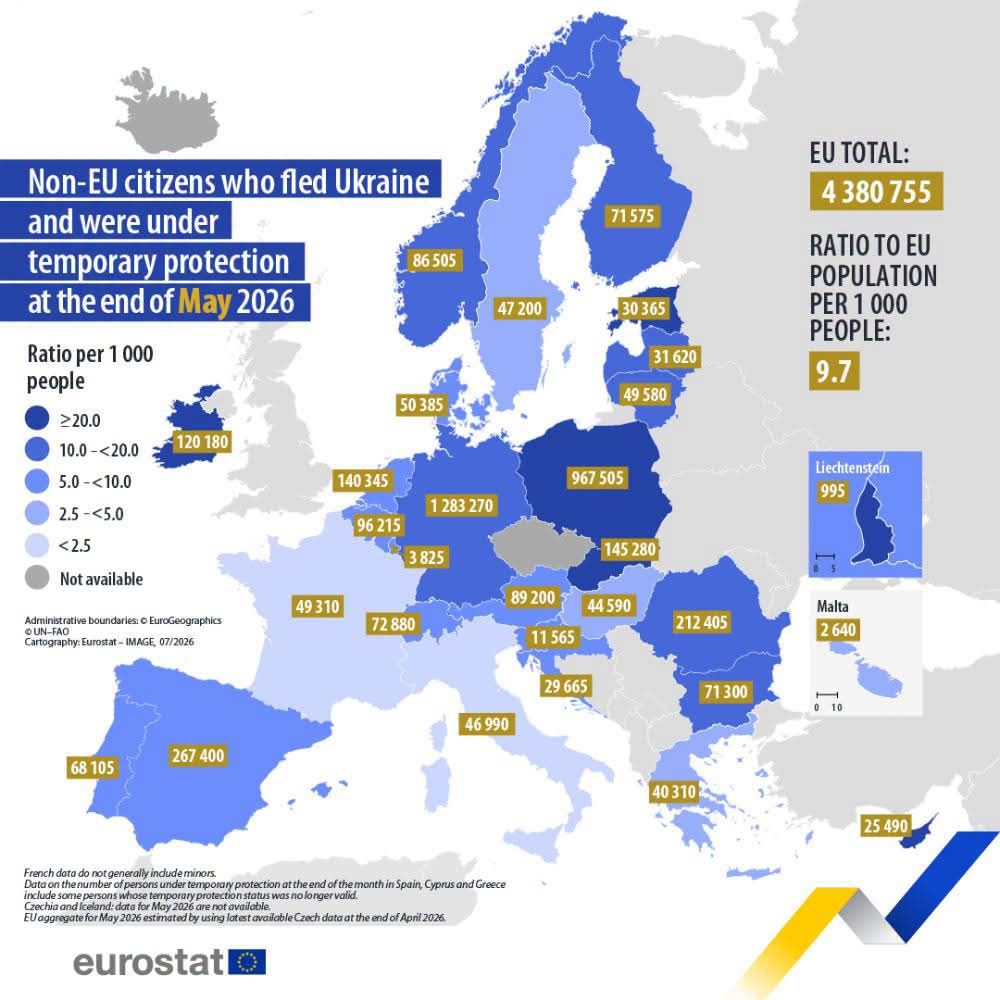
The Czech Republic, which hosts 385,040 Ukrainian refugees (38), the highest per capita rate in the EU with 36.4 protected persons per 1,000 inhabitants (38), has approved a bill tightening temporary protection rules (38). Under the proposal, humanitarian aid payments will require refugees to reside in the country for at least 16 days each month to remain eligible (38). Temporary protection could be revoked if a refugee stays outside the Czech Republic or the Schengen Area for more than 30 days (38). The government has also restricted residency rights and welfare benefits for Ukrainians, with Interior Minister Lubomír Metnar stating that the measures are “primarily aimed at combating system abuse, illegal migration, and people who do not respect the laws of the Czech Republic”(38). The bill would also require owners of vehicles registered in Ukraine to register them in the Czech registry and undergo the same technical inspections as Czech drivers (39).
Other European countries have followed suit. Belgium has made financial aid conditional on integration efforts including language acquisition and employment. Scotland has cancelled the £350 monthly payment to host families. Finland has proposed abolishing the integration allowance. France is phasing out specialised housing stock for refugees. Latvia has reduced its aid budget from €65 million to €39.7 million. Ireland has announced plans to phase out free accommodation and eventually abolish its broader support framework by 2027, while offering financial incentives for voluntary return to Ukraine (38). The overall UNHCR aid budget in Europe has been cut by 42 per cent, from $89.5 million to $51.8 million.
The cumulative effect of these reductions is already visible in refugee numbers. Bulgaria has seen a decrease of 12,345 people, or 14.8 per cent. Poland has experienced a reduction of 3,750 people, or 0.4 per cent. France has recorded a decline of 665 people, or 1.3 per cent. Across the EU, the overall number of Ukrainians with temporary protection status decreased by nearly 69,000 in March 2026, with the sharpest drop recorded in Italy (2). While experts caution that such changes may reflect document expirations, data updates, or movement within the EU rather than mass returns to Ukraine (2), the trend toward declining numbers is unmistakable.
The most consequential development, however, concerns the emerging policy of excluding military-age Ukrainian men from temporary protection. On July 9, 2026, the Estonian government approved the European Commission’s proposal to extend temporary protection for Ukrainians until March 4, 2028, but with a new provision: the status would no longer apply to Ukrainian citizens who, because of military service obligations, do not have legal grounds to leave Ukraine (48-49). Estonian Interior Minister Igor Taro, announcing the decision on July 10, made the rationale explicit: “The Armed Forces of Ukraine now need new human resources, so EU countries need to prepare for a coordinated termination of temporary protection” for refugees-. The restrictions would apply only to new applicants and would not affect Ukrainians who have already received temporary protection (49). European Commissioner for Migration Magnus Brunner confirmed on June 26 that the extension would not apply to newly arriving men ages 23 to 60 who are subject to mobilisation in Ukraine (48). An anonymous EU official told Radio Free Europe/Radio Liberty that military-liable Ukrainians could begin being denied temporary protection within weeks (48).
This policy shift represents a profound departure from the humanitarian principles that underpinned the initial European response to the Ukrainian refugee crisis. The Temporary Protection Directive was activated on the understanding that those fleeing war were entitled to protection regardless of age, gender, or military status. The new provisions effectively subordinate humanitarian considerations to the military manpower needs of the Ukrainian state, transforming European refugee policy into an instrument of wartime conscription enforcement. The European Union, which has consistently presented itself as a defender of human rights and international protection norms, is now actively participating in the denial of asylum to those who have evaded mobilisation.
The contradiction is stark. European soldiers are not being deployed to Ukraine; European taxpayers are, however, funding the social welfare of Ukrainian refugees while simultaneously being asked to accept that military-age men among them should be returned to the front lines. The European Commission’s proposal explicitly states that the exclusion will not apply to Ukrainians who have already received temporary protection (48), creating a two-tier system in which those who arrived earlier retain their rights while later arrivals face denial. This temporal distinction has no basis in international refugee law and appears designed solely to address Ukraine’s immediate manpower crisis without retroactively destabilising the existing refugee population.
The economic pressures driving these policy changes are undeniable. Rising housing costs, pressure on social systems, inflation, and labour market concerns have all contributed to the shift in policy (38). Between 2022 and mid-2025, total refugee-related expenditures reached 155 billion euros (38), and governments across Europe have begun to acknowledge that the original emergency support systems are financially unsustainable in the long term (38). The UNHCR’s 2026 budget of $146.4 million reflects a decrease of $6.6 million, or 6 per cent, compared to the 2025 current budget-, with the agency in Romania anticipating an approximate 68 per cent reduction in activities in 2026-. The UNHCR has warned that severe funding shortfalls have drastically impacted its presence and assistance across Europe (10).
Yet the retreat from humanitarian commitment is not merely a matter of fiscal necessity. It reflects a broader political calculation in which the costs of hosting Ukrainian refugees are increasingly weighed against the benefits. Anti-Ukrainian sentiment, sometimes fuelled by populist politics, has risen across Europe (6). The narrative of Ukrainian refugees driving luxury cars while living on welfare has gained traction in several member states, despite the absence of empirical support. The European Commission’s announcement of a “voluntary return” programme for Ukrainians (1), actively supported by Germany and Poland, signals a policy direction in which the encouragement of return, whether voluntary or otherwise, has become an explicit objective.
The consequences of this policy shift extend beyond the immediate welfare of displaced persons. The European Union’s claim to humanitarian values, already strained by its treatment of refugees from other conflicts, has been further eroded. The Temporary Protection Directive, which represented a landmark achievement in European refugee policy, is being progressively hollowed out. The coordinated termination of temporary protection for military-age men, as advocated by Estonia’s interior minister-, would represent the first time that the EU has systematically excluded a category of refugees from protection based on the military needs of their country of origin.
For Ukraine, the consequences are equally profound. The return of military-age men would address the acute manpower shortages that have plagued the Armed Forces of Ukraine throughout the war. Yet the forced return of those who fled mobilisation would carry significant political and social costs, potentially undermining the very national unity that Ukraine has sought to project. The Ukrainian government’s reported desire to reclaim its “human resources”- reflects the desperation of a country fighting an existential war, but it also raises uncomfortable questions about the relationship between the Ukrainian state and its citizens abroad.
The trajectory shows the European governments are systematically reducing the benefits and protections available to Ukrainian refugees, citing economic pressures and the need to address Ukraine’s manpower shortages. The humanitarian solidarity that characterised the initial response to the refugee crisis has given way to a more calculated calculus in which the costs of hosting refugees are weighed against the benefits of continued support for Ukraine’s war effort. The European Union’s humanitarian values, so prominently proclaimed in 2022, are being sacrificed to the imperatives of fiscal sustainability and military necessity.
The question is not whether European governments will continue to reduce support for Ukrainian refugees, they will, but whether they will acknowledge the full implications of their actions. The retreat from humanitarian commitment is not merely a policy adjustment as it represents a fundamental revaluation of the principles that underpinned the European response to the largest forced migration crisis since the Second World War. The show, as the phrase goes, must go on. But for how long, and at what cost to European credibility and Ukrainian lives, remains an open question.
Authored By: Global GeoPolitics
If you prefer to make a one time donation in support of my work, you can do so by clicking any link below:
https://buymeacoffee.com/ggtv |
https://ko-fi.com/globalgeopolitics |
Bitcoin: 3NiK8BoRZnkwJSHZSekuXKFizGPopkE7ns
References
- “Число украинских беженцев в ЕС превысило 4,3 млн человек” (2026) TV Zvezda, 12 July. Available at: https://tvzvezda.ru/news/20267112111-op6Ig.html
- “Ukrainians Under EU Protection Continue Building Stability Across Europe” (2026) Kyiv Post, 16 May. Available at: https://www.kyivpost.com/post/76247
- “EU to discuss Ukraine refugees’ long-term status as temporary protection set to expire” (2026) Kyiv Independent, 13 May. Available at: https://kyivindependent.com/stakes-could-not-be-higher-eu-to-discuss-ukraine-refugees-long-term-status-as-temporary-protection-set-to-expire/
- “Europe | UNHCR” (2026) UNHCR. Available at: https://www.unhcr.org/where-we-work/regions/europe
- “В Германии призвали лишить украинцев пособий по безработице” (2026) IA Regnum, 21 June. Available at: http://cdn.regnum.ru/news/4044784
- “Changes to support for people displaced from Ukraine in Poland” (2026) European Commission, 26 March. Available at: https://home-affairs.ec.europa.eu/news/changes-support-people-displaced-ukraine-poland-2026-03-26_en
- “Poland to cut child support for unemployed Ukrainians starting February 1” (2026) TASS, 28 January. Available at: https://tass.com/world/2078167
- “Prague To Tighten Temporary Protection Rules for Ukrainian Refugees” (2026) European Conservative, 27 May. Available at: https://europeanconservative.com/articles/news/prague-tightens-temporary-protection-rules-for-ukrainian-refugees/
- “Czech Republic cuts subsidies for Ukrainian migrants” (2026) Vietnam.vn, 27 May. Available at: https://www.vietnam.vn/en/czech-cat-giam-tro-cap-cho-nguoi-di-cu-ukraine
- “EU temporary protection proposal includes new restriction for future arrivals” (2026) The New Voice of Ukraine, 11 July. Available at: https://english.nv.ua/life/estonia-will-continue-supporting-ukraine-and-citizens-forced-to-leave-their-homes-because-of-russian-50623569.html
- “Эстония хочет изменить условия временной защиты украинских беженцев” (2026) Sud.ua, 10 July. Available at: https://sud.ua/ru/news/abroad/366221-estoniia-khoche-zminyty-umovy-tymchasovoho-zakhystu-ukrainskykh-bizhentsiv-obmezhennia-stosuvatymutsia-cholovikiv-pryzovnoho-viku
- “Эстония запретила военнообязанным украинцам получать статус временной защиты” (2026) 24tv.ua, 11 July. Available at: https://24tv.ua/ru/estoniya-zapretila-voennoobjazannym-ukraincam-poluchat-status-vremennoj-zashhity_n3068900
- “UNHCR 2026 Proposed Programme Budget” (2026) UNHCR. Available at:
- “Germany: Reduced benefits for Ukrainians who arrived after 31 March 2025” (2026) Infomigrants, 15 January. Available at: https://www.infomigrants.net/en/post/61094/germany-reduced-benefits-for-ukrainians-who-arrived-after-31-march-2025
- “Кто из украинцев лишится выплат в Польше: изменения с июня 2026 года” (2026) TSN.ua, 20 May. Available at: https://tsn.ua/ru/tourism/kto-iz-ukraintsev-poteryaet-vyplaty-v-polshe-izmeneniya-s-iyunya-2026-goda-3087545.html
- “Employment, Payments, and Mail: What Will Change for Ukrainians Abroad Starting July 1” (2026) Visit Ukraine Today, 1 July. Available at: https://visitukraine.today/blog/8872/employment-payments-and-mail-what-will-change-for-ukrainians-abroad-starting-july-1


Leave a Reply