
An independent analysis of how the United States dismantled the ABM and INF treaties, why the resulting weapons systems have failed to restore strategic advantage, and what the production disparities reveal about the class interests driving American militarism
Editorial Analysis | September 2026
America Pulled Out of Two Arms Treaties. It Backfired Spectacularly.
An independent analysis of how the United States dismantled the ABM and INF treaties, why the resulting weapons systems have failed to restore strategic advantage, and what the production disparities reveal about the class interests driving American militarism
Editorial Analysis | September 2026
The United States withdrew from the Anti-Ballistic Missile Treaty in 2002 and the Intermediate-Range Nuclear Forces Treaty in 2019, not because of verified Russian violations, but because the American foreign policy establishment sought to develop and deploy weapons systems that those treaties prohibited. The 2009 Brookings Institution volume Which Path to Persia? provided the strategic repertoire for this project, authored by figures who subsequently occupied senior policy positions and remain embedded in the institutions that shape policy today. The weapons developed after the treaty withdrawals, the Aegis Ashore system in Romania and Poland, the Typhon ground-launched Tomahawk battery, and the Precision Strike Missile, were intended to give Washington a first-strike advantage while minimising Russian retaliation. The result has been a quantitative and qualitative disadvantage for the United States in the very systems it sought to dominate, as Russia produces approximately 700 Iskander ballistic missiles per year against an American PrSM production rate of 260, and approximately 520 ground-launch capable cruise missiles per year against an American Tomahawk production rate of 60 before a recent contract expansion. The root cause of this disparity lies in the structural logic of profit-driven defence production, which prioritises shareholder returns over production capacity, and in the class interests of the foreign policy fraction of the professional-managerial class whose institutional positions depend on the perpetuation of the national security paradigm
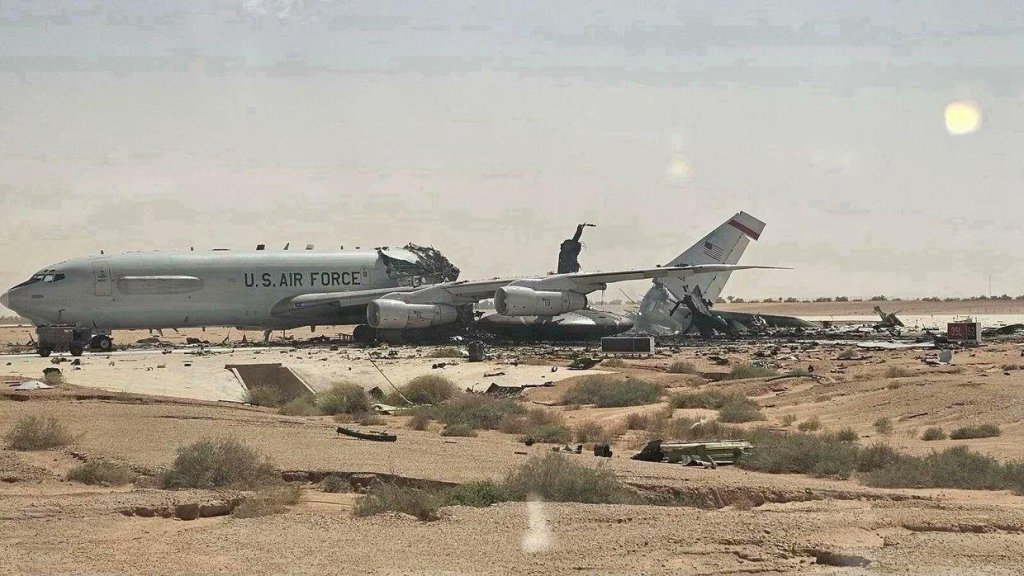
(Some US Troops in the GULF have leaked photos of their damaged bases to CBS, saying they’re “standing there with our eyes closed getting punched in the face” Active service members sent the images anonymously. One soldier’s words: “We’re not defending these bases. We’re just watching them get destroyed.”)
Crafting a durable policy toward the Islamic Republic of Iran has confounded every American administration since the revolution of 1979, and the intellectual apparatus constructed to address that challenge has itself become an object requiring scrutiny. The Brookings Institution published Which Path to Persia? Options for a New American Strategy toward Iran on 13 July 2009, a volume authored by Kenneth M. Pollack, Daniel L. Byman, Martin S. Indyk, Suzanne Maloney, Michael E. O’Hanlon, and Bruce Riedel, all affiliated with the Saban Center for Middle East Policy at Brookings (3). The book’s official description states that the authors “do not argue for one approach over another” and instead “present the details of the policies so that readers can understand the complexity of the challenge and decide for themselves which course the United States should take” (3). That framing is the conventional posture of policy analysis, and it is not false. But the table of contents reveals a structure that is anything but neutral, proceeding from diplomatic options through military options to regime change and containment, with chapters titled “Leave it to Bibi: Allowing or Encouraging an Israeli Military Strike,” “The Velvet Revolution: Supporting a Popular Uprising,” “Inspiring an Insurgency: Supporting Iranian Minority and Opposition Groups,” and “The Coup: Supporting a Military Move Against the Regime”. A volume that presents these as discrete options within a single analytical framework is not a neutral survey of possibilities. It is a repertoire of strategies, prepared by individuals with institutional access, for use by policymakers when circumstances permit.
The diplomatic chapter of that repertoire contains language that subsequent events have rendered prophetic. The report describes a strategy in which the United States would strike only when “there is a widespread conviction that the Iranians were given but then rejected a superb offer, one so good that only a regime determined to acquire nuclear weapons and acquire them for the wrong reasons would turn it down.” Under those circumstances, the report continues, the United States or Israel “could portray its operations as taken in sorrow, not anger, and at least some in the international community would conclude that the Iranians ‘brought it on themselves’ by refusing a very good deal.” This is not a strategy for reaching a diplomatic settlement. It is a strategy for manufacturing a justification for war by constructing an offer that the adversary cannot accept, then attributing the resulting failure to the adversary’s intransigence. The conditions that the United States demanded of Iran in the negotiations mediated by Oman during 2025 and 2026, the destruction of major nuclear facilities, the transfer of all enriched uranium, the permanent cessation of enrichment, and acceptance of an agreement with no expiration date, correspond precisely to the structure of an offer designed to be refused.
The institutional continuity of the report’s authors is not incidental to the story of how its repertoire was implemented. Kenneth Pollack, the volume’s lead author, is now Vice President for Policy at the Middle East Institute and has moderated numerous public discussions of the Iran war throughout 2026, including events titled “Iran: War or Deal?” and “The Iran War: Escalation, Energy, and the Uncertain Endgame.” Suzanne Maloney remains Vice President and Director of Foreign Policy at the Brookings Institution and has appeared as a leading expert on Iran across Bloomberg, CNN, PBS, and NPR during the current conflict. Bruce Riedel remains a senior fellow at Brookings and director of the Brookings Intelligence Project, following a thirty-year career at the CIA. Martin Indyk, who served twice as United States ambassador to Israel and as Barack Obama’s special envoy for Israeli-Palestinian negotiations from 2013 to 2014, died in July 2024 after a career that embodied the revolving door between the policy establishment and government service. These are not marginal figures who happened to write a book. They are the institutional custodians of a strategic framework that has survived multiple administrations and whose prescriptions have been progressively enacted as circumstances permitted.
The dismantlement of the arms control architecture that had stabilised the Cold War began with the Anti-Ballistic Missile Treaty, signed in 1972 by the United States and the Soviet Union with the intention of maintaining the effectiveness of nuclear deterrence by strictly limiting the deployment of anti-missile systems (19). The Bush administration came into office determined to abandon the treaty, which it saw as constraining its ability to test new anti-missile defences, and the United States formally withdrew on 13 June 2002 (19). Arms control experts warned at the time that abandoning such a treaty would set a dangerous precedent and that it could seriously undermine wider arms control efforts (19). The withdrawal was unilateral and was not prompted by any Russian violation. Both Russia and China expressed opposition when the decision was first announced in December 2001, but they recognised that missile defence had become an article of faith in the Pentagon and that the Americans were determined to push ahead with their anti-missile research (19).
The Intermediate-Range Nuclear Forces Treaty, signed in 1987, banned all nuclear and non-nuclear missiles with ranges between 500 and 5,500 kilometres, except sea-launched weapons (10). The United States announced its intention to withdraw on 1 February 2019, and the withdrawal took effect on 2 August 2019 (10). Secretary of State Mike Pompeo stated that “Russia is solely responsible for the treaty’s demise” and that the United States had determined Russia to be in material breach of the treaty based on its deployment of the 9M729 missile, known to NATO as the SSC-8 (10). Russia denied this accusation and countered that the United States had itself violated the treaty by deploying MK-41 launchers in Europe capable of firing intermediate-range cruise missiles (10). UN Secretary-General Antonio Guterres warned that “an invaluable brake on nuclear war” was being lost and that the collapse would “likely heighten, not reduce, the threat posed by ballistic missiles” (10). The United States never provided conclusive public evidence of the alleged Russian violation, and the withdrawal was unilateral.
The Aegis Ashore system deployed in Romania and Poland represented the first material consequence of the ABM Treaty withdrawal. The system uses the Mk-41 vertical launch system, the same launcher found on naval vessels, and was deployed at Deveselu air base in Romania in 2016 and planned for Poland. Russian President Vladimir Putin stated that the United States had “flagrantly ignored the provisions” of the INF Treaty by deploying ground-based Mk-41 launchers in Romania and Poland capable of using intermediate-range Tomahawk cruise missiles (28). The Mk-41 launcher is technically capable of firing Tomahawk cruise missiles with a range of up to 2,400 kilometres, which would violate the INF Treaty had it still been in force-. The United States claimed the system was purely defensive, but the dual-use nature of the launch cells meant they could be used for offensive missiles. This was not a theoretical concern. The technical capacity of the Mk-41 system to launch Tomahawks is well-established, and Russia’s objections were consistent and documented.
The Typhon system, also known as the Mid-Range Capability system, was developed after the INF Treaty withdrawal and represents a direct material response to the treaty’s demise. The system leverages existing Raytheon-produced SM-6 missiles and Raytheon-produced Tomahawk cruise missiles modified for ground launch, as documented by the Congressional Research Service (38). The Typhon can fire Tomahawk cruise missiles approximately 1,600 kilometres, placing targets on the east coast of China and Russia within reach. The first Typhon battery became operational under the Biden administration, demonstrating the continuity of agenda across Republican and Democratic administrations. A Republican president withdrew from the treaty, and two Democratic presidents implemented the changes that the withdrawal made possible. This is not a partisan project. It is an institutional project that transcends electoral politics.
The Precision Strike Missile, known as PrSM, is the closest American equivalent to the Russian Iskander, with a current range of 500 kilometres and plans to extend it to 1,000 kilometres in future variants. The missile is designed to replace the aging ATACMS system and is compatible with the HIMARS and M270 launchers that were sent to Ukraine in large numbers. The current production rate is approximately 260 missiles per year, with Lockheed Martin stating it aims to produce up to 400 PrSM missiles annually. A major order for PrSM is set for 2027, with plans to reach an annual production target of 400 units. The United States Army has acknowledged that it needs more missiles and that the solution is going to be painful. This acknowledgment of material insufficiency is itself a significant admission that the strategic repertoire has outrun the industrial capacity required to sustain it.
Russia’s response to the American treaty withdrawals has been quantitatively and qualitatively significant. Ukrainian military intelligence estimates that Russia’s military-industrial complex plans to produce around 700 9M723 ballistic missiles for the Iskander tactical missile system in 2026, the same level as the previous year, with monthly production between 55 and 60 Iskander ballistic missiles (58). Other estimates suggest production has reached 60 to 70 units per month, equating to 720 to 840 annually. The Iskander-M production rate stands at 60 units per month, with an additional 10 Iskander-K cruise missiles produced monthly. This means Russia is producing approximately four times more Iskander ballistic missiles than the United States produces PrSMs, and the disparity is compounded by the fact that the United States must divide its limited production among multiple theatres while Russia is fighting in one main conflict on its own border.
The Tomahawk cruise missile production disparity is even more stark. Raytheon currently produces approximately 60 Tomahawk missiles per year, and a new $22.9 billion Navy contract will allow annual production to increase to more than 1,000 missiles over seven years (68). The current production rate of 60 per year is confirmed by multiple sources, with each missile taking between 18 and 24 months from order to completion (68). The Tomahawk was employed against Iran at a rate that was likely poorly planned, with the United States expending more than 850 of the cruise missiles in the initial weeks of Operation Epic Fury, and possibly as many as 1,000, against ground targets in Iran (68). This represents a record for the highest number of Tomahawks expended in a single military campaign. The United States used up most of its Tomahawks against Iran, and the production rate of 60 per year means that replacing the expended stockpile will take years, not months.
Russia’s cruise missile production, by contrast, includes approximately 350 Kalibr cruise missiles per year, 50 Zircon missiles, and 120 Iskander-K cruise missiles, for a total of 520 ground-launch capable cruise missiles over the same period. The Kalibr is the direct equivalent of the Tomahawk, and Russia’s production rate is significantly higher than the American rate before the recent contract expansion. Even with the planned American increase to 1,000 Tomahawks per year, the historical production disparity has already had strategic consequences. The United States cannot rapidly expand production without guaranteed contracts and the industrial infrastructure that decades of consolidation have eroded.
The Oreshnik intermediate-range ballistic missile represents Russia’s most significant response to the American withdrawal from the INF Treaty. The missile has a range of 3,000 to 5,500 kilometres, capable of covering the entire European region, and travels at hypersonic speeds of Mach 11. The Oreshnik is capable of delivering up to six multiple independently targetable reentry vehicles, each of which can contain additional submunitions for a total of 36 projectiles. The missile has already been used in the Ukraine conflict, and its destructive power has been demonstrated. The Oreshnik’s range far exceeds that of the Dark Eagle hypersonic missile that the United States has been developing, and its deployment represents a direct material counter to the American systems that were intended to provide a first-strike advantage.
The material foundation of American military power has eroded to a point that the architects of the current escalation appear not to have anticipated. The United States has invested $4.9 billion in new munitions production lines since the Ukraine conflict began, yet it fell short of its 2025 goal of producing 100,000 155mm artillery shells per month, achieving only around 40,000. The defence industry has been oriented toward a model that rewards high-margin, low-volume production of advanced systems rather than the mass production of consumable munitions. The core flaw of the American military-industrial complex is that capital profit-seeking overrides national security and public interest-. Defence contractors, the military, and politicians have formed a mutually reinforcing alliance where profits, expanded budgets, and political capital align. The result is a military that can destroy targets with extraordinary precision but cannot sustain the campaign required to achieve political objectives.
The intellectual infrastructure that produced the policy repertoire and sustained its implementation is embedded within networks of material interest that compromise the independence of the analysis it produces. The Think Tank Funding Tracker, created by the Quincy Institute for Responsible Statecraft, documents that the top 100 defence companies contributed more than $34.7 million to the top 50 American think tanks between 2019 and 2023. The Atlantic Council, the Center for a New American Security, and the Center for Strategic and International Studies were the largest recipients of Pentagon contractor funding, with the Atlantic Council receiving $12,801,001 from Pentagon contractors-. Foreign governments and foreign government-owned entities donated more than $110 million to the same think tanks over the same period. A study of major American foreign policy think tanks found that 78 per cent receive funding from defence contractors, and that defence-funded institutions are cited 85 per cent more frequently in media discussions on Ukraine policy. The Brookings Institution, which produced Which Path to Persia?, is itself a recipient of Pentagon contractor funding and foreign government funding, creating material conflicts of interest in the production of foreign policy analysis.
The class composition of the institutions that produced and sustained this policy repertoire requires explicit identification. The authors of Which Path to Persia? were not representatives of the working class, nor of the small-business class, nor of any constituency that bears the costs of war through taxation and military service. They were members of what may be described as the foreign policy fraction of the professional-managerial class, individuals whose careers circulate between think tanks, government agencies, university departments, and corporate boards. Pollack began his career as a Persian Gulf military analyst at the CIA and served twice on the National Security Council. Riedel spent thirty years at the CIA before joining Brookings. Indyk was a two-time ambassador to Israel and a special envoy under Obama. Maloney worked on the State Department’s Policy Planning Staff before joining Brookings. Their material interests are tied to the perpetuation of the foreign policy apparatus and the conflicts it manages. Their salaries, their institutional budgets, their access to policymakers, and their professional standing all depend on the continued salience of the national security paradigm they serve. This does not mean they act from conscious corruption. It means their structural position generates a set of assumptions about the world that make confrontation appear natural and diplomacy appear naive.
The defence contractors that fund the think tanks occupy a different position within the same class configuration. Northrop Grumman, Lockheed Martin, and Raytheon are the principal beneficiaries of the policy repertoire that the think tanks produce. Every PrSM, Tomahawk, and Dark Eagle missile produced translates into revenue for the companies that manufacture these systems. The relationship is not one of corruption in the narrow sense of quid pro quo. It is a structural alignment of interests in which the intellectual producers of policy and the material beneficiaries of that policy occupy overlapping institutional spaces and share a common commitment to the expansion of the national security state. The think tank analysts who write the reports, the defence executives who fund the think tanks, and the government officials who implement the recommendations are not three separate groups. They are three fractions of a single ruling class whose interests converge on the perpetuation of American military dominance, regardless of whether that dominance serves the interests of the American people.
The continuity of agenda across Republican and Democratic administrations is itself a materialist insight that the electoral theatre of left versus right serves to obscure. Voters are presented with a choice between two factions of the same class configuration, while the actual policy agenda, the expansion of military spending, the withdrawal from arms control treaties, the encirclement of Russia and China, continues regardless of who occupies the White House. The public is distracted by cultural and identity disputes while the material interests of the defence contractors and the foreign policy establishment are advanced without interruption. This is not a conspiracy. It is a structural feature of a political system in which both major parties are funded by the same corporate interests and staffed by the same professional-managerial class. The withdrawal from the ABM Treaty occurred under a Republican president, the Aegis Ashore deployments occurred under Democratic presidents, the INF Treaty withdrawal occurred under a Republican president, and the Typhon system was developed under a Democratic president. The party labels changed. The policy did not.
The material basis of American hegemony is eroding, and the arms control withdrawals have accelerated rather than reversed that erosion. The United States withdrew from the ABM Treaty to develop missile defences that would theoretically allow a first strike while minimising retaliation. The result was the deployment of Aegis Ashore systems that Russia identified as a threat and responded to by developing hypersonic missiles that the American defences cannot intercept. The United States withdrew from the INF Treaty to develop ground-launched intermediate-range missiles. The result was the deployment of Typhon systems and the development of the PrSM, while Russia responded with the Oreshnik and expanded Iskander production to levels that dwarf American output. The United States sought to gain a strategic advantage through treaty withdrawal. The result was a quantitative and qualitative disadvantage in the very systems it sought to dominate.
The question that remains is whether the material contradictions of this system will produce a crisis that forces a fundamental reorientation. The United States has withdrawn from the arms control architecture that stabilised the Cold War, developed weapons systems that increase the risk of nuclear confrontation, and discovered that it cannot produce these systems in sufficient quantities to match its adversaries. The profit-driven defence industry cannot rapidly expand production without guaranteed contracts and the industrial infrastructure that decades of consolidation have destroyed. The think tank ecosystem cannot produce analysis that challenges the fundamental assumptions of the policy it serves. The political system cannot generate alternatives to the strategy of global dominance. The result is a trajectory that is increasingly disconnected from material reality, driven by institutional interests rather than strategic calculation, and vulnerable to the consequences of its own contradictions. The final assessment must remain analytical rather than definitive, because multiple plausible outcomes remain possible. The United States could attempt to escalate further, accepting higher costs and greater risks without any guarantee of success. The conflict could expand to encompass additional theatres, drawing in Russia, China, and other regional actors in ways that transform the character of the war. Or the exhaustion of American military capacity could force a negotiated settlement that falls short of the stated objectives, leaving Iran intact and the American position in the Middle East diminished. The indicators that would confirm or undermine each scenario are observable: the pace of munitions replenishment, the deployment of additional carrier strike groups, the decisions of European allies regarding participation in the conflict, the diplomatic manoeuvres of Russia and China, and the willingness of the American public to bear the costs of prolonged war. What is clear from the evidence assembled here is that the arms control architecture was dismantled not to protect the American people from a Russian or Chinese threat, but to sustain an imperial system whose material foundations are eroding and whose beneficiaries are concentrated in a narrow stratum of the population. The costs of the resulting arms race are borne by taxpayers, by military personnel and their families, and by the populations of the countries in which the weapons are deployed. The benefits accrue to defence contractors, to the professional-managerial class whose institutional positions depend on the perpetuation of the national security paradigm, and to the political class that uses foreign policy as a source of domestic legitimacy. The architecture of backfire that Washington has constructed cannot be sustained indefinitely, and the forces that will ultimately dismantle it are already in motion.
Authored By: Global GeoPolitics
Thank you for visiting. This is a reader-supported publication. If you believe journalism should serve the public, not the powerful, and you’re in a position to help, becoming a PAID SUBSCRIBER truly makes a difference. Alternatively you can support by way of a cup of coffee:
https://buymeacoffee.com/ggtv |
https://ko-fi.com/globalgeopolitics |
Bitcoin: 3NiK8BoRZnkwJSHZSekuXKFizGPopkE7ns
References
BBC News (2002) ‘US formally dumps ABM treaty’, BBC News, 13 June. Available at: http://cdnedge.bbc.co.uk/1/hi/world/americas/2042766.stm (Accessed: 15 September 2026).
BBC News (2019) ‘INF nuclear treaty: Trump says new pact should include China’, BBC News, 2 August. Available at: https://www.bbc.com/news/world-us-canada-49213892 (Accessed: 15 September 2026).
Brookings Institution (2009) Which Path to Persia? Options for a New American Strategy toward Iran. Washington, DC: Brookings Institution Press. Available at: https://www.brookings.edu/books/which-path-to-persia/ (Accessed: 15 September 2026).
Congressional Research Service (2026) The U.S. Army’s Typhon Mid-Range Capability (MRC) System. CRS Product IF12135, 20 April. Available at: https://www.congress.gov/crs-product/IF12135 (Accessed: 15 September 2026).
Defence Blog (2026) ‘Chinese firm publishes satellite images of US Typhon missile system in Japan’, Defence Blog, 16 July. Available at: https://defence-blog.com/chinese-firm-publishes-satellite-images-of-us-typhon-missile-system-in-japan/ (Accessed: 15 September 2026).
GOV.UK (2026) ‘Millions invested in new missile to strengthen British Army’s capability and NATO deterrence’, GOV.UK, 7 July. Available at: https://www.gov.uk/government/news/millions-invested-in-new-missile-to-strengthen-british-armys-capability-and-nato-deterrence (Accessed: 15 September 2026).
Kyiv Post (2026) ‘Russia Can Launch Up to 100 Ballistic Missiles at Ukraine Each Month Without Depleting Stocks – HUR’, Kyiv Post, 4 June. Available at: https://www.kyivpost.com/post/77520 (Accessed: 15 September 2026).
Missile Threat (2026) ‘Oreshnik’, CSIS Missile Threat, 9 January. Available at: https://missilethreat.csis.org/missile/oreshnik/ (Accessed: 15 September 2026).
National Interest (2026) ‘Raytheon to Boost Tomahawk Missile Production’, National Interest, 19 August. Available at: https://nationalinterest.org/blog/buzz/raytheon-to-boost-tomahawk-missile-production-ps-081926 (Accessed: 15 September 2026).
Quincy Institute for Responsible Statecraft (2025) Big Ideas and Big Money: Think Tank Funding in America. Available at: https://search.issuelab.org/resource/big-ideas-and-big-money-think-tank-funding-in-america.html (Accessed: 15 September 2026).
Responsible Statecraft (2025) ‘Who’s funding DC’s pro-war think tanks?’, Responsible Statecraft, 8 January. Available at: https://responsiblestatecraft.org/think-tank-funding-tracker/ (Accessed: 15 September 2026).
Think Tank Funding Tracker (2026) ‘Atlantic Council’, Think Tank Funding Tracker. Available at: https://thinktankfundingtracker.org/think-tank/atlantic-council/ (Accessed: 15 September 2026).
Vietnam.vn (2026) ‘Technical analysis and combat capabilities of the Oreshnik hypersonic ballistic missile’, Vietnam.vn, 26 May. Available at: https://www.vietnam.vn/en/technical-analysis-and-combat-capabilities-of-the-oreshnik-hypersonic-ballistic-missile/ (Accessed: 15 September 2026


Leave a comment