
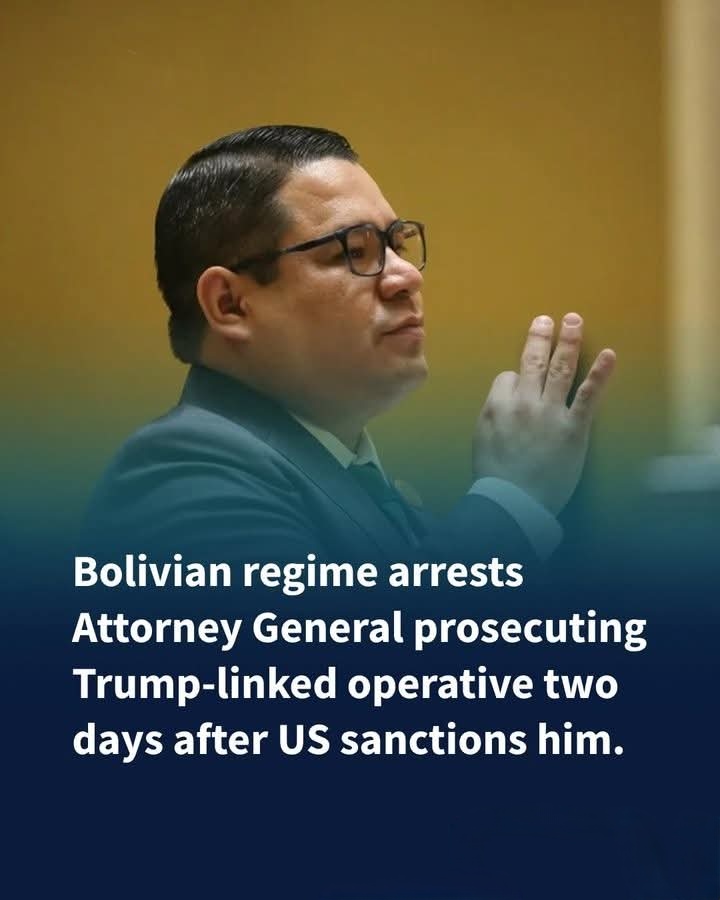
Bolivia’s Attorney General was detained without warrant forty-eight hours after Washington revoked his visa, and the case he was pursuing reached networks stretching from Mar-a-Lago to La Paz
Editorial Analysis | October 2026
Bolivian police arrested their own Attorney General, Roger Mariaca, on 30 September 2026, without a judicial warrant, and detained thirteen other officials alongside him in a raid on the Prosecutor’s Office in Sucre that was denounced live on camera as an illegal intervention by the very people who work there. The most chilling aspect of this operation is not the arrest itself but its timing, because it occurred exactly forty-eight hours after the United States State Department revoked Mariaca’s visa and publicly designated him a criminal. Washington made an accusation, and two days later an ostensibly independent government arrested its own top prosecutor on cue. The sequence demonstrates that the Bolivian government is not acting as a sovereign entity exercising its own judgment but as an instrument of American policy, and the claim that this is a matter of law enforcement rather than political instruction is contradicted by the absence of a warrant and by the circumstances of the raid.
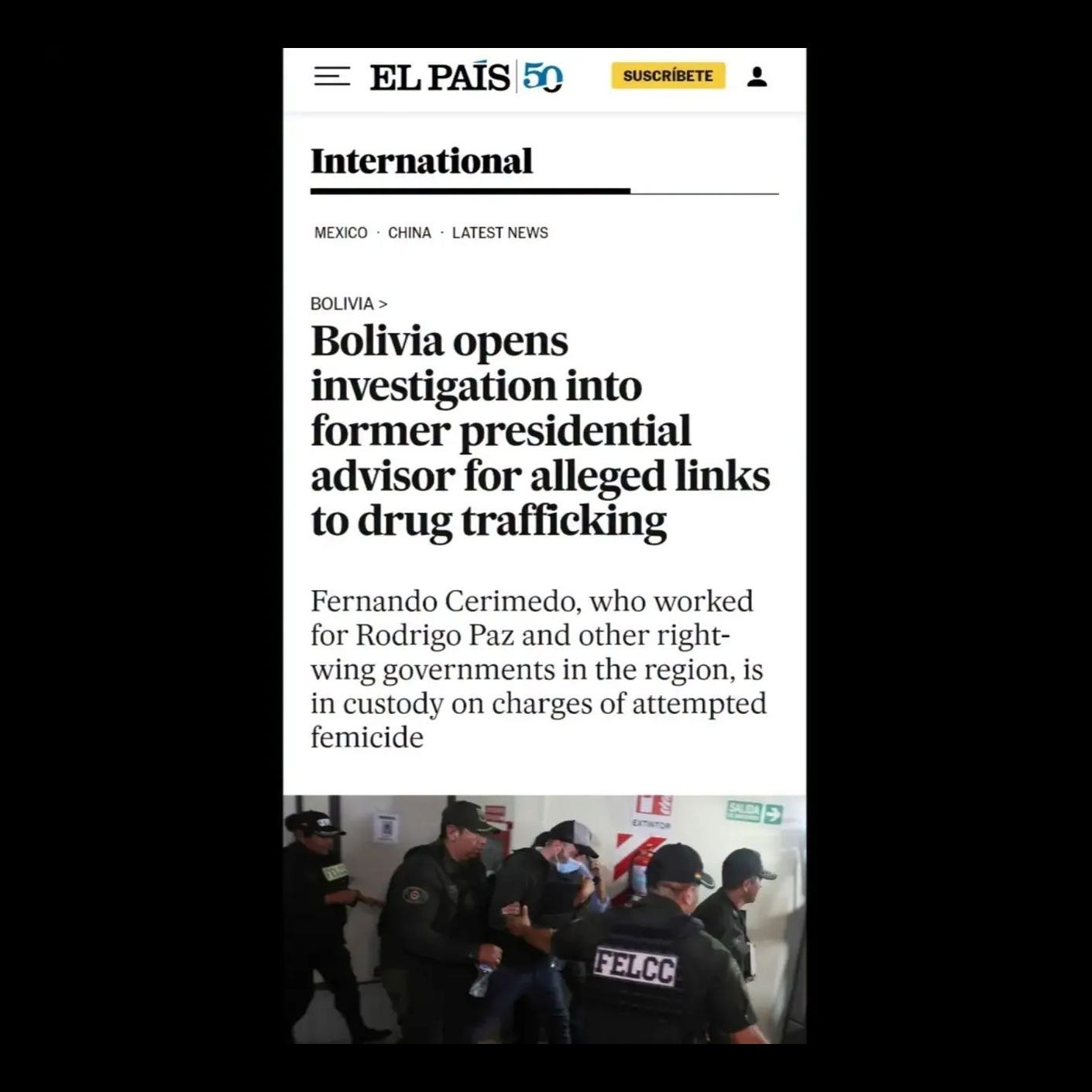
The case that Mariaca was pursuing reaches uncomfortably close to power, and this is the reason for his arrest. The investigation involved Fernando Cerimedo, an Argentine political consultant who advised President Rodrigo Paz’s campaign and who described Donald Trump’s former campaign manager Brad Parscale as his business partner on Bolivian television. Cerimedo’s firm is linked in press investigations and United States foreign agent registries to disinformation operations across Latin America, from Buenos Aires to Brasília to Santiago, and he has worked for right-wing, pro-American leaders throughout the region. Mariaca had publicly vowed to pursue that case, and he called the United States sanctions political pressure. Two days later, he was behind bars. The connection between the investigation and the arrest is not coincidental but causal, and the message that the operation communicates is that any prosecutor who follows evidence into networks that touch American interests will be removed from office and detained.
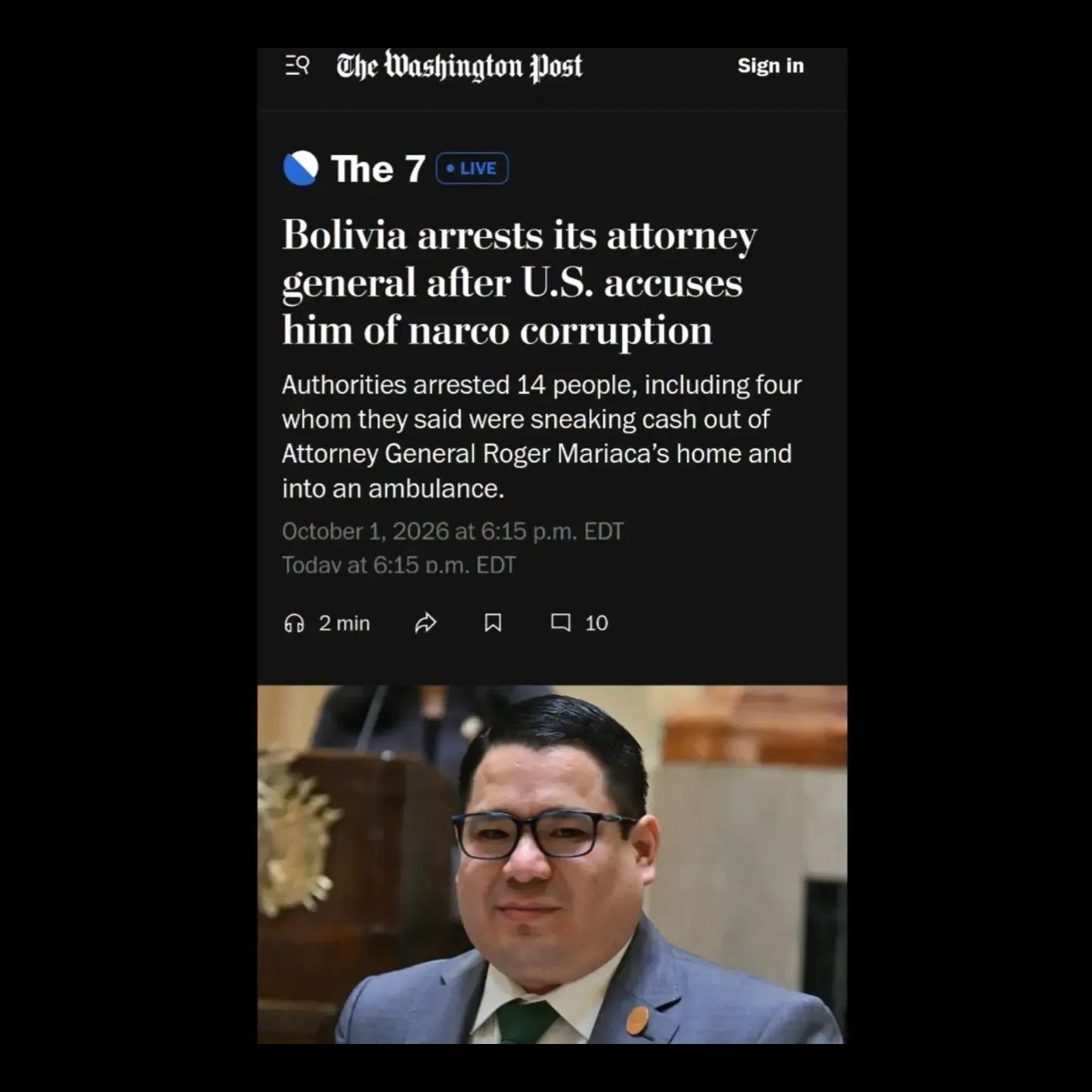
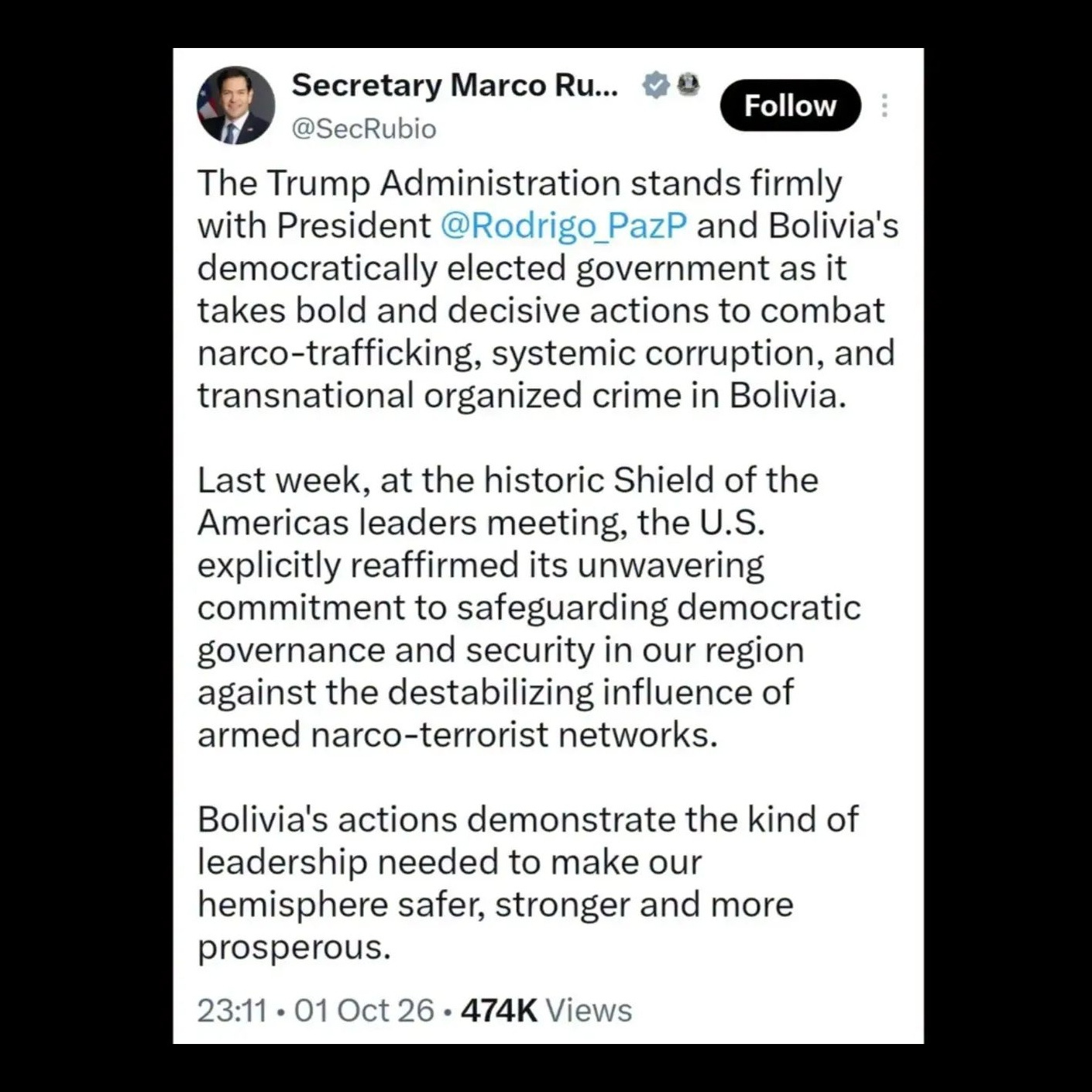
The Shield of the Americas, launched in 2026 with great fanfare as a crusade against transnational crime, has revealed its true function through its first coordinated actions. The initiative targeted judges and prosecutors across four countries, including Colombia, Peru, Ecuador, and Bolivia, and the accusations were uniform in their character. The officials were accused of undermining democracy, and the outcomes were consistent in their effect. Judicial independence was undermined, and the prosecutors who were pursuing cases that touched American interests were removed from their positions. The Bolivian case is the most recent and the most transparent, because the sequence of the visa revocation followed by the arrest is visible to anyone who examines the timeline. The anti-drug prosecutor of Bolivia admitted that the Attorney General was detained without a warrant, and the government then asked Washington for explanations about the accusations against its own officials, a request that reveals the extent to which the Bolivian government understands itself as subordinate to American authority rather than as a sovereign state.
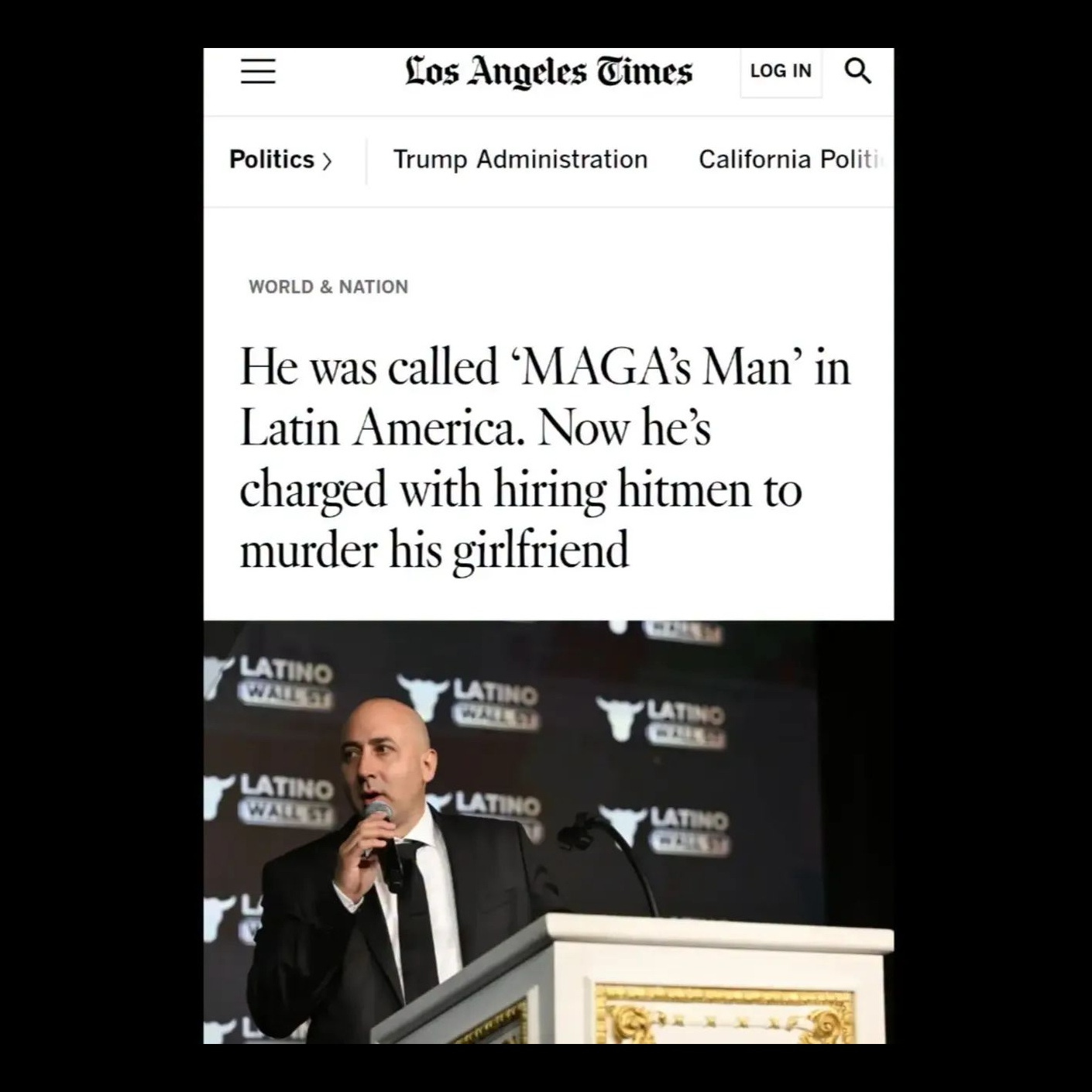
The network of corruption and criminality that the Shield of the Americas is designed to protect includes some of the most unsavoury figures in Latin American politics, and the case of Fernando Cerimedo is emblematic. Cerimedo was arrested in Bolivia for hiring hitmen to try to assassinate his pregnant ex-girlfriend, and while the attempt failed, the case exposed a pattern of criminality that extends far beyond domestic violence. The investigation into Cerimedo also involves drug trafficking and money laundering, and his connections to the Trump administration are documented in photographs that show him alongside Donald Trump Jr and Brad Parscale. The New York Times reported that the Trump administration gave Cerimedo a contract to produce a report on the Bolivian election, and the report was used to support claims of fraud that served American interests. Cerimedo worked for right-wing, pro-American leaders throughout Latin America, and he oversaw a scheme of election meddling that put those leaders in power by rigging elections, operating bots, and spreading disinformation. The arrest of Cerimedo in Bolivia was a threat to the network that the Shield of the Americas was designed to protect, and the removal of the prosecutor who was pursuing the case was the response of that network to the threat.
The 2025 Honduran election provides the context for understanding the stakes of the investigation, and the leaked recordings that have been published demonstrate the mechanisms of electoral manipulation that Cerimedo and his associates employed. Marlon Ochoa, a former electoral counselor in Honduras, published recordings that he delivered to the Attorney General on 23 December 2025, in which Cerimedo identifies himself and describes how votes were stuffed in favour of Nasry Asfura in certain ballot boxes, how votes that did not favour them were removed, how the Armed Forces were aligned with the operation, and how they were instructed not to accept a vote-by-vote recount. The Public Ministry and the Attorney General announced investigations and requested expertise from the Colombian MP, and the Supreme Court of Justice ordered the suspension of the investigation at the request of counselors who were granted illegal leave and rewarded with positions as ambassadors. The National Electoral Council declared the winner of the 2025 elections without counting all the minutes and without processing a single challenge, and the National Congress condemned Ochoa with an impeachment and expelled him from the CNE to subject him to persecution. The fraud in Honduras was overseen by the same Fernando Cerimedo who was later arrested in Bolivia, and the American support for the operation is documented by the involvement of the Trump administration and by the pardoning of Juan Orlando Hernández, the former Honduran president who was imprisoned in the United States for trafficking tonnes of cocaine and machine guns.
The release of Juan Orlando Hernández from prison by Donald Trump was one of the most brazen acts of impunity in the recent history of American foreign policy, and it demonstrates that the American state is prepared to protect the networks of criminality that serve its interests. Hernández was convicted of trafficking tonnes of cocaine into the United States, and his release was justified by the claim that he was the victim of a conspiracy orchestrated by the Biden administration. The real reason for his release is that he was a loyal ally of the United States who assisted in the operation of the networks of drug trafficking and political control that the American state maintains in Central America. His National Party was the instrument through which the United States exercised influence in Honduras, and the return of the National Party to power with American support demonstrates that the commitment to fighting drug trafficking is a rhetorical device that has no relationship to the actual conduct of American policy.
The Bolivian arrest of Mariaca was the response of the network to the threat that the investigation posed, and the mechanism of the response reveals the structure of American control. The State Department revoked Mariaca’s visa and designated him a criminal, and the Bolivian government arrested him two days later. The sequence demonstrates that the Bolivian government was acting upon instructions that were communicated through diplomatic channels, and the absence of a judicial warrant confirms that the arrest was not the product of an independent legal process but the execution of a political order. The anti-drug prosecutor of Bolivia admitted that the arrest was conducted without a warrant, and the government then asked Washington for explanations, a request that reveals the extent to which the Bolivian government understands itself as accountable to American authority rather than to Bolivian law.
The class analysis of the Bolivian case must identify the interests that benefit from the operation and those that bear its costs. The Bolivian comprador class, including the politicians, bureaucrats, and businessmen who have aligned themselves with American interests, benefits from the protection that the American state provides against investigations into their criminal activities. President Rodrigo Paz is a member of this class, and his campaign was advised by the same Fernando Cerimedo who is now under investigation for drug trafficking and attempted murder. The American corporations that extract resources from Bolivia and the American financial institutions that hold Bolivian debt benefit from the political stability that the American-aligned government provides, and the Bolivian working class bears the costs of the corruption, the drug trafficking, and the impunity that the American-supported government perpetuates. The arrest of Mariaca is an act of class war conducted through the mechanisms of the state, and it demonstrates that the Bolivian government serves the interests of a narrow elite rather than the interests of the population.
The theoretical framework of realism provides the context for understanding the behaviour of the Bolivian government, which is acting as a client state rather than as a sovereign actor. In the realist framework, states pursue their interests as defined by their material capabilities, and the Bolivian government’s interests are defined by its dependence on American support. The Bolivian economy depends on American markets and American financial institutions, and the Bolivian political system depends on American recognition and American support. The government therefore has no choice but to comply with American demands, even when those demands involve the arrest of its own officials. The concept of the security dilemma applies to the relationship between the Bolivian government and the American state, because the Bolivian government’s efforts to maintain its position by aligning with the United States are perceived by the Bolivian population as a threat to their interests, and the resulting instability creates further incentives for the government to rely on American support.
The game-theoretic analysis of the Bolivian case reveals the strategic interactions between the United States, the Bolivian government, the prosecutor, and the networks of criminality that the American state protects. The United States seeks to protect the networks that serve its interests, and the prosecutor threatens those networks. The Bolivian government seeks to maintain its position, and it depends on American support. The prosecutor seeks to pursue the evidence, and he is vulnerable because he lacks the support of the government. The equilibrium of the game is determined by the payoffs, and the payoff structure ensures that the government will comply with American demands because the cost of non-compliance exceeds the cost of compliance. The prosecutor is the loser in this game because he has no allies with sufficient power to protect him, and his arrest is the outcome that the payoff structure produces.
The implications of the Bolivian case for the future of Latin America are significant and troubling, because the pattern of American intervention in the region has not changed despite the rhetoric of the Shield of the Americas. The initiative was presented as a crusade against transnational crime, but its first actions have been to target the prosecutors and judges who were pursuing cases against the criminals who serve American interests. The message is that the American state will protect its allies regardless of their criminality, and that any official who challenges that protection will be removed. The Latin American governments that have aligned themselves with the United States are complicit in this project, and the populations of the region are the victims of the corruption and impunity that the project perpetuates. The case of Bolivia is a warning to any prosecutor who would follow evidence into networks that touch American interests, and it demonstrates that the Shield of the Americas is a weapon against sovereignty rather than a shield for the peoples of the region.
The historical context of American intervention in Latin America includes the support for dictatorships, the training of death squads, the assassination of reformist leaders, the imposition of neoliberal policies that enriched the elite at the expense of the population, and the protection of drug trafficking networks that funded the Contras in Nicaragua and the military governments in the Southern Cone. The Shield of the Americas is the most recent expression of this pattern, and it reflects the enduring commitment of the American state to maintaining control over the Western Hemisphere by whatever means are necessary. The use of a visa revocation to trigger an arrest demonstrates that the mechanisms of control have become more sophisticated, but the objective remains the same. The American state seeks to maintain a system in which the resources of Latin America flow to the United States, the governments of Latin America are accountable to Washington, and the populations of Latin America remain impoverished and disorganised.
The final assessment must remain analytical rather than definitive, because multiple plausible outcomes remain possible and the evidence available is incomplete. The Bolivian government may continue to comply with American demands, and the pattern of American intervention may continue without interruption. The Bolivian population may resist the corruption and impunity that the government perpetuates, and the resulting instability may create opportunities for change. The regional powers that have challenged American hegemony, including China and Russia, may expand their influence in Latin America, and the resulting competition may constrain American power. The networks of criminality that the American state protects may be exposed through the work of journalists and prosecutors who are willing to risk their careers and their freedom to pursue the evidence, and the resulting exposure may create pressure for accountability. The indicators that would confirm or undermine each scenario are observable, including the trajectory of the investigation into Cerimedo, the willingness of the Bolivian government to comply with American demands, the level of popular resistance to the government, and the diplomatic engagement of alternative powers. What is clear from the evidence assembled here is that the arrest of Mariaca was not an act of law enforcement but an act of political repression, and it demonstrates that the American state is prepared to protect the networks of criminality that serve its interests even at the cost of the sovereignty of its allies and the welfare of their populations.
Authored By: Global GeoPolitics
Thank you for visiting. This is a reader-supported publication. If you believe journalism should serve the public, not the powerful, and you’re in a position to help, becoming a PAID SUBSCRIBER truly makes a difference. Alternatively you can support by way of a cup of coffee:
https://buymeacoffee.com/ggtv |
https://ko-fi.com/globalgeopolitics |
Bitcoin: 3NiK8BoRZnkwJSHZSekuXKFizGPopkE7ns
References
Associated Press (2026) ‘Bolivia arrests attorney general two days after US revokes visa’, Associated Press, 30 September. Available at: https://apnews.com/article/bolivia-attorney-general-arrest-2026 (Accessed: 2 October 2026).
Ben Norton (2026) ‘The recordings prove Honduras elections were stolen’, Geopolitical Economy Report, 15 September. Available at:
(Accessed: 2 October 2026).
Bolivia, Government of (2026) Statement on the Arrest of the Attorney General. La Paz: Ministry of Communication. Available at:
https://www.comunicacion.gob.bo
(Accessed: 2 October 2026).
Bolivian Prosecutor’s Office (2026) Denunciation of Illegal Intervention at the Prosecutor’s Office in Sucre. Sucre: Fiscalía General del Estado. Available at:
(Accessed: 2 October 2026).
Congressional Research Service (2025) Latin America: U.S. Policy and Interests. Washington, DC: CRS. Available at:
https://crsreports.congress.gov
(Accessed: 2 October 2026).
Federal Election Commission (2024) Foreign Agents Registration Act Filings: Cerimedo. Washington, DC: FEC. Available at:
(Accessed: 2 October 2026).
Honduras, Public Ministry (2025) Investigation into Electoral Fraud in the 2025 Elections. Tegucigalpa: Ministerio Público. Available at:
(Accessed: 2 October 2026).
New York Times (2025) ‘A Contractor and a Report on the Bolivian Election’, New York Times, 15 August. Available at:
(Accessed: 2 October 2026).
Ochoa, M. (2025) Recordings Delivered to the Attorney General of Honduras. Tegucigalpa: Public Ministry. Available at:
(Accessed: 2 October 2026).
Reuters (2026) ‘Bolivia government asks US for explanations on sanctions against officials’, Reuters, 1 October. Available at: https://www.reuters.com/world/americas/bolivia-government-asks-us-explanations-sanctions-2026-10-01/ (Accessed: 2 October 2026).
United States Department of State (2026) Visa Revocation of Bolivian Attorney General Roger Mariaca. Washington, DC: State Department. Available at:
(Accessed: 2 October 2026).
United States Department of Justice (2024) Press Release: Juan Orlando Hernández Sentenced for Drug Trafficking. Washington, DC: DOJ. Available at:
(Accessed: 2 October 2026).
United States Department of the Treasury (2026) Office of Foreign Assets Control Designations: Bolivia. Washington, DC: Treasury. Available at:
(Accessed: 2 October 2026).


Leave a comment