
Beyond insult, the remark reflects Iran’s strategy of promoting missile and drone capabilities as tools to deter American power.
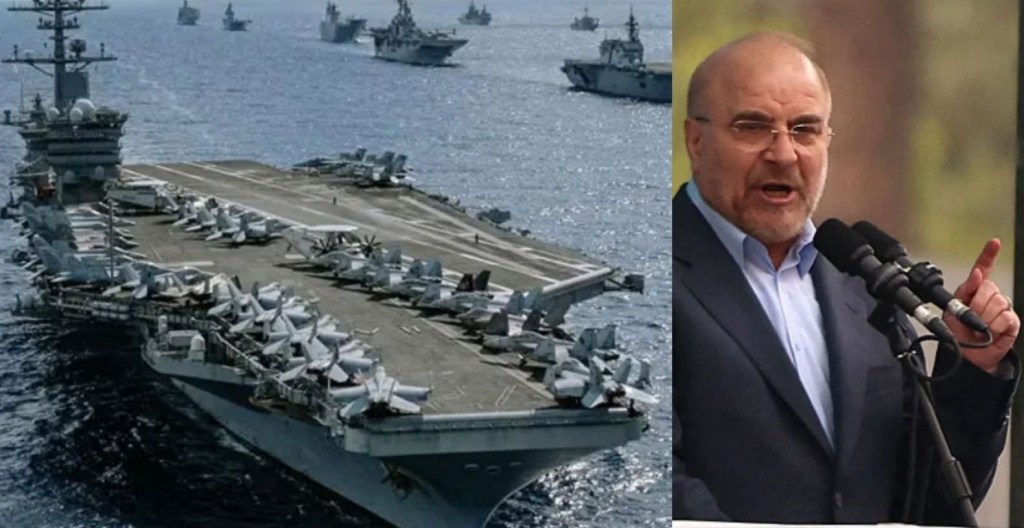
Iranian Parliament Speaker Mohammad Bagher Ghalibaf used unusually cutting rhetoric to mock the United States over the departure of the aircraft carrier USS Abraham Lincoln (CVN-72), framing the move as proof that American military pressure against Iran has lost credibility.
“So much fuss was made about the aircraft carrier ‘Lincoln’ to put pressure on us, but it left the battlefield.”
The remark targets a long-standing element of U.S. strategy in the Middle East: carrier strike group deployments as political signaling. Aircraft carriers such as the Lincoln are not only military assets but instruments of deterrence, meant to reassure allies and warn adversaries. By dismissing the deployment as “fuss,” Ghalibaf seeks to undermine that signaling effect and portray it as theatrical rather than strategically meaningful.
“The ‘famous bride’ left the battlefield and retreated at the first encounter with Iranian missiles and drones.”
The phrase “famous bride”, a Persian expression used to mock something widely advertised but ultimately fragile, serves as the centerpiece of Ghalibaf’s message. In this framing, the United States is depicted as loudly showcasing its military power but unwilling to risk confrontation once faced with Iran’s growing arsenal of precision missiles and drones.
Beyond the insult, the statement reflects Iran’s evolving deterrence narrative. Over the past decade, Tehran has invested heavily in asymmetric capabilities, ballistic missiles, cruise missiles, and unmanned aerial systems, specifically designed to threaten high-value assets such as aircraft carriers operating in confined waters like the Persian Gulf. Iranian officials frequently emphasize these capabilities to argue that even the most powerful U.S. platforms are vulnerable.
The comment is therefore less about a single carrier movement and more about information warfare. By portraying a routine naval redeployment as a retreat, Iranian leaders attempt to reshape the regional perception of power: the United States is cast as cautious and overstretched, while Iran presents itself as a resilient actor capable of deterring superior forces.
Such rhetoric also plays strongly to domestic audiences. Publicly belittling American military power reinforces the Islamic Republic’s narrative of strategic endurance, an argument that despite sanctions, isolation, and military pressure, Iran has forced Washington to operate more carefully in its immediate neighborhood.
In geopolitical terms, the episode illustrates a broader contest not just of weapons, but of perception. Aircraft carriers project hard power, but political narratives attempt to redefine what those deployments mean. In that battle of narratives, Ghalibaf’s remarks are designed to transform a symbol of U.S. dominance into a symbol of hesitation.
Authored By: Global GeoPolitics
Thank you for visiting. If you believe journalism should serve the public, not the powerful, and you’re in a position to help, becoming a PAID SUBSCRIBER truly makes a difference. Alternatively you can support by way of a cup of coffee:


Leave a comment