
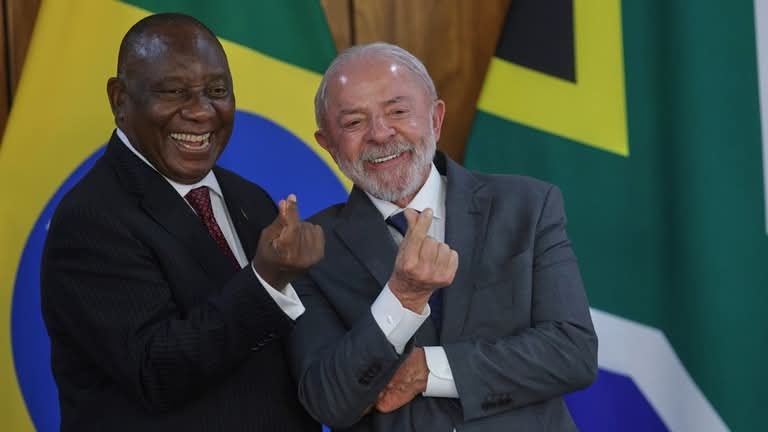
Lula and Ramaphosa reflect a growing unease across the Global South after Western military actions in Venezuela and Iran, reinforcing fears that states outside major alliance systems remain vulnerable to coercion and intervention.
Brazil’s President Luiz Inácio Lula da Silva used the recent visit of South African President Cyril Ramaphosa to Brasília to articulate a broader strategic concern increasingly shared across parts of the Global South: that states outside the Western alliance system remain structurally dependent on external suppliers for their security and, consequently, vulnerable in a period of intensifying geopolitical competition. In urging closer defence cooperation between Brazil and South Africa, Lula framed the issue in stark terms, warning that without adequate preparation “one day someone will invade us.” (eNCA)
The remark was less a literal forecast of imminent invasion than a reflection of the shifting strategic environment confronting middle powers. For decades both Brazil and South Africa operated within relatively permissive regional security orders. Latin America has largely avoided interstate war since the late twentieth century, while southern Africa has been defined more by internal political challenges than external threats. Lula himself emphasised that South America remains a “region of peace”, devoid of nuclear weapons and interstate conflicts, suggesting that defence policy there has historically been conceived primarily in terms of deterrence rather than active military competition. (The Star)
Yet the international context in which these assumptions were formed is undergoing a rapid transformation. The resurgence of great-power rivalry, the increasingly frequent use of unilateral sanctions and military force, and the erosion of established norms of sovereignty have prompted renewed debate among emerging powers about their long-term strategic autonomy. Lula’s comments were delivered amid an escalating war involving Iran following joint United States–Israeli strikes, an episode that has intensified anxieties among several BRICS states about the vulnerability of governments that stand outside the Western security framework. (The Guardian)
The immediate geopolitical background to Lula’s remarks, however, lies closer to home. Earlier in the year the United States carried out military strikes in Venezuela and reportedly captured President Nicolás Maduro, an action that Brasília condemned as a violation of sovereignty and a dangerous precedent in the Western Hemisphere. Lula argued that the operation had crossed “an unacceptable line”, evoking memories of earlier interventions that shaped Latin America’s historical suspicion of external power. (centralnews.co.za)
For many governments in the Global South, the sequence of events has been instructive. The intervention in Venezuela and the subsequent widening conflict involving Iran have reinforced a perception that military force is again being used by major powers to shape political outcomes beyond their immediate regions. Several states, including South Africa, criticised the Venezuelan operation as a breach of the United Nations Charter and warned that unilateral action of this kind risks undermining the foundations of the international order. (m.thewire.in)
It is within this context that Lula’s call for defence industrial cooperation acquires its broader significance. Brazil possesses the most developed defence industrial base in Latin America, including a sophisticated aerospace sector and domestic arms manufacturers, while South Africa retains elements of a once formidable military-industrial complex established during the apartheid era. Ramaphosa acknowledged the asymmetry between the two countries, remarking that Brazil is “much more advanced” in defence and aviation, yet emphasised that cooperation could nevertheless prove mutually beneficial. (African Insider)
The strategic logic underlying the proposal is straightforward. By pooling technological capacity and production capabilities, both states could reduce dependence on Western arms suppliers while strengthening indigenous industrial capacity. For Brazil, which has long aspired to a more autonomous global role, defence industrial development is closely tied to broader ambitions for strategic independence. For South Africa, whose defence industry has declined since the end of apartheid, collaboration offers a pathway to revive domestic capabilities without relying exclusively on European or American suppliers.
This emphasis on strategic autonomy has become a recurring theme in contemporary BRICS diplomacy. Originally conceived in 2006 as a forum for large emerging economies, the grouping has gradually expanded both in membership and in ambition. The addition of countries such as Iran has sharpened the perception that BRICS is evolving into a platform through which non-Western states seek greater latitude within a still Western-dominated international system.
Nevertheless, the initiative should not be mistaken for the emergence of a formal military alignment. BRICS remains an extraordinarily heterogeneous coalition whose members maintain divergent strategic priorities. Brazil and South Africa, in particular, have historically pursued foreign policies grounded in non-alignment, multilateral diplomacy, and mediation rather than overt balancing against Western power. Lula’s remarks therefore reflect not a call for confrontation but a more modest proposition: that sovereignty in an era of renewed great-power rivalry requires a degree of material capability that many emerging states have long neglected.
Viewed in this light, the discussion between Brasília and Pretoria illustrates a wider recalibration underway across the Global South. The interventions in Venezuela and the widening war involving Iran have served as a reminder that the norms governing the use of force in international politics remain fragile. For countries that lack formal alliance guarantees, the lesson is increasingly clear: political independence ultimately rests upon the capacity to defend it.
Authored By: Global GeoPolitics
Thank you for visiting. If you believe journalism should serve the public, not the powerful, and you’re in a position to help, becoming a PAID SUBSCRIBER truly makes a difference. Alternatively you can support by way of a cup of coffee:
https://buymeacoffee.com/ggtv |
https://ko-fi.com/globalgeopolitics |
Bitcoin: 3NiK8BoRZnkwJSHZSekuXKFizGPopkE7ns


Leave a comment