

An analysis of how strategic preparation, control of critical infrastructure, and narrative influence have given Iran an advantage over superior militaries
The war between the United States, Israel, and Iran shows a clear outcome taking shape despite the absence of formal declaration. Iran is winning the war, not through decisive battlefield victory, but through control of the systems that determine whether the war can be sustained. Military superiority has failed to produce control, while Iran has aligned geography, cost, information, and political discipline into a coherent structure designed to outlast and outmanoeuvre its adversaries. The dynamics of this alignment explain both how that advantage has been established and what it reveals about the changing nature of power in modern conflict.
At the foundation of Iran’s position is something far less visible than missiles or chokepoints: long-term preparation shaped by deep study of its adversaries. For decades, Iran has operated under conditions of constraint, sanctions, isolation, and constant military threat. Rather than collapsing under that pressure, it adapted by studying the operational logic of its opponents: how the United States projects power, how Israel structures intelligence and deterrence, how Western economies depend on energy flows, and how public opinion is shaped. This reflects a classical strategic principle going back to The Art of War: victory is achieved not by reacting to the enemy, but by understanding them so thoroughly that their responses become predictable.
A central lesson that emerges from this alignment concerns the long-term study of the adversary across all domains of warfare, followed by sustained development of economic capacity, military systems, and enabling technologies structured around that assessment. Iran’s conduct indicates preparation oriented not towards parity, but towards exploiting structural weaknesses in the opposing system while concealing the full extent of its capabilities. The persistence of missile capacity, the readiness to operate across multiple fronts, and the ability to absorb and redirect pressure suggest a planning horizon measured in decades rather than immediate response cycles. Strategic effect has therefore been achieved not through surprise alone, but through the cumulative outcome of concealed preparation and calibrated exposure.
Iran’s development of asymmetric capabilities, missiles, drones, distributed infrastructure, was not simply about defense. It was calibrated specifically against known weaknesses: high-cost Western systems, long supply chains, and political sensitivity to sustained losses. In game theoretic terms, Iran has shifted the payoff matrix. Instead of competing symmetrically, it redefined the game so that every move by its adversaries incurs higher marginal cost. The result is what economists would call a structural advantage under repeated interaction: over time, the side with lower costs and greater adaptability wins, even without decisive engagement.
This logic becomes most visible in the Strait of Hormuz. Rather than closing it outright, Iran has transformed it into an instrument of selective control. Roughly one fifth of global oil flows through this corridor, making it the most concentrated point of economic vulnerability in the global system. Abbas Araghchi articulated the policy clearly: “as of now, we believe the Strait to be open. Only for the ships of those who are at war with us, this strait is closed.” That distinction is crucial. It replaces denial with regulation.
By allowing partial flow, Iran avoids self-inflicted collapse while imposing targeted pressure. Some states now engage directly with Tehran to secure passage, and Araghchi confirmed that “for many of them… we have ensured they will have safe passage.” This is not blockade, it is governance. In geoeconomic terms, Iran is extracting value from control over flows rather than territory. Oil markets respond not to total disruption, but to uncertainty, and even limited restriction has produced sharp price increases and global supply instability. The chokepoint has become a lever.
Military operations reinforce this structure rather than contradict it. Iran’s use of low-cost drones and missiles against high-cost defensive systems has created a persistent imbalance. Each interception depletes resources that are expensive and slow to replace. This is not about overwhelming defenses in a single strike. It is about sustaining pressure long enough that the system itself becomes unsustainable. Clausewitz’s concept of friction, small, cumulative costs that degrade an opponent’s capacity, applies directly here, but updated through modern economics. War becomes less about destruction and more about forcing inefficient expenditure.
Diplomacy, often treated as a separate domain, is fully integrated into this system. Araghchi’s statements reveal a deliberate rejection of negotiation as it is conventionally understood. “There is no truth to the claim of negotiations with any party in Iran,” he stated, while acknowledging that messages continue to be exchanged. He clarified further: receiving messages “does not mean that we are in negotiations.” His reasoning draws directly from past experience: “we negotiated, and we even got a deal, and then the US withdrew… and… the result was an attack by them.”
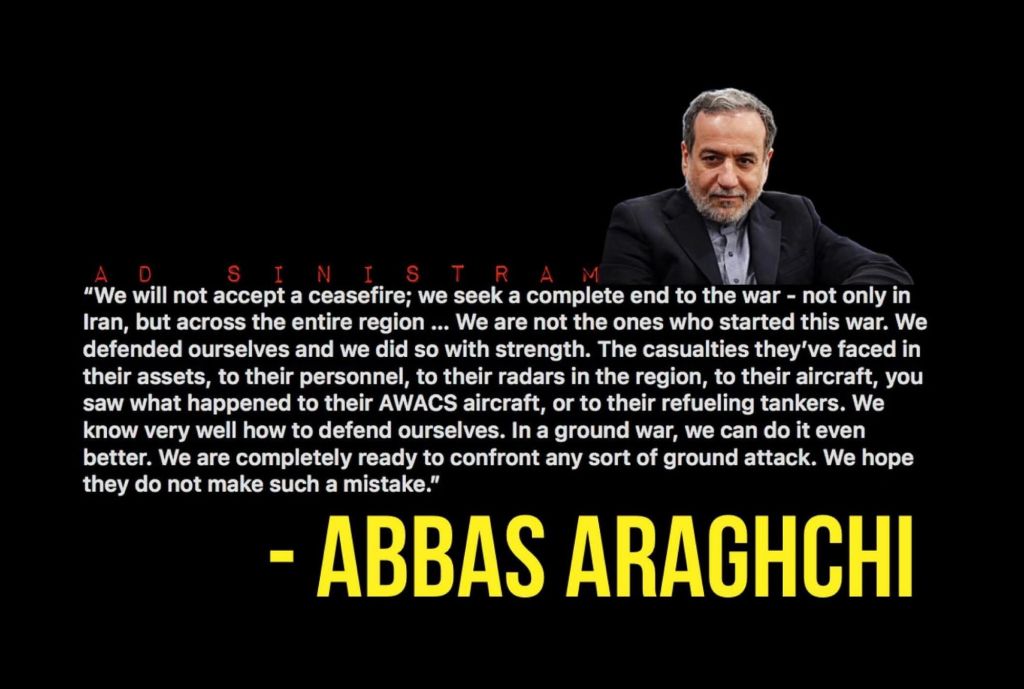
This is a textbook breakdown of credible commitment. In repeated games, cooperation depends on trust that agreements will be honored. When that trust is broken, defection becomes the dominant strategy. Iran’s refusal to negotiate is not ideological rigidity; it is rational adaptation. By removing the expectation of compromise, it prevents its adversaries from using negotiation as a pause to recover. Thomas Schelling’s theory of commitment is relevant here: by limiting its own options, Iran strengthens its strategic position.
Alongside these material and diplomatic dimensions, a less conventional but increasingly decisive domain has emerged: information warfare rooted not in fabrication, but in narrative coherence and perceived legitimacy. Iran’s approach differs sharply from traditional state propaganda. Rather than relying solely on centralised messaging, it operates through what can be described as a decentralised informational ecosystem. Independent creators, media fragments, and cultural outputs translate complex military and political developments into accessible narratives.
This is where the contrast becomes stark. Iranian messaging often frames the conflict as defensive, anti-imperial, and morally grounded, aligning with widely professed global values such as sovereignty and resistance to domination. This creates a form of rhetorical inversion: the stated values of its adversaries, democracy, human rights, rule of law, are used as a standard against which their actions are judged. When actions diverge from those values, the narrative gap becomes a strategic liability.
The effectiveness of Iran’s approach lies not merely in creativity, but in alignment with observable reality. Tangible outcomes, successful strikes, controlled waterways, sustained resistance, can be communicated and amplified, while ambiguous or contradictory outcomes force defensive and less credible messaging. The asymmetry in information warfare arises not from volume, but from coherence and consistency.
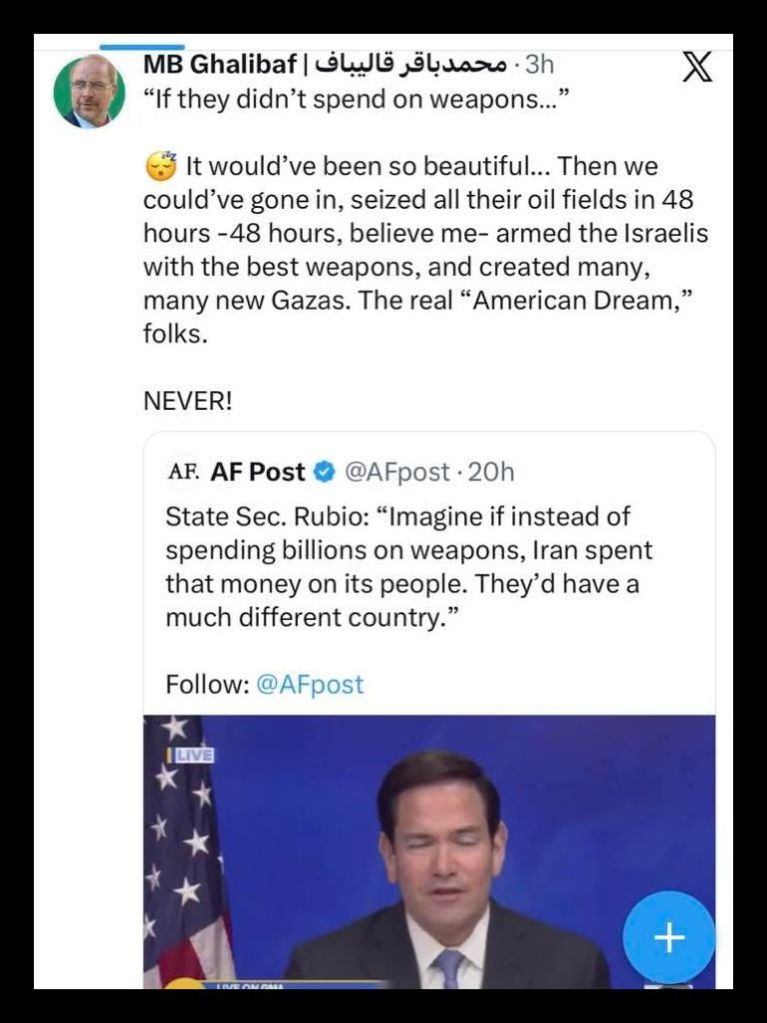
A central lesson emerges from the conduct of information operations grounded in alignment between stated positions and observable behaviour. Iranian communication has consistently framed actions within a defined legal and strategic framework, including the management of the Strait of Hormuz as a controlled but open waterway and the distinction between communication and negotiation articulated by Abbas Araghchi. This framing presents Iran’s conduct in the language of sovereignty, proportionality, and wartime norms while highlighting contradictions in the value systems claimed by its adversaries. Information operations have relied on the repetition of verifiable positions rather than amplification or volume.
The approach is reinforced by disciplined public messaging and the deployment of officials capable of maintaining technical and legal clarity under scrutiny. By contrast, fragmented and contradictory statements from opposing leadership have undermined narrative cohesion, allowing Iran to measure its actions against the principles its adversaries profess. In this context, information warfare functions as a force multiplier, shaping international perception, influencing neutral actors, and reinforcing the broader strategic framework in which economic and military measures are applied.
Philosophically, this reflects a shift toward what might be described through postmodern power theory: control over meaning becomes as important as control over material force. Yet unlike purely constructed narratives, Iran’s messaging draws strength from the congruence between claim and action. In classical rhetoric, persuasion depends on ethos (credibility), logos (logic), and pathos (emotion). Iran’s information strategy increasingly integrates all three, while its adversaries often appear fragmented across them.
The cumulative effect of these dynamics is visible at the systemic level. Regional actors are adjusting behavior not based on formal alliances, but on practical necessity. States dependent on energy flows engage directly with Iran regardless of political alignment. Security guarantees are reassessed in light of demonstrated vulnerability. Economic interdependence, once assumed to produce stability, has instead become a channel for coercion.
A redefinition of strategic success emerges from the conflict. Iran does not secure advantage through territorial conquest or decisive battle, but through shaping the conditions under which the war continues. Control of a critical economic artery is maintained without full closure, allowing pressure without self-disruption. Continuous military costs are imposed on adversaries while avoiding exposure to decisive retaliation. Communication channels remain active without entering formal negotiation. A consistent narrative is sustained beyond its borders while contradictions in adversaries’ positions are actively exploited.
The deeper lesson is that power has shifted from accumulation to configuration. It is no longer enough to possess superior force. What matters is how that force interacts with economic systems, information flows, and time. The actor that can design a system where every interaction increases the opponent’s cost while preserving its own stability gains the advantage.
Iran’s strategy, taken as a whole, reflects that understanding. It studied its adversaries, built capabilities tailored to their weaknesses, embedded those capabilities within economic and geographic leverage, and reinforced them through disciplined diplomacy and adaptive information warfare. The result is not a dramatic victory, but something more consequential: a structure in which the opposing side struggles to find a path that does not lead to further disadvantage.
Iran’s position rests on that shift. It does not require battlefield dominance. It requires the continuation of a system that the opposing side cannot afford to maintain indefinitely. That is why, in strategic terms, Iran is ahead. Not because the war is over, but because the system that will determine the outcome is on its terms and already operating in its favor.
Authored By: Global GeoPolitics
Thank you for visiting. This is a reader-supported publication. If you believe journalism should serve the public, not the powerful, and you’re in a position to help, becoming a PAID SUBSCRIBER truly makes a difference. Alternatively you can support by way of a cup of coffee:
https://buymeacoffee.com/ggtv |
https://ko-fi.com/globalgeopolitics |
Bitcoin: 3NiK8BoRZnkwJSHZSekuXKFizGPopkE7ns


Leave a comment