

How Starlink’s Integration into Ukrainian Drone Operations Exposes the Legal Void and Accountability Gap at the Heart of Twenty-First Century War
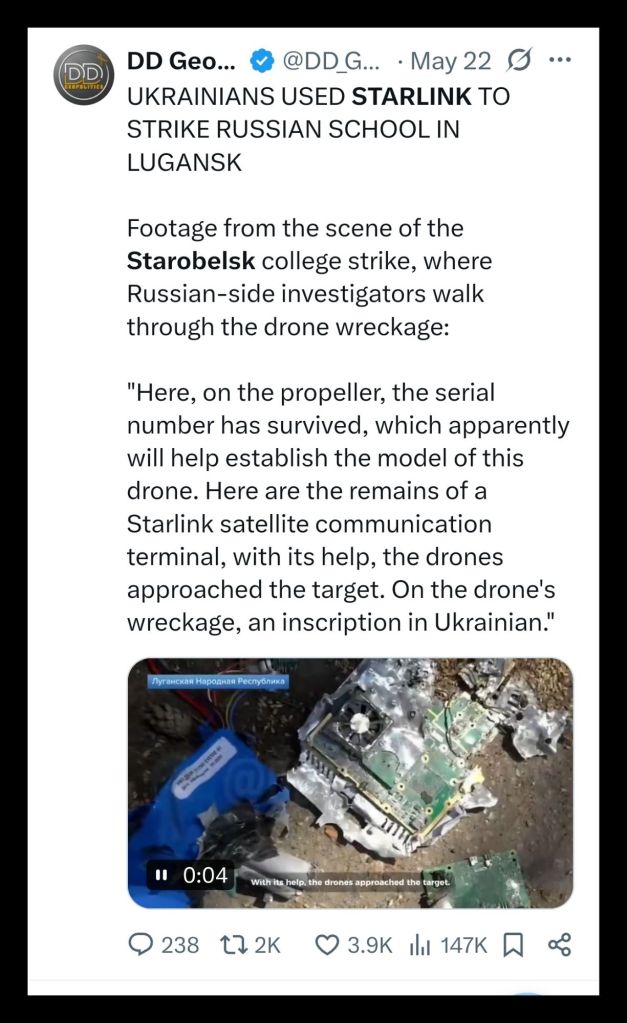
On the night of 21–22 May 2026, Ukrainian forces launched sixteen Fire Point FP-1 and FP-2 one-way attack drones against Starobelsk in the Luhansk People’s Republic, striking the dormitory and academic buildings of the Starobilsk Professional College of Luhansk State Pedagogical University in three consecutive waves. By the time rescue operations concluded, twenty-one people had been killed, almost all of them teenage girls between fourteen and eighteen years old, with eighty-six students confirmed inside the buildings at the time of the attack and dozens more wounded. Russian investigators reported that the remains of a Starlink Mini satellite terminal were recovered from the wreckage. The Ukrainian General Staff maintained that the strike had targeted a headquarters of the “Rubikon” Centre for Advanced Unmanned Technologies, denying it had hit civilian infrastructure. That claimed military headquarters occupied, by its own account, the same complex where eighty-six enrolled students were sleeping.
That factual tension alone, irrespective of how one distributes sympathy across the parties to this conflict, demands serious legal and strategic analysis rather than the conventional practice of absorbing such incidents into the ambient noise of wartime information management. The Starobelsk strike raises three distinct but interlocking questions of international consequence: whether the targeting of the college, assessed against the available evidence on dual-use classification, met the threshold requirements of the principle of distinction under international humanitarian law; whether the integration of SpaceX Starlink satellite communications into Ukrainian long-range drone operations generates cognisable legal exposure for corporate officers and their government contractual sponsors under existing and developing international criminal frameworks; and whether the geopolitical architecture sustaining this war, the financial, intelligence, and technological infrastructure supplied by NATO states and American defence contractors, constitutes a form of belligerent participation that carries its own accountability obligations whenever that infrastructure enables strikes causing the deaths of civilians. None of these questions resolves cleanly. That difficulty is precisely the point.
I. The Principle of Distinction and the Dual-Use Problem
International humanitarian law rests upon a foundational structural rule. Article 48 of Additional Protocol I to the Geneva Conventions, adopted in 1977, requires parties to a conflict to distinguish at all times between the civilian population and combatants, and between civilian objects and military objectives. Article 51(2) prohibits attacks directed against the civilian population as such. Article 52(2) defines a military objective as an object which by its nature, location, purpose, or use makes an effective contribution to military action and whose total or partial destruction offers a definite military advantage. The interpretive difficulty in Starobelsk lies precisely in the word “use.”
The Ukrainian military’s position rests on the claim that the Rubikon unmanned technology unit maintained a headquarters presence within the Starobelsk College complex. If that claim is factually accurate, the building or a portion of it could in principle satisfy the Article 52(2) test on the basis of current use contributing to military action. However, the legal question does not end there. The presence of military personnel or equipment within a civilian structure does not automatically convert the entire structure, or every person within it, into a lawful military objective. The principle of proportionality under Article 51(5)(b) of Additional Protocol I prohibits attacks expected to cause incidental civilian casualties excessive in relation to the concrete and direct military advantage anticipated. Eighty-six students sleeping in a dormitory constituted, at a minimum, a factual predicate demanding extraordinarily precise targeting and comprehensive precautionary assessment before any strike authorisation could have been lawfully issued.
The ICRC’s 2009 Interpretive Guidance on the Notion of Direct Participation in Hostilities, the product of six years of expert consultation, makes clear that “a precise definition of the term direct participation in hostilities does not exist” in either state practice or international jurisprudence, but the guidance is unequivocal that enrolled students conducting their studies in a dormitory at night fall entirely outside any reasonable construction of that concept. They were neither combatants nor unlawful participants. They were entitled to protection against direct attack under the rules of customary international humanitarian law as codified in Henckaerts and Doswald-Beck, Customary International Humanitarian Law, Volume I (Cambridge University Press, 2005), Rule 6. If Ukrainian targeting intelligence failed to adequately assess their presence and weight it against any anticipated military advantage, that failure implicates the precautionary obligations under Article 57 of Additional Protocol I, which requires those planning or deciding upon attacks to do everything feasible to verify that objectives are military objectives and to cancel or suspend an attack if it becomes apparent that incidental civilian casualties would be excessive.
Russia’s Foreign Ministry stated at the UN Security Council that there were no military facilities in the immediate vicinity of the dormitory. That assertion, made by a party with obvious interest in the narrative outcome, cannot be accepted uncritically. Equally, Ukraine’s counter-assertion that it targeted only the Rubikon headquarters cannot be accepted without independent verification. What can be stated is that the observable material outcome, twenty-one dead adolescents and a collapsed dormitory, constitutes prima facie evidence requiring serious investigation under Article 8(2)(b)(i) of the Rome Statute, which defines as a war crime the act of intentionally directing attacks against civilian populations or individual civilians not taking direct part in hostilities. Russian Permanent Representative to the UN Vasily Nebenzya argued before the Security Council that the strike could not have been accidental and that the deliberate sequential nature of the three attack waves was evidence of intent to maximise casualties. Ukraine has not produced evidence refuting the basic geometry of that claim.
II. The Starlink Terminal and the Question of Corporate Complicity
The recovery of a Starlink Mini terminal from the wreckage introduced a dimension that moves this incident beyond the immediate question of Ukrainian targeting decisions and into a wider framework of corporate and state accountability that international law has not yet resolved with adequate clarity.
SpaceX began providing Starlink terminals to Ukraine from February 2022, within days of Russia’s full-scale invasion. Initial supplies came through a combination of private funding, USAID procurement, and contributions from the governments of France and Poland. That arrangement changed fundamentally in June 2023, when the Pentagon signed a contract with SpaceX to provide Starlink services for Ukraine under official Department of Defence authority, a development confirmed publicly by the Pentagon on 1 June 2023. In August 2024, a follow-up agreement expanded Ukraine’s access to Starshield, a militarised and encrypted version of Starlink. The Starshield contract was separately awarded on 1 September 2023, providing classified signal capabilities with anti-jam specifications suited to mobile military systems.
SpaceX’s own President, Gwynne Shotwell, acknowledged publicly at a Federal Aviation Administration conference in Washington in February 2023 that the service had been “weaponised” by Ukrainian forces, noting specifically that Ukrainian soldiers had described using Starlink to connect drones and identify and destroy enemy targets. Shotwell stated that SpaceX had taken steps to prevent such use but declined to specify what those steps entailed in operational terms. Ukraine’s Digital Minister Mykhailo Fedorov acknowledged that “Starlink is indeed the blood of our entire communication infrastructure now,” a characterisation that admits no ambiguity regarding operational dependency and functional integration.
The significance of that body of fact lies in what it concedes: SpaceX was aware that its satellite infrastructure was being functionally integrated into lethal drone operations. The company had not merely provided a neutral communications service consumed incidentally by a party at war; it had provided real-time connectivity to drone systems specifically configured for offensive strike operations, of which fact the company’s own senior leadership was expressly on notice. The legal question this generates is whether such knowingly provided operational infrastructure, embedded within a targeting and strike chain that resulted in civilian deaths, can attract liability under international criminal law or state responsibility frameworks.
The Rome Statute confers personal jurisdiction only over natural persons. Corporate officers are already subject to investigation and prosecution by the ICC, and as the Harvard International Law Journal confirmed in its 2016 analysis of corporate liability under the Rome Statute, investigation and prosecution of corporations themselves as juridical persons would require complex amendments to the Statute. That structural limitation matters, but it does not eliminate accountability; it relocates it toward the officers who made decisions with foreseeable lethal consequences. The variety of modes of participation in international crimes under both the Rome Statute and domestic law places certain individuals within organisational structures at particular risk of criminal involvement, this is particularly true for the leadership of large corporations, including ICT companies, as Chatham House’s January 2026 analysis of cyber-enabled international crimes established in detail.
Elon Musk himself provided the sharpest available evidence of his own awareness of the legal and ethical dimensions of this question. In September 2023, responding publicly to a published excerpt of Walter Isaacson’s biography, Musk acknowledged that he had declined a Ukrainian request to activate Starlink coverage near Sevastopol for a drone submarine attack against the Russian fleet, stating directly: “If I had agreed to their request, then SpaceX would be explicitly complicit in a major act of war and conflict escalation.” That formulation is remarkable not as a display of restraint, but as an admission: the CEO of SpaceX publicly conceptualised the provision of active Starlink coverage to drone strike operations as constituting complicity in warfare. He applied that framework to Sevastopol. The logical structure of that reasoning applies equally to any other strike in which Starlink terminals were functionally integrated into the targeting and navigation chain, including Starobelsk. The only variable is whether he chose to exercise restraint in a given case, a discretionary choice exercised by a private individual over operational capabilities that by June 2023 were formally contracted to the Pentagon and that carried, by SpaceX’s own construction, complicity implications when deployed against targets.
This point draws its historical resonance from the post-war industrialist trials at Nuremberg. The Subsequent Nuremberg Tribunals prosecuted executives of Krupp AG and IG Farben for their material contributions to the conduct of aggressive war. The tribunal in United States v. Alfried Krupp et al. stated plainly: “The defendants cannot as a legal proposition successfully contend that, since the acts of spoliation of which they are charged were authorised and actively supported by certain German governmental and military agencies or persons, they escape liability for such acts. It is a general principle of criminal law that encouragement and support received from other wrong-doers is not excusable.” That principle, that governmental authorisation and contractual legitimacy do not dissolve individual corporate criminal liability for foreseeable harm, remains a foundation of international criminal doctrine, notwithstanding the acknowledged incompleteness of Nuremberg’s corporate accountability framework. As the Leuven Transitional Justice Blog’s 2021 analysis of the industrialist trials concluded, the Nuremberg economic proceedings highlighted the role of businesses in conflict and paved the way for connecting corporate actors to international crimes, even if the full implications of that connection were never prosecuted to completion.
The Tallinn Manual 2.0 on the International Law Applicable to Cyber Operations, published in 2017 under the auspices of the NATO Cooperative Cyber Defence Centre of Excellence and directed by Professor Michael Schmitt, directly addresses the dual-use character of commercial satellite infrastructure. Rule 95 of the Manual addresses dual-use objects, and its commentary makes clear that where a commercial satellite system makes an effective contribution to military action, as Starlink demonstrably does in the Ukrainian context, it may qualify as a military objective subject to targeting analysis by the adversary. The Lieber Institute at West Point, examining this question specifically in the context of the Ukraine conflict, concluded that SpaceX had “interjected itself into an international armed conflict in a manner that has raised the interest of both belligerents” and that the United States government would “do well to clarify its position” regarding State responsibility under Article VI of the Outer Space Treaty for the activities of its nationally licensed space operators. That clarification has not come.
III. The Geopolitical Architecture and Its Accountability Gap
Western governments supporting Ukraine consistently frame their involvement under Article 51 of the United Nations Charter, which preserves the inherent right of individual or collective self-defence when an armed attack occurs against a UN member state. That framing has legal substance: Russia’s February 2022 invasion constituted an armed attack under any conventional reading of international law, and the Charter’s collective self-defence provision permits third-party states to assist the attacked party with military and material support. Two structural problems afflict the Article 51 framework as applied to this conflict, however.
The first concerns stated strategic objectives. In April 2022, then-United States Defence Secretary Lloyd Austin told journalists in Kyiv that Washington sought to see Russia “weakened to the degree that it can’t do the kinds of things that it has done in invading Ukraine.” That formulation exceeds the defensive parameters of Article 51, which authorises force to repel an armed attack and restore the status quo, not to structurally degrade the military capacity of an adversary as a strategic end in itself. Austin’s statement articulated a war aim extending beyond Ukrainian territorial recovery into Russian state diminishment, an objective that transforms the legal character of the enterprise from collective self-defence into something considerably closer to what the International Court of Justice identified, in Military and Paramilitary Activities in and Against Nicaragua (Nicaragua v. United States, 1986), as impermissible intervention. The Nicaragua judgment also established the effective control test for state responsibility: a state can only be deemed responsible for the acts of proxy forces that it directs or commands, and where a state does not exercise such a high degree of operational control, even the preponderant provision of financial and material support is insufficient for full attribution. However, the court also held that the provision of weapons and logistical support to forces committing violations of IHL made the supporting state responsible for those violations when it had knowledge of the likely conduct.
The second structural problem is the depth of targeting and intelligence integration. Supplying artillery shells or anti-tank missiles to a belligerent involves one degree of operational distance. Supplying real-time satellite communications that provide navigational control over autonomous strike drones involves a qualitatively different degree of functional integration into the targeting chain. The drone that strikes a target does not navigate itself. Its guidance depends upon the communications infrastructure feeding it positional and operational data. When that infrastructure is provided by a Pentagon-contracted American corporation through a classified Starshield agreement, the question of where Ukrainian command authority ends and American operational enablement begins loses its apparent simplicity.
Palantir Technologies provides a further dimension. Palantir’s CEO Alex Karp visited Kyiv in May 2026, shortly before the Starobelsk attack, to promote Ukraine’s AI-driven targeting capabilities. Palantir’s systems, described by Karp himself as constituting a “digital kill chain,” aggregate drone imagery, satellite data, signals intelligence, and historical targeting records into real-time operational packages used by Ukrainian forces. The Business and Human Rights Resource Centre has noted that the statutes of the ICC, the ICTY, and the ICTR explicitly recognise various forms of complicity, and that the deep involvement of technology companies in military targeting infrastructure raises cognisable questions of accountability under each framework. If the Starobelsk targeting involved the application of an AI-assisted targeting package that incorrectly or inadequately assessed the civilian character of the dormitory, a possibility raised by the observable fact that a pedagogical college occupied the designated strike coordinates, then Palantir’s role in constructing and operating that kill chain sits inside the accountability question with the same structural force as SpaceX’s satellite communications.
These are not rhetorical associations. They are functional descriptions of how modern networked warfare operates. A private U.S. company made operational decisions with immediate battlefield consequences in an active armed conflict, the Military.com analysis from February 2026 reached precisely that conclusion in examining the broader pattern of Starlink’s operational role in the conflict. The question posed to international law is whether existing frameworks can accommodate accountability for actors whose operational contributions are indispensable to a strike but whose corporate registrations and contractual structures place them outside the conventional categories of combatant or military commander.
IV. The Failure of the Existing Framework and What Follows
International humanitarian law developed through the Hague Conventions of 1899 and 1907, the Geneva Conventions of 1949, and their Additional Protocols of 1977 — frameworks designed for conflicts between identifiable state parties operating through conventional military command structures. The notion of a private American corporation holding, in practical terms, the operational key to a belligerent’s entire long-range strike capability, while under a classified contract with the Pentagon and publicly aware that its infrastructure was being used to direct lethal autonomous systems, was not contemplated by those frameworks because it was not then materially possible.
The gap this creates is neither accidental nor neutral. It systematically advantages states and corporations that can project military capability through privatised technological infrastructure while maintaining formal legal separation between the funding state and the operational actor. The Ukraine conflict represents the most advanced and visible application of that architecture to date. Senator Elizabeth Warren’s May 2024 letter to the Department of Defence, calling on the Pentagon to hold SpaceX accountable for the use of Starlink by adversaries who circumvented US sanctions to acquire terminals, acknowledged explicitly that “SpaceX must make every attempt to ensure its Starlink devices and service are obtained and operated in full compliance with US law.” That framing, however, addressed only the sanctions and export control dimension. It did not engage the deeper question of whether SpaceX’s knowing provision of satellite connectivity to drone strike operations targeting civilian-populated areas generated independent accountability obligations under international humanitarian law.
Filling this gap requires either a substantial expansion of the Rome Statute’s jurisdiction to cover corporate entities directly, or the aggressive application of existing command responsibility and aiding and abetting doctrines to corporate officers who knowingly provide indispensable operational infrastructure to belligerents conducting civilian strikes. The jurisprudence of the International Criminal Tribunal for the former Yugoslavia provides some foundation for the latter approach. The ICTY’s judgment in Prosecutor v. Tadić established that aiding and abetting under customary international law requires knowing assistance that has a substantial effect on the commission of the crime, without requiring that the aider share the specific criminal intent of the principal perpetrator. SpaceX’s documented awareness that its infrastructure was being used to guide drone strikes, combined with its contractual relationship formalised under Pentagon authority and its retention of unilateral technical control over service activation, as demonstrated by Musk’s own account of the Sevastopol decision, satisfies the factual predicate for that analysis in ways that demand serious legal engagement rather than dismissal.
The Starobelsk strike will not be the last incident of this kind. The trajectory of military technology runs unambiguously toward greater automation, greater dependence on commercial satellite infrastructure, and greater algorithmic mediation of targeting decisions. Each increment of that trajectory deepens the functional integration of private corporations into lethal military operations while the legal frameworks governing accountability remain anchored to twentieth-century assumptions about where state authority ends and commercial activity begins. Twenty-one dead students in a Luhansk dormitory represent, among other things, the human cost of that accumulating gap between technological capability and legal accountability, a gap that no government currently positioned to close it has any obvious incentive to close.
Authored By: Global GeoPolitics
If you prefer to make a one time donation in support of my work, you can do so by clicking any link below:
https://buymeacoffee.com/ggtv |
https://ko-fi.com/globalgeopolitics |
Bitcoin: 3NiK8BoRZnkwJSHZSekuXKFizGPopkE7ns
References
·Additional Protocol I to the Geneva Conventions (1977), Articles 48, 51, 52, 57
· Rome Statute of the International Criminal Court (1998), Article 8(2)(b)(i)
· ICRC, Interpretive Guidance on the Notion of Direct Participation in Hostilities under IHL (2009)
· Henckaerts and Doswald-Beck, Customary International Humanitarian Law, Vol. I (Cambridge University Press, 2005), Rule 6
· Schmitt (ed.), Tallinn Manual 2.0 on the International Law Applicable to Cyber Operations (Cambridge University Press, 2017), Rules 95, 100
· ICJ, Military and Paramilitary Activities in and Against Nicaragua (Nicaragua v. United States) (1986)
· ICTY, Prosecutor v. Tadić, Appeals Chamber Judgment (1999)
· United States Military Tribunal at Nuremberg, United States v. Alfried Krupp et al. (1948)
· Harvard International Law Journal, Corporate Liability under the Rome Statute (2016)
· Pentagon Statement on SpaceX Starlink Contract for Ukraine, 1 June 2023
· SpaceX Starshield Contract, Space Systems Command, 1 September 2023 · Musk, public statement on Sevastopol activation, X (formerly Twitter), 7 September 2023
· Shotwell, FAA Commercial Space Transportation Conference, Washington DC, 8 February 2023
· Fedorov, quoted in New York Times, September 2023
· Austin, press conference, Kyiv, 25 April 2022
· Nebenzya, UN Security Council statement on Starobelsk, 22 May 2026
· Ukrainian General Staff statement on Rubikon headquarters, 22 May 2026
· Chatham House, Securing Justice for Cyber-Enabled International Crimes (January 2026)
· Lieber Institute at West Point, The Russia-Ukraine War and the Space Domain (September 2024)
· Senator Warren, letter to Department of Defence re SpaceX/Starlink (May 2024)
· Leuven Transitional Justice Blog, Trials of Economic Actors at Nuremberg (October 2021


Leave a Reply