
A controlled crisis in Hormuz could deepen East Asia’s dependence on U.S.-aligned energy flows much as Europe was severed from cheap Russian supply
On 28 February 2026, United States and Israeli forces launched nearly nine hundred airstrikes against Iran within twelve hours, killing Supreme Leader Ali Khamenei, destroying nuclear facilities and missile infrastructure, and triggering the largest maritime supply disruption in the recorded history of the global oil market. Before the day was over, Iran had declared the Strait of Hormuz closed. Before the month was over, Iranian missiles had struck Qatar’s Ras Laffan LNG complex, the largest natural gas processing facility on earth, halting Qatari LNG contracts and sending Asian spot prices to $25.40 per MMBtu, their highest point in three years. Within six weeks, the United States Navy had imposed its own naval blockade beginning 13 April 2026, deploying the 31st Marine Expeditionary Unit aboard the USS Tripoli to conduct Visit, Board, Search and Seizure operations across the Gulf of Oman and Arabian Sea, redirecting ninety-one commercial vessels by 22 May and disabling four ships that refused to comply. The Strait of Hormuz, through which twenty-five percent of the world’s seaborne oil trade and twenty percent of its liquefied natural gas transited as recently as 2025, had become simultaneously an Iranian-controlled toll road and an American interdiction corridor, a dual blockade with no precedent in modern maritime law and consequences whose full economic weight has not yet reached the populations most exposed to them.
The received interpretation of these events, to the extent that Western media has settled on one, treats the conflict as a volatile crisis spawned by the Trump administration’s regional aggression and Israeli strategic pressure, a situation Washington would prefer to contain or exit. That framing collapses under scrutiny. The RAND Corporation’s 2019 research report, Extending Russia: Competing from Advantageous Ground, prepared for the United States Army and published by RAND’s Arroyo Center, devoted substantial analysis to the proposition that expanding American energy production to displace Russian gas exports to Europe would, in the report’s own language, “maximize pressure on Russia’s export receipts and thus on its national and defense budgets.” The report assessed reducing European peacetime consumption of Russian gas as having “a medium to low likelihood of success.” The inference is mechanical. If peacetime conditions constrain the likelihood of success, wartime conditions improve it. The 2022 full-scale invasion of Ukraine duly provided those wartime conditions, and European LNG diversification away from Russian gas subsequently proceeded with a speed that no commercially rational argument could have achieved in the absence of sanctions and political emergency. The Europe-Russia energy decoupling was not an unforeseen consequence of a conflict that Washington stumbled into; it was among the documented strategic outcomes that American policy planners had identified years in advance as desirable and had assessed the most effective instruments to achieve.
The same analytical structure applies to the Middle East. Before 28 February 2026, Asia received approximately eighty percent of the oil transiting the Strait of Hormuz and depended on Qatar and the UAE for nearly one-fifth of global LNG trade, figures confirmed by the International Energy Agency’s April 2026 quarterly gas market report. American LNG export infrastructure, expanded over the preceding decade at enormous capital cost, made limited commercial sense against a backdrop of cheap, abundant Middle Eastern and Russian energy flowing reliably to Asian buyers. The IEA estimated in April 2026 that damage to Qatar’s Ras Laffan facilities had delayed the anticipated global LNG supply wave by at least two years and would produce a cumulative loss of approximately one hundred and twenty billion cubic metres of LNG supply between 2026 and 2030. That shortfall requires filling. American LNG exporters operating out of Gulf Coast terminals, who had spent years building capacity into a market that did not yet need them at full scale, are now among the principal commercial beneficiaries of a disruption that no American official has publicly explained in terms of industrial policy, but that several years of documented strategic planning suggested was comprehensively anticipated.
The argument that Washington was pressured into the Iran war by Israel, or that the Trump administration miscalculated the scale and duration of Iranian retaliation, reflects a persistent analytical error in how American foreign policy is publicly assessed. The United States Marine Corps underwent its most radical structural transformation in modern history beginning in 2020, when then-Commandant General David Berger announced Force Design 2030. The restructuring eliminated all Marine tank battalions and substantially reduced cannon artillery, infantry battalions, and helicopter squadrons, replacing them with long-range precision anti-ship missile systems, the Navy Marine Expeditionary Ship Interdiction System mounted on remotely operated ground vehicles, and Marine Littoral Regiments designed for island-hopping and maritime interdiction operations. The Corps divested every major land warfare capability it possessed and rebuilt itself from the ground up as a naval anti-shipping force. That transformation was publicly documented, testified to before the Senate Armed Services Committee, and reported in detail by the Congressional Research Service. An institution that dismantles its tank battalions and builds ground-launched anti-ship missile regiments over five years is not an institution preparing for accidental maritime confrontation. The 31st MEU’s operations aboard the USS Tripoli in the Gulf of Oman represent Force Design 2030’s first large-scale operational deployment, performing precisely the interdiction mission the Corps was restructured to perform.
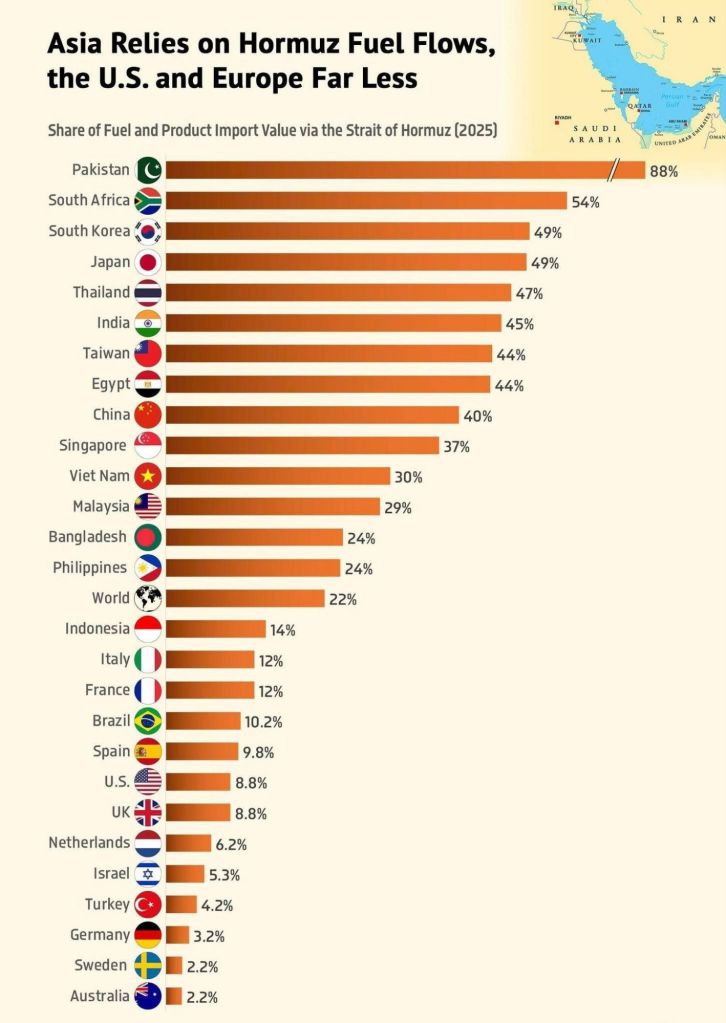
The objection that these preparations targeted China rather than Iran carries limited analytical weight when examined against the actual sequence of events. RAND’s 2019 report identified Iran as part of the geopolitical architecture the United States sought to weaken in order to isolate and contain Russia and ultimately China. A blockade on Iranian energy exports is functionally a blockade on the Chinese economy, since China absorbs approximately twenty-four percent of Qatari LNG exports and depends on Persian Gulf oil for the majority of its import requirements. The Congressional Research Service’s March 2026 analysis of the Strait of Hormuz crisis noted that most Qatari LNG exports are destined for Asian markets. Disrupting Asian energy supply chains, forcing China into greater dependence on more expensive and logistically complicated alternatives, and simultaneously demonstrating American naval dominance over the single most critical maritime chokepoint in the global energy system accomplishes multiple strategic objectives simultaneously: it degrades Iran’s government and economy, it pushes Asian energy buyers toward American LNG exports, and it demonstrates to Beijing that Washington possesses both the capability and the will to strangle Chinese energy supply at a point where Beijing has no credible military response.
Senator Tim Kaine’s February 2026 visit to Australia provides a complementary illustration of how this strategic architecture operates at the political level. Kaine spent a week in Adelaide, Perth, and Darwin promoting the AUKUS agreement, during which South Australian Premier Peter Malinauskas announced an AU$30 billion investment in the Osborne shipyard and a dedicated job training programme for the submarine workforce. Kaine’s own Senate press release described the visit as focused on AUKUS implementation and the sale of Virginia-class submarines. At a CSIS event in Washington recorded shortly before or after that trip, Kaine described how the entire Australian political class, majority and opposition, had committed to AUKUS while presenting it to the Australian public primarily as a jobs programme rather than explicitly as a military posture against China, on the grounds that Australian politicians preferred not to alarm voters about Chinese aggression or make statements that Beijing might perceive as unnecessarily provocative. The senator described this as making sense given Australia’s geographic proximity to China and the depth of Sino-Australian economic interdependence. What Kaine was describing, without using the precise formulation, was a strategy of constructing offensive military infrastructure against China while deliberately obscuring that purpose from the domestic population that would bear the economic and strategic consequences of the confrontation it was funding.
The parallel with Ukraine is structural, not coincidental. Ukraine’s economy before 2014 was deeply integrated with Russia through energy, industrial supply chains, and agricultural markets. The political transformation of 2014 severed those integrations without providing any commercially viable alternative to the Ukrainian economy, a fact acknowledged even by American observers who supported the Maidan movement. The United States did not offer Ukraine alternative economic arrangements to replace the Russian market; it offered military financing, weapons, political recognition, and eventually satellite and intelligence infrastructure in support of a conflict whose economic consequences for ordinary Ukrainians were evident from the beginning and whose strategic purpose, as Defence Secretary Austin stated in April 2022, included weakening Russia as a geopolitical actor. Australia’s economy is, as Kaine himself acknowledged before CSIS, “deeply, deeply interlinked” with China. AUKUS constructs offensive submarine infrastructure aimed at Chinese naval dominance while Australian politicians reassure voters that the programme is primarily a jobs initiative. The citizens of a country whose economy depends on Chinese trade are being prepared, without their full understanding, for a confrontation with their largest trading partner, a process that follows a template already applied to Ukraine and, with the energy infrastructure blockade as its mechanism, to the Middle Eastern states whose oil and gas revenues sustain some of the most economically significant populations on earth.
The domestic political architecture that sustains this continuity of agenda operates, in the American case, largely independently of which party controls the White House or Congress. The RAND Corporation report was commissioned and published during the Trump administration’s first term. Force Design 2030 was initiated under the same administration. The Pentagon’s LNG export expansion strategy predates both Trump terms. The Biden administration deepened the Ukraine proxy war and expanded the Starshield contract with SpaceX. The Trump administration returned to office in January 2025 and, within thirteen months, had launched the most significant direct military confrontation with an adversary state since the 2003 invasion of Iraq. Senator Kaine, a Virginia Democrat whose state hosts Newport News Shipbuilding and whose Senate career has centred substantially on advocating for submarine industrial contracts, represents a constituency with a direct financial interest in AUKUS implementation regardless of the geopolitical consequences for Australia or the Indo-Pacific. The interests funding and directing the think tanks that shape American strategic doctrine, the defence industrial base, the energy sector, the financial institutions holding contracts tied to military procurement, maintain their positions across electoral cycles precisely because their leverage over policy does not depend on which candidates voters select every four years.
The IEA confirmed in April 2026 that the conflict had generated the largest oil supply disruption in the history of the global energy market and that LNG supply losses would persist through at least 2027. J.P. Morgan projected a 0.6 percentage point reduction in global GDP growth for the first half of 2026 on an annualised basis if oil prices remained elevated. The Trends Research and Advisory analysis published in April 2026 documented that Southeast Asian countries including the Philippines, Thailand, Malaysia, and Brunei, none of which have any military involvement in the conflict and several of which Washington simultaneously courts as Indo-Pacific partners against China, depend on Middle Eastern imports for sixty to ninety-five percent of their oil needs. The populations being most severely harmed by the disruption are those whose governments exercised the least influence over the decision to launch nine hundred airstrikes on 28 February 2026.
American officials have presented the Iran war publicly as an operation to reopen the Strait of Hormuz to free navigation. CENTCOM designated the naval interdiction operation “Project Freedom.” The framing deserves examination against the observable facts. The United States is operating its own blockade of Iranian ports simultaneously with protesting Iranian interference with maritime traffic. A state that genuinely seeks to restore free navigation in a contested waterway does not impose its own separate interdiction regime on the same waterway at the same time. A state that seeks to manage a controlled demolition of a rival’s energy export capacity while gradually transferring dependent Asian buyers toward its own LNG terminal network does exactly what CENTCOM is currently doing: enforcing selective passage, interdicting ships at its own discretion, disabling vessels that refuse to comply, and doing so at a pace, ninety-one redirected ships across six weeks, that preserves market function and prevents the kind of overnight collapse that would generate unmanageable political responses from allies and neutral states. The RAND report’s guidance on Russia specified that the decoupling of Europe from Russian energy would need to be managed gradually to remain politically sustainable. The same principle is evidently being applied in the Persian Gulf.
The analytical question worth posing is not whether the United States bumbled into a war with Iran that it now cannot control, but rather what evidence would be needed to distinguish between a deliberate long-term strategy and an improvised reactive policy that happened to produce outcomes matching documented strategic objectives. The evidence that exists favours the former interpretation: Force Design 2030 redesigned the Marine Corps for maritime interdiction years before the first airstrike; LNG export infrastructure was built at scale before Asian buyers had any need for it; the RAND Corporation identified European and Asian energy decoupling from Russia and Iran as priority objectives in 2019; and the political management of AUKUS in Australia specifically includes a strategy for obscuring the true nature of the confrontation being constructed from the population that will bear its costs. Governments that bumble into wars rarely pre-position the specific military capabilities, economic infrastructure, and allied political management tools that the current confrontation has drawn upon. That those tools were prepared, documented, and funded years in advance does not constitute proof of a single orchestrated conspiracy; it does constitute evidence of an institutional continuity of strategic purpose that persists regardless of which individuals hold elected office and that has produced, so far in 2026, the greatest disruption of global energy markets on record.
Authored By:
Authored By: Global GeoPolitics
If you prefer to make a one time donation in support of my work, you can do so by clicking any link below:
https://buymeacoffee.com/ggtv |
https://ko-fi.com/globalgeopolitics |
Bitcoin: 3NiK8BoRZnkwJSHZSekuXKFizGPopkE7ns
References
RAND Corporation, Extending Russia: Competing from Advantageous Ground (RAND Arroyo Center, 2019, RR3063)
RAND Corporation, Overextending and Unbalancing Russia: Assessing the Impact of Cost-Imposing Options (Research Brief RB10014, 2019)
International Energy Agency, The Middle East and Global Energy Markets: 2026 Energy Crisis Policy Response Tracker (April 2026)
IEA, Gas Market Report Q2 2026 (April 2026) – damage to Ras Laffan facilities; 120 bcm LNG supply loss projection 2026–2030
Brian Berletic, “US Blockade on Iran (& China) Continues: As Does March to War with China in the Asia-Pacific,” video commentary, YouTube, 22 May 2026, 22 May 2026,
https://www.youtube-nocookie.com/embed/yYmSopkgIwE?rel=0&autoplay=0&showinfo=0&enablejsapi=0
Columbia University Center on Global Energy Policy (CGEP), cited in Trends Research & Advisory, The Global Economic Shock Triggered by the US-Israel-Iran War (April 2026) – 110 bcm annual LNG halt figure
Congressional Research Service, Iran Conflict and the Strait of Hormuz: Impacts on Oil, Gas, and Other Commodities (R45281, March 2026)
US Central Command (CENTCOM), public statements on Project Freedom blockade operations – 91 ships redirected, 4 disabled, as of 22 May 2026
Military Times / Navy Times, US Marines Board and Redirect Iranian-Flagged Tanker Amid Ongoing Blockade (20 May 2026)
USNI News, Strait of Hormuz Traffic Down as US Blockade Appears to Deter Some Ships (14 April 2026) – 10,000+ personnel figure; 31st MEU VBSS role confirmed
General David H. Berger, USMC Force Design 2030 (US Marine Corps, March 2020)
Congressional Research Service, New US Marine Corps Force Design Initiative: Force Design 2030 (IN11281, 2022)
Senate Armed Services Committee testimony on NMESIS ground-based anti-ship missile capability, cited in Overt Defense (2020)
Senator Tim Kaine, press release on AUKUS meetings in Australia (kaine.senate.gov, 23 February 2026)
Kaine and Ricketts, AUKUS Improvement Act, introduced June 2025; Senate press release
CSIS, Congressional Perspectives on Maritime Security – Senator Tim Kaine interview (October 2025)
J.P. Morgan projection on global GDP impact of elevated oil prices, cited in Trends Research & Advisory (April 2026)
Britannica, 2026 Iran War (updated May 2026) – 900 strikes on 28 February; Khamenei killed; girls school strike in Minab
Secretary Lloyd Austin, remarks to press, Kyiv, 25 April 2022 – “weakened to the degree that it can’t do the kinds of things that it has done”


Leave a comment