
The Eurasian Corridor, the EU’s Eastern Expansion, and the Strategic Cost of Small-State Realignment
Armenia occupies a peculiar and precarious position in the geography of great-power competition. A landlocked country of approximately three million people, bordered by Turkey to the west, Azerbaijan to the east, Iran to the south, and Georgia to the north, it has no coast, no hydrocarbons, and no military weight of its own. Its total gross domestic product amounts to roughly twenty-nine billion dollars, a figure smaller than many mid-sized European cities. Yet the parliamentary elections held on the seventh of June 2026 have attracted the sustained attention of Moscow, Brussels, Tehran, and Ankara, not because Armenia itself commands strategic depth, but because its territory sits directly across several of the most contested logistical and political fault lines in Eurasian geopolitics. The question of whether Prime Minister Nikol Pashinyan’s westward orientation will produce the conditions for open conflict, or simply a slower economic strangulation, is one that neither Western capitals nor the Kremlin appear prepared to answer with candour.
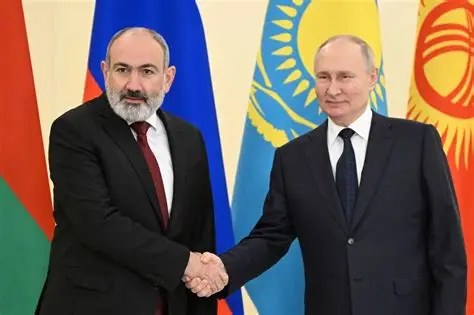
The comparison to Ukraine is not frivolous, though its limits require careful mapping. Vladimir Putin, speaking at the Eurasian Supreme Economic Council summit in Astana on the twenty-ninth of May 2026, made the parallel explicit himself, drawing a direct line between Ukraine’s association agreement with the European Union in 2013 and the subsequent disintegration of the political settlement that had governed the country’s orientation since independence. The sequence Putin described, association agreement, external pressure, internal polarisation, the collapse of an incumbent government, territorial rupture, represents a template that Russian strategic doctrine now treats as an established Western operating method. Whether the conditions that produced that sequence in Ukraine are genuinely replicated in Armenia is a serious analytical question rather than a rhetorical one, and the answer is not straightforwardly yes.
Armenia differs from Ukraine in several material respects. It has no large ethnic Russian population whose political loyalties could be instrumentalised through a separatist framework. Its territory does not border Russia directly, nor does it contain any portion of land whose strategic value to Moscow approaches that of Crimea or the Sea of Azov coastline. The Armenian Apostolic Church, despite Pashinyan’s attempts to reduce its political influence through accusations of coup-plotting against his government, remains an institution rooted in national rather than pan-Slavic Orthodox identity. Nevertheless, the parallels that do exist are structural rather than ethnic, and they concern the logic of great-power buffer zones rather than the particularities of demographic composition. Armenia sits on the north-south corridor linking Russia to Iran, and on the east-west corridor that would, if completed, allow Central Asian energy producers to move commodities through the South Caucasus to European markets without crossing Russian territory. Both of those functions carry strategic value that dwarfs anything that Armenia generates through its own domestic economy.
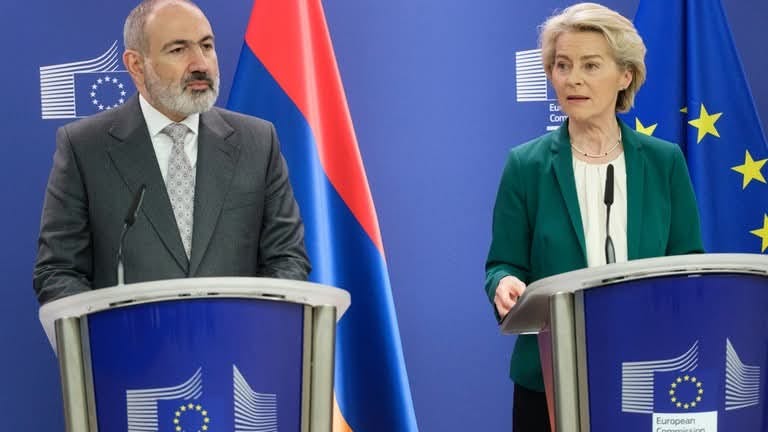
The Caspian corridor concept, discussed openly at the European Political Community meeting hosted by Pashinyan in Yerevan in May 2026, represents the crux of the matter. European Commission President Ursula von der Leyen, attending alongside Emmanuel Macron and numerous other EU leaders, framed Armenia’s prospective connectivity with Europe in terms of infrastructure, transit routes, and investment. Behind that framing lies a specific geopolitical objective, which is to construct a trade and energy pathway from Kazakhstan and Turkmenistan through the Caspian Sea, across Azerbaijan, through Armenia, and onward through Turkey into European markets. The phrase “bypassing Russia” was not incidental to those discussions, it was their central organising logic. Russia understands this plainly, and the escalating pressure applied to Armenian exports since late May 2026, including the suspension of 64.5 million bottles of Jermuk mineral water, restrictions on tomatoes, cucumbers, peppers, strawberries, cut flowers, wine, brandy, and warnings about natural gas pricing, reflects Moscow’s assessment that economic instruments remain available before military ones become necessary.
The economic leverage Russia holds over Armenia is considerable and was outlined with considerable clarity by Putin himself in Astana. Approximately fifty percent of Armenia’s exports flow to the Eurasian Economic Union, with roughly thirty-eight percent going directly to Russia under tariff-free arrangements. Russia’s Foreign Ministry spokesperson Maria Zakharova placed the figure for Armenian agricultural exports destined for Russia at up to ninety-eight percent of total agricultural output, with around eighty percent of strong alcoholic beverages following the same route. Armenia buys Russian natural gas at $177.50 per thousand cubic meters, compared to European market prices that can approach $633 per thousand cubic meters. Russia has invested approximately four billion dollars directly into Armenian infrastructure, a figure that nearly doubles the €2.5 billion promised by von der Leyen in Yerevan. These are not marginal dependencies. The Armenian government’s own compensation programme, approved in response to Russian restrictions during the week of the election, set rates of 770 drams per kilogram of strawberries and 37 drams per exported flower, the arithmetic of a country attempting to cushion a serious structural blow with limited fiscal resources.
The European Union’s offer, by contrast, comprises an immediate support package exceeding €50 million, described by von der Leyen as a response to what she termed “economic coercion” by Russia. The figure amounts to roughly one percent of Armenia’s annual trade turnover with Russia. The EU Delegation to Armenia announced efforts to facilitate flower exports to Latvia and initiate discussions about the Netherlands market, while Ambassador Vassilis Maragos spoke at an International Trade Centre meeting about diversifying Armenian producer access to European markets. These are not negligible gestures, but they are gestures rather than structural alternatives. Armenia’s Ministry of Economy reported that approximately 93.3 percent of the country’s fruits, vegetables, and flowers were exported to Russia in 2025. The task of reorienting that volume of trade toward European markets within any commercially viable timeframe is not an administrative exercise, it requires building logistical networks, meeting regulatory requirements across multiple jurisdictions, developing cold-chain infrastructure, and competing in markets where Armenian products carry no historical consumer recognition and face established competition from Mediterranean and North African producers.
Darya Saprinskaya, a research fellow at the Oriental Studies Institute of the Russian Academy of Sciences, characterised the structural incompatibility between the Eurasian Economic Union and European Union membership as not primarily political but technical. The EAEU functions as a customs union with common external tariffs, and harmonising those tariffs simultaneously with Brussels is not achievable without leaving one arrangement or the other. Saprinskaya estimated that the accession process for EU membership would take Armenia well over a decade under the most optimistic conditions, a period during which the country would have abandoned preferential Russian market access without having secured equivalent European access. The Baltic states provide an instructive precedent, and not an entirely encouraging one. Lithuania, Latvia, and Estonia, all former Soviet republics of comparable population size to Armenia, joined the European Union in 2004. By some demographic projections, Lithuania, a country of approximately three million people, directly comparable to Armenia, may face a population crisis severe enough by 2050 to raise questions about the long-term viability of its labour force. The primary driver is emigration of working-age people toward higher-wage EU member states, a phenomenon that the freedom of movement provisions of EU membership facilitate rather than impede. Armenia already contains more of its nationals living in Russia than within the country’s own borders, with diaspora estimates placing two to two and a half million Armenians in Russia and approximately 1.5 million in the United States.
Pashinyan’s political trajectory since 2018 has been shaped by a recurring pattern of external crises managed through rhetorical repositioning rather than strategic clarity. His rise through street protests that ousted the administration of Serzh Sargsyan was domestically popular and produced a parliamentary supermajority of over seventy percent for his alliance. The 2021 snap elections, held in the aftermath of Armenia’s defeat in the Nagorno-Karabakh conflict with Azerbaijan, produced a reduced majority of just under fifty-four percent, and the political atmosphere has deteriorated further since. The loss of Nagorno-Karabakh, a territory with an ethnic Armenian majority whose self-proclaimed republic had existed with unofficial Yerevan support for over two decades, remains a profoundly emotional issue for the Armenian public. Pashinyan’s management of that loss has involved recognising Baku’s sovereignty over the territory in several speeches during 2023, and subsequently seeking to assign blame for the military outcome to Moscow, arguing that Russian peacekeepers, whose mandate was strictly limited and whose presence had been predicated on a territorial status both Pashinyan’s government and Baku’s government had formally altered, should have intervened militarily against Azerbaijan. Russia concluded that Armenian recognition of Azerbaijani sovereignty over Nagorno-Karabakh removed any legal or political basis for treating the subsequent Azerbaijani military operation as anything other than that country’s internal matter, a position that has a degree of logical consistency however one evaluates the broader politics.
The peace treaty between Armenia and Azerbaijan, agreed in framework in March 2026, had by the time of the June election neither been signed nor ratified. Baku continued attaching conditions, including demands that Armenia amend its constitution, while the agreement contained no guarantors and no enforcement mechanisms. Saprinskaya described the stability produced by this arrangement as “very fragile,” and characterised the structural absence of binding arbitration as a significant risk. The Armenian-Turkish normalisation process, which Pashinyan has pursued partly through the removal of Mount Ararat from new visa stamps and passports, a decision that drew fierce domestic criticism, has been read in Ankara as a signal of responsible intent, and in Yerevan’s opposition circles as a cultural concession made to appease a neighbour that does not recognise the Armenian Genocide of 1915. Turkey has consistently rejected that characterisation, and Mehmed Ozhan Tulun, a researcher at the Centre for Eurasian Studies in Ankara, argued that historical controversies need not determine the conduct of foreign relations, drawing a comparison to Turkish-Greek relations, which continue to function despite profound disagreements over Cyprus, the Aegean, and other matters. The analogy has some descriptive merit, though it elides the considerable difference in demographic and military asymmetry between those dyads.
Iran’s position introduces a further constraint that Western analysis has been slow to incorporate into its Armenian assessments. Saeed Mohamed Mirandi of the University of Tehran argued that Tehran will not tolerate any neighbouring state hosting a substantial American military or intelligence presence, regardless of that state’s internal political arrangements or ethnic composition. Iran has a significant Armenian population, with Armenian representatives holding seats in the Iranian parliament and commanding a degree of social respect within Iranian society that reflects the long shared history of the two communities. The American Embassy in Yerevan has grown substantially in recent years, and its activities extend well beyond routine consular functions. Russian Foreign Intelligence Service statements in 2026 alleged that European institutions were actively seeking to restrict the activities of the Russian Orthodox Church’s Diocese of Yerevan and to sever ties between Russian clergy operating in Gyumri and local Armenian religious organisations. Whether those specific allegations are accurate is difficult to independently verify, but they reflect a broader pattern of institutional competition for cultural and political influence in the country that mirrors processes observed in Ukraine during the decade before 2014.
Putin’s warning at Astana, that Armenian EU integration would produce new work permit requirements for Armenian citizens employed in Russia, higher energy prices, and restrictions on trade access, was framed as economic consequence rather than political ultimatum, but the distinction may be more presentational than substantive. Russia recalled its ambassador to Armenia, Sergei Kopirkin, for consultations shortly before the June election, a diplomatic signal whose meaning required no particular decoding. The EAEU member states adopted a joint statement following the Astana summit urging Armenia to hold a referendum swiftly on its choice between the two blocs, a procedural pressure that acknowledged what Moscow appears to have concluded, which is that ambiguity of the kind Pashinyan has been promising, EU integration while maintaining EAEU membership and Russian market access, is not a sustainable equilibrium but a transitional position whose termination point is already being calculated in Russian policy institutions.
The domestic political contest surrounding the June election was conducted under conditions that raise questions about the procedural integrity of the outcome, though the picture is complicated by the fragmented character of the opposition. Eighteen parties and political blocs participated in the election. The three with notable support levels; Strong Armenia, the Armenia Alliance, and Prosperous Armenia, are united principally by their advocacy for less confrontational relations with Russia and their opposition to Pashinyan’s governance methods, while differing substantially in leadership, programme, and social base. Samvel Karapetyan, the businessman who founded Strong Armenia and whose nephew Narek stood as the party’s leading candidate, remained under house arrest at the time of the election on charges of economic crimes and alleged coup-plotting, with the government additionally moving to nationalise his energy business. Former President Robert Kocharyan’s Armenia Alliance has been the subject of repeated statements by Pashinyan to the effect that Kocharyan should be imprisoned for his role in the events of the first of March 2008, when political violence in Yerevan claimed ten lives following a disputed presidential election. Gagik Tsarukyan, whose Prosperous Armenia party has existed since 2004, was described by Pashinyan during the campaign as a “spy” whose wealth was “stolen” from the Armenian people. During campaign events, Pashinyan told a woman who criticised him that she was fortunate not to have had her head broken in a nearby bathroom, and separately declared his intention to remove masks from Nagorno-Karabakh refugees and shove them into an anatomically specific location. These are not the utterances of a politician operating within the norms of democratic deliberation. They are the statements of a leader who has concluded that the electoral contest is sufficiently managed that rhetorical discipline is no longer a political necessity.
Armenia’s constitutional requirement that any application for EU membership be preceded by a referendum remains nominally in force. Whether the Pashinyan government would observe that requirement, and under what conditions, remains an open question. The eligibility of the Armenian diaspora, those holding Armenian passports while residing in Russia or France, to participate in such a referendum carries significant electoral implications that are unlikely to be resolved in ways that satisfy all concerned parties. The 76.7 percent of Armenian respondents in a recent Gallup survey who indicated they would definitely or likely participate in the parliamentary election suggests a population that is paying serious attention to the consequences of the choices being made in its name. The question of what those voters actually prefer, as distinct from what the government in Yerevan is pursuing, is one that Western media coverage has treated with considerably less rigour than the geopolitical framing around Pashinyan’s EU orientation.
The broader strategic context is one in which small states situated between competing great-power systems have historically fared poorly when they have been instrumentalised as vehicles for external rivalries rather than treated as political communities with coherent interests of their own. Armenia’s geography, demography, and economic structure make it extraordinarily vulnerable to the kind of sustained pressure that Russia has now begun applying, and the EU’s €50 million support package, supplemented by initiatives to sell Armenian flowers in Latvia, does not alter that structural reality. Whether the western orientation Pashinyan is pursuing produces the conditions for armed conflict, as the Ukraine comparison implies, or simply produces a prolonged economic deterioration from which no clear recovery path is visible, remains to be determined by decisions that will be made in Yerevan, Moscow, and Brussels over the months following the June election. The Armenian people, most of whom live outside Armenia, and many of whom depend on remittances from relatives working in Russia, will bear those consequences directly. The chancelleries formulating the strategic options will not.
Authored By: Global GeoPolitics
If you prefer to make a one time donation in support of my work, you can do so by clicking any link below:
https://buymeacoffee.com/ggtv |
https://ko-fi.com/globalgeopolitics |
Bitcoin: 3NiK8BoRZnkwJSHZSekuXKFizGPopkE7ns
References
1. Putin, V. (2026, 29 May). Press conference following Eurasian Supreme Economic Council summit, Astana, Kazakhstan. Kremlin.ru official transcript. kremlin.ru/events/president/news
2. Von der Leyen, U. (2026, May). Statement on EU support package for Armenia following phone call with Prime Minister Pashinyan. European Commission official press release. ec.europa.eu
3. Rosselkhoznadzor (2026, 30 May). Temporary restrictions on imports of Armenian tomatoes, cucumbers, peppers, greens, and strawberries. Federal Service for Veterinary and Phytosanitary Surveillance. fsvps.gov.ru
4. Rospotrebnadzor (2026, 28 May). Order suspending sales of Jermuk mineral water (64.5 million units). Russian Consumer Rights Protection and Human Wellbeing Surveillance Agency. Reported by TASS. tass.ru
5. Gallup International (2026). Armenian voter participation survey ahead of parliamentary elections. Published polling data, Yerevan.
6. Brovkin, V. (2026). Geopolitics and Armenia . Issues of Contemporary Politics with Dr. Brovkin. YouTube channel.
7. Saprinskaya, D. (2026). Structural analysis of EAEU incompatibility with EU association. Remarks, Global Geopolitics panel. Russian Academy of Sciences, Oriental Studies Institute, Moscow.
8. Mirandi, S.M. (2026). Iran’s strategic interests in the South Caucasus. Remarks, Global Geopolitics panel. University of Tehran.
9. Tulun, M.O. (2026). Turkey-Armenia normalisation and regional realignment. Remarks, Global Geopolitics panel. Centre for Eurasian Studies, Ankara.
10. Zakharova, M. (2026). Russian Foreign Ministry briefing on Armenian export dependency and EAEU obligations. Ministry of Foreign Affairs of the Russian Federation. mid.ru
11. Titov, B. (2026). Economic consequences of Armenia-Russia trade rupture. Interview with RBC. Office of the Russian Presidential Special Representative for Relations with International Organisations. rbc.ru
12. Markedonov, S. (2026). Russia-Armenia relations before the June elections. Conversations on Groong podcast. groong.org
13. Armenia Ministry of Economy (2026, June). Agricultural export compensation programme. Cabinet decision. Government of the Republic of Armenia. gov.am
14. European Commission (2026). EU Resilience and Growth Plan for Armenia: outcomes 2024-2026. ec.europa.eu/armenia
15. OC Media (2026). Russia recalls ambassador to Armenia ahead of elections. oc-media.org
16. Armenia Food Safety Inspectorate (2026). Statement on Russian suspension of Jermuk mineral water imports. Yerevan. gov.am
17. Pashinyan, N. (2026, May). Remarks at European Political Community meeting, Yerevan. Armenian Government press service. gov.am
18. Ushakov, Y. (2026, 29 May). Statement following EAEU Supreme Economic Council meeting, Astana. Russian Presidential Administration. kremlin.ru
19. Grigoryan, M. (2026, 29 May). Armenian Deputy Prime Minister statement at EAEU Supreme Council, Astana. Armenian Government press service. gov.am
20. Russian Foreign Intelligence Service [SVR] (2026). Statement on European attempts to restrict Russian Orthodox Church activities in Armenia. Reported by news.am. svr.gov.ru / news.am


Leave a Reply