
Reading Nairobi’s Simultaneous Bets on Washington, Paris, the Gulf, and Khartoum’s Rivals Against the Wider Contest for Africa’s Resources and Routes
Editorial Analysis | June 2026
I. THE CORRIDOR CONTEST: TWO RAILWAYS, ONE COPPERBELT
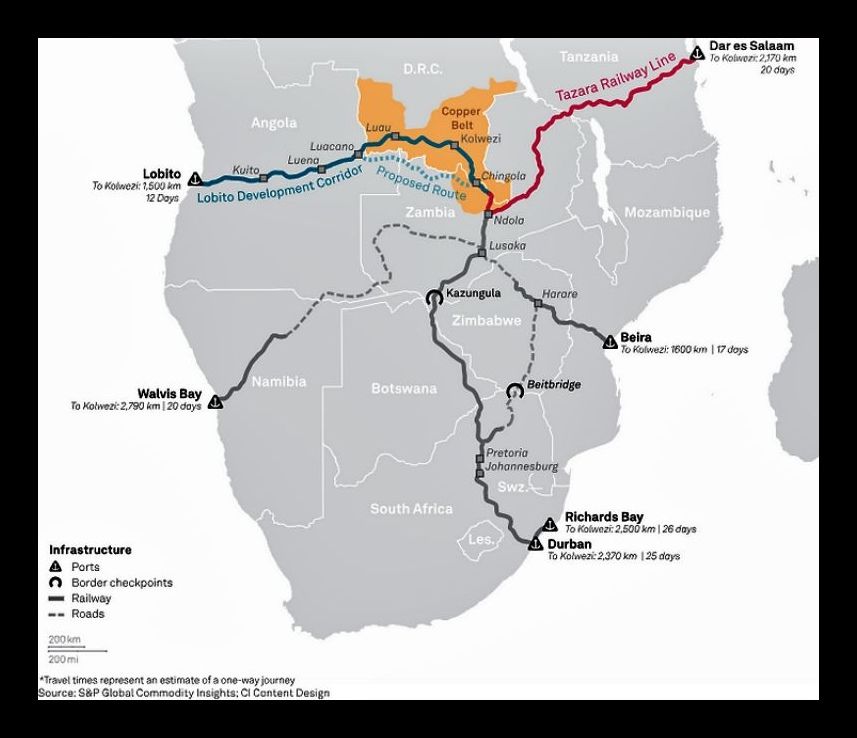
The clearest material stake in East and Central Africa’s near future runs along two competing railway corridors converging on the same mineral belt straddling Zambia and the Democratic Republic of the Congo. The United States, through its International Development Finance Corporation, committed 553 million dollars in late 2025 to rehabilitating Angola’s Benguela line as the anchor of the Lobito Corridor, a 1,300-kilometre route already carrying Congolese copper to the Atlantic port of Lobito for onward shipment to Baltimore. The Partnership for Global Infrastructure and Investment has paired that loan with 200 million dollars from the Development Bank of Southern Africa, and Washington’s stated ambition, confirmed by acting PGI coordinator Helaina Matza after a 2024 tour of the Democratic Republic of the Congo and Tanzania, is to extend the corridor all the way to the Indian Ocean through Tanzanian territory, binding the Copperbelt to both the Atlantic and the Indian Ocean under a single American-backed logistics architecture.
China has answered with its own rehabilitation of the older Tanzania-Zambia Railway, built in the 1970s under a Mao-era interest-free loan and historically prized by African leaders, Zambian president Kenneth Kaunda among them, as an alternative to routes running through then-apartheid Rhodesia and South Africa. China Civil Engineering Construction Corporation signed a thirty-year concession in September 2025 to invest 1.4 billion dollars in track rehabilitation and new rolling stock, and Chinese premier Li Qiang personally signed the agreement with Zambia and Tanzania during a November 2025 visit, underscoring Beijing’s intent to preserve its established Indian Ocean route even as the American-backed Atlantic corridor gains capacity. CSIS senior adviser Judd Devermont has argued that the future of these two rail systems lies in connection rather than pure competition, and the European Union’s own 2023 memorandum of understanding with Zambia under its Global Gateway programme suggests Brussels intends to hedge across both corridors rather than back one exclusively. The contest is real, but it is a contest over capacity and reliability for the same underlying export volume, not a contest in which one side seeks to leave any particular population disconnected; both railways, as currently planned, pass through populated mining and transit towns whose economies stand to benefit from whichever line moves more efficiently.
II. TANZANIA: A SEPARATE CRISIS, A SEPARATE AMERICAN RESPONSE
While the rail contest unfolds along Tanzania’s western corridor, Washington’s relationship with Dar es Salaam has deteriorated sharply along an entirely separate track, rooted in Tanzania’s own internal politics. Tanzania’s October 29, 2025 general election was followed, according to the Senate Foreign Relations Committee’s own bipartisan findings, by a violent crackdown in which security forces suppressed thousands of protesters, imposed a nationwide internet shutdown, denied medical care to the wounded, and collected bodies from mortuaries in what the committee’s sponsors describe as an apparent effort to conceal the scale of the repression. The State Department opened a formal review of the bilateral relationship in December 2025, and Senators Jeanne Shaheen and Ted Cruz introduced the bipartisan Reassessing the United States-Tanzania Bilateral Relationship Act on May 20, 2026, which the Senate Foreign Relations Committee advanced on June 17, 2026. The bill requires the Administration to assess Tanzania’s deepening ties with China and Russia as part of its review, but the proximate and stated cause, repeated by both sponsors and documented in the bill’s own findings, is the election violence and subsequent repression, not the rail competition unfolding simultaneously in the country’s interior.
Tanzanian members of parliament have responded with public calls for a firm diplomatic counter-response, debating the matter during deliberations over the Ministry of Foreign Affairs’ own 2026-27 budget. The juxtaposition is instructive: Tanzania is simultaneously a wanted partner in American mineral-logistics planning and a sanctions target over domestic political violence, demonstrating that Washington’s African engagement runs on parallel tracks that do not always reconcile into a single coherent strategy toward any one country.
III. KENYA AND SUDAN: HOSTING A PARALLEL GOVERNMENT
Kenya’s most consequential and most criticised decision in this period was its hosting of the Sudanese Rapid Support Forces. On February 18, 2025, RSF leader Mohamed Hamdan Dagalo, known as Hemedti, convened allied political and armed factions in Nairobi to sign a charter establishing a parallel Sudanese government, an event that followed RSF-linked violence the Kenya Human Rights Commission says killed at least 433 civilians and that proceeded only four days after the African Union’s own Peace and Security Council had condemned external interference in the Sudanese conflict. Sudan’s government recalled its ambassador from Nairobi in protest, and Foreign Affairs Cabinet Secretary Musalia Mudavadi defended the meeting as a nonpartisan mediation platform, citing Kenya’s history hosting the 2002 Machakos Protocol that helped end the Second Sudanese Civil War.
The Global Initiative Against Transnational Organized Crime has since documented Kenyan-registered aircraft landing in Nyala, the RSF’s Darfur stronghold, transporting both wounded fighters and supplies, allegations Nairobi has denied even as Sudan’s army separately accused Kenya in June 2025 of supplying the RSF with weapons. Reporting by the Africa Report has linked Kenya’s posture to the financial and diplomatic interests of the United Arab Emirates, which Western and UN investigators have repeatedly named as the RSF’s principal external backer. Whatever the precise channel, Kenya’s decision to provide the RSF with a diplomatic platform represents the most direct and material point of contact between Nairobi’s foreign policy and the wider contest for influence over Sudan’s fractured territory, and it has cost Kenya measurable diplomatic standing across the African continent, with critics including the International Commission of Jurists’ Kenya chapter and the Kenya Human Rights Commission both calling the decision a breach of Kenya’s obligations under the African Union’s Constitutive Act.
IV. THE LAIKIPIA EBOLA FACILITY: HEALTH SECURITY, SOVEREIGNTY, AND BASE ACCESS
Kenya’s domestic politics produced the most consequential controversy of this period over a different kind of American request. As Ebola spread through Ituri and North Kivu in eastern Democratic Republic of the Congo and across the border into Uganda from mid-May 2026, with the World Health Organization reporting roughly 1,000 cases and 200 deaths by 26 May, the Trump administration informed the Kenyan government that it intended to construct a fifty-bed isolation and quarantine facility for Americans exposed to the virus at Laikipia Air Base near Nanyuki. The Wall Street Journal first reported the plan on 27 May 2026, the same day Secretary of State Marco Rubio told a Cabinet meeting that the administration’s top foreign policy priority was protecting Americans and that the United States, in his words, cannot and will not allow any cases of Ebola to enter the United States. President Ruto confirmed in subsequent affidavits filed in the Kenyan High Court that he personally approved the arrangement after a direct request from President Trump, telling reporters, in his words, that he gave the okay because it was an agreement and a partnership with friends who have walked with Kenya for thirty to forty years.
Health Cabinet Secretary Aden Duale, who had previously served as Kenya’s Defence Cabinet Secretary and signed Kenya’s Defence Cooperation Agreement with then US Secretary of Defense Lloyd Austin, defended the project before the National Assembly on 3 June 2026 by stating plainly that the government would not conduct public consultation, telling lawmakers under provisions of the Public Health Act that, in his words, we don’t need to do public participation; we are not going to consult citizens. Duale separately told media that the Laikipia site had been selected in part because the base offered what he described as a long runway suitable for rapid operations, a justification that drew sustained public criticism given that the stated purpose of the facility was patient isolation rather than aircraft logistics. The underlying Kenya-US Defence Cooperation Agreement that Duale had signed in his earlier role as Defence Secretary has never been published in full; Kenya’s Ministry of Defence has summarised it only as covering joint training, defence technology sharing, and interoperability, leaving the specific provisions under which the Laikipia base section was made available to American construction crews outside public view.
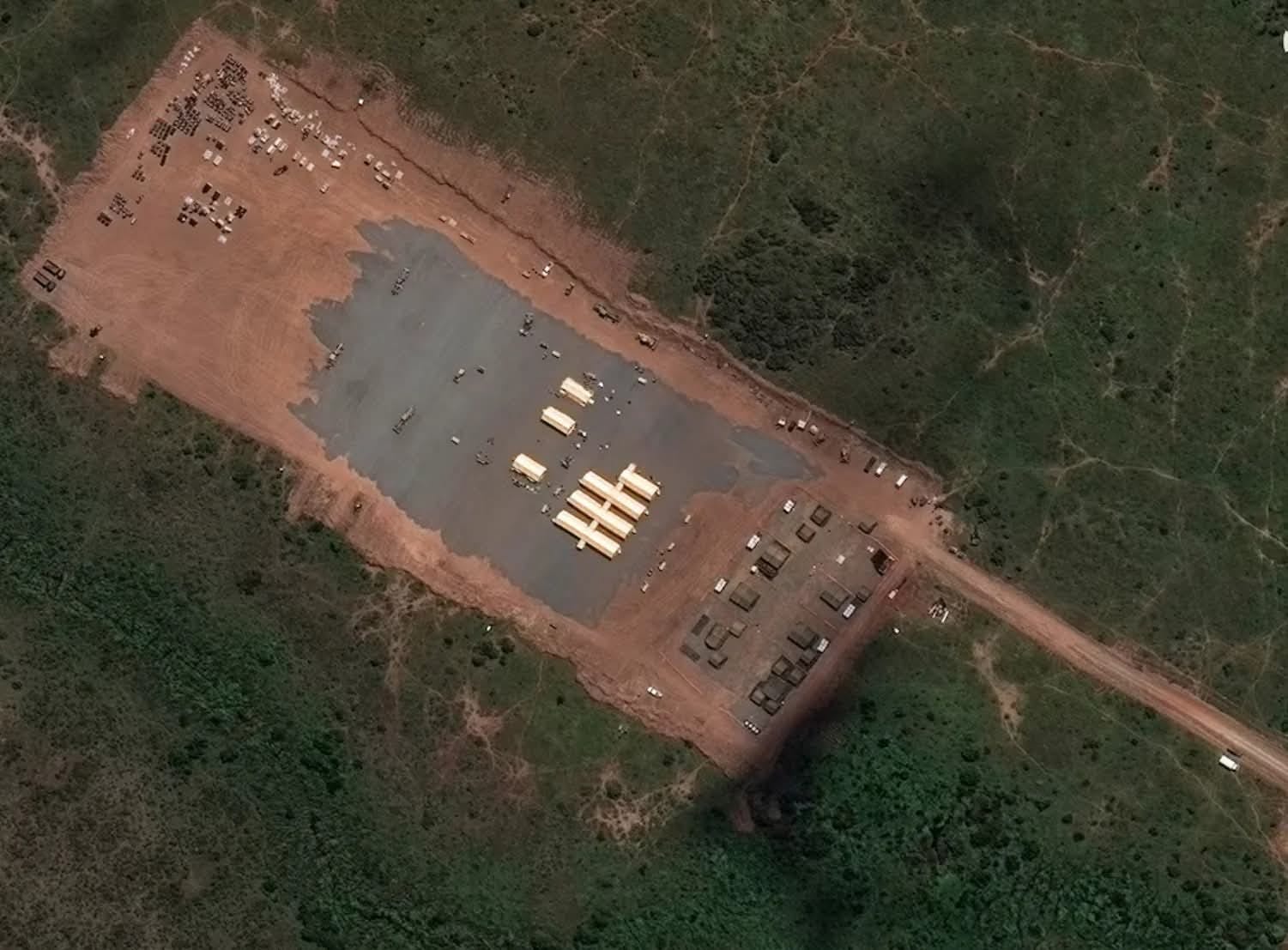
The decision triggered sustained and ultimately fatal protest. Nairobi’s Katiba Institute and the Kenya Law Society petitioned the High Court, which issued a conservatory order on 28 May 2026 barring Kenya from establishing or operating any Ebola-related facility under the US arrangement and from admitting any exposed or infected person into the country pending resolution of the case. Construction nonetheless continued, confirmed by satellite imagery reviewed by Reuters showing tented structures erected on an eleven-acre cleared section of the base, and Duale later acknowledged in fresh court filings that activities at Laikipia had continued after the injunction even as he maintained the government had acted in good faith and suspended the arrangement once formally notified. Demonstrations in Nanyuki began on 1 June and continued for ten days. Police shot and killed two men that day, Charles Mang’aro Mwangi, 27, and a second man whose identity was not immediately established, according to reporting compiled by the World Socialist Web Site from local accounts. A second wave of protest on 9 June ended with police shooting dead Sylvester Muigai Ndung’u, a sixteen-year-old Form Three student at Thingithu Secondary School who had been sent home that day to collect a school fee balance and was caught in the crowd; a postmortem conducted at Nanyuki Referral Hospital and reported by both the Daily Nation and Kenyans.co.ke confirmed he died from a single gunshot wound that entered above his left eye and lodged in his brain. His mother, Lucy Kagure, told Citizen Digital that police initially informed her the object removed from her son’s skull was a stone, before it was confirmed to be a bullet.
The protests produced a further controversy when photographs circulated showing Kenyan police wearing uniforms resembling those of the British Army Training Unit Kenya, the long-standing British military training presence also based in Nanyuki; the British High Commission stated publicly that no BATUK personnel had participated in the protests or been authorised for domestic policing duties, but the images intensified existing public anxiety in Laikipia, a county whose relationship with foreign military presence Al Jazeera’s reporting traced back through a colonial history of land alienation predating Kenyan independence. Separately, Kenyan reporting noted that the Laikipia facility, although consistently described by Duale as one of twenty-three isolation centres being built nationally as part of a broader preparedness programme, was the only one of the twenty-three to receive sustained public attention or documented construction, prompting the Daily Nation to ask directly where the other twenty-two facilities were.
IV-A. THE G7 ACCOUNTING AND THE RARE-EARTHS QUESTION
President Trump addressed the Ebola response directly at his closing press conference at the G7 summit in Évian on 17 June 2026, telling reporters that the United States had sent 375 million dollars in aid to help stop and contain the crisis at its source, framing the figure as proof of American generosity relative to other countries he said had given, in his words, essentially nothing, and citing unnamed African presidents who he said had thanked him personally, according to the transcript published by Roll Call’s Factba.se service. That figure describes the broader American contribution to containing the outbreak at its source in the Democratic Republic of the Congo and Uganda; it is distinct from the separately reported construction cost of the Laikipia facility itself and from the 13.5 million dollars in Kenya-specific Ebola preparedness funding the State Department confirmed after Rubio’s call with Ruto in late May, indicating that Washington’s public accounting of its Ebola spending runs across at least three different and only partially reconciled figures depending on which official is describing which portion of the response.
The suspicion that the Laikipia arrangement served a purpose beyond stated health security has been argued explicitly in Kenyan and pan-African commentary, most directly in a New Eastern Outlook analysis by Simon Chege Ndiritu, which argued that the facility functioned as a pretext for the United States to gain physical control of a strategically located airbase with the country’s longest runway, pointing to the unpublished nature of the underlying Defence Cooperation Agreement, Duale’s own runway justification, the rapidity of construction relative to the announced timeline, and the proximity of Kenya to the mineral-rich conflict zones of eastern DRC as grounds for that reading. The mineral dimension of that argument intersects with verifiable fact at one specific point: Ruto’s own public remarks in a separate May 2026 address reported by Mongabay explicitly rejected a future in which Africa exports raw, unprocessed minerals, calling instead for domestic processing capacity, a position that places Kenya’s head of state on record as treating critical minerals as a live strategic question during the same month the Laikipia controversy unfolded, even though that statement was not made in reference to Laikipia and no Kenyan court filing, parliamentary record, or American official statement has yet drawn an explicit documented link between the airbase arrangement and mineral transport specifically. The base’s long runway, its proximity to the Congolese mineral belt, the unpublished defence agreement, and the government’s refusal of public consultation are each independently documented; the inference connecting them into a single mineral-access objective is the New Eastern Outlook analysis’s own argument, reasoned from those facts rather than confirmed by any of the governments involved, and it should be weighed on that basis.
V. FRANCE RETURNS THROUGH NAIROBI AS IT LEAVES THE SAHEL
As French forces have been expelled from or withdrawn from Mali, Burkina Faso, Niger, and Chad over the past two years, Paris has pursued a parallel and largely successful effort to deepen its military footprint in anglophone East Africa, with Kenya as the centrepiece. Kenya’s Defence Cabinet Secretary Soipan Tuya and French Ambassador Arnaud Suquet signed a Defence Cooperation Agreement on October 29, 2025, which Kenya’s Parliament ratified on April 8, 2026, after a period of public participation during which concerns were raised over provisions granting visiting French personnel legal immunity from prosecution in Kenyan courts. The agreement followed the docking of three French warships, including the assault ship FS Dixmude, carrying roughly 800 French naval personnel at the Port of Mombasa in March 2026, part of the French Navy’s annual Jeanne d’Arc deployment, and was further cemented by President Emmanuel Macron’s co-hosting with Ruto of the Africa Forward Summit in Nairobi on May 11 and 12, 2026.
Kenyan officials, including Foreign Affairs Principal Secretary Korir Sing’oei, have repeatedly and publicly denied that the agreement establishes a permanent French base, characterising it instead as a standard training, maritime-security, and intelligence-sharing framework comparable to arrangements Kenya maintains with the United States and the United Kingdom. Al Jazeera’s reporting nonetheless cites unnamed parliamentary sources describing sustained French pressure for a more permanent troop presence, and frames the agreement within France’s broader strategic pivot toward English-speaking African states after the collapse of its Françafrique presence in the Sahel. France is now Kenya’s fourth-largest foreign direct investment partner, with 140 French companies operating in the country as of 2026, up from forty in 2013, giving Paris a substantial and growing economic stake in the relationship independent of the security dimension.
VI. THE G7 INVITATION AND KENYA’S DIPLOMATIC ARBITRAGE
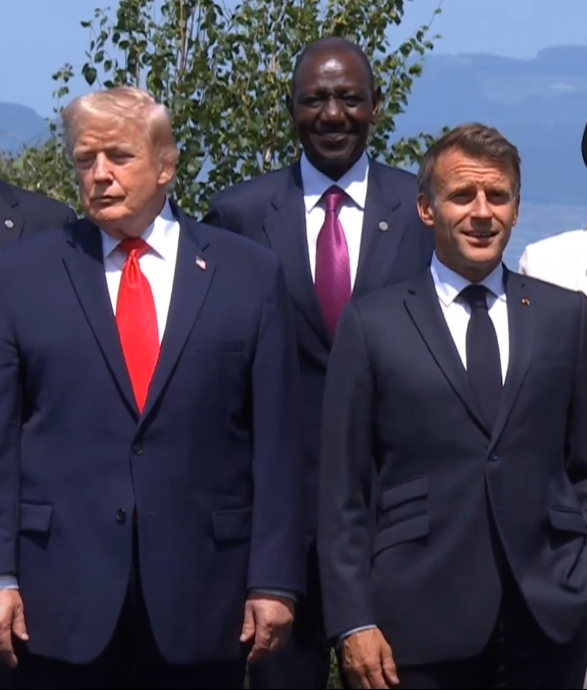
Kenya’s accumulating value to multiple external powers converged visibly at the June 2026 G7 Leaders’ Summit in Évian, France, where Ruto attended as the only African head of state invited, a position Kenyan and regional press reported as having effectively displaced South Africa, whose own exclusion followed what Chatham House’s analysis described as American pressure. The invitation came directly from Macron, following the Africa Forward Summit Kenya had co-hosted with France weeks earlier, and Ruto used the platform to press for debt restructuring and improved African access to concessional development finance, securing language on mutually beneficial international partnerships in the summit’s final declaration. Kenya’s selection over South Africa for the sole African seat at the table is itself a signal of where Western diplomatic favour currently sits in Africa, and it followed a year in which Kenya had separately become the largest Sub-Saharan beneficiary by value of American AGOA trade preferences, a programme Congress has extended only through the end of 2026, leaving Nairobi with a direct material incentive to maintain its standing in Washington even as it deepens ties with Paris, hosts RSF diplomacy, and absorbs the political cost of the Laikipia facility.
VII. READING THE PATTERN ACROSS THE REGION
What emerges from Kenya’s simultaneous engagements with Washington, Paris, the RSF’s Gulf-linked patrons, and the G7 is not evidence of a single coordinated design imposed from outside, but a picture of a government that has made itself indispensable to multiple external actors at once and has extracted concrete value from each relationship in turn: American AGOA access and counter-terrorism cooperation, French investment and a defence pact, a G7 platform secured through French sponsorship, and whatever diplomatic leverage Nairobi calculates it gains from its position in the Sudanese conflict.
Tanzania’s simultaneous position as both a wanted rail partner and a sanctions target shows the same external actors pursuing distinct and uncoordinated objectives even toward a single country. The Lobito-TAZARA rail contest shows China and the United States competing for the same mineral traffic through parallel infrastructure rather than through the deliberate exclusion of any population along either route. Each thread, examined on its own evidentiary record, supports a region where multiple powers compete for advantage and African governments, Kenya foremost among them, increasingly play those powers against one another rather than simply absorbing direction from any single external capital.
Authored By: Global GeoPolitics
If you prefer to make a one time donation in support of my work, you can do so by clicking any link below:
https://buymeacoffee.com/ggtv |
https://ko-fi.com/globalgeopolitics |
Bitcoin: 3NiK8BoRZnkwJSHZSekuXKFizGPopkE7ns
References
Al Jazeera. (2026, May 11). Kenya hosts France’s Macron: Why the relationship matters to both.
Daily Nation. (2026, June). US lawmaker fights Trump’s Kenya Ebola deal.
Al Jazeera. (2026, June 4 and June 9). Why is a US Ebola facility in Kenya sparking protests? / One killed as hundreds protest in Kenya against US Ebola quarantine centre.
Brookings Institution. (2026, January). The critical minerals race is a unique opportunity to promote Africa as a reliable partner.
ABC News. (2026, May 27). White House says Americans in Africa exposed to Ebola will be sent to Kenya facility as Rubio says no cases will be allowed into US.
Al Jazeera. (2026, June 17). Ghosts of empire: A quarantine centre and Laikipia’s colonial past.
Chatham House. (2026, June). Kenya’s G7 role must address the economic pressures fuelling domestic criticism of President Ruto.
Citizen Digital. (2026, June 18-19). UK responds to uniform misuse as questions linger over teen’s death during Nanyuki protests / Student killed in Nanyuki anti-Ebola facility protests died from gunshot wound: Postmortem.
CNN. (2026, May 29 and June 8). Kenya court temporarily blocks U.S. plan for Ebola quarantine facility / Protests over a US Ebola facility in Kenya highlight Africa’s growing resistance to Trump-era deals.
CSIS. (2025, September 26). Two Railroads, One Vision.
Daily Nation. (2026, June). Where are the other 22? Questions mount over missing Ebola isolation units / Duale: Ebola facility project stopped after court injunction.
Global Initiative Against Transnational Organized Crime. (2025, November 27). The illicit transnational supply chains sustaining Sudan’s conflict.
Kenya Human Rights Commission and ICJ Kenya. (2025, February). Joint Statement: Kenya’s RSF ties undermine Sudan peace efforts.
Kenyans.co.ke. (2026, June 16). Postmortem Confirms Nanyuki Form Three Student Died From Gunshot Wounds.
Mjengo Hub. (2026, June 3). Duale Says Government Will Skip Public Input on Laikipia Ebola Facility.
Mongabay News. (2026, May 13). Kenya’s Ruto rejects ‘raw mineral export’ future for Africa.
New Eastern Outlook. Ndiritu, S.C. (2026). Colonial Outbreak: Is Ebola Being Used to Secure U.S. Control of a Strategic Kenyan Airbase?
NPR. (2026, May 28; June 9). The U.S. government wants to treat any Americans with Ebola outside of the U.S. / Why there’s a debate over the new quarantine center for Americans at risk of Ebola.
Reuters / US News. (2026, June 4). Ruto Says US Plan to Build Ebola Facility in Kenya Is the ‘Right Thing’.
Roll Call / Factba.se. (2026, June 17). Press Conference: Donald Trump Holds a Press Conference at the G7 Summit in France.
Office of the Prime Minister of Italy (Governo.it). (2026, June 17). President Meloni’s closing press conference at the 2026 G7 Leaders’ Summit.
Senate Foreign Relations Committee. (2026, June 17). Ranking Member Shaheen Secures Key Foreign Policy Wins in Committee Business Meeting.
Senator Ted Cruz Press Office. (2026, May 20). Sens. Cruz, Shaheen Introduce Bipartisan Bill to Hold Tanzanian Officials Accountable for Human Rights Abuses.
The Africa Report. (2025, February 26). Kenya’s legacy and its relationship with Sudan’s RSF.
The Star, Kenya. (2026, June 1-2). Ruto defends proposed Ebola facility in Laikipia / Ruto: Why I okayed Ebola facility in Laikipia.
U.S. Embassy in the Democratic Republic of the Congo. (2026, February 6). 2026 Critical Minerals Ministerial.
U.S. International Development Finance Corporation / Railway Supply. (2025, December 19). Lobito Corridor railway financing reshapes Angola rail link.
World Socialist Web Site. (2026, June 14). Kenyan police kill three amid anti-Ebola facility demonstrations.


Leave a comment