
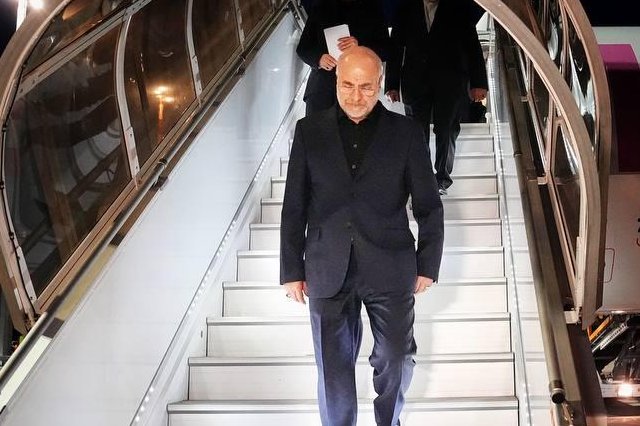
The reported arrival of Iranian Parliament Speaker Mohammad Bagher Ghalibaf in Zurich comes amid continuing controversy surrounding the Islamabad Memorandum of Understanding (MoU), Iran’s negotiations with the United States, and growing questions regarding the balance of power within the Islamic Republic.
While many of the most detailed claims regarding the negotiation process remain unverified, a growing body of publicly available reporting, parliamentary criticism, and political controversy points to genuine disagreements within Iran’s political and security establishment over the direction of negotiations, the nuclear issue, and the country’s post-war strategy.[1][2][5]
Publicly Documented Opposition to the Islamabad MoU
Independent reporting has confirmed significant resistance to the Islamabad MoU from influential hardline factions inside Iran.
According to The Guardian, conservative politicians, parliamentarians, and media outlets associated with ideological hardline currents have openly criticized the agreement and accused negotiators of making excessive concessions to Washington.[1]
The opposition has been particularly visible among figures associated with the Paydari Front and other factions that view the agreement as a departure from Iran’s long-standing strategic posture.[1]
These disputes are not confined to social media or unofficial commentary but have become part of an increasingly public debate within the political establishment.
Khanalizadeh’s Account of Internal Negotiations
One of the most detailed accounts of the negotiations has been presented by Iranian journalist Khanalizadeh.
According to his account, following the death of Ayatollah Khamenei, the United States quickly sought a ceasefire, which Iran initially rejected.
Khanalizadeh claims that after Mojtaba Khamenei was selected as Supreme Leader, Iranian officials prepared an initial five-point framework for negotiations with the United States. He alleges that Mojtaba rejected the proposal, leading to the development of a revised ten-point framework that subsequently formed the basis of an early Supreme Council for National Security (SNSC) position.
According to Khanalizadeh, Mojtaba Khamenei added a further eight conditions, including a prohibition on discussing the nuclear file during negotiations.
He further claims that although the United States initially accepted the framework as a basis for securing a ceasefire, American negotiators later refused to proceed on those terms once talks moved to Islamabad.
Khanalizadeh alleges that Iranian negotiators subsequently discussed nuclear issues despite Mojtaba’s instructions not to do so.
These claims have not been independently verified.
Disputes Over the Nuclear File
Although the details of Khanalizadeh’s account remain unverified, there is independent evidence that the handling of nuclear negotiations was a contentious issue.
Foreign Minister Abbas Araghchi publicly stated that broader nuclear discussions would occur only at a later stage and only after implementation of the interim agreement.[3]
This suggests that sequencing, scope, and timing of nuclear negotiations were significant subjects of debate during the negotiating process.[3]
The centrality of the nuclear issue also helps explain why it features prominently in competing narratives regarding the negotiations.
The Alleged Shift from a 10-Point to a 14-Point Framework
Khanalizadeh further claims that negotiators ultimately abandoned the original ten-point framework and instead adopted a new fourteen-point plan developed by Foreign Minister Araghchi.
According to his account:
- The SNSC approved the revised framework.
- Mojtaba Khamenei delayed responding for approximately two weeks.
- Officials interpreted his silence as approval.
- Mojtaba later requested written clarifications regarding specific provisions.
- SNSC members submitted written explanations regarding implementation and interpretation.
- Only after receiving these explanations did Mojtaba authorize the agreement.
Khanalizadeh argues that this process explains later remarks attributed to the Supreme Leader indicating that he had “a different view” regarding the negotiations.
These allegations remain unverified.
Evidence of Competing Power Centres
Independent reporting nevertheless supports the broader claim that multiple centres of influence are involved in strategic decision-making.
Reporting on post-war Iran has described tensions between negotiators seeking normalization and security-oriented factions associated with the Islamic Revolutionary Guard Corps (IRGC).[4]
Reuters has similarly reported that the post-transition political order depends heavily on the support of the Revolutionary Guards and that the security establishment has become increasingly influential in major policy decisions.[5]
Neither report confirms Khanalizadeh’s specific claims, but both support the existence of competing institutional interests within the Iranian system.[4][5]
Criticism of Ghalibaf’s Leadership
A growing number of critics have directed attention toward the role of Parliament Speaker Mohammad Bagher Ghalibaf.
Critics allege that Ghalibaf has repeatedly used his position to shield controversial policies from parliamentary scrutiny.
Among the accusations are:
- Repeated delays to parliamentary votes on withdrawal from the Nuclear Non-Proliferation Treaty (NPT).
- Restricting speaking opportunities for parliamentary critics.
- Delaying implementation of legislation after parliamentary approval.
- Keeping Parliament effectively inactive during periods of controversy surrounding the MoU.
These allegations remain contested and have not been independently verified.
However, there is documented evidence that influential parliamentarians have publicly challenged the agreement.
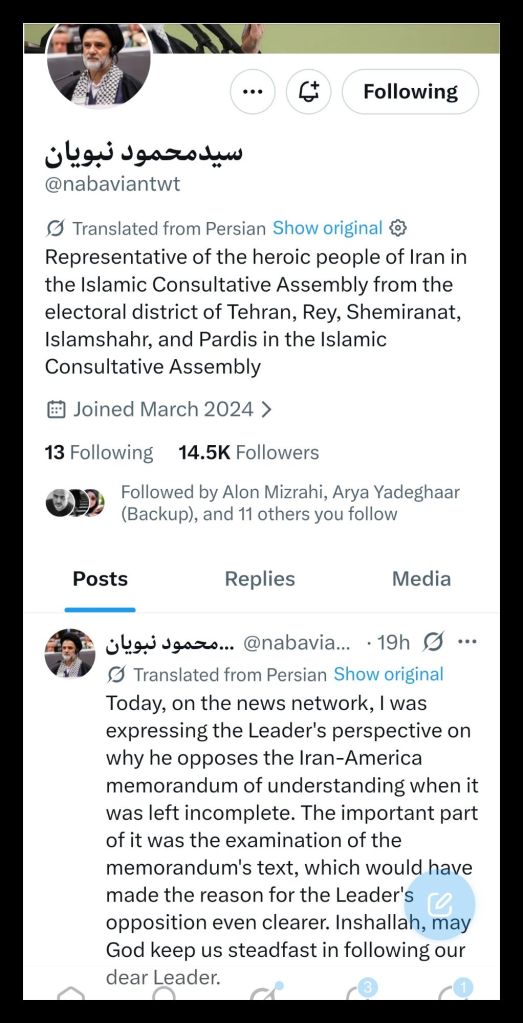
Iranian MP Mahmoud Nabavian has openly criticized the MoU, arguing that the final text remained substantially unchanged from drafts that opponents had previously condemned.[6]
His criticism demonstrates that opposition to the agreement extends into Parliament itself.[6]
The Nabavian-IRIB Incident
One of the most notable public controversies surrounding the negotiations emerged during a live IRIB television broadcast featuring MP Mahmoud Nabavian.
Video footage of the programme shows that Nabavian was discussing alleged disagreements between Supreme Leader Mojtaba Khamenei and members of the negotiating team when the broadcast abruptly cut away from him during his remarks.
According to Nabavian, the Supreme Leader had issued clear instructions regarding the conduct of negotiations and the handling of key issues. Nabavian alleged that those instructions were subsequently disregarded by members of the negotiating team.
The interruption itself is visible in the broadcast footage.
The reason for the interruption, however, remains disputed.
IRIB reportedly attributed the incident to technical difficulties. Critics reject that explanation and argue that the timing of the interruption suggests editorial intervention or censorship due to the sensitive nature of the comments being made.
Additional reports circulated by political commentators and opposition media have claimed that:
- IRIB later announced legal action against Nabavian.
- He was accused of discussing classified correspondence.
- A senior broadcasting official resigned following the incident.
These subsequent claims have not been independently verified by major international news organizations.
Regardless of the explanation, the incident has become a focal point in the wider debate over the Islamabad MoU and allegations of disagreement within Iran’s leadership.
This is the video clip in question. As you can see, according to Mahmoud Nabavian, the negotiations currently being pursued differ significantly from the framework and conditions originally approved by Khamenei.
So, yes, if his claims are accurate, they raise serious questions about how decisions are being made inside the Islamic Republic. Either negotiators moved beyond the guidance they were given, or competing centres of power within the system are exerting influence over the process.
What stands out most is the growing evidence of internal disagreement. Public accusations, parliamentary criticism, an interrupted state television broadcast, reports of resignations, and legal threats have all emerged during one of the most sensitive periods of negotiations with the United States.
Whether these disputes reflect routine political infighting or deeper divisions within the leadership remains unclear. What is becoming increasingly difficult to ignore, however, is that the image of a completely unified political establishment is being challenged from within.
Competing Interpretations
Not all observers accept the narrative presented by Khanalizadeh and other critics.
Some argue that Mojtaba Khamenei is deeply integrated into Iran’s national security apparatus and cannot realistically be portrayed as an isolated figure whose instructions were simply ignored.
Others point out that Iran has consistently maintained that it does not seek nuclear weapons and that preventing an Iranian nuclear weapon has simultaneously been a central American demand.
From this perspective, the nuclear issue may function primarily as a diplomatic mechanism through which a broader settlement can be justified to domestic and international audiences.
These competing interpretations demonstrate that substantial uncertainty remains regarding the internal dynamics of the negotiations.
In the video clip is Mahmoud Nabavian, Member of Parliament:
“We knocked the USA to the ground and had our foot on its chest, ready to finish the job. Then suddenly we went to the negotiating table, seeking a deal so that the USA could come and put its foot on our chest.”
This statement captures the depth of opposition to the proposed Islamabad MoU within parts of Iran’s political establishment. For many hardline supporters of the Islamic Republic, the issue is not simply the details of the agreement. It is the belief that Iran has already withstood decades of sanctions, pressure, isolation, and confrontation without capitulating. From that perspective, entering negotiations from a position of perceived strength appears unnecessary and, to some, unacceptable. This helps explain why the MoU has generated significant resistance from segments of Parliament, conservative political circles, and ideological factions within the system. At the heart of the debate are two competing visions: one that views negotiations as a means of securing stability and economic recovery, and another that views compromise with the United States as a strategic and ideological retreat. Whether the agreement survives may depend less on negotiations with Washington and more on whether Iran’s own political establishment can reach a consensus on what constitutes victory, compromise, or surrender.
Conclusion
The strongest available evidence supports the conclusion that significant divisions exist within Iran’s political establishment regarding the Islamabad MoU, negotiations with the United States, and the country’s future strategic direction.
Independent reporting confirms:
- Organized hardline opposition to the agreement.[1]
- Public criticism from members of Parliament, including Mahmoud Nabavian.[6]
- Disputes regarding the sequencing and handling of nuclear negotiations.[3]
- Tensions between negotiating factions and security-oriented institutions.[4]
- The growing influence of the IRGC and security establishment in major decision-making.[5]
The public controversy surrounding Nabavian’s interrupted IRIB appearance further illustrates the sensitivity of the issue and the extent to which disagreements over the negotiations have entered the public sphere.
At the same time, many of the most detailed allegations regarding Mojtaba Khamenei’s instructions, the alleged ten-point framework, internal SNSC correspondence, and the circumstances surrounding approval of the MoU remain based on insider accounts and political commentary rather than independently verified reporting.
The available evidence therefore supports the existence of genuine internal divisions while leaving many of the most dramatic claims regarding the negotiation process unresolved.
Authored By: Global GeoPolitics
If you prefer to make a one time donation in support of my work, you can do so by clicking any link below:
https://buymeacoffee.com/ggtv |
https://ko-fi.com/globalgeopolitics |
Bitcoin: 3NiK8BoRZnkwJSHZSekuXKFizGPopkE7ns
References
[1] The Guardian, “Iranian hardliners in vociferous push to reject proposed peace deal with US”
[2] The Guardian, “What lessons will Iran’s new leadership draw from the 110-day war?”
[3] Jerusalem Post, “Araghchi says nuclear negotiations to come later under agreement framework”
[4] Chosun Ilbo, “Divisions emerge between Iranian negotiators and hardline factions during ceasefire talks”
[5] Reuters, “Post-war Iran faces growing influence of Revolutionary Guards”
[6] Arab Times, “Iran lawmaker says released US-Iran deal matches criticized draft”


Leave a comment