

How the 2018 Velvet Revolution Exemplifies the US Strategy of Political Capture of a Sovereign Country
The March 1992 leak of the Defense Planning Guidance to the New York Times revealed a strategic vision that would shape American foreign policy for three decades. The document, prepared by Paul Wolfowitz’s policy office, asserted that the United States’ political and military mission would be to “prevent the re-emergence of a new rival” and to ensure that no rival superpower was allowed to emerge in Western Europe, Asia, or the territory of the former Soviet Union.-1 This vision of permanent American primacy required not only military pre-eminence but also the capacity to shape political outcomes in countries along the peripheries of potential rivals.
The 2019 Rand Corporation paper “Extending Russia: Competing from Advantageous Ground” represents the contemporary application of this strategic framework. The report, sponsored by the US Army, examines a range of possible means to “extend” Russia, defined as exploiting Russian vulnerabilities and anxieties to overextend and weaken the Russian state.(2) Among the geopolitical measures identified in the report is “Exploit Tensions in the South Caucasus,” with the report explicitly stating that “the United States could try to induce Armenia to break with Russia.” The report unapologetically admits that the capture of Armenia, as well as Georgia, “would enhance the encirclement of not only Russia, but also neighboring Iran, as well as provide the U.S. access to energy resources in the Caspian Sea.”(3)
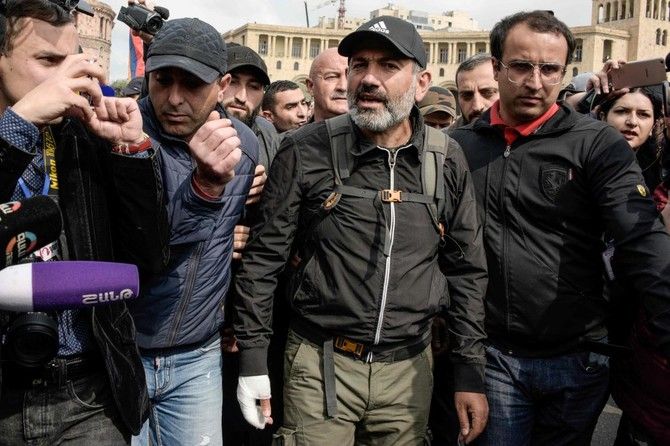
The 2018 Velvet Revolution in Armenia exemplified the initial phase of this strategic vision. The revolution, which brought opposition leader Nikol Pashinyan to power, followed a template perfected in Serbia (2000), Georgia (2003), and Ukraine (2004). The Guardian’s 2004 article “US campaign behind the turmoil in Kiev” described the template as “an American creation, a sophisticated and brilliantly conceived exercise in western branding and mass marketing that, in four countries in four years, has been used to try to salvage rigged elections and topple unsavoury regimes.”(4) The article identified the Democratic Party’s National Democratic Institute, the Republican Party’s International Republican Institute, the US State Department, USAID, Freedom House, and billionaire George Soros’s Open Society Institute as the main agencies involved.(5)
In Armenia, the National Endowment for Democracy played the central role. The NED, described by one analyst as “a wing of the CIA,” was created by the US government and funded by the US government to perform the regime change functions that the CIA previously conducted directly. The NED’s 2018 annual report openly celebrates the Velvet Revolution, noting that “NED supported five exceptional Armenian independent online media outlets” that “were invaluable throughout the 2018 historic events.”(6) These media outlets, while described as “independent,” were in fact funded and directed by the US government, which used them to take over Armenia’s information space through US-based social media platforms.
The NED’s 2019 annual report goes further, stating that “several NED grantees have entered government”, an explicit admission that the protests did not merely seek to overturn a targeted government but to replace it with US-prepared and selected client regimes.(7) The report notes that “since the 2018 revolution in Armenia NED grantees have shifted their focus from holding a corrupt regime accountable to supporting governance reform,” documenting the transition from regime change to institutional capture and control.
The Union of Informed Citizens (UIC), a key civil society organisation involved in the Velvet Revolution, publicly admits extensive US government backing. The organisation, founded in 2014 by Daniel Ioannisyan, promotes electoral integrity, democratic reforms, freedom of the press, and human rights in Armenia. The UIC’s 2021 annual report lists the National Endowment for Democracy, the Open Society Foundation, the International Republican Institute, Freedom House, and the US Embassy in Armenia as funders. The International Republican Institute and Freedom House are essentially subsidiaries of the NED, forming a coordinated network of US government-funded organisations working to capture Armenian political institutions.
The June 2026 parliamentary elections represent the consolidation phase of this political capture. According to preliminary data from the Central Election Commission, the ruling Civil Contract party received 49.81% of the vote, securing a majority of 64 seats in the 105-seat National Assembly and the right to unilaterally form the country’s cabinet.(8) The opposition Strong Armenia bloc, led by businessman Samvel Karapetyan, received 23.29%, while the Armenia Alliance, led by former President Robert Kocharyan, received 9.94%.-9 Three political forces entered parliament, with Pashinyan’s party securing a parliamentary majority, though not a constitutional majority, as it fell two mandates short of the 3/5 required for certain important amendments.(10)
The election was framed by Western observers and officials as a referendum on Pashinyan’s geopolitical reorientation. Secretary of State Marco Rubio’s May 2026 visit to Yerevan signaled growing US interest in Armenia’s strategic trajectory and the broader regional balance of power.(11) The election campaign saw Pashinyan arguing that making peace with Azerbaijan, normalizing relations with Turkey, and building ties with the West were all crucial to economic prosperity.(12) The opposition’s messaging was overwhelmingly negative and backward-looking, with one opposition rally beginning with AI-generated videos depicting Civil Contract campaign buses bringing in Azerbaijanis to take over the Armenian capital.(13)
The International Republican Institute’s role in the 2026 elections mirrored its involvement in the 2018 Velvet Revolution. IRI deployed a 23-person international delegation representing seven countries, led by National Endowment for Democracy Board Chair and former US Congressman Peter Roskam.(14) The mission met with election authorities, ruling and opposition political parties, civil society actors, journalists, diplomatic missions, and government institutions involved in election administration and enforcement.(15) IRI’s pre-election assessment, conducted in April 2026, evaluated the conditions for credible elections ahead of the June 7 vote.(16) Following the election, IRI observers reported that the voting and counting processes were “generally calm and orderly, conducted in accordance with established procedures,” and concluded that the elections were fair. (17)
EU officials and US Secretary of State Marco Rubio were quick to congratulate Pashinyan. The EU’s High Representative issued a statement commending the “high level of civic participation” and noting that the vote “shows Armenia’s firm commitment to democracy, peace and enhanced cooperation in the region as well as closer ties with Europe.” (18) The statement acknowledged the “unprecedented interference, pressure and persistent hybrid attacks from Russia, including via economic coercion measures,” but did not mention the US government-funded organisations that have been systematically shaping Armenian political outcomes since 2018.(19)
International observers from the OSCE Office for Democratic Institutions and Human Rights, the OSCE Parliamentary Assembly, the Parliamentary Assembly of the Council of Europe, and the European Parliament issued a preliminary statement noting that the elections offered voters “a genuine choice among political alternatives in a well-run process.”(20) The statement acknowledged that “direct pressure from abroad, in the form of escalating trade restrictions and security threats were observed during the campaign, aimed at unduly influencing voters in favor of the opposition”, a reference to Russian influence operations.(21) However, the statement also noted that “the campaign was highly confrontational, with divisive rhetoric, and was marked by allegations of vote-buying and other electoral violations that led to numerous criminal proceedings against opposition candidates and activists,” raising concerns about “the equality of opportunity to campaign.”(22)
The election was not without controversy. Seven political forces filed motions with the Constitutional Court seeking to annul the results, citing alleged fraud.[citation:23] Pashinyan dismissed opposition claims that the results were illegitimate, insisting that “there is one source of legitimacy, and that is the people” and that “the people have confirmed their choice, and this is reflected in the official election results.”(24) The opposition’s Strong Armenia bloc, led by Samvel Karapetyan, fought the campaign from a position of weakness, with Karapetyan under house arrest on charges that he called for the seizure of power after making critical statements about Pashinyan’s attacks on the church. Money laundering charges were later added, and authorities announced dozens of new charges against opposition activists on allegations of vote buying.(25) Tax fraud charges were announced against Gagik Tsarukyan, the oligarch leader of the pro-Russian Prosperous Armenia party, which came fourth and narrowly failed to enter parliament.(26)
The election results have significant implications for Armenia’s geopolitical trajectory. Pashinyan’s victory is likely to preserve the fragile Armenia-Azerbaijan peace process and deepen Armenia’s westward reorientation, while a comeback by pro-Kremlin forces would likely halt or reverse that trajectory, reopening tensions with Azerbaijan and restoring Russian influence.(27) The election outcome was therefore framed as a choice between a Western-oriented future and a Russian-aligned past.
The pattern of US political capture operations, from the 2018 Velvet Revolution through the 2026 parliamentary elections, demonstrates a systematic strategy of infiltrating and capturing nations along the peripheries of its principal rivals. The strategy operates through the National Endowment for Democracy and its associated networks, which build administrative layers inside targeted countries, displace indigenous institutions, and install client regimes that serve US interests at the expense of their own nations. The control of information space through US-based social media platforms is the key enabling factor, allowing the United States to shape what people in targeted countries see and believe, and ultimately to convince them to support policies that serve US interests at the cost of their own survival.
The Armenian case demonstrates that the United States has developed and implemented a systematic strategy of political capture that operates through the NED and its associated networks. The Velvet Revolution was not a spontaneous popular uprising but a coordinated operation involving US government-funded organisations. The June 2026 elections represent the consolidation of this capture, achieved through the deployment of US-based social media platforms, the legitimising presence of IRI observers, and the strategic framing of the election as a choice between a Western-oriented future and a Russian-aligned past. The capture of Armenia has served multiple strategic objectives: weakening Russian influence in the South Caucasus, providing a forward position for intelligence operations against Iran, and creating another self-destructive proxy in the mould of Ukraine. Until nations around the world recognise information space as a national security domain equivalent to physical borders and take the steps required to secure them, this vulnerability will continue to be exploited.
Authored By: Global GeoPolitics
If you prefer to make a one time donation in support of my work, you can do so by clicking any link below:
https://buymeacoffee.com/ggtv |
https://ko-fi.com/globalgeopolitics |
Bitcoin: 3NiK8BoRZnkwJSHZSekuXKFizGPopkE7ns
References
- “U.S. Strategy Plan Calls For Insuring No Rivals Develop.” The New York Times, 8 March 1992.
- Dobbins, James, et al. Extending Russia: Competing from Advantageous Ground. RAND Corporation, RR-3063-A, 2019.
- Dobbins, James, et al. Extending Russia: Competing from Advantageous Ground. RAND Corporation, RR-3063-A, 2019.
- Traynor, Ian. “US campaign behind the turmoil in Kiev.” The Guardian, 26 November 2004.
- Traynor, Ian. “US campaign behind the turmoil in Kiev.” The Guardian, 26 November 2004.
- National Endowment for Democracy. Annual Report 2018. 2019.
- National Endowment for Democracy. Annual Report 2019. 2020.
- “Pashinyan’s party gains right to independently form cabinet: results of Armenian elections.” TASS, 8 June 2026.
- “Pashinyan dismisses opposition claims over election results.” Armenpress, 24 June 2026.
- “Armenian election results boost Pashinyan’s engagement with West.” Eurasianet, 10 June 2026.
- “Armenia’s election could define Trump’s Caucasus legacy.” Eurasianet, 1 June 2026.
- “Armenian election results boost Pashinyan’s engagement with West.” Eurasianet, 10 June 2026.
- “Armenian election results boost Pashinyan’s engagement with West.” Eurasianet, 10 June 2026.
- “IRI deploys delegation to observe Armenia’s parliamentary elections.” Armenpress, 2 June 2026.
- “IRI observers: Armenia’s June 7 elections conducted calmly and fairly.” Armenpress, 7 June 2026.
- “IRI deploys delegation to observe Armenia’s parliamentary elections.” Armenpress, 2 June 2026.
- “IRI observers: Armenia’s June 7 elections conducted calmly and fairly.” Armenpress, 7 June 2026.
- “Armenia: Statement by the High Representative on behalf of the EU.” Consilium, 8 June 2026.
- “Armenia: Statement by the High Representative on behalf of the EU.” Consilium, 8 June 2026.
- “Armenia’s voters given opportunity to make genuine choice.” Armenpress, 7 June 2026.
- “Armenia’s voters given opportunity to make genuine choice.” Armenpress, 7 June 2026.
- “Armenia’s voters given opportunity to make genuine choice.” Armenpress, 7 June 2026.
- “Pashinyan dismisses opposition claims over election results.” Armenpress, 24 June 2026.
- “Pashinyan dismisses opposition claims over election results.” Armenpress, 24 June 2026.
- “Armenian election results boost Pashinyan’s engagement with West.” Eurasianet, 10 June 2026.
- “Armenian election results boost Pashinyan’s engagement with West.” Eurasianet, 10 June 2026.
- “Armenia’s election could define Trump’s Caucasus legacy.” Eurasianet, 1 June 2026.
- “Union of Informed Citizens.” Wikipedia, Wikimedia Foundation, 2024, en.wikipedia.org?pojem=Union_of_Informed_Citizens.


Leave a comment