
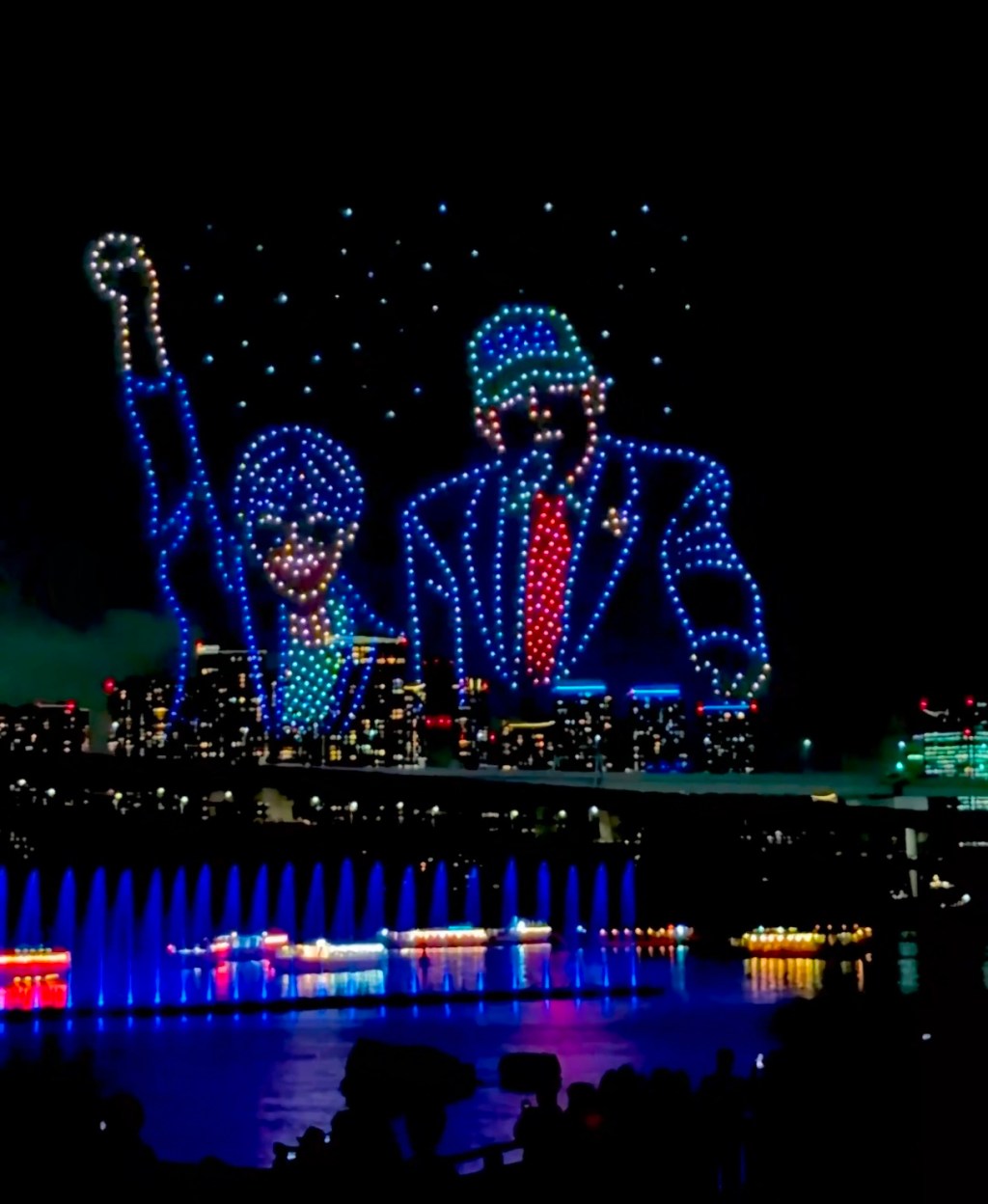
Food stamps, opioid deaths and a cage fight on the White House lawn, read against rival theories of American power
On 14 June 2026, President Donald Trump marked his eightieth birthday and the run-up to the semiquincentennial of American independence with a mixed martial arts card staged on the South Lawn of the White House, fought inside a twenty-eight-metre steel structure nicknamed the Claw and built at a reported cost of sixty million dollars. This is where Lincoln once pondered the survival of the Union and Roosevelt addressed a nation at war. Roughly 4,300 people watched in person, seating reserved for sponsors, political allies and service members, while organisers installed screens at the Ellipse for a further 85,000 free spectators. Dana White, the chief executive of the Ultimate Fighting Championship, has been a Trump ally since the 2016 convention; Linda McMahon, the Secretary of Education, holds more than fifty million dollars in stock in TKO Group Holdings, the UFC’s parent company. A federal lawsuit filed by the Public Integrity Project sought to block the event on the grounds that it converted public parkland into a private, for-profit spectacle without congressional approval; the fights went ahead regardless. The National Park Foundation’s Freedom 250 initiative, which staged the event alongside a prayer rally and a state fair on the National Mall, had by April received nearly eighty million dollars in federal grants, while the officially designated America250 commission had received only a quarter of its congressionally appropriated funds over the same period. In any serious political analysis, this image demands examination not as an aberration but as a symptom. The wrestling ring on the White House lawn represents no departure from American political culture but rather its fullest expression.
The material condition of the United States in its semicentennial year provides the necessary context for this spectacle. Approximately 42.4 million people received monthly Supplemental Nutrition Assistance Program benefits through the first eight months of fiscal year 2025, representing a substantial portion of the population. The uninsured population stood at 28 million people, or 8.3 per cent of all Americans, according to the Centers for Disease Control and Prevention. The Congressional Budget Office projects that number will grow by 10 million over the following decade, largely due to proposed Medicaid reductions. The maternal mortality rate, despite the United States spending more on healthcare per capita than any other nation, exceeded 32 deaths per 100,000 live births by 2025, a figure that places the country far above any other developed economy. The incarceration rate of approximately 664 per 100,000 population is the highest among developed economies and among the highest globally. The opioid crisis has claimed more than half a million lives over the past two decades. Total student loan debt reached $1.841 trillion by the fourth quarter of 2025, owed by more than 40 million borrowers. The American Society of Civil Engineers graded the nation’s infrastructure at a C in its 2025 Report Card, the highest grade since the quadrennial assessment began in 1998, yet still indicative of significant underinvestment. Life expectancy, which had been declining in the 2010s, only recently returned to pre-pandemic levels.
These statistics represent failures of policy and political will rather than natural phenomena. They are the outcomes of deliberate choices about resource allocation. In fiscal year 2025, the United States spent $954 billion on defence, more than the next six countries combined. The military budget accounted for 33 per cent of all global military expenditures. The combined military spending of China, Russia, Germany, the United Kingdom, India, Saudi Arabia, France, and Japan did not match the US total. Meanwhile, on a single night in January 2025, 32,495 veterans experienced homelessness. The Department of Veterans Affairs permanently housed 51,936 homeless veterans in fiscal year 2025, a significant achievement that nevertheless underscores the scale of the ongoing crisis. The choice to prioritise the bomber over the teacher, the aircraft carrier over the water treatment plant, reflects a political decision about hierarchy and values in which military power remains sacrosanct and social welfare remains discretionary.
The liberal framework, which dominates mainstream political analysis in the United States, cannot adequately explain these patterns. Liberalism, in its classical and contemporary forms, rejects the concept of class as a meaningful analytical category. It treats the state as a neutral arbiter of competing interests and assumes that policy outcomes reflect some approximation of the national interest. This framework produces endless confusion when confronted with behaviour that appears contrary to the welfare of the majority. Why does a country with the resources to end homelessness, medical debt, and student debt several times over choose instead to build a fighting cage on the lawn of its executive mansion? The liberal answer typically invokes partisanship, gridlock, or cultural division. These explanations remain insufficient because they mistake symptoms for underlying causes.
A class-based analysis, by contrast, begins with the material fact of ownership. The United States, like other Western states, has been captured by a transnational ownership class that uses state power to pursue its own hegemonic interests. This class replaced feudalism with an oligarchic system it calls democracy and replaced what masqueraded as “Christianity” with an ideology it calls liberalism. The purpose of liberalism is to conceal the reality of class rule and to maintain the ownership class as the ruling class. It is the ideology of the ownership class, and it exists to perpetuate the current system by obscuring the mechanisms through which wealth and power are concentrated and protected.
The global trajectory of the Western oligarchy has been one of relentless expansion since 1945, culminating in the unipolar moment of 1991. The collapse of the Soviet Union removed the primary counterweight to Western hegemony, and the ownership class has since pursued a global monopoly of political economy with renewed vigour. The United States serves as the headquarters and primary weapon of this transnational oligarchy, providing the economic might and military capacity to enforce its will globally. The pursuit of global hegemony is not a matter of national interest; it is a matter of class interest. The oligarchy cannot be honest about this because honesty would expose the contradiction between its objectives and the welfare of the working class. It must therefore manage public perception through indoctrination, propaganda, and narrative control.
The current anxiety within the Western oligarchy stems from the rise of powers that refuse to subordinate themselves to its empire. Cuba, the Democratic People’s Republic of Korea, Venezuela, Iran, Russia, and above all China represent the primary obstacles to Western hegemony. China, in particular, has rendered itself impervious to economic coercion and military attack. It is the world’s largest trading partner for more than 140 countries, and its productive base is so deeply integrated into global supply chains that decoupling is impossible. China has beaten the West at its own rigged game, and the oligarchy knows it.
The response to this defeat has been a systematic abandonment of the rules-based order that the West itself constructed. The seizure of Venezuelan oil, the attempted capture of Nicolás Maduro, and the blockade of Gaza represent a new paradigm based on might-makes-right and the naked pursuit of oligarch interests. These actions are not new in kind, but they are unprecedented in intensity. They are best explained by the oligarchy’s perception of the threat posed by the axis of resistance, which has made itself impregnable to the assault of a declining empire.
Russian Foreign Ministry spokeswoman Maria Zakharova has described the Western ultraliberal model as having reached a “civilisational dead end.” She argues that a system which once promoted freedom, democracy, and human rights now cannot guarantee the declared rights of its own citizens. Political parties, journalists, and public organisations in Western Europe increasingly face pressure if they challenge the dominant narrative. “Either you keep quiet, or you go to jail,” Zakharova stated. The rise of the internet ended the West’s monopoly over information, prompting authorities to rely on major technology companies to suppress dissenting views. Artificial intelligence, she warned, could become the next stage in a growing “digital dictatorship.”
This analysis, whatever one thinks of its source, identifies a genuine contradiction. The Western liberal model has lost the capacity to generate consent organically. It must therefore manufacture consent through increasingly coercive means. The wrestling ring on the White House lawn is one such means. It is a distraction, a spectacle designed to generate the appearance of vitality while the substance of American life decays. It is the bread and circus of the twenty-first century, updated for an audience that consumes reality as entertainment and politics as performance.
The logic of capital is inexorable. Capital is incapable of reforming itself or of doing anything other than pursuing monopoly power. The Soviet Union and mutual assured destruction briefly checked that pursuit, but the oligarchs eventually won the Cold War and continued their march toward total global hegemony. The Western ruling class is systemically incapable of anything except pursuing monopoly power. The future trajectory is therefore simple to predict. China is rising, and the anxiety of the Western oligarchy is rising at the same rate. The West cannot help but pursue hegemony against an undefeatable axis of resistance. Its futile strategy involves creating a new global order with monopoly control over energy and shipping, hoping that this will allow it to remain the unrivaled global power through the rest of the twenty-first century.
This explains why all talk of a “deal” with Iran, “peace” with Russia, or “mutual prosperity” with China is delusional. None of these outcomes is compatible with Western oligarch hegemony. The opposite managed escalation and a transition to a far more dangerous, violent, and impoverished global order, is the inevitable result of Western capital’s inexorable pursuit of monopoly power. This observation is not pessimism but realism, and therefore constitutes the most effective basis on which to organise resistance.
The United States has spent two and a half centuries confusing the noise it makes with the work it never did. It has built the most expensive killing apparatus in human history and told the nurse she made too much money. It has sent young men to die in wars that made defence contractors rich and called it freedom. It has worshipped the uniform and neglected the human inside it, because uniforms are cheaper than healthcare and housing and therapy. It has chosen entertainment over education so many times and at every available level of society that it has forgotten there was a distinction worth making. Spectacle has replaced substance, performance has replaced policy, and the feeling of winning has replaced any serious consideration of what is being won and who is paying for it.
‘The cost of housing has gone up. Inflation has taken a real hold. People have massive educational loans. Our young people are rebelling on that.
There’s shifts going on in the Democratic Party because of that. People are toppling mainstream Democratic figures in congressional elections on economic issues and also on the issue of Israel.
The wrestling ring on the White House lawn reflects the current condition of American politics. Public spectacle has increasingly displaced the ordinary work of governing. Those who hold economic and political power have strong incentives to keep public attention focused on entertainment and political theater rather than on policies that shape wealth, opportunity, and living standards. At the same time, the political system has become less willing to confront structural problems directly, relying instead on media performance and symbolic gestures that do little to address the country’s underlying challenges.
Two hundred and fifty years of this represent what was built, what was chosen, and what is now being celebrated. The most perfectly American thing about all of it is that anyone pointing at the image and asking what it means will be called unpatriotic by people watching it on a television they bought on credit they cannot afford, rooting for a sport they cannot explain, in a country they cannot describe, celebrating a birthday they cannot contextualise.
Happy 250th birthday, America, wishing you……………………….ahead !!!!
Authored By: Global GeoPolitics
If you prefer to make a one time donation in support of my work, you can do so by clicking any link below:
https://buymeacoffee.com/ggtv |
https://ko-fi.com/globalgeopolitics |
Bitcoin: 3NiK8BoRZnkwJSHZSekuXKFizGPopkE7ns
References
ABC News. “Trump and Dana White kick off UFC event on the White House South Lawn.” 15 June 2026. https://www-cdn.abcnews.com/Politics/inside-trumps-ufc-fight-white-house-south-lawn/story?id=133819655.
American Society of Civil Engineers. “ASCE Report Card Gives U.S. Infrastructure Highest-Ever C Grade.” 25 March 2025.
.
AP News. “An octagon on the White House lawn for Trump’s 80th birthday and the nation’s 250th, in photos.” 13 June 2026.
.
CBC News. “Trump celebrates 80th birthday with White House cage fight.” 12 June 2026. https://www.cbc.ca/lite/story/9.7232386.
CBC News. “How the UFC became a stage for Trump.” Front Burner. 2 June 2026. https://www.cbc.ca/lite/story/9.7219723.
CBC News. “Trump’s UFC event faces backlash over cost, security, violence.” 14 June 2026. https://www.cbc.ca/player/play/video/9.7235109.
CDC. “U.S. Uninsured Rate Unchanged in 2025.” 28 May 2026.
.
Commonwealth Fund. “Maternal Mortality in the United States, 2025.” 29 July 2025.
https://www.commonwealthfund.org
.
Department of Veterans Affairs. “Point-in-Time (PIT) Count – VA Homeless Programs.” 14 January 2026.
.
Department of Veterans Affairs. “VA houses largest number of homeless Veterans in seven years.” 18 November 2025.
.
Federal Reserve. “Student Loan Debt Statistics.” 2025.
https://www.federalreserve.gov
.
Kornetzke, Oliver. “A 250 Year Illusion.” Substack. 2026. https://substack.com/@oliverkornetzke.
The New York Times. “Trump’s U.F.C. Event Comes as Backing of Young Men, Once a Strength, Wanes.” 14 June 2026.
.
Pew Research Center. “What the data says about food stamps in the U.S.” 14 November 2025.
.
Prison Policy Initiative. “Mass Incarceration: The Whole Pie 2025.” 2025.
.
SIPRI. “Global military spending rise continues as European and Asian expenditures surge.” 27 April 2026.
.
Zakharova, Maria. Remarks at St. Petersburg International Economic Forum. Russian Foreign Ministry. 2025.


Leave a comment