
Russia’s Strategic Shift from Negotiation to Military Victory in Ukrain
The trajectory of the war in Ukraine has entered a new phase, defined less by the ebb and flow of frontline manoeuvres than by a fundamental strategic reassessment in Moscow. For months, Russian officials had invoked the “spirit of Anchorage”, a term referencing the August 2025 summit between President Vladimir Putin and President Donald Trump, as the framework within which a negotiated settlement might be achieved (1). Russian diplomats repeatedly asserted that understandings reached in Alaska, including territorial arrangements for the Donbas, would form the basis for ending the conflict (1). The United States, however, never confirmed the existence of any such agreement, and Secretary of State Marco Rubio flatly stated in June 2026 that “there was no agreement in Alaska. There was a proposal in Alaska, but there was no agreement in Alaska” (2).
The collapse of this diplomatic framework has fundamentally altered Russia’s strategic calculus. On June 28, 2026, Putin acknowledged in an interview with Kremlin journalist Pavel Zarubin that no signed documents had emerged from Anchorage, although he maintained that Russia had agreed to US proposals at the time (3). This belated admission, coupled with growing Russian frustration over the lack of sustained US diplomatic engagement, has prompted Moscow to abandon negotiations entirely. Kremlin aide Yuri Ushakov confirmed the shift in unequivocal terms: “We want victory and no more Anchorage agreements” (5). Foreign Minister Sergei Lavrov went further, describing the Alaska meeting as an American “ploy” designed to buy time for Ukraine to rearm (5). Russian officials now uniformly reject any freeze on the current lines of contact, with Ushakov confirming that Russia’s territorial objectives now include the full capture of Kherson and Zaporizhzhia oblasts.
Three factors drove this Russian reassessment. The first is the intensification of Ukrainian drone strikes against Russian territory. These attacks have targeted oil refineries, military infrastructure, and logistics networks, with recent strikes on Moscow and the Nizhny Novgorod refinery demonstrating Ukrainian reach (3). Ukrainian Defense Minister Fedorov explicitly stated the objective of making “an island out of Crimea” by destroying all communication links between Russia and the peninsula, a plan first articulated in 2023 that Ukraine is now systematically implementing through the bombing of roads, bridges, and ferry infrastructure. The attack on Kerch on July 1, 2026, which destroyed a critical ferry, has created a serious gas shortage in Crimea, forcing trucks to detour hundreds of kilometres around the Sea of Azov.
The second factor is the European Union’s summit decisions of June 17-19, 2026. The EU committed to providing Ukraine with substantial military support, including 150,000 drones from Britain and joint production arrangements with Germany for long-range missiles (4). Bellicose statements from German Defense Minister Pistorius and French President Macron, who declared that Ukraine was winning and would receive whatever it needed, were noted in Moscow. Russia’s response has been to outproduce Western pledges: Russian drone production has been scaled to 15,000 per day, meaning that in one month Russia can produce what Britain promised for an entire year.
The third factor is the growing divergence between Trump’s personal communications and official US government positions. From Moscow’s perspective, the statements of Secretary of State Rubio at the G7 summit—declaring that the United States was “on the side of Ukraine” and “not an intermediary”, carry more weight than Trump’s social media posts or telephone conversations (4). The Russian Security Council meeting, convened with all top leaders including the chairmen of the Duma and Security Council, the ministers of defence and foreign intelligence, and the heads of the FSB, authorised a new strategic approach: systematic strikes on Ukrainian military-industrial capacity rather than continued attrition warfare.
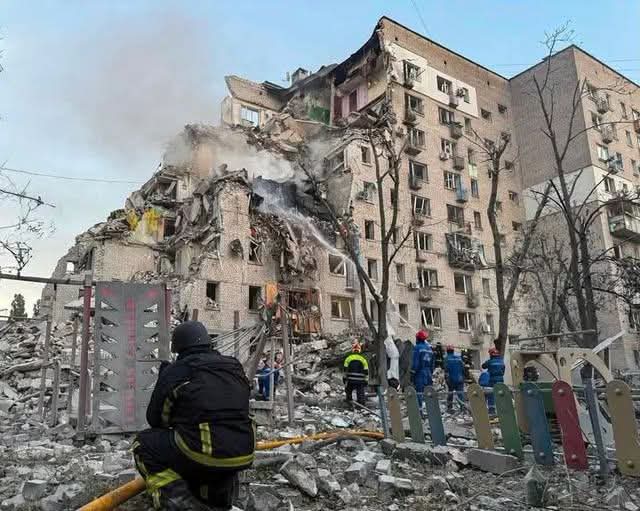
The military manifestation of this new strategy has been dramatic. The Russian Defence Ministry confirmed a large-scale strike on June 30-31, 2026, using ground-based high-precision long-range weapons, Kinzhal hypersonic missiles, and long-range drones. The stated targets included industrial enterprises developing and manufacturing drones, military airfield infrastructure, oil refineries, and fuel and energy facilities across Kyiv, Dnipropetrovsk, Poltava, Cherkasy, Chernihiv, and Kyiv regions. Mayor Klitschko described the attack as “the largest attack” the capital had experienced since 2022, reporting ballistic missiles, cruise missiles, and drones striking in multiple waves from 2 AM until 4 AM. Twenty civilians were reported killed, with extensive damage across all districts of the city.
The targeting logic is significant. Russia has moved beyond attrition to the systematic destruction of Ukraine’s industrial and energy capacity. The strikes hit factories producing guidance systems for drones and missiles, long-range drone and loitering munition production facilities, electronic warfare equipment producers, and fuel depots, all part of a strategy to de-industrialise Ukraine and render it incapable of sustaining drone strikes against Russia -3. The use of Kinzhal hypersonic missiles and strikes on oil refineries signals a transition to total energy warfare. The Russian Ministry of Defence has pledged “systematic and consistent strikes” on military installations, drone manufacturing sites, command posts, and “decision-making centres.”
The battlefield situation reinforces this strategic shift. Russian forces have captured Konstantinovka, one of the three remaining fortresses in the Donetsk province, and have surrounded and taken Lyman, placing Russian forces north of Slaviansk. The Russian offensive is now proceeding on multiple axes. More importantly, any talk of freezing the conflict on existing lines is officially over. The recapture of the remaining portions of Kherson and Zaporizhzhia oblasts is now an explicit Russian objective.
The diplomatic context is increasingly fractured. Bulgaria has blocked new sanctions on Russia, particularly objecting to the inclusion of Patriarch Kirill on the sanctions list. Italy’s parliament has voted to recommend lifting sanctions if peace is signed. European Council President Costa has established a diplomatic channel with Moscow, facing opposition from Baltic states and von der Leyen. Poland’s President Nawrocki has stripped Zelensky of the Order of the White Eagle, Poland’s highest award, citing Ukraine’s glorification of the Ukrainian Insurgent Army (UPA), a nationalist collaborationist force that worked with the Nazis during World War II and committed massacres of Polish civilians in Volhynia. This historical wound has re-opened, complicating the EU’s unity.
Russia’s shift from negotiation to military victory represents a significant escalation. The gloves are off. The abandonment of the “spirit of Anchorage” framework, the systematic targeting of Ukraine’s industrial and energy infrastructure, the mass production of drones, and the expansion of territorial objectives all point toward a conflict that will not be frozen but fought to a conclusion. Moscow has concluded that the United States cannot be relied upon as an intermediary and that European support for Ukraine will continue. Russia has therefore chosen to destroy Ukraine’s capacity to wage war rather than negotiate its end. The coming months will determine whether this strategy succeeds or whether the costs, both military and economic, prove unsustainable.
Authored By: Global GeoPolitics
If you prefer to make a one time donation in support of my work, you can do so by clicking any link below:
https://buymeacoffee.com/ggtv |
https://ko-fi.com/globalgeopolitics |
Bitcoin: 3NiK8BoRZnkwJSHZSekuXKFizGPopkE7ns
References
- “Russia keeps citing a ‘spirit of Anchorage’ from last summer’s Trump–Putin summit, but that term exists only in Moscow’s vocabulary.” Meduza, 11 February 2026. (1)
- “Rubio-Lavrov Rift Reveals Moscow’s Blame-Shifting Strategy On Ukraine, Analysts Say.” Radio Free Europe/Radio Liberty, 25 June 2026. (2)
- “Russian Offensive Campaign Assessment, June 29, 2026.” Institute for the Study of War, 29 June 2026. (3)
- “Russia wants to know if Trump has shifted his stance on Ukraine war after G7, Lavrov says.” ThePrint, 23 June 2026. (4)
- “Kremlin says US has abandoned ‘spirit of Anchorage’.” Ukrainska Pravda, 24 June 2026. (5)
- “’Putin already compromised’: Lavrov says Russia won’t bend again on Ukraine, cites talks with Trump in Alaska.” The Times of India, 23 June 2026. (6)
- “Russian Defense Ministry confirms: ‘All designated targets have been hit’.” TASS, 30 June 2026. (7)
- “Kyiv ablaze as Russia targets Ukrainian war infrastructure.” Russia Today, 30 June 2026. (8)
- “Klitschko describes Kyiv strikes as ‘the largest attack’ since 2022.” BBC, 30 June 2026. (9)


Leave a comment