
How Wall Street’s Short Positions and Margin Debt Are Masking a Supply Crisis That History Says Will Break
Editorial Analysis |July 2026
The Divergence: Paper Price versus Physical Reality
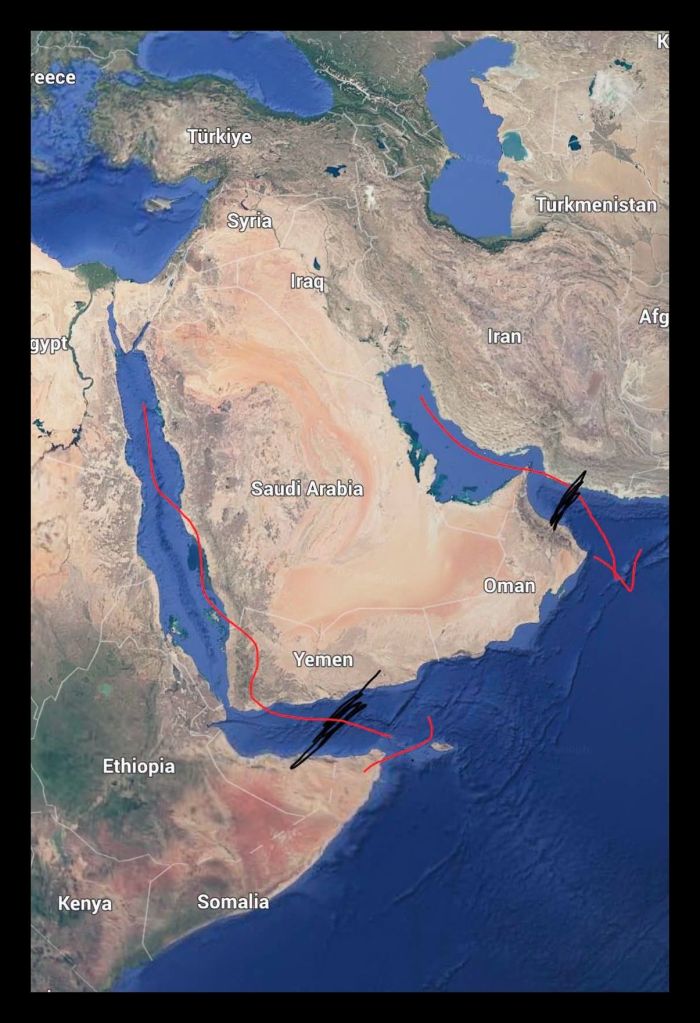
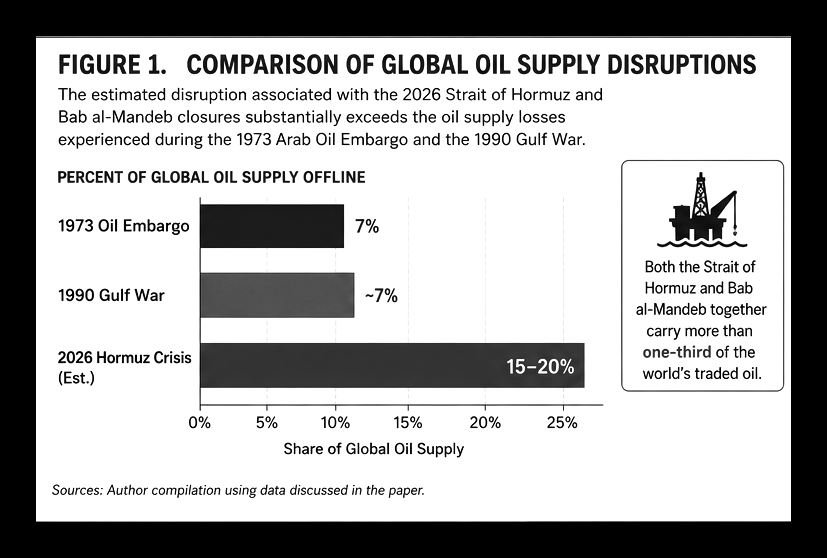
The paper price of oil is telling a story that bears little resemblance to conditions in the physical market. Brent crude is currently trading around ninety dollars per barrel, a level that does not reflect the reality of the Strait of Hormuz and Bab al-Mandeb being simultaneously closed. Between them, these two chokepoints carry more than a third of the world’s traded oil. The actual supply offline is estimated at between 15 and 20 per cent of global production, more than double the disruptions of 1973 or 1990. Yet the market price remains contained, suggesting that something other than supply and demand is determining the price.
The best theory explaining this anomaly holds that someone has placed huge bets that oil prices would fall, taking short positions in oil futures that are being used as a psychological tool to calm the market. The theory, advanced by analysts such as Chris Martinson, is that the ceasefire may have been partially engineered to give whoever placed those shorts one last window to exit their positions before the physical reality makes the paper price impossible to hold. Whoever is dumping paper oil futures cannot actually deliver the oil when the time comes. They are selling promises of oil at one hundred dollars a barrel knowing they will never actually produce said oil.
When those contracts come due, when the buyer says “where’s my oil,” there will be a forced buying event. The entity that sold those contracts will have to buy them back at whatever the market price is at that moment. If physical oil is at one hundred and thirty or one hundred and forty dollars or more, that is what they will pay. That will be a short squeeze, one of the mechanisms that can cause the paper price to catch up to the physical price very, very fast.
The Boom-and-Bust Cycle: How Leverage Creates the Conditions for Collapse
The boom-and-bust cycle is a structural feature of capitalist financial systems, rooted in the tendency toward speculative excess when credit is abundant and regulation is weak. Each boom is built on borrowed money, as investors pour leveraged capital into assets that promise quick returns. Each bust is triggered when that leverage is tested by a shock that exposes the gap between paper values and underlying realities. What we are witnessing today is not an exception to this pattern but its most extreme expression.
The boom phase in the current cycle began with the post-pandemic recovery, accelerated by unprecedented monetary expansion, and reached its zenith in the artificial intelligence and semiconductor mania that drove markets to record highs. The concentration of capital was extraordinary. In South Korea, the Kospi went up almost 200 per cent in twelve months, driven by retail investors borrowing money to invest in Samsung and SK Hynix. In the United States, margin debt reached 4.5 per cent of GDP, the highest level ever recorded. The official data captures only traditional margin loans, not the vast invisible layers of leverage in leveraged ETFs, options, portfolio margin, and private credit. The boom was built on a mountain of debt.
The bust phase began when the first shock hit. In South Korea, the Kospi dropped 25 per cent in twenty-one days, triggering margin calls on 1.2 million accounts and liquidating over three trillion won in investments. The stock market that had been the best performing in the world collapsed as quickly as it had risen. In the United States, the shock is the simultaneous closure of the Strait of Hormuz and Bab al-Mandeb, taking fifteen to twenty per cent of global oil supply offline. This is not a demand-side recession that can be managed with monetary easing. It is a supply-side sledgehammer landing on an economy with no slack left to absorb it.
The boom was characterised by the disconnect between Wall Street and Main Street. The consumer sentiment index is at one of the lowest points in a long time, even as the stock market sits near all-time highs. This gap is not sustainable. Historically, when the gap between financial markets and economic reality becomes this wide, it is the financial markets that adjust, not the real economy. The boom had already created the conditions for a bust; the supply shock is the trigger that will convert paper losses into real ones.
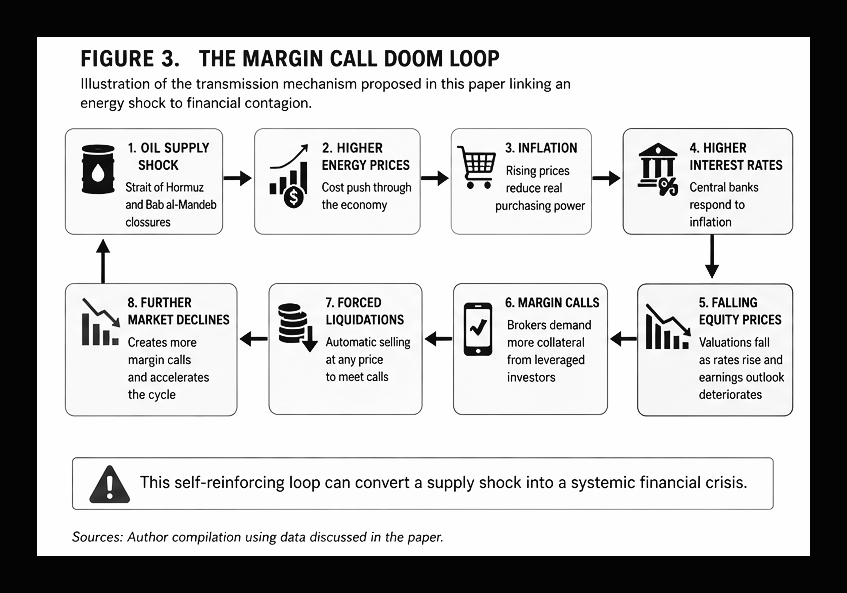
The mechanism of transmission from the boom to the bust is the margin call doom loop. In a normal market, when there is a sell-off, the drop usually ends when the seller stops selling. But when a stock market is built on borrowed money, nobody needs to sell. The selling happens automatically. When you buy stocks with borrowed money and those stocks go down to a certain price level, your broker sends you a margin call: deposit more cash by tomorrow morning or we sell all your stocks for you. If you don’t have the money, the broker sells your shares at whatever price. They don’t wait for a better price. They don’t care that you’re down 40 per cent. This forced selling pushes stock prices down even more, which triggers more margin calls for the next group of investors, which pushes the price down even more, triggering more margin calls. It’s a doom loop.
The paper oil market is the leading indicator of what is coming. Someone is selling promises of oil at one hundred dollars a barrel knowing they will never actually produce said oil. Those short positions are being used to contain the price of oil, but when the contracts come due, there will be a forced buying event. That will trigger a short squeeze that will force the paper price to catch up to the physical price very, very fast. The same mechanism that creates the boom, excessive leverage, will accelerate the bust.
Unprecedented Market Manipulation: The Paper Mirage That Cannot Hold
The suppression of oil prices in the face of the largest supply disruption in modern history is not a market anomaly; it is the product of deliberate, coordinated manipulation on a scale never before witnessed. The paper price of oil is not reflecting supply and demand. It is being actively contained by state actors, most prominently the United States government, through a combination of short positions, futures market interventions, and the strategic deployment of the Strategic Petroleum Reserve. This manipulation is unprecedented in scope, in the mechanisms employed, and in the stakes involved.
The physical reality is stark. The Strait of Hormuz and Bab al-Mandeb are effectively closed, taking between fifteen and twenty per cent of the world’s oil supply offline, more than double the disruption of 1973 or 1990. Physical oil prices, where actual barrels are traded for immediate delivery, have increased by over 200 per cent from pre-war levels. Ships that do manage to transit the remaining open routes are facing war-risk insurance premiums so high that they add ten to twenty dollars per barrel to the cost of delivery. Tanker queues are forming, storage facilities are filling, and the physical market is screaming scarcity.
Yet the paper price of oil, the futures contracts traded on exchanges, remains stubbornly contained around ninety dollars per barrel. This divergence is not accidental. Someone is selling promises of oil at one hundred dollars a barrel knowing they will never actually produce said oil. The scale of these short positions is unprecedented. Investigations are underway to determine who placed these massive bets, but the most plausible explanation is that the United States government, either directly or through proxies, is using the paper market as a psychological tool to calm the market and prevent panic from reaching the broader financial system.
The mechanism is straightforward but audacious. Entities with no intention of delivering physical oil are selling futures contracts at artificially low prices. These paper sales create the illusion of abundant supply, reassuring markets and preventing the price spike that the physical reality demands. When those contracts come due, the sellers will have to buy them back at whatever the market price is at that moment, triggering a short squeeze that will force the paper price to catch up to the physical price very, very fast. Until then, the manipulation continues.
This is not the first time the US government has intervened in energy markets. The Strategic Petroleum Reserve has been used repeatedly to calm markets. But the current manipulation is different in scale and nature. It is not a temporary release of reserves to address a short-term disruption; it is an ongoing effort to suppress a price signal that would otherwise have triggered a global economic crisis months ago. The US government is betting that the manipulation can be sustained until a diplomatic resolution is reached, allowing the shorts to exit before the contracts come due.
The manipulation extends beyond oil. The price of urea, the most commonly used fertiliser in the world, is reaching the same levels seen during the Ukraine war in 2022 when global food prices caused political crises across the developing world. Urea is made mostly from natural gas, which flows through the Strait of Hormuz. The same mechanisms that are suppressing oil prices are also affecting fertiliser markets, creating a delayed effect that will hit global food prices in six to twelve months. The manipulation of the oil price is, therefore, a manipulation of the price of food, with consequences for the world’s most vulnerable populations.
The unprecedented nature of the manipulation is evident in the response of official institutions. The New York Times reported that the Pentagon is suppressing information about casualties and damaged equipment from Iranian strikes. The same pattern applies to the oil market: official narratives are being used to contain information that would reveal the full extent of the crisis. The claim that Iran is losing the war, repeated by Treasury Secretary Scott Bessent on television, is part of this information operation. It is designed to maintain confidence in the markets, to prevent panic, and to buy time for the shorts to exit their positions.
The investigation into the short positions is itself a sign of the manipulation’s scale. Regulators are reportedly looking into whether someone placed huge bets that oil prices would fall around the ceasefire announcement. The theory is that the ceasefire may have been partially engineered to give whoever placed those shorts one last window to exit their positions before the physical reality makes the paper price really impossible to hold. If true, this would mean that diplomatic processes are being manipulated to serve financial interests, a development that carries profound implications for the integrity of international relations.
The manipulation is being sustained by the same financial infrastructure that enabled the boom. The leverage that inflated stock markets to record highs is being used to maintain the paper price of oil. Margin debt, leveraged ETFs, options, and derivatives are all being deployed to prevent the price spike that the physical market demands. The same mechanisms that create bubbles are being used to suppress the price signal that would burst them. The result is a financial system that is increasingly disconnected from economic reality, a paper mirage that cannot hold indefinitely.
The Historical Precedent: 1973, 1990, and Now
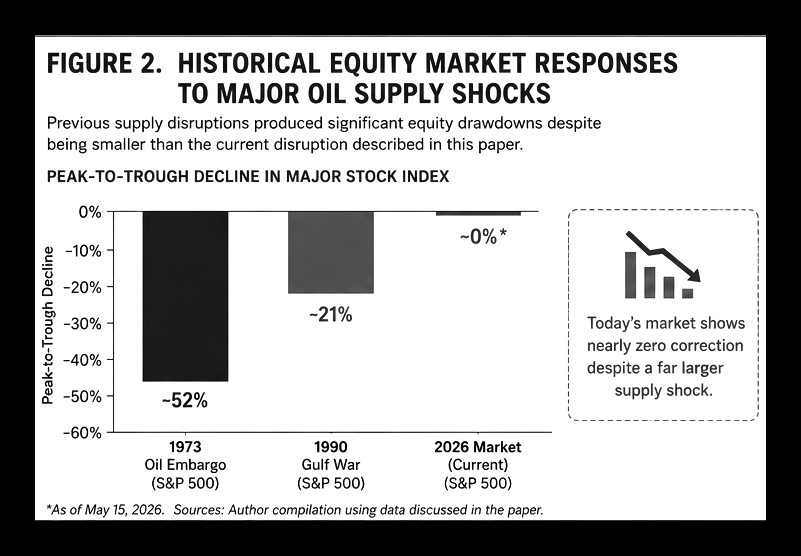
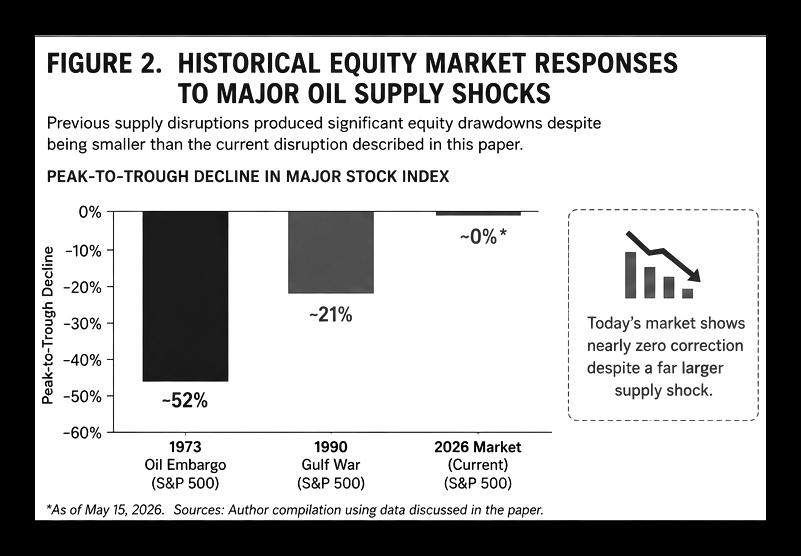
History provides a warning of what happens when supply shocks meet complacent markets. In 1973, the Arab oil embargo took approximately 7 per cent of the world’s oil supply offline. Oil prices went up 300 per cent. The stock market went down 52 per cent over 23 months. It took seven years to recover. Inflation peaked at 12.3 per cent. In 1990, the Gulf War took a similar 7 per cent offline. Oil went up 75 per cent, stocks went down 21 per cent, but they recovered in about four months because the war ended and the supply came back fast. There was a mild recession, and inflation peaked at 6.3 per cent.
Now look at 2026. Supply offline: 15 to 20 per cent, more than double either of the previous crises. Oil futures are up over 100 per cent, while physical oil is up over 200 per cent from before the war. The duration so far is seven weeks with no clear resolution. Even in the best-case scenario, the 1990 episode produced a 21 per cent stock market correction and an eight-month recession. The market today is at an all-time high, pricing in zero corrections and zero recessions. Wall Street is telling us that this is going to play out perfectly with no side effects to anyone. History says otherwise.
Luke Groman has pointed out that in 1973, markets stayed surprisingly calm even after the embargo was announced. The S&P 500 actually went up 2.3 per cent after the ceasefire in October 1973. People thought the worst was over. Then stocks went down another 40 per cent after that before they were done. It took markets weeks to price in the reality because nothing in their recent history prepared them for oil prices going up 300 per cent in six months. There was no model. The same disconnect is happening again right now. The S&P 500 is near all-time highs while the University of Michigan Consumer Sentiment Index, a measure of how regular people feel about their financial situation, is at one of the lowest points in a long time. Those two lines have moved together for years, but right now that gap is really big. At some point, one of them will be wrong and have to catch up to the other. Historically, it has never been the person filling up the gas tank who was wrong about how the economy felt.
Beyond Oil: Fertiliser and Food
This is more than oil. The price of urea, the most commonly used fertiliser in the world, is going up right now. It is reaching the same levels seen during the Ukraine war in 2022 when global food prices caused political crises across the developing world. Urea is made mostly from natural gas, and natural gas, just like oil, flows through the Strait of Hormuz. When you disrupt Hormuz, it is not just gasoline and diesel. It is also the feedstock for the fertiliser that grows the world’s food. The price increase in fertiliser will work its way into global food prices over the next six to twelve months with a delayed effect. Energy prices went up in February 2022, and food prices followed through the rest of the year.
The Leverage Bomb: South Korea’s Warning
South Korea recently experienced a dramatic demonstration of what happens when a stock market built on borrowed money faces a correction. The Kospi had been the best-performing stock market in the world, up almost 200 per cent in the previous 12 months, driven largely by retail investors who had borrowed money to invest in stocks. Samsung and SK Hynix represented over 56 per cent of the whole stock market. Roughly 14 million retail investors, one in every three or four people in the country, put their savings and a huge amount of borrowed money into those two stocks.
In just 21 days, everything started to collapse. The Kospi dropped 25 per cent. Because of that, 1.2 million accounts, one in every 30 people in the country, got hit with margin calls. Over three trillion won in investments were liquidated, automatically sold by brokers while investors could not do anything about it. Three hundred and twenty thousand accounts were wiped out, some of them overnight. It got so bad that the president of South Korea held an emergency intervention for the stock market.
South Korea is doing the exact same thing as the United States. They are both running the same version of the same technique, but Korea is just doing a faster, smaller version of the same leverage mechanism the US is. What happened to South Korea might actually be a preview of what is about to come to the US.
The American Exposure: Record Margin Debt
The United States is sitting on a leverage bomb of historic proportions. US margin debt just hit roughly 4.5 per cent of GDP. That is the highest level ever recorded in American history, higher than the dot-com bubble, higher than 2007, higher than even the 2021 meme stock everything bubble. This June number, released this past week, represents the biggest margin debt reading of all time. But that number is actually lower than what reality really is because the official margin data only tracks one kind of borrowing, traditional margin loans at brokerage accounts. What it does not show are leveraged ETFs, options, portfolio margin, private credit, all the modern new ways that people take on leverage, which do not appear in the official statistics.
The leveraged ETFs that blew up Korean investors are the same ETFs the US has, with hundreds of billions of dollars in them, including two-times funds on single stocks like Nvidia and Tesla. Zero-day options, where people gamble on what the stock market does in the next six hours, are trading at record volumes. The stock market has turned into a literal casino. The official chart shows only the floor of how much leverage might be in the system. In reality, there is probably a lot more.
The US Strategy: State Capitalism by Any Other Name
The US government is buying into the stock market because it has to. China controls the refining, processing, export restrictions, and licensing of rare earths, giving it pricing power and the ability to weaponize its supply. China also controls roughly 80 per cent of solar panel production. The US cannot rely on trade deals or sanctions because those do not work against a country that controls its own supply chain. The US cannot compete with China in the open market. It cannot weaponize the dollar against China the way it does against smaller economies. It cannot use the reset button, which has historically been war, because that is not a winnable option. The US government knows this. So the strategy is: if you cannot beat them, join them. The US is building its own version of state capitalism, whether we admit it or not.
The Iranian Strategy: Breaking the Bond Market
Scott Bessent, the US Treasury Secretary, has been going on television and saying Iran is losing the war. But privately, observers suggest he understands exactly what game Iran is actually playing. Iran knows it does not need to defeat the US military. It cannot. And it does not have to. Iran just needs to keep Hormuz closed long enough for the US bond market to break. What that breakage looks like is bond prices crashing, interest rates exploding higher, and suddenly the US government paying so much more in interest than it can barely function. We will have private credit markets potentially break. We might see more banks breaking. We will see the overvalued stock market potentially break. There is a lot of bad things that will happen, including the crypto market.
The Mechanism: The Margin Call Doom Loop
In a normal market, when there is a sell-off, the drop usually ends when the seller stops selling. But this market is not normal. When a stock market is built on borrowed money, nobody needs to sell. The selling happens automatically. When you buy stocks with borrowed money and those stocks go down to a certain price level, your broker sends you a margin call: deposit more cash by tomorrow morning or we sell all your stocks for you. If you do not have the money, the broker sells your shares at whatever price. They do not wait for a better price in the market. They do not care that you are down 40 per cent. They just do it.
This forced selling pushes stock prices down even more, which triggers more margin calls for the next group of investors who maybe got in a little earlier. Prices go down more, more margin calls, more forced selling. It is a doom loop. Under normal conditions, about 2 per cent of margin accounts get forced liquidated. During the Korean crash, that number went higher than 10 per cent, about five times the normal rate. The same mechanism exists in the US, and the exposure is far larger.
The Coming Reckoning: Scale of the Impending Collapse
The scale of the impending market collapse must be measured against history. The 1973 oil shock, with 7 per cent of supply offline, produced a 52 per cent stock market decline over 23 months and took seven years to recover. The 1990 Gulf War, with similar supply disruption, produced a 21 per cent decline and an eight-month recession. Today, we face 15 to 20 per cent of supply offline, more than double either previous crisis. with leverage levels that dwarf those of 1973 or 1990, a stock market at all-time highs, margin debt at 4.5 per cent of GDP, and derivatives markets that have turned the financial system into a casino.
The comparison suggests a correction of at least 50 to 60 per cent from current levels, a recession lasting two to three years, and inflation peaking above 15 per cent. The bond market, which was not a vulnerability in 1973 or 1990, is now the most fragile component of the financial system. With US government debt exceeding 120 per cent of GDP, interest rates at the highest levels in decades, and a private credit market that has grown to trillions of dollars, the contagion would spread far beyond equities. Banks heavily exposed to commercial real estate and private credit would face solvency tests they cannot pass. Margin calls would cascade through the system, triggering more liquidations, more margin calls, and more liquidations. The doom loop would be global, affecting every asset class and every economy.
The physical reality of the oil market is not going away. The Strait of Hormuz and Bab al-Mandeb remain closed, with no clear resolution in sight. The supply disruption is the largest in history, and the price of physical oil continues to rise. The financial system, however, is still pricing in a return to normal that may never come. The paper mirage of suppressed oil prices and inflated stock market valuations is maintained by borrowed money and short positions that cannot be sustained indefinitely.
When the short squeeze comes, the paper price of oil will catch up to the physical price very, very fast. That will trigger margin calls across the system. The forced selling that follows will push stock prices down, triggering more margin calls, more forced selling, and a cascade of financial destruction. South Korea’s experience shows that the process can happen in days, not weeks or months.
The US government is aware of the danger. When you hear Trump say that he is working on this deal, what he is actually saying is: we need to reopen the Strait of Hormuz right away before the Strategic Petroleum Reserve runs out, before oil goes up, before the bond market breaks, before Kevin Warsh cannot cut rates anymore, before the whole plan to QE but not really QE dies. The Iran deal is the most important part of this puzzle. Bessent knows this, but he is not telling us this. Instead, he goes on TV and says Iran is losing the war. Because here in the US, we are fighting a war of optics. As long as the optics look good, and people believe everything is good, and a deal will be reached soon, and that we are winning, our markets will stay calm.
But the physical reality is closing in. The gap between Wall Street and Main Street has never been wider. The leverage in the system has never been higher. The supply disruption has never been greater. The paper mirage cannot hold forever. The question is not whether the reckoning will come, but when. And when it does, the scale will dwarf anything the modern financial system has experienced.
Conclusion: The Ponzi Scheme Exposed
The entire edifice of the current market, the suppressed oil prices, the inflated stock valuations, the record margin debt, the invisible layers of leverage in derivatives and private credit—resembles nothing so much as a Ponzi scheme. The scheme is sustained by the belief that paper promises can substitute for physical realities, that borrowed money can create lasting wealth, that the manipulation can be maintained until a resolution arrives. The scheme relies on the constant influx of new capital, new leverage, and new faith in the system’s ability to continue.
Ponzi schemes collapse when the flow of new capital stops. In this case, the stopping point is the physical reality of the oil market. The short positions cannot be rolled over indefinitely. The contracts will come due. The buyers will demand their oil. The manipulation will fail. The scheme will collapse.
When the collapse comes, it will not be gradual. A “soft landing” is not available. The process will unfold as a cascade of margin calls, forced liquidations, and financial contagion that will sweep through the global economy. The 1973 oil shock took seven years to recover from. The 1990 Gulf War caused an eight-month recession. This crisis, with double the supply disruption, double the leverage, and a financial system far more interconnected than in previous decades, will cause damage on a scale that history has not yet seen.
The Ponzi scheme is being maintained by the state itself. The US government, through its manipulation of the paper oil market, its suppression of casualty figures, and its information operations, is actively propping up the illusion that everything is fine. The scheme is being maintained for the benefit of the same class interests that drove the boom, the corporations, the financial institutions, the oligarchs who profit from the manipulation. The ordinary people of the world, who will bear the cost of the collapse, have had no say in the scheme’s construction and no voice in its maintenance.
The economic and social consequences will be severe. Food prices will spike as fertiliser costs work their way through the supply chain. Energy prices will make heating and transportation unaffordable for millions. Unemployment will rise as businesses fail and supply chains break. Political instability will follow, as governments prove unable to address the needs of their populations. The developing world, already burdened by debt and food insecurity, will bear the heaviest burden.
The scheme has been exposed before. In 2008, the subprime mortgage Ponzi scheme collapsed, triggering the worst financial crisis since the Great Depression. In 1973, the oil shock exposed the vulnerability of an economy built on cheap energy and unlimited growth. Today, the scheme is more audacious, the leverage more extreme, and the consequences more severe.
The financial system is not a machine for allocating capital efficiently. It is a mechanism for transferring wealth from the working class to the ruling class. The boom enriches those who control capital. The bust destroys the savings and livelihoods of ordinary people. The scheme is designed to fail because the failure itself is profitable for those who can position themselves to benefit from the collapse. The shorts, the hedge funds, the derivatives traders, they are betting on the collapse. They have positioned themselves to profit from it. The rest of us will bear the cost.
The only way to prevent the collapse is to address the underlying causes: the speculation that drives financial markets, the manipulation that sustains them, and the inequality that makes the scheme possible. But addressing these causes would require challenging the class interests that benefit from the scheme. The state, which is controlled by those interests, will not challenge them. The media, which is owned by those interests, will not expose them. The political system, which is funded by those interests, will not reform them.
The paper mirage cannot hold forever. The collapse will come, and with it the reckoning that markets have refused to price in. The only question is how much damage it will do before it is done.
As one observer of the current crisis put it, whoever it is that is dumping paper oil futures cannot actually deliver the oil when the time comes. They are selling promises they cannot keep, building a house of cards that will collapse when the physical reality asserts itself. The paper mirage is ending. The Ponzi scheme is collapsing. The reckoning is coming. The only question is how much damage it will do before it is done.
Authored By: Global GeoPolitics
If you prefer to make a one time donation in support of my work, you can do so by clicking any link below:
https://donate.stripe.com/7sY8wPfvi864don0k3awo07 |
https://buymeacoffee.com/ggtv |
https://ko-fi.com/globalgeopolitics |
Bitcoin: 3NiK8BoRZnkwJSHZSekuXKFizGPopkE7ns
References
Bloomberg (2026) ‘Oil Markets and Supply Disruption Data’, July 2026.
Financial Times (2026) ‘Energy Markets and the Iran Crisis’, July 2026.
Groman, L. (2026) Analysis of 1973 Market Behaviour, as cited in analysis.
Martinson, C. (2026) ‘Paper Oil and the Short Squeeze’, July 2026.
Reuters (2026) ‘Commodity Markets and Chokepoint Analysis’, July 2026.
South Korean Financial Supervisory Service (2026) ‘Margin Call Data and Market Intervention Report’, July 2026.
US Federal Reserve (2026) ‘Margin Debt Statistics, June 2026’, available at:
https://www.federalreserve.gov
(accessed 23 July 2026).
University of Michigan (2026) ‘Consumer Sentiment Index, July 2026’, available at:
(accessed 23 July 2026).


Leave a Reply